Quick wins for a faster PC:
Repair Windows errors before they cause bigger problemsFix Now →Scan for outdated or missing drivers - takes under a minuteDriver Scan →Daily life for the Aztecs was built around maize agriculture, household production, neighborhood obligations, and sharply unequal access to power and goods. Farmers, fishers, craftworkers, merchants, soldiers, priests, nobles, and enslaved people lived within the same imperial system, but their routines differed by status, occupation, gender, and place. Tenochtitlan’s lake environment created opportunities unavailable in many provincial communities, while tribute and trade connected both to a much larger empire.
“Aztec” is the broad, familiar term used here. “Mexica” refers more specifically to the people who founded Tenochtitlan and dominated its imperial political system. The account below focuses on the late pre-conquest period and distinguishes life in the capital from patterns found across central Mexico.


What was daily life like for the Aztecs?
Most people’s days combined productive work with household responsibilities and obligations to their community. Food had to be grown, caught, processed, cooked, and exchanged; clothing and tools were often made at home or by local specialists; roads, canals, temples, and other public works required organized labor. A person’s social position determined how much labor they owed, which goods they could obtain, and how much political influence they possessed.
Commoners might farm a household plot, fish in the lakes, make pottery or baskets, carry goods to market, or perform public labor. Women commonly prepared food and produced textiles, and some sold goods or practiced specialist occupations. Men are described in museum summaries as working in fields, fishing, crafts, or public service, but these are broad patterns rather than rules that governed every household. Children were socialized into expected behavior and work, while life-cycle ceremonies marked changes in status and responsibility.
Do these 3 things before closing this tab:
1Repair Windows errors before they cause bigger problems2Scan for outdated or missing drivers - takes under a minute3Clear out junk files and repair common Windows errors#1 Best Overall
“Regardless of their occupation or social position, Aztec people experience similar life-cycle paths and are socialized into a strict set of cultural codes, social expectations, and behavioral etiquette.”
— Frances Berdan and Michael E. Smith, Everyday Life in the Aztec World
The quotation describes a shared cultural framework, not equal living conditions. Noble privilege, commoner labor, specialist roles, and enslavement produced very different material experiences within that framework.
What did Aztecs eat?
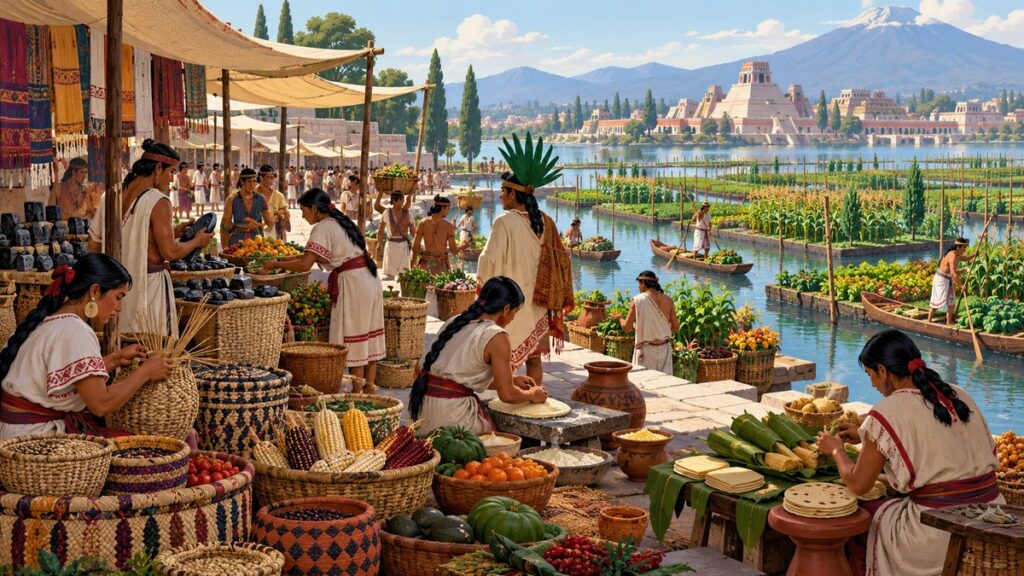
Maize was the foundation of the food system. It supplied calories for households and cities and was eaten in several preparations, including tortillas. Beans and squash complemented maize, while chili peppers, tomatoes, greens, and other crops added flavor and nutrients. Fish and other lake resources were especially important around the capital and its surrounding waterways. Men and women both contributed to obtaining and processing food, although food preparation is commonly associated with women’s household work.
Recommended Free Tools
Common meals
A practical everyday meal could center on maize foods served with beans or squash, perhaps accompanied by tomatoes, chili, or greens. The exact menu changed with season, locality, household resources, and access to markets. A rural family, a fisher living near the lake, and a city resident buying prepared foods did not eat identically.
Elite and imported foods
Nobles had greater access to tribute goods and expensive imports. Cacao beverages, in particular, signaled access to resources that were not representative of ordinary commoner life. Elite meals could include a broader range of valued foods, but the existence of such luxury consumption should not be mistaken for a typical Aztec diet.
How did Aztec farming work?
Agriculture supported households, urban populations, and the political economy of the empire. Maize, beans, squash, chili, tomatoes, and other crops were cultivated through several methods adapted to local terrain. The lake basin around Tenochtitlan allowed particularly intensive production through chinampas.
Chinampas in the lake environment
Chinampas were engineered cultivation plots associated with the lake system. Farmers built up fertile planting surfaces and used the surrounding canals and waterlogged soils to maintain productive fields close to the capital. Calling them simply “floating gardens” is misleading: the plots were constructed agricultural landscapes anchored in shallow lake areas, not free-floating rafts drifting across the water.
The Templo Mayor museum of Mexico’s National Institute of Anthropology and History (INAH) describes chinampa development as part of Mexica agricultural and urban growth. The system expanded usable land not only for crops but also for houses and other buildings. Its productivity helped sustain a dense capital, yet chinampas were not the only farming method in the empire. Communities outside the lake basin adapted cultivation to their own soils, rainfall, slopes, and political obligations.
Land, neighborhoods, and obligations
The calpulli functioned as a community unit associated with neighborhood life and shared land. Its organization and obligations could vary, so it should not be treated as a uniform village template across the empire. Tribute, local production, and trade linked calpulli communities to larger political structures. Farming households therefore worked both for their own subsistence and within systems that moved food and goods toward cities, rulers, temples, and armies.
What work did ordinary people do?
Production was the central fact of most people’s lives. Publisher material for Everyday Life in the Aztec World describes commoners working land, fishing lakes, and making everyday goods such as pottery, baskets, and stone tools. The Australian Museum likewise emphasizes field work, public labor, cloth production, food preparation, and market activity.
Farming and fishing
Farmers planted, weeded, harvested, stored, and processed crops. In the lake basin, fishers and other aquatic specialists supplied food and materials from canals and shorelines. Agricultural calendars and water management demanded cooperation, while transport by canoe helped move produce through the capital’s waterways.
Household manufacture
Many households made items they used themselves or exchanged locally. Spinning, weaving, sewing, pottery, basketry, and stone-tool production could be part of ordinary domestic life or the work of specialists. Women are often associated with preparing food and making cloth, but women also participated in markets and could hold specialist occupations. Men’s work likewise ranged beyond farming to fishing, craft production, public labor, administration, and military service.
Public labor and service
Large cities required roads, canals, temples, defensive works, and other infrastructure. Public labor drew on commoner communities and was one way households contributed to the state or local authorities. The burden and form of service depended on status, place, occupation, and political circumstances; there was no single schedule that applied identically throughout the empire.
What was the Aztec social hierarchy?
Aztec society was hierarchical, and status shaped access to land, goods, authority, education, and legal privileges. Birth and family position mattered greatly, yet the system was not entirely closed. Military distinction, successful commerce, and some religious or educational paths could improve a person’s standing.
| Social position | Typical role and advantages | Important qualification |
|---|---|---|
| Nobles | Held political and economic privileges and greater access to tribute goods, luxury consumption, and authority. | Noble status was consequential, but individual wealth and office still varied. |
| Commoners | Supplied much of the food, craft production, taxation, and public labor that sustained cities and institutions. | Commoners were not a single class; farmers, artisans, householders, and others had different opportunities. |
| Merchants | Long-distance traders moved specialty and luxury goods and could gain considerable esteem and wealth. | Commercial success offered a route to status, but did not erase the importance of birth and political rank. |
| Specialist artisans | Produced valued textiles, tools, ceramics, ornaments, and other goods for local and elite use. | Skill, patronage, and market access affected material conditions. |
| Enslaved people | Occupied an unfree status with obligations and protections distinct from those of commoners. | Enslavement was not interchangeable with every form of debt or service, and experiences varied. |
Gender and household position
Gender influenced the division of labor and access to public roles, but it did not confine everyone to one identical routine. Women’s food and textile work was economically essential, and market participation could provide income and influence. Men’s expected work often involved fields, fishing, craft, military, or public service. Wealthy households could organize labor differently from subsistence households, and regional custom mattered.
PC Slower Than It Used to Be?
A free scan shows the junk files, broken settings and background clutter dragging Windows down - then fixes them in one click.Free scan · Windows 10 & 11Outdated Drivers Are Slowing You Down
One free scan finds every outdated or missing driver and matches the right update for your exact hardware.Free scan · exact hardware matchMobility within a stratified system
Military achievement could bring recognition and advancement. Merchants, especially the pochteca, were held in considerable esteem and operated long-distance trade networks. Religious or educational pathways also offered limited opportunities for distinction. These routes did not make society meritocratic: inherited status remained powerful, and most people’s prospects were constrained by family and community position.
Independent reader supportYour contribution helps us test, update, and keep practical guides available for everyone.What did people do at Aztec markets?
Markets connected household provisioning with regional and long-distance exchange. Local sellers offered food, fuel, tools, pottery, cloth, and other necessities, while specialist traders handled rarer materials and luxury goods. Cacao seeds could serve as a medium of exchange, illustrating how commercial transactions operated alongside tribute and other forms of obligation.
Tlatelolco and the scale of exchange
The Tlatelolco market, adjacent to Tenochtitlan, is described as one of the largest marketplaces in the region. A Yale Human Relations Area Files culture summary reports an estimated 25,000 buyers and sellers daily and up to 50,000 attendees on the major market held every fifth day. These are reference-reported estimates, not a modern census; the summary’s retrieved text does not state a publication year.
| Market occasion | Reported attendance | How to read the figure |
|---|---|---|
| Ordinary market day | 25,000 buyers and sellers | Estimate attributed to the Yale Human Relations Area Files summary; year not stated. |
| Major fifth-day market | Up to 50,000 attendees | Upper estimate attributed to the same summary; not a modern headcount. |
Who participated?
Women could sell food and manufactured goods, while merchants traveled farther to obtain specialty products. Farmers and fishers brought surplus, artisans sold finished goods, and urban households purchased items they did not produce. Market participation therefore crossed occupational and gender lines, even though wealth and status determined what a person could buy or sell.
What’s actually slowing this PC down?
Pick the symptom - the matching free tool is one click away.
How did place change daily life?
Tenochtitlan and its neighboring cities formed a dense lake-basin world of canals, causeways, chinampas, temples, palaces, and busy markets. Water transport, intensive cultivation, and proximity to imperial institutions shaped routines there. Residents could encounter traders, officials, soldiers, priests, and tribute goods from distant regions.
Provincial communities faced different resources and obligations. Some relied on rain-fed fields, upland agriculture, forests, or local fisheries rather than chinampas. Tribute demands, local leadership, craft traditions, and distance from the capital affected what people produced and consumed. It is therefore inaccurate to describe one uniform “Aztec village life” or to assume that every imperial subject experienced Tenochtitlan’s urban environment.
How did tribute and trade affect households?
Tribute moved food, textiles, raw materials, and finished goods toward rulers and major centers. Trade moved other goods through market networks, often over long distances. For a farming household, these systems could mean obligations in crops or labor as well as opportunities to sell surplus. For a noble household, they increased access to imported luxuries and political resources. The same economy thus generated both dependence and opportunity, depending on a person’s position.
What can be said confidently—and what remains variable?
The broad pattern is clear: maize agriculture, household production, labor obligations, markets, and hierarchy structured daily life. The details were not identical everywhere. Men did not all farm, women did not all remain at home, and commoners did not share one level of wealth. Food varied by season and region; obligations changed with local institutions; and mobility was possible but limited.
Descriptions of schools and education appear in general museum overviews, but the surviving summaries do not establish consistent figures for attendance, curriculum, or reach. It is safer to say that people were socialized into expected cultural behavior and that some religious or educational paths could support advancement than to assign a single schooling system to every child.
Why daily life matters for understanding the Aztec Empire
The empire was sustained by ordinary activities: planting maize, tending chinampas, fishing canals, spinning thread, shaping clay, carrying tribute, selling food, and maintaining public works. Political power and temple ceremonies depended on this material foundation. At the same time, daily life reveals inequality. Nobles and successful merchants could command goods and influence unavailable to most laboring households, while enslaved people occupied a distinct and vulnerable position.
Viewing the late pre-conquest world through food, work, status, and markets avoids two opposite errors. The Aztecs were neither a society in which everyone lived alike nor a system so rigid that no one could improve their position. Their lives were organized by strong hierarchy and shared cultural expectations, but shaped in practice by occupation, gender, household resources, and the place where a person lived.
Quick Recap
Product prices and availability are accurate as of the date/time indicated and are subject to change. Any price and availability information displayed on Amazon at the time of purchase will apply.






Say something about this film