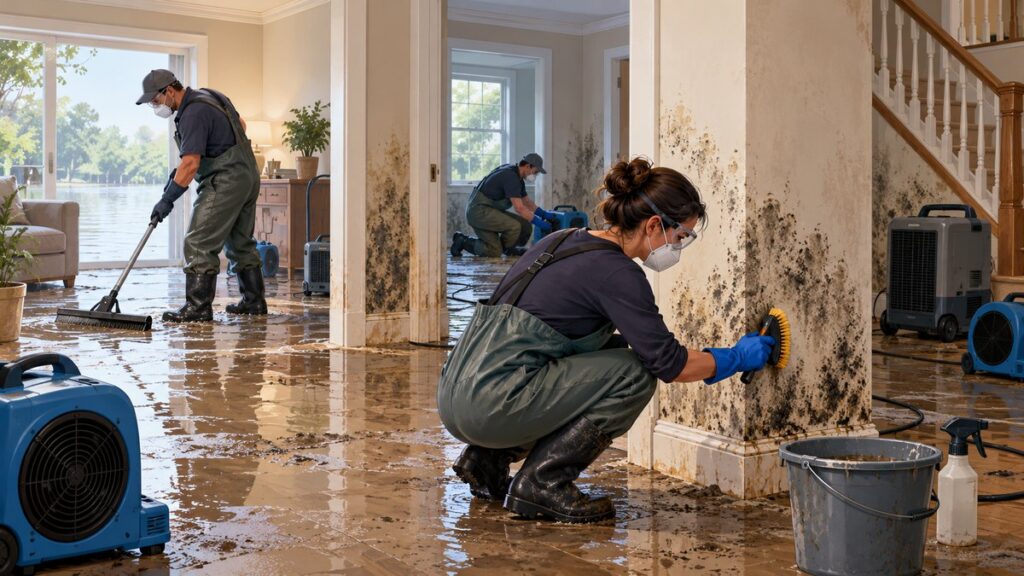
Do not begin mold cleanup until the building, utilities, electrical system and flood hazards are judged safe. Once entry is safe, isolate the area, use proper respiratory and skin protection, remove materials that cannot be cleaned and dried promptly, clean hard surfaces before disinfecting, and dry the structure completely before anyone moves back in.
1. Make re-entry safe before you think about mold
Floodwater can leave hazards that are more urgent than mold: unstable walls and floors, damaged wiring, gas leaks, contaminated water, sharp debris and unsafe air. Have the property assessed as safe for entry, and keep out until utilities and structural conditions have been checked. If power was affected, an electrician or utility authority should determine when circuits can be energized.
Never operate a gasoline, propane or diesel generator indoors, in a garage, or near doors and windows. EPA flood guidance says generators belong outside and away from buildings so carbon monoxide cannot accumulate indoors. Open doors and windows for ventilation only after doing so is safe.
Keep children, pets and people with allergies, asthma, COPD, lung disease or suppressed immune systems away from the work area. Those groups should not participate in mold cleanup. Photograph rooms, contents and damage before moving or discarding items, and contact your insurer first when practical; documentation can matter for a claim.
#1 Best Overall

- NIOSH Approved : (NIOSH Approval Number: TC-84A-9276) - NIOSH Approved N95 respirator mask certified for at least 95% filtration efficiency against particulate aerosols free of oil.
- Credible Manufacturer : Manufactured by Shanghai Yunqing Industrial Co., Ltd., a NIOSH approved manufacturer of N95 respirator mask. The mask is listed on the NIOSH website as an approved N95 mask.
- Standard Head Loops : This is a NIOSH approved N95 mask that straps must go behind head instead of the ears to offer better protection. The straps are firmly attached and made of very comfortable cotton materials, more comfortable to wear for long periods of time.
- New Upgraded Material : The active filter layer of these N95 masks is composed of dual ultra-high grade electrostatically charged meltblown polypropylene. Our N95 respirators far exceeds NIOSH filtration requirements, filters at least 95% non-oil based airborne particles with less than 60pa breathing resistance. Skin-friendly non-woven inner layer gives you the most comfortable wearing experience.
- Adjustable Nose Clip : Moldable nose clip with anti-fog cushioning foam provides better seal and reduced fog on eyewear. With plastic covered metal nose clip, it is not easily broken and can be used many times.
Floodwater from a sewer backup, overflowing river mixed with sewage, industrial site or unknown source requires more caution than clean rainwater. Sewage and chemical contamination can change the required cleanup methods and may make professional help the safer choice.
2. Wear protection that matches the work
At minimum, CDC and EPA guidance calls for a NIOSH-approved N95 respirator, goggles that seal against dust and splashes, protective gloves, long sleeves or other protective clothing, and waterproof boots. A respirator must fit properly; facial hair or an incorrect size can prevent a seal. Do not substitute a loose dust mask for an approved respirator.
| Protection or item | Purpose | Practical point |
|---|---|---|
| NIOSH-approved N95 respirator | Reduces inhalation of airborne particles and mold debris | Use at minimum; follow the product’s fit and use instructions |
| Sealed goggles | Protect eyes from splashes and disturbed debris | Ordinary safety glasses do not seal around the eyes |
| Nitrile or rubber gloves | Protect skin during dirty-water and cleaning work | Replace damaged or contaminated gloves |
| Waterproof boots and protective clothing | Limit skin contact and carryout of contamination | Cover exposed skin; remove and clean clothing separately |
| Bucket, detergent and stiff-bristle brush | Allow damp wiping and gentle scrubbing | Gather supplies before disturbing mold |
| Household bleach or another labeled disinfectant | Disinfection after physical cleaning | Use only as the label directs; never mix products |
| Wet/dry vacuum or dehumidifier | May assist water removal and drying | Use only when electricity is confirmed safe and at the correct cleanup stage |
3. Stop spread while removing wet contents
Document and contain first
Photograph damage, identify the high-water line and note which rooms and contents were affected. Close off unaffected parts of the house as much as possible. Bag or otherwise contain mold-damaged debris before carrying it through clean areas. Avoid shaking, sweeping or dry-brushing moldy materials, actions that can put particles into the air.
Use the 24–48-hour decision window
CDC guidance says to take out items that cannot be cleaned and dried completely within 24–48 hours. Mold can grow on wood, drywall, carpet and furniture while they remain wet. The clock is a practical decision point, not permission to keep a saturated item that is visibly moldy or structurally damaged.
Rank #2

- NIOSH APPROVED: For at least 95 percent filtration efficiency against certain non-oil based particles
- COMPATIBLE: With a variety of protective eyewear and hearing protection
- ADJUSTABLE NOSECLIP: Reduces potential for eyewear fogging and helps provide a custom and secure seal
- TWO-STRAP DESIGN: With welded dual point attachement that helps provide a secure fit
- APPLICATIONS: Gringing, sanding, sweeping, bagging, and other dusty operations. Metalworking, chemical processing, construction, and metal processing
| Material or item | Typical post-flood decision | Why |
|---|---|---|
| Carpet and carpet pad | Usually remove when flood-contaminated or moldy | Absorbent layers are difficult to clean and dry fully |
| Drywall and insulation | Remove wet, swollen or mold-contaminated sections | Mold can remain in paper facing, cavities and insulation |
| Ceiling tiles and wallpaper | Discard when wet or moldy | Porous surfaces retain contamination |
| Upholstered furniture and mattresses | Often discard after contaminated flooding | Foam and fabric can hold mold and dirty water |
| Paper, books and cardboard | Discard when soaked or moldy unless a specialist can salvage them | Fibers absorb water and are hard to disinfect |
| Solid, non-porous items | Clean and dry if structurally sound | Hard surfaces can generally be physically cleaned |
| Some wood products | Evaluate individually; remove if swollen, delaminated or moldy beyond cleaning | Wood varies in porosity and structural condition |
Do not assume that an item is safe because it no longer smells damp or appears dry. Dead mold can remain allergenic, and porous materials may retain growth in places that surface wiping cannot reach.
4. Dry the building without spreading contamination
Open windows and doors when outdoor conditions and security permit. Remove standing water and wet contents as soon as possible. Fans and dehumidifiers can accelerate drying, but use them only after electrical safety is confirmed and after visible mold has been gently cleaned; strong airflow over untreated mold can spread spores into clean rooms.
Direct air toward damp, cleaned surfaces rather than blowing across piles of moldy debris. Empty dehumidifier tanks safely and clean equipment according to its instructions. Continue drying until building materials are fully dry, including edges, wall cavities that were opened, floors and framing. If you cannot reach or verify a hidden cavity, treat that uncertainty as a reason to obtain professional assessment.
Do not close walls, reinstall carpet, replace insulation or load furniture back into a room merely because the surface looks dry. Moisture trapped behind finishes can support hidden growth and undo the visible cleanup.
Do these 3 things before closing this tab:
1Scan for outdated or missing drivers - takes under a minute2Repair Windows errors before they cause bigger problems3Fix the driver behind crashes, sound loss and screen glitchesRank #3

- 20-pack NIOSH Approved N95 Respirator Mask - (NIOSH Approval Number: TC-84A-9315) - N95 mask certified for protection against 95% of non-oil based particles 0.3microns or larger. Size Medium/Large. Elastic bands go over the head, not over the ears.
- MADE IN USA – Manufactured by BNX Converting LLC in Houston TX, a NIOSH/CDC Approved and FDA Registered (Registration # 3017489417) manufacturer of N95 mask respirators.
- Superior Protection & Breathability - BNX’s 5-layer filtration technology provides maximum protection, comfort and breathability. The active filter layer of these N95 masks is composed of ultra-high grade electrostatically charged meltblown polypropylene. Extremely breathable up to 50%+ more breathable than NIOSH minimum requirement.
- Latex Free Enhanced Comfort and Secure Fit - Features latex free and amazingly soft and durable headband straps as well as an adjustable metal nose piece to ensure a tight yet comfortable seal. Please follow all recommended fitting instructions and guidelines to ensure proper fit and protective seal. Flat fold design allows for convenient storage prior to use. Improved 3D design provides room for your mouth to move when you speak and greater compatibility with and reduced fog on eyewear.
- BNX Quality Promise & Applications - BNX is committed to delivering the highest quality American made safety products using the latest automated manufacturing processes and technology and the strictest quality standards. Our N95 respirator masks are ideal for use by industries such as: Commercial Buildings, Construction, Food Processing & Safety, Retail, Manufacturing, Infrastructure, Education, Oil & Gas, Transportation, and mor
5. Clean hard surfaces, then disinfect
Physical cleaning comes first
Use clean water and detergent with damp cloths or gentle scrubbing to remove dirt, flood residue and microorganisms. A stiff-bristle brush may be needed for rough hard surfaces. Work in manageable sections, changing dirty water and wiping from cleaner areas toward dirtier ones. Keep materials damp enough to avoid creating dust, but do not add water faster than you can remove it.
Use bleach only within the stated limit
After cleaning, a compatible disinfectant may be used exactly as its label directs. CDC’s mold-cleanup guidance gives a maximum of 1 cup of household bleach in 1 gallon of water. That is an upper limit, not a requirement to make the strongest possible solution; follow the product label and allow the required contact time.
Never mix bleach with ammonia or any other cleaner. CDC warns that the combination can create toxic vapors. Keep the area ventilated, avoid splashing, and never use an unlabeled mixture in a closed room. Disinfecting does not replace removal of porous materials or correction of the moisture source.
6. Treat porous materials differently from hard surfaces
Carpet, pad, drywall, insulation, ceiling tiles, upholstered furnishings, wallpaper, paper and many absorbent wood products can hold mold in fibers, backing or joints. Scrubbing the visible face does not prove that the interior is clean. When these materials were soaked, sewage-contaminated or visibly moldy, removal is commonly safer than attempting household cleaning.
Recommended Free Tools
Rank #4

- NIOSH-APPROVED N95 for at least 95 percent filtration efficiency against certain non-oil-based particles and aerosols
- 3M COOL FLOW EXHALATION VALVE helps direct exhaled air downward and allows for easy breathing
- UP TO 50% EASIER BREATHING. Compared to non-valved 3M 8200 Testing
- ADVANCED FILTER MEDIA for easy breathing
- ADJUSTABLE M-NOSECLIP helps provide a custom and secure seal
Remove damaged drywall and insulation in a controlled manner that limits dust. Keep removed pieces contained and carry them out by a route that avoids clean living areas. Do not tear out more structure than you can safely support; load-bearing damage, hidden wiring and plumbing require qualified assessment.
Some solid wood, metal, glass and plastic items may be salvageable if they are structurally sound and can be completely cleaned and dried. Separate salvageable items from discard piles, clean them before bringing them into an unaffected room, and do not store wet materials indoors while deciding.
Independent reader supportYour contribution helps us test, update, and keep practical guides available for everyone.7. Know when do-it-yourself cleanup is not appropriate
DIY work is reasonable only when the area is limited, the source of water is understood, materials can be removed safely, electricity and structure are sound, and you can maintain the required protective equipment and drying conditions. Compare the job against these factors:
| Decision factor | Lower-risk situation | Professional help is more appropriate when |
|---|---|---|
| Contamination size and visibility | Small, visible area on cleanable hard surfaces | Growth is extensive, recurring or hidden behind walls and ceilings |
| Floodwater source | Known clean rainwater | Sewage, chemicals or an unknown source is involved |
| Porous-material removal | Little or no demolition | Large amounts of drywall, insulation, carpet or upholstery must be removed |
| Building hazards | No structural or electrical damage | Unstable structure, damaged wiring, suspected asbestos or lead |
| Equipment and protection | Correct respirator, goggles, gloves, boots and safe drying equipment available | You cannot maintain respiratory protection, containment or controlled drying |
| Occupants | No medically vulnerable people exposed to the work area | Residents have asthma, COPD, lung disease, allergies or immune suppression |
CDC’s 2026 hurricane safety messaging directs people to EPA guidance for areas larger than 10 square feet. That threshold is a prompt to seek more detailed guidance, not a guarantee that a smaller job is safe. Hidden contamination, sewage and hazardous building materials can justify professional help at any size.
The Tool Desk
Outbyte PC Repair FREERepair Windows errors before they cause bigger problemsFix Now →Outbyte Driver Updater FREEScan for outdated or missing drivers - takes under a minuteDriver Scan →Best Value
- NIOSH-APPROVED N95 for at least 95 percent filtration efficiency against certain non-oil-based particles and aerosols
- USE FOR: Sanding, drywall cutting, sweeping, sawing, woodworking, fiberglass insulating, yard work, grinding and dusting
- 3M ADVANCED ELECTROSTATIC MEDIA enhances the capture of airborne particles and allows for easy breathing
- 3M COOL FLOW VALVE helps release warm, exhaled breath from inside the respirator
- UP TO 50% EASIER BREATHING Compared to 3M 8200
8. Choosing a mold or water-damage professional
Look for an experienced mold-cleanup or water-damage restoration contractor who will explain containment, removal, drying and verification in writing. Ask what training workers have, how they protect occupants, how they handle sewage-contaminated debris and whether they can coordinate structural, electrical or hazardous-material specialists.
EPA does not certify contractors. Check your state’s licensing or registration requirements, request references, and verify insurance and the scope of work before signing. Be wary of anyone who proposes spraying or painting over visible mold without removing damaged materials and fixing the moisture source.
9. Correct the moisture problem before rebuilding
Painting or caulking over mold does not solve it. Find and correct the source of wetness—flood entry, roof or plumbing leaks, condensation, seepage or trapped moisture—then remove growth and dry materials completely. Only after those steps should you replace drywall, insulation, flooring or finishes.
If mold returns, assume that moisture remains or that a hidden cavity was missed. Stop cosmetic repairs, investigate the area behind and beneath finishes, and bring in a professional when access would require unsafe demolition.
What’s actually slowing this PC down?
Pick the symptom - the matching free tool is one click away.
10. Confirm cleanup before reoccupying
Keep occupants out while contaminated materials are being removed and surfaces are being cleaned. Before moving back, confirm that the cleanup is complete, damaged porous materials are gone or appropriately restored, visible moisture has been eliminated, and the building can be occupied without exposing residents to ongoing work. EPA’s instruction is direct: “Ensure the mold cleanup is complete before reoccupying your home.”
Do not rely on fragrance, a coat of paint or a short period of fan use as proof of completion. If you cannot see inside a wall, floor assembly or ventilation space that was flooded, obtain an assessment rather than guessing.
Quick Recap
Common mistakes that make flood-mold problems worse
- Entering before utilities, structure and electrical systems are declared safe.
- Allowing children, pets or medically vulnerable people to help.
- Cleaning without an N95 respirator, sealed goggles, gloves, protective clothing and boots.
- Running fans over untreated mold and spreading particles into clean rooms.
- Keeping carpet, drywall, insulation or upholstery that cannot be cleaned and dried within 24–48 hours.
- Using bleach before removing dirt and flood residue.
- Mixing bleach with ammonia or another cleaner.
- Painting or caulking over mold instead of correcting moisture and removing growth.
- Demolishing walls without considering wiring, plumbing, structural support, asbestos or lead.
- Reoccupying before cleanup and drying are complete.
Product prices and availability are accurate as of the date/time indicated and are subject to change. Any price and availability information displayed on Amazon at the time of purchase will apply.






Say something about this film