Recommended Free Tools
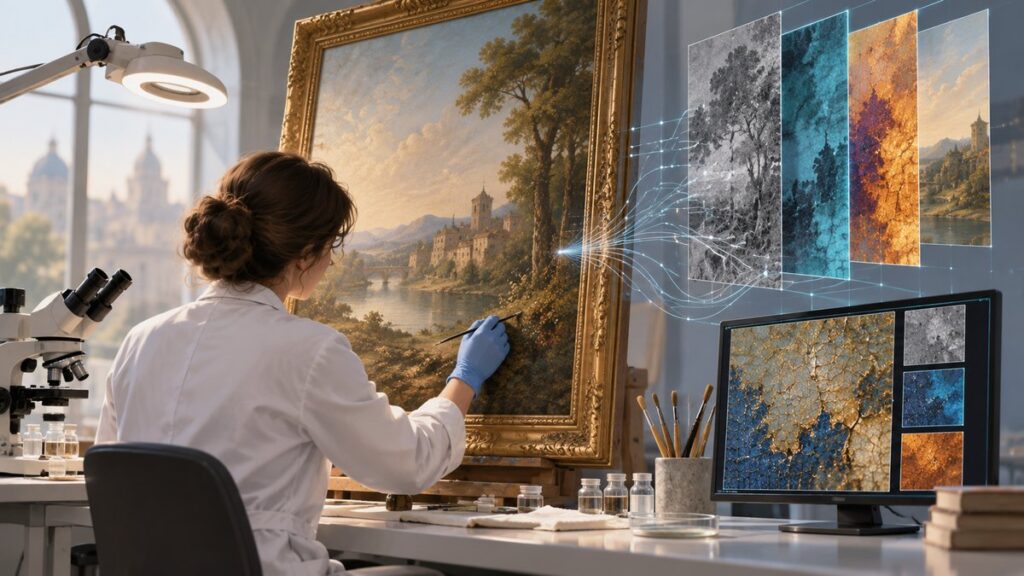
Not yet. Artificial-intelligence systems can detect visual and material patterns, rank likely artists, and flag relationships that deserve investigation. Current evidence does not show that they can replace specialists who authenticate an individual historical painting. Attribution depends on provenance, documents, materials, condition, workshop practice, technical imaging, and expert judgment—evidence that a single image-classification score cannot supply.
The most defensible role for AI is as a documented aid to research: it can narrow a field, compare details consistently, or identify a possible workshop relationship. The final finding may still be “workshop,” “follower,” “circle of,” or “uncertain,” rather than the name of one painter.
What current AI studies actually measure
Claims about AI “accuracy” are meaningful only in relation to the images, labels, and test conditions used. A model trained on known examples can perform well inside that closed world while failing on a painting from another period, a different workshop, a restored surface, or an artist absent from its training set. The published studies below therefore demonstrate capabilities, not a universal authentication rate.
The Rembrandt-circle study: about 72% in a bounded dataset
A study by Lucio Colizzi, Atila Soares da Costa Filho, and Salvatore Lorusso, published on the Conservation Science in Cultural Heritage journal page on June 10, 2026 (the citation identifies it as a 2025 article), examined overlapping styles in the School of Rembrandt. Researchers used 1,578 images associated with 16 painters and compared Random Forest, Support Vector Machine, and deep-learning approaches, including a proprietary system called Luminari.
#1 Best Overall

- Read Before You Buy — No Video Output: These adapters support charging and USB 2.0 data transfer, but cannot transmit video signals. Except for standard USB webcams (which use USB data only), they are not compatible with HDMI/DisplayPort cables, video-capable USB-C hubs, or docking stations with video output.
- Convert USB-A Ports to USB-C: Designed to connect USB-C earphones, cables, flash drives, card readers, and other USB-C accessories to standard USB-A ports. Plug-and-play with no drivers or software required.
- Aluminum Alloy Housing: Built with a sturdy aluminum alloy shell that aids in heat dissipation and protects against daily wear and scratches. Designed to maintain a stable and secure connection.
- Compact & Travel-Friendly: The ultra-compact design allows the adapter to stay plugged into your device without blocking adjacent ports or adding bulk, reducing wear and tear on your original USB ports.
- 12-Month Warranty: Backed by a 12-month manufacturer warranty for peace of mind. Designed to meet strict quality control standards for reliable everyday performance.
The best reported result came from a ResNet50 model, with about 72% overall accuracy on that study dataset. That number does not mean that 72% of all historical paintings can be authenticated. It describes performance when the candidate painters, image material, and labels were defined by the experiment. A disputed work, Portrait of a Man (The Auctioneer), did not receive a conclusive single-author assignment; the output was framed within the circle of Aert de Gelder. That unresolved result is exactly what a responsible attribution tool should expose rather than conceal behind a confident name.
Surface topography: promising signals, controlled subjects
The 2021 npj Heritage Science paper “Discerning the painter’s hand: machine learning on surface topography” tested a different input: microscopic structure in a paint surface. Researchers made optical-profilometry measurements from paintings produced by art students, divided the measurements into virtual patches, and trained convolutional neural networks. Across patch sizes from 0.5 to 60 millimeters, reported accuracy ranged from 60% to 96%; surface-topography models performed particularly well in the comparisons with color-image CNNs.
Those results suggest that the physical traces of a painter’s process can contain useful information, including information relevant to workshop studies. The experiment, however, used a controlled student-painting set. It did not validate a 60–96% success rate for anonymous Old Master paintings with centuries of varnish, abrasion, relining, restoration, or mixed authorship. Applying the method to historical objects requires equivalent measurements, suitable reference works, and careful control of those confounding factors.
Rank #2

- 5-in-1 USB-C Hub: Experience comprehensive connectivity featuring a Power Delivery input, two USB-A 2.0 ports, a USB-A 3.0 port, and an HDMI port. (Note: The USB-C power delivery input port is only for connecting an external wall charger to power your laptop and cannot power peripheral devices.)
- 90W Pass-Through Charging: Achieve optimal charging with 90W pass-through power to your laptop, supported by a total input of 100W, with the hub reserving 10W for operational efficiency. (Note: Wall charger not included.)
- Quick Data Transfers: Accelerate your productivity with rapid data transfers using a high-speed 5Gbps USB 3.0 port and two 480Mbps USB 2.0 ports.
- 4K HDMI Display: Enhance your visual experience with a hub capable of delivering 4K resolution at 30Hz in both mirror and extend modes. Please note that this hub is compatible with MacBook (macOS 12 and newer), Windows 10 and 11, ChromeOS, and laptops equipped with DP Alt Mode and Power Delivery. Note: This device is not compatible with Linux.
- What You Get: Anker USB-C Hub (5-in-1, 4K HDMI), welcome guide, 18-month warranty, and our friendly customer service.
Why the field is still changing
A 2026 npj Heritage Science early-sharing article on computational art attribution describes limitations such as bias introduced by averaging image tiles and the scarcity of high-fidelity training samples. Because that page is an early version that may change before its Version of Record, it is best read as evidence of active methodological development and openly stated problems—not as a settled benchmark or a guaranteed improvement.
Why attribution is more than recognizing style
A photograph can show composition, palette, brushwork, and visible condition. It cannot by itself establish when a support was made, who owned the object, whether a passage was overpainted, or how a studio operated. Institutional investigations combine several evidence streams.
Object history and documentary evidence
Provenance records trace ownership, sales, inventories, exhibitions, and transfers. Historical descriptions and sales catalogues can reveal when a work first appeared and under what name. Archival documents may connect an object to a commission or collection. Gaps do not automatically disprove authenticity, but a model that sees only pixels cannot evaluate a chain of custody or weigh contradictory documents.
Rank #3

- Sleek 7-in-1 USB-C Hub: Features an HDMI port, two USB-A 3.0 ports, and a USB-C data port, each providing 5Gbps transfer speeds. It also includes a USB-C PD input port for charging up to 100W and dual SD and TF card slots, all in a compact design.
- Flawless 4K@60Hz Video with HDMI: Delivers exceptional clarity and smoothness with its 4K@60Hz HDMI port, making it ideal for high-definition presentations and entertainment. (Note: Only the HDMI port supports video projection; the USB-C port is for data transfer only.)
- Double Up on Efficiency: The two USB-A 3.0 ports and a USB-C port support a fast 5Gbps data rate, significantly boosting your transfer speeds and improving productivity.
- Fast and Reliable 85W Charging: Offers high-capacity, speedy charging for laptops up to 85W, so you spend less time tethered to an outlet and more time being productive.
- What You Get: Anker USB-C Hub (7-in-1), welcome guide, 18-month warranty, and our friendly customer service.
Materials, supports, and technical imaging
Specialists examine pigments, binders, canvas or panel supports, ground layers, and the way a work was constructed. The National Gallery of Art’s account of Rembrandt workshop attribution describes microscopy, signature examination, X-radiography, infrared and ultraviolet photography, and analysis of panel or canvas supports. Restoration history matters: cleaning, lining, abrasion, and retouching can alter the very features an image model uses.
Iconography, technique, and the artist’s oeuvre
The Van Gogh Museum explains that its assessments draw on knowledge of Vincent van Gogh’s oeuvre, iconography, painting and drawing techniques, materials, and provenance. A plausible subject, period, and working method must fit the artist’s documented practice, not merely resemble a set of training images. The museum accepts authenticity requests through a defined procedure; it says many are assessed from photographs, while only some require the original object for closer examination, and that its requests are free. This is the Van Gogh Museum’s process, not a universal rule for every institution.
What’s actually slowing this PC down?
Pick the symptom - the matching free tool is one click away.
How museums handle workshop and collaboration cases
Historical studios were production environments, not always solitary authorship. A master could design a composition, have assistants execute passages, revise parts of the surface, and sign a finished work. A forced choice between “genuine” and “forgery” erases those possibilities.
Rank #4

- Dual Converters, Infinite Potential:Includes 2× USB C male to USB A female adapters and 2× USB A male to USB C female adapters. Perfect for a wide range of uses—tablets with Bluetooth keyboards, expand USB ports on macbook, and more. Two different converters for all your daily needs
- Next-Level 10Gbps & 3A Charging: No more slow 480Mbps, this usb to usb c adapter has a transfer speed of up to 10Gbps, allowing you to do more transferring in less time. This usb adapter fits both USB A and USB C charger, supporting up to 3A fast charging
- Upgraded Exquisite Craftsmanship: With an aluminum alloy housing and metal connector, the usbc to usb adapter is extremely durable and sturdy. Rigorously tested to withstand more than 10,000 times of plugging and unplugging, ensuring long-lasting performance
- Broad Compatible: The usb c to usb adapter widely supports all USB C/ USB A devices like laptops, tablets, cellphones, car chargers, and phone chargers. Such as compatible with MacBook Pro/Air 2023/2022, Thunderbolt 4/3 Devices,Apple MagSafe Watch 9/8/7/SE/Ultra, iPad Pro 2022/2021, Samsung Galaxy S23/S20/S10, and iPhone 17/16/15 Pro. Plug and play
- Please Note: To reach 10Gbps speed, keep the cable under 3.3 ft. For USB A Male to USB C adapters, try flipping the USB C connector. USB C Male to USB A adapters support bidirectional 10Gbps transfer within 3.3 ft
Attribution categories are not interchangeable
The National Gallery of Art’s Rembrandt terminology distinguishes Rembrandt, Rembrandt Workshop, Follower of Rembrandt, and Style of Rembrandt. “Rembrandt van Rijn and Workshop” signals evidence of collaboration in execution. These labels communicate different levels and kinds of evidence; they should not be collapsed into one binary label for an algorithm to predict.
The Gallery’s historical account also shows that catalogues and opinions change as technical examination and scholarship develop. New restoration findings can support a revised attribution, while a painting may remain unresolved when its style and technique cannot be identified with a specific hand.
What the Mauritshuis examples show
In its report on three paintings, the Mauritshuis found that the signature on Study of an Old Man was almost certainly genuine and had been applied while the paint was wet. That did not settle authorship: a master could sign a student’s work. After conservation, experts judged the execution unconvincing and concluded that the painting was made by someone employed by Rembrandt.
Best Value

- 5-in-1 Connectivity: Equipped with a 4K HDMI port, a 5 Gbps USB-C data port, two 5 Gbps USB-A ports, and a USB C 100W PD-IN port. Note: The USB C 100W PD-IN port supports only charging and does not support data transfer devices such as headphones or speakers.
- Powerful Pass-Through Charging: Supports up to 85W pass-through charging so you can power up your laptop while you use the hub. Note: Pass-through charging requires a charger (not included). Note: To achieve full power for iPad, we recommend using a 45W wall charger.
- Transfer Files in Seconds: Move files to and from your laptop at speeds of up to 5 Gbps via the USB-C and USB-A data ports. Note: The USB C 5Gbps Data port does not support video output.
- HD Display: Connect to the HDMI port to stream or mirror content to an external monitor in resolutions of up to 4K@30Hz. Note: The USB-C ports do not support video output.
- What You Get: Anker 332 USB-C Hub (5-in-1), welcome guide, our worry-free 18-month warranty, and friendly customer service.
For another panel, evidence from the wood and underpainting supported a studio context, yet the museum could not establish whether Rembrandt himself or a student painted it. Its published conclusion is that “The mystery remains unsolved.” The case demonstrates why a genuine signature, a single imaging result, or one stylistic feature cannot substitute for a joined assessment.
Independent reader supportYour contribution helps us test, update, and keep practical guides available for everyone.AI and expert assessment: a fair comparison
| Question | AI system | Expert-led investigation |
|---|---|---|
| What evidence can it use? | Depending on the project, ordinary photographs, high-resolution details, color images, or surface-topography measurements. | Images plus provenance, archival records, materials, supports, condition, microscopy, X-radiography, infrared and ultraviolet imaging, and direct examination. |
| What determines reliability? | Whether the training and test data represent the relevant artist, period, workshop, materials, restorations, and condition. | Quality and independence of documentary, technical, and comparative evidence, interpreted by specialists familiar with the oeuvre and historical context. |
| How does it handle workshops? | Many classifiers are designed around artist labels and may force a single answer unless workshop categories are explicitly represented. | Can report a master, workshop, follower, circle, collaboration, or unresolved attribution when the evidence supports those distinctions. |
| How is uncertainty expressed? | A probability or ranking can be useful, but a high score is not proof of authorship and may hide dataset bias. | Can explain conflicting evidence, revise a view after conservation, and publish a qualified category rather than an invented certainty. |
| Can results be checked? | Only when data, preprocessing, model design, and the object’s input are sufficiently documented and reproducible. | Investigators can preserve examination records, compare physical samples and images, and relate conclusions to provenance and prior scholarship. |
A responsible workflow for using AI in attribution
AI is most useful when it sits inside a controlled research process rather than acting as an online “who painted this?” oracle.
- Define the question. Decide whether the task is image retrieval, comparison with a known artist, identification of a workshop relationship, or authentication of a specific object. These are different claims requiring different evidence.
- Document the object before modeling. Record dimensions, support, inscriptions, labels, condition, restoration history, ownership history, and the exact images or scans supplied to the system. Preserve original files and capture settings.
- Choose a reference set that fits. Include works from the same period and workshop, comparable materials and supports, and known examples with reliable attribution. State what the set excludes. A model cannot compensate for missing or mislabeled comparators.
- Separate image sources and tests. Do not mix near-duplicate photographs of one painting between training and evaluation. Test whether results change with lighting, cropping, varnish, restoration, and image resolution.
- Inspect more than the score. Check which regions drive the result and whether the model is responding to frames, labels, cracks, museum backgrounds, or restoration artifacts instead of paint handling.
- Compare against independent evidence. Bring the output to a conservator, paintings specialist, or museum process alongside provenance and technical findings. Treat disagreement as a reason to investigate, not as proof that either side is wrong.
- Report the narrowest defensible conclusion. Preserve the model version, dataset, preprocessing, confidence or ranking, and known limitations. If the evidence supports only “circle of” or “workshop,” publish that category rather than upgrading it to a named master.
Common mistakes and how to avoid them
- Confusing classification with authentication: recognizing a Rembrandt-like visual category does not prove that a particular historical object was painted by Rembrandt.
- Quoting a study result without its conditions: 72% belongs to the 1,578-image, 16-painter study; 60–96% belongs to patch sizes in a controlled student-painting experiment.
- Testing a disputed original without evidence: the Rembrandt-circle study’s published description does not establish that the model examined the physical disputed painting itself. Do not imply that it did.
- Ignoring workshop production: a single-name output can be wrong even when a signature is genuine and the work belongs to a master’s studio.
- Uploading valuable art to a general image service: consumer tools are not a substitute for secure handling, conservation advice, or a qualified institutional or specialist review.
- Presenting early research as a standard: the 2026 computational-attribution article is an early-sharing version, and its limitations are part of the evidence.
What this means for collectors, museums, and viewers
For a collector considering a purchase
Use an AI output, if available from a transparent research project, as a question generator. Before relying on it financially, obtain a condition report, establish the object’s provenance, ask what technical examinations have been performed, and seek an opinion from a qualified specialist or relevant museum procedure. Keep the model’s result separate from the legal and financial description of the work.
For a museum or archive
Set governance rules before deployment: approved imaging protocols, access controls for collection data, versioned models, independent validation, and a policy for recording uncertainty. Ensure that a model cannot silently overwrite catalogue terminology or convert a workshop attribution into a named artist. Re-run evaluations when galleries, restorations, or reference datasets change.
The Tool Desk
Outbyte PC Repair FREEClear out junk files and repair common Windows errorsFree Scan →Outbyte Driver Updater FREEFix the driver behind crashes, sound loss and screen glitchesFind Drivers →For documentary audiences
Ask five questions whenever a program presents an AI attribution: What exactly was measured? Which works trained and tested the system? Was the disputed object itself examined? Can workshop or collaboration labels be returned? What evidence would change the conclusion? Those questions distinguish a useful research aid from a dramatic but unsupported “AI solved the mystery” claim.
The practical answer
AI can make attribution research faster and more systematic, especially when it combines image analysis with physical surface data and a carefully chosen reference set. The strongest published examples still operate within bounded experiments, and their unresolved cases reveal the limits as clearly as their successful classifications. Human experts remain necessary because authorship is a historical, material, and interpretive judgment—not just a pattern-recognition task.





Say something about this film