Recommended Free Tools
Some links on this page are affiliate links: if you buy through them we may earn a commission, at no extra cost to you.
TikTok warned on January 17, 2025, that it would suspend U.S. service unless the Biden administration gave its app-store and infrastructure partners a definitive assurance against penalties under a new law. The administration had said enforcement would be left to the incoming Trump administration, but that was not the same as a legal safe harbor for Apple, Google, hosting companies, or other providers. After the Supreme Court upheld the law, TikTok went offline for U.S. users on the evening of January 18, then began restoring service the next day after President-elect Donald Trump pledged to act. It was a temporary U.S. interruption—not a worldwide shutdown or a court order directly switching off the app.
Why did TikTok say it would go offline if Biden was leaving enforcement to Trump?
Because the administration’s position did not give TikTok’s service providers the concrete protection the company said they needed. Biden’s team indicated that the next administration would handle implementation and enforcement, but TikTok argued that providers still faced legal uncertainty when the statute took effect on January 19.


In its January 17 statement, TikTok said it would be “forced to go dark” unless the Biden administration made a “definitive statement” assuring critical service providers that they would not be penalized for continuing to make the app available. TikTok’s statement was a conditional warning about U.S. service—not an announcement that it had permanently abandoned the country.
The timing made the gap consequential. The statutory deadline fell one day before Trump’s inauguration on January 20. Biden was still president when the deadline arrived, while Trump, then president-elect, was promising a different approach. A public statement about who would enforce a law did not itself suspend the law, bind a future administration, or settle what liability providers might face.
Popular on Amazon
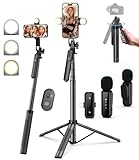
- 【Complete Vlogging Kit】This vlogging kit is designed specifically for content creators on platforms such as TikTok and YouTube. The complete starter kit combines a selfie stick tripod, dual fill lights, a wireless mic, and a smart remote—professional essentials for vlogging, live streaming, interviews, and social media videos. As a one-stop mobile studio kit, it helps you effortlessly launch high-quality creation—shoot anywhere.
- 【Pro Dual-Mic Wireless System】This Plug-and-play wireless mic with studio-quality sound - no apps required. Perfect for vloggers and creators, with 12-hour runtime on 2-hour fast charge. The dual-interface receiver (Type-C/Lightning), it works seamlessly across iPhone & Android. With 79ft stable transmission range, move freely while maintaining crystal-clear audio. Your simplest pro audio solution.
- 【Detachable Fill Lights & Smart Remote】This content creator essential tripod with light features dual detachable mini LED fill lights, with 3 color modes (Warm/Cool/Natural) and 3 brightness levels to enhance low-light shots. Studio-grade lighting control lets it adapt effortlessly to diverse scenes and moods. Also included is a Bluetooth remote (33ft range) for wireless shutter control, plus Type-C rechargeability for on-the-go use.
- 【360° Rotating Aluminum Tripod】Crafted from premium aluminum alloy, this stable, versatile tripod is essential for content creators. Its 5-stage telescopic legs adjust 11.6–71 inches, and the universal phone holder supports 270° vertical tilt and 360° rotation for easy multi-angle shooting. A smooth 360° balance handle enables precise composition control. Use as a phone tripod stand or YouTube starter kit for vlogging, live streaming, and photography.
- 【Universal 1/4" Thread Tripod】The phone tripod included universal phone holder fits 4-4.7" devices, with a standard 1/4" thread compatible with cameras, GoPros, ring lights and other recording devices. This selfie stick features a compact design for easy portability. Content creator kit includes: selfie stick tripod*1, LED lights*2, wireless remote*1, mic transmitter*1, receiver*2, Type-C cable*2, storage bag*2, user manual*2
What did the TikTok law actually require?
The Protecting Americans from Foreign Adversary Controlled Applications Act, enacted as Division H of Public Law 118-50, created a divest-or-stop-supporting regime. It prohibited U.S. entities from distributing, maintaining, or updating TikTok unless the app underwent a legally sufficient “qualified divestiture.”
A qualified divestiture was not simply a change in corporate branding or a sale of some shares. The separation had to end foreign-adversary control and specified operational relationships with the former owner, including arrangements involving data sharing and recommendation-algorithm operations. The statute applied to covered foreign-adversary-controlled applications, although TikTok was its central focus.
In ordinary coverage, the law was often called a TikTok “ban.” Legally, however, its structure was a restriction on the U.S. entities and services that distribute, maintain, or update a covered app, unless the divestiture condition was met. The law did not simply direct TikTok engineers to switch off servers at a particular hour. But app distribution and ongoing infrastructure support are necessary to operate a large service, so the restrictions could effectively make U.S. service untenable.
Why did third-party liability matter?
Apple and Google were important because their app stores distribute the app and updates. Cloud and hosting companies supply computing infrastructure; content-delivery and network providers help deliver video and other content. If those companies stopped supporting TikTok, users could lose access even if TikTok itself wanted to keep the service running.
The statute’s civil penalties gave providers a reason to demand clarity. The Congressional Research Service described potential penalties of up to $5,000 multiplied by the number of U.S. users who accessed, maintained, or updated TikTok as a result of a provider’s violation. That was a potential statutory calculation, not a fine that the cited sources report was imposed. The CRS legal analysis explains the potential exposure.
Also popular on Amazon
That mechanism helps explain why TikTok’s warning focused on its partners rather than only on the administration’s intentions. Even if officials signaled that they did not expect immediate enforcement, a company facing a potentially large penalty could still conclude that it needed a more authoritative assurance before continuing to distribute or host the app.
What was Biden’s position—and what did it not guarantee?
The Biden administration’s stated position was that TikTok should remain available to Americans, while implementation and enforcement of the law would be left to the incoming administration. It also said TikTok should continue under American ownership or another arrangement that addressed the national-security concerns identified by Congress. Reuters coverage carried by Investing.com reported the White House’s position.
Free tools Windows power users keep installed
One-click scans. No signup required.
That stance was not equivalent to a formal executive order suspending the statute, a written safe-harbor commitment to every service provider, a guarantee against future liability, a court order delaying the law, or a completed qualified divestiture. Those are different legal and political acts. TikTok’s January 17 warning reflected its view that the administration had not supplied the kind of assurance its providers required.
It is therefore more precise to say that Biden’s administration handed enforcement decisions to the incoming team than to say that Biden formally suspended the law. The distinction does not establish what any individual company would ultimately have decided in court; it explains why a general policy statement did not automatically eliminate provider concerns.
What did the Supreme Court decide?
On January 17, 2025, the Supreme Court upheld the challenged provisions of the law against a First Amendment challenge. The Court recognized the impact on TikTok and its users’ expressive activity, but concluded that the provisions survived constitutional review as applied to TikTok and the other petitioners. The Court’s opinion is the primary source for the ruling.
Also popular on Amazon
The decision removed the immediate constitutional obstacle to the statute taking effect; it did not itself order TikTok to shut down. Several separate events were involved: the Court upheld the law, the law reached its effective date, the executive branch retained enforcement decisions, providers assessed their own exposure, and TikTok chose to suspend U.S. service. Treating all of those as one event—“the Supreme Court banned TikTok”—is inaccurate.
Do these 3 things before closing this tab:
1Clear out junk files and repair common Windows errors2Scan for outdated or missing drivers - takes under a minute3Repair Windows errors before they cause bigger problemsWhen did TikTok go offline, and when did it return?
U.S. users lost access on the evening of January 18, hours before the statute’s January 19 effective date. TikTok began restoring service on January 19 after Trump, still president-elect, pledged to delay enforcement once in office and said providers would not be liable for helping restore access. The Congressional Research Service and contemporary reporting describe the brief interruption and return. CRS’s account and TechCrunch’s report on restoration distinguish the U.S. event from a worldwide outage.
| Date | What happened |
|---|---|
| January 17, 2025 | The Supreme Court upheld the law; TikTok issued its conditional shutdown warning. |
| Evening of January 18 | TikTok service became unavailable to U.S. users. |
| January 19 | TikTok began restoring U.S. service after Trump’s public assurances. |
| January 20 | After taking office, Trump signed Executive Order 14166, directing a 75-day enforcement delay while his administration evaluated the situation. |
| February 13 | Apple and Google restored TikTok and related ByteDance apps to their U.S. app stores, reportedly after Justice Department assurances against fines. |
Trump’s January 19 statements helped prompt restoration, but he was not yet president and could not amend the statute by public statement. The formal action came on January 20: Executive Order 14166 directed the attorney general not to enforce the law for 75 days and directed that providers receive assurances concerning liability during that delay. It delayed enforcement; it did not repeal the law or reverse the Supreme Court decision.
Was the shutdown voluntary or legally required?
It involved both legal pressure and an operational decision by TikTok. The statute threatened providers with penalties for specified forms of support, and the Supreme Court had upheld the law. TikTok then suspended U.S. service rather than ask its distribution and infrastructure partners to keep operating under unresolved risk.
The law did not necessarily require TikTok to take a particular technical action at a particular time. Nor does the record support describing the interruption as a routine voluntary product choice. It was a company decision made under substantial statutory pressure, where continued U.S. operation depended on third parties willing to keep supporting the service.
PC Slower Than It Used to Be?
A free scan shows the junk files, broken settings and background clutter dragging Windows down - then fixes them in one click.Free scan · Windows 10 & 11Crashes, No Sound, or Screen Glitches?
Random freezes, missing sound and display glitches usually trace back to one bad driver. Find and replace yours safely.Free scan · under a minuteAlso popular on Amazon
What did the interruption mean for existing users, downloads, and updates?
“TikTok went offline” did not mean every user experienced the same thing. An existing installation, a new download, and an app update depend on different parts of the service chain. The law’s restrictions covered distribution, maintenance, and updates as well as availability, so a user might face an unavailable app-store listing or blocked update even if an installed app still opened temporarily.
During the interruption, TikTok and other ByteDance applications, including Lemon8 and CapCut, were removed from certain app stores. CRS reported that Apple and Google restored the apps to their U.S. stores on February 13, 2025, reportedly after receiving Justice Department assurances they would not face fines for carrying them. App-store availability was thus a separate practical milestone from the return of TikTok’s service.
The episode was limited to the United States. The cited reporting describes a U.S. service interruption, not a global TikTok shutdown. Likewise, the statutory penalties principally concerned providers that distributed, maintained, or updated the app; it would be misleading to tell ordinary users they were breaking the law simply by trying to watch TikTok.
Could a VPN get users back onto TikTok?
Not reliably. CRS reported that some users tried VPNs or other IP-masking services, but location signals did not produce a consistent workaround: accounts created in the United States could remain inaccessible even when a VPN was used, while some newly created accounts appearing to be outside the country reportedly could access the service. The CRS report on the disruption describes those reported differences.
The Tool Desk
Outbyte Driver Updater FREEScan for outdated or missing drivers - takes under a minuteDriver Scan →Outbyte PC Repair FREEClear out junk files and repair common Windows errorsFree Scan →A VPN changes a device’s apparent network location; it does not necessarily change an account’s country, billing details, device region, app-store availability, or other location signals. A VPN therefore should not be treated as a guaranteed fix, and a workaround may raise platform-terms, account-security, or privacy concerns. The sources do not establish a clear statutory penalty for ordinary users merely accessing TikTok through a VPN, but that is not legal endorsement or a guarantee of access.
Also popular on Amazon
Did Trump’s order permanently resolve the dispute?
No. The January 20 order created a 75-day enforcement delay; it did not repeal the statute, cancel the Supreme Court’s ruling, or itself complete a qualified divestiture. The later restoration of app-store listings and service addressed immediate access, not necessarily every question about ownership, data, algorithms, and the law’s requirements.
A later White House order in September 2025 described a contemplated framework for a qualified divestiture. That action is a subsequent policy development, not an explanation for why the app went dark in January. The September order should be read as a later step in the dispute, not as evidence that the January interruption was worldwide, permanent, or directly commanded by the Supreme Court.
Frequently Asked Questions
Was TikTok’s January 2025 outage worldwide?
No. The cited accounts describe the interruption as affecting users in the United States. They do not report that TikTok shut down globally.
Could someone be fined just for opening TikTok during the interruption?
The law’s principal civil penalties applied to entities that distributed, maintained, updated, or enabled the app, not ordinary viewers simply using it. That distinction is not a blanket legal opinion about every possible user action.
Did the Supreme Court order TikTok to turn off its servers?
No. The Court upheld the statute against the challenge before it; it did not issue a separate order directing the company to switch off its service. The interruption followed from the law’s effective date, provider risk, and TikTok’s operational response.
Were Lemon8 and CapCut affected too?
Yes. CRS reported that those ByteDance apps were also removed from certain U.S. app stores during the disruption and later restored with TikTok. Their presence in the episode did not make them interchangeable with TikTok.






Say something about this film