What’s actually slowing this PC down?
Pick the symptom - the matching free tool is one click away.
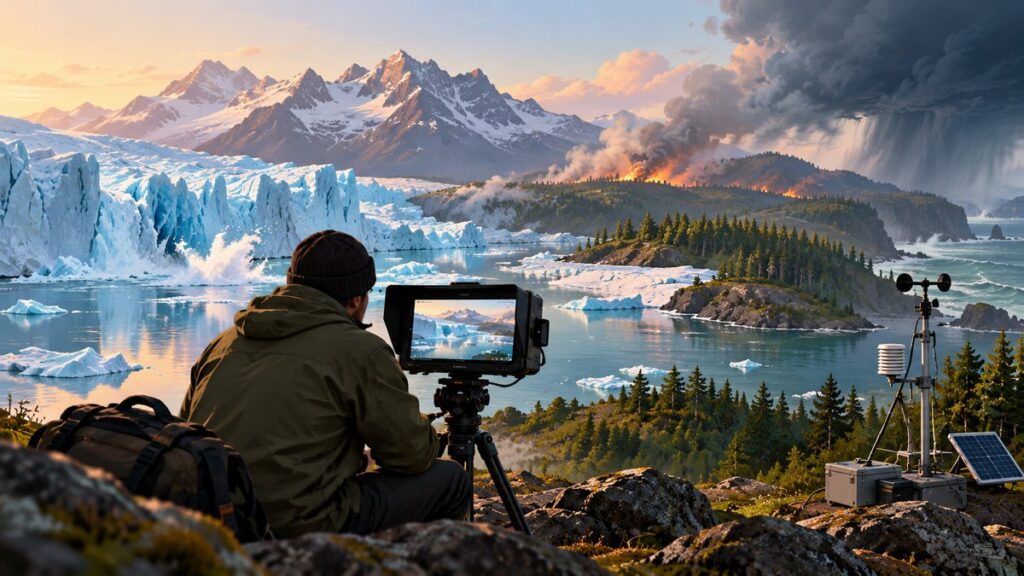
Climate documentaries can make climate evidence understandable, connect scientific concepts to real places and people, and motivate better questions. They cannot replace the measurements, attribution studies, projections, or formal assessments on which climate knowledge rests. Every film selects a date, sources, interviewees, images and narrative, so it should be read as an interpretation and communication product rather than a complete scientific assessment.
The practical answer to “Can I trust a climate documentary?” is conditional: trust clearly sourced observations and explanations that survive comparison with authoritative evidence, while checking striking statistics, predictions, single-event explanations and proposed solutions. The framework below shows what films are good at, where they can mislead, and how to fact-check one without losing the value of watching it.
What can climate documentaries tell you?
They can make a large, abstract system visible
Climate science involves atmospheric chemistry, ocean circulation, ice, ecosystems, infrastructure and human decisions operating across different time scales. A documentary can connect those pieces through animation, field reporting, interviews and historical footage. It can show a measurement being made, introduce the people affected by a hazard, or explain why a change in one part of the Earth system matters elsewhere. That storytelling is useful because it gives viewers a mental map before they encounter technical reports.
They can introduce the evidence behind established conclusions
Multiple independent lines of evidence show that the planet is warming. NASA’s evidence overview describes instrumental temperature records alongside natural archives such as ice cores, tree rings, ocean sediments and coral reefs. A film may photograph or animate those records, but the images are illustrations of observations; they do not substitute for the methods, calibration, uncertainty estimates and time series behind them. Read the underlying evidence at NASA’s climate evidence overview.
Free tools Windows power users keep installed
One-click scans. No signup required.
#1 Best Overall

- HD streaming made simple: With America’s number 1 TV streaming platform,* exploring popular apps—plus tons of free movies, shows, and live TV—is as easy as it is fun. *Based on hours streamed—Hypothesis Group
- Compact without compromises: The sleek design of Roku Streaming Stick won’t block neighboring HDMI ports, and it even powers from your TV alone, plugging into the back and staying out of sight. No wall outlet, no extra cords, no clutter.
- No more juggling remotes: Power up your TV, adjust the volume, and control your Roku device with one remote. Use your voice to quickly search, play entertainment, and more.
- Shows on the go: Take your TV to-go when traveling—without needing to log into someone else’s device.
- TV, simplified: With setup that only takes minutes, a simple-to-navigate Home Screen, and an uncluttered remote control that does all you need—Roku makes it easier to watch the TV you love.
They can connect science with choices and consequences
Good films help viewers ask how emissions, land use, adaptation, energy systems or public policy affect risk. The 2024 U.S. Global Change Research Program Climate Literacy Guide defines climate literacy as “an understanding of how the climate system works, how human actions influence climate, and how climate influences people and other parts of the Earth system.” Its goals include assessing evidence and claims, discussing options for managing risk and making informed decisions. A documentary can support those skills when it supplies enough context for viewers to evaluate what they see.
What a film cannot establish on its own
An image is not a scale bar or a causal test
Aerial footage of a retreating glacier, a wildfire or a flooded street can be accurate and still leave crucial questions unanswered. Where and when was it recorded? Is the scene representative, exceptional or selected because it is visually powerful? What baseline is being used? An image can show that an event happened; it cannot by itself establish how much the global climate has changed, how unusual the event is, or what portion of it was caused by human influence.
A single extreme event is not automatically evidence of a long-term trend
Weather varies from day to day and year to year, while climate trends are evaluated over longer periods. A film should distinguish an observed trend, an attribution analysis, a projection and an anecdote. If it moves from one dramatic event directly to a statement about all future events without explaining the analysis, pause and verify the claim.
Storytelling does not make a film comprehensive
Documentaries necessarily leave things out. One may focus on impacts, another on energy or politics, and a third on personal stories. Kate Manzo’s peer-reviewed analysis in Geoforum identifies recurring debates about scientific verisimilitude and image integrity and proposes teachability and integrity as criteria for judging usefulness. An engaging production can therefore be valuable without covering the full evidence base, and emotional force is not a measure of accuracy. See Manzo’s analysis at “The usefulness of climate change films.”
The Tool Desk
Outbyte PC Repair FREERepair Windows errors before they cause bigger problemsFix Now →Outbyte Driver Updater FREEFix the driver behind crashes, sound loss and screen glitchesFind Drivers →Rank #2

- Ultra-speedy streaming: Roku Ultra is 30% faster than any other Roku player, delivering a lightning-fast interface and apps that launch in a snap.
- Cinematic streaming: This TV streaming device brings the movie theater to your living room with spectacular 4K, HDR10+, and Dolby Vision picture alongside immersive Dolby Atmos audio.
- The ultimate Roku remote: The rechargeable Roku Voice Remote Pro offers backlit buttons, hands-free voice controls, and a lost remote finder.
- No more fumbling in the dark: See what you’re pressing with backlit buttons.
- Say goodbye to batteries: Keep your remote powered for months on a single charge.
The scientific baseline to check against
Warming and human influence
NASA reports about 2°F (1°C) of global average surface warming since the late nineteenth century on its evidence page, accessed October 13, 2026. NASA also states that current warming is occurring roughly 10 times faster than the average rate of warming after an ice age. These are comparisons with specified historical baselines, not a temperature for every place or every year.
Human activity is the principal cause of the recent warming trend. NASA’s summary explains that natural influences still affect climate but cannot explain the changes over the last 150 years; fossil-fuel burning and the resulting greenhouse-gas increases account for the dominant influence. NASA quotes the Intergovernmental Panel on Climate Change: “Since systematic scientific assessments began in the 1970s, the influence of human activity on the warming of the climate system has evolved from theory to established fact.”
Carbon dioxide and the pace of change
NASA states that carbon dioxide from human activities is increasing about 250 times faster than it did from natural sources after the last Ice Age. Preserve the comparison’s context when citing it: it describes rates of increase against a particular natural post-Ice-Age reference, not a claim that every modern carbon measurement rises at one fixed speed. A documentary that uses this statistic should identify NASA or another source and explain what is being compared.
Natural factors still matter, but they do not erase attribution
Solar variation, volcanic eruptions, orbital cycles and internal ocean variability influence climate. NASA’s 2024 educational explanation, “NASA’s Earth Minute: Usual Suspects,” explains how natural influences differ from the human emissions driving the recent trend. Look for a film to present both facts: natural variability exists, and it does not account for the observed warming over the past century and a half.
Quick wins for a faster PC:
Fix the driver behind crashes, sound loss and screen glitchesFind Drivers →Clear out junk files and repair common Windows errorsFree Scan →Scan for outdated or missing drivers - takes under a minuteDriver Scan →Rank #3

- 4K streaming made simple:With America’s number 1 TV streaming platform,* exploring popular apps—plus tons of free movies, shows, and live TV—is as easy as it is fun. *Based on hours streamed—Hypothesis Group
- 4K picture quality: With Roku Streaming Stick Plus, watch your favorites with brilliant 4K picture and vivid HDR color.
- Compact without compromises: Our sleek design won’t block neighboring HDMI ports, and it even powers from your TV alone, plugging into the back and staying out of sight. No wall outlet, no extra cords, no clutter.
- No more juggling remotes: Power up your TV, adjust the volume, and control your Roku device with one remote. Use your voice to quickly search, play entertainment, and more.
- Shows on the go: Take your TV to-go when traveling—without needing to log into someone else’s device.
How accurate are climate change documentaries?
Accuracy is not a single yes-or-no property. Evaluate the film’s individual claims, sourcing and teaching design. Use the following process while watching or when writing a review.
- Record the film’s date, audience and purpose. Evidence, projections and policy conditions change. An older film may remain useful as history, advocacy or a record of public debate while requiring updated scientific context. Note whether it is aimed at children, a general audience, activists, students or decision-makers.
- Classify each important statement. Mark it as a measured observation, an attribution claim, a projection, an interpretation of impacts or a proposed solution. Different categories require different checks. A measured temperature series is not evaluated the same way as a forecast or a policy cost estimate.
- Write down the source behind numbers and graphics. Look for report titles, authors, dates, datasets, map legends and links in end credits or companion material. If a statistic has no origin, treat it as a prompt for verification rather than an established fact.
- Check consequential claims against authoritative evidence. Compare observations and explanations with NASA’s evidence overview and use the USGCRP Climate Literacy Guide for source-evaluation and literacy principles. For communication practice, the United Nations recommends authoritative scientific information and warns that misleading communication can distort perceptions of climate science and solutions; its guidance is at Communicating on Climate Change.
- Inspect the visual context. Ask where, when and under what conditions footage was made. Does a graph show units, a baseline, a time span and uncertainty? Are before-and-after images matched for season, tide, camera position and scale? Does the narration distinguish a representative record from a memorable example?
- Assess uncertainty proportionately. Responsible communication explains what is well established, what has a range of outcomes and what remains uncertain. Be wary of two opposite moves: presenting a projection as a guarantee, or using uncertainty to suggest that nothing is known.
- Test the teaching value. Can the intended audience understand the evidence, terms and causal chain? Does the film provide enough context for a viewer or teacher to follow up? Manzo’s criteria of teachability and integrity are useful here: a production can be technically ambitious yet difficult to teach from, or accessible yet careless with evidence.
A comparison table for reviewing two films
Apply the same questions to every documentary rather than rewarding one film for a standard you do not apply to another.
| Evaluation axis | Questions to ask | What a strong film provides |
|---|---|---|
| Scientific accuracy | Are observations, attribution findings and projections represented correctly? | Precise claims, appropriate qualifiers and references that can be checked. |
| Source transparency | Can viewers identify the study, dataset, expert or institution behind a number or graphic? | Clear credits, dates, methods or companion references. |
| Visual integrity | Are images and animations labelled, dated and shown with enough geographic and temporal context? | Captions, honest scale, consistent comparisons and a clear distinction between illustration and measurement. |
| Teachability | Does the film give its intended audience the concepts needed to interpret the evidence? | Definitions, logical sequencing and openings for discussion or follow-up reading. |
| Date and updating | Could newer observations, projections or policy developments change the interpretation? | A publication date, explicit historical framing and pointers to current sources. |
| Balance of content | How does it handle evidence, uncertainty, impacts and solutions? | Attention to all relevant categories without false balance or solution claims presented as guaranteed outcomes. |
Can I trust a climate documentary?
Trust it as a guided presentation, not as your only authority. Confidence should rise when the film names sources, separates fact from interpretation, explains uncertainty and makes its visual construction visible. Confidence should fall when it relies on an unnamed expert, a decontextualized number, a montage presented as proof, or a confident prediction with no date, scenario or assumptions.
Do not confuse disagreement between films with equal scientific support. A documentary may include a dissenting voice for historical or rhetorical reasons, but the presence of two speakers does not make their evidence equally strong. Check whether the film explains the weight of evidence and the qualifications of each claim.
Rank #4

- Stunning 4K and Dolby Vision streaming made simple: With America’s number 1 TV streaming platform,* exploring popular apps—plus tons of free movies, shows, and live TV—is as easy as it is fun. *Based on hours streamed—Hypothesis Group
- Breathtaking picture quality: Stunningly sharp 4K picture brings out rich detail in your entertainment with four times the resolution of HD. Watch as colors pop off your screen and enjoy lifelike clarity with Dolby Vision and HDR10+.
- Seamless streaming for any room: With Roku Streaming Stick 4K, watch your favorite entertainment on any TV in the house, even in rooms farther from your router thanks to the long-range Wi-Fi receiver.
- Shows on the go: Take your TV to-go when traveling—without needing to log into someone else’s device.
- Compact without compromises: Our sleek design won’t block neighboring HDMI ports, so you can switch from streaming to gaming with ease. Plus, it’s designed to stay hidden behind your TV, keeping wires neatly out of sight
Likewise, do not demand that every film cover every climate topic. A narrowly focused film can be accurate within its scope. The relevant question is whether it signals that scope and avoids implying that a selected case is the whole climate system.
Independent reader supportYour contribution helps us test, update, and keep practical guides available for everyone.Using documentaries for teaching and follow-up
For classroom or public discussion, pair the screening with an evidence task rather than treating the film as the lesson’s final authority. Ask viewers to select one observation, one attribution statement, one projection and one proposed solution, then identify the source and uncertainty attached to each.
NOAA’s Toolbox for Teaching Climate & Energy is a directory of educational resources associated with documentary projects, including Climate Classroom for Years of Living Dangerously and education resources for An Inconvenient Sequel. NOAA marks some Climate.gov material as archived, so confirm that an individual link still works and check its date before assigning it.
A practical follow-up sequence is:
- Define the climate concept shown in the scene.
- Locate the original observation or assessment.
- Separate what the scene demonstrates from what the narration infers.
- Discuss who is affected, what options are available and which assumptions shape the proposed response.
- Write a short correction or qualification for any claim that lacked scale, date, source or uncertainty.
What documentaries can teach about solutions—and what they cannot promise
Films can show how communities, governments and businesses are attempting mitigation or adaptation. They can make trade-offs visible: cost, reliability, land use, equity, timing and political feasibility. They cannot establish that a featured project will work everywhere, deliver a stated reduction at a stated cost, or remove risk without independent evaluation. Those conclusions depend on system boundaries, data, implementation and time horizon.
Best Value

- The Google TV Streamer (4K) delivers your favorite entertainment quickly, easily, and personalized to you[1,2]
- HDMI 2.1 cable required (sold separately)
- See movies and TV shows from all your services right from your home screen[2]; and find new things to watch with tailored recommendations for everyone in your home based on their interests and viewing habits
- Watch live TV and access over 800 free channels from Pluto TV, Tubi, and more[3]; if you find an interesting show or movie on your TV, mobile app, or Google search, you can easily add it to your watchlist, so it’s ready when you are[2]
- Up to 4K HDR with Dolby Vision delivers captivating, true-to-life detail[4]; and you can connect speakers that support Dolby Atmos for more immersive 3D sound
When a documentary presents a solution, ask whether it is describing an example, reporting measured results or forecasting future performance. A case study is evidence that a particular approach was attempted under particular conditions; it is not automatically a universal prescription.
What is known about audience impact?
Documentary makers often intend to improve knowledge, attitudes or behavior, and a well-made film may prompt discussion. However, the evidence assembled here does not establish a documentary-specific numerical effect on viewers’ knowledge, beliefs or actions. Do not infer an effect size from a film’s popularity, emotional intensity or educational purpose. If a production claims that it changed behavior, look for a clearly described study, sample, comparison group and follow-up period.
A concise checklist for viewers and reviewers
- What is the film’s publication date, audience and stated purpose?
- Which statements are measurements, attribution findings, projections, impacts or solutions?
- Who produced each number, image, map and animation, and when?
- Are units, baselines, geographic areas, time periods and uncertainty shown?
- Does the film distinguish weather from climate and an event from its attribution?
- Does it explain natural influences without implying that human influence is unproven?
- Can you verify consequential claims with NASA, USGCRP, peer-reviewed work or another authoritative source?
- Is the film teachable for its intended audience, with enough context for follow-up?
- When comparing films, are you applying the same standards of accuracy, integrity, teachability, currency and balance?
Used this way, a climate documentary does something valuable without pretending to be a complete assessment: it turns distant evidence into questions that viewers can investigate with the underlying science.
Quick Recap
Product prices and availability are accurate as of the date/time indicated and are subject to change. Any price and availability information displayed on Amazon at the time of purchase will apply.






Say something about this film