Recommended Free Tools
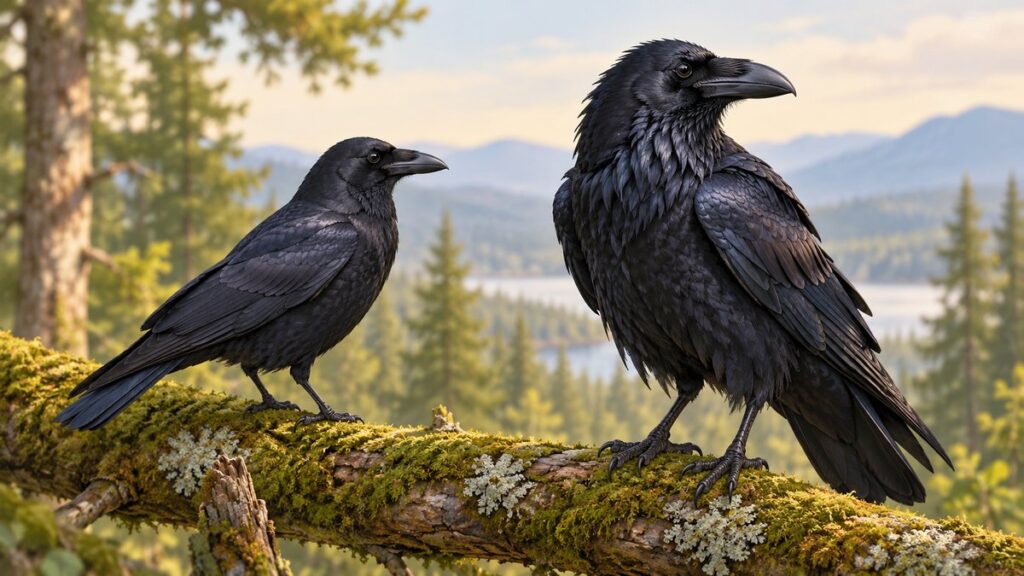
The comparison here is between the American Crow (Corvus brachyrhynchos) and the Common Raven (Corvus corax). A Common Raven is usually much larger, with a heavier bill, shaggy throat feathers, longer wings, and a wedge-shaped tail. An American Crow is smaller, more often seen in sizable groups, and best known for its familiar caw. Those clues are reliable when combined, but no single visual feature identifies every bird at every distance.
The names crow and raven cover several species around the world. The field marks and behavior in this guide apply to this North American pair, not automatically to every Corvus species. Cornell Lab of Ornithology provides the core comparison in its Crow and Raven guide and its species accounts for the American Crow and Common Raven.


The fastest reliable answer
If you have only a few seconds, look for a combination of scale, silhouette, and voice:
- Size: a raven is substantially larger on average. Compare it with a nearby bird, fence post, car, or tree limb rather than trusting an isolated impression.
- Head and neck: ravens have a deeper, heavier bill and a shaggy throat (often called hackles); crows look smoother and more delicately proportioned.
- Tail and wings: a raven’s tail forms a long wedge in flight, and its wings are long and narrow with prominent fingered primaries. A crow’s tail is shorter and more rounded or squared, with broader, rounder wings.
- Voice: the typical crow call is a sharp, scratchy caw. A raven commonly gives a lower, gurgling or croaking sound.
- Social setting: crows frequently gather in large groups, sometimes numbering in the thousands. Ravens are more often alone or in pairs, although food can bring many together.
These are tendencies, not rules. A lone crow can be mistaken for a raven when it is close, and a distant raven can look deceptively small. Cornell’s identification advice is to combine size and shape, behavior, color pattern, sound, habitat, and location rather than relying on one cue; see its black-bird identification guide.
PC Slower Than It Used to Be?
A free scan shows the junk files, broken settings and background clutter dragging Windows down - then fixes them in one click.Free scan · Windows 10 & 11Outdated Drivers Are Slowing You Down
One free scan finds every outdated or missing driver and matches the right update for your exact hardware.Free scan · exact hardware match#1 Best Overall
Size: the strongest first clue
Published measurements show a clear average difference, while also showing why an apparent-size judgment can fail without a reference object. Cornell’s Bird Academy comparison uses typical lengths of 20 inches for an American Crow and 27 inches for a Common Raven. The species accounts give the following ranges:
| Measurement | American Crow | Common Raven | How to interpret it |
|---|---|---|---|
| Length | 15.8–20.9 in (40–53 cm) | 22.1–27.2 in (56–69 cm) | Ravens are generally much longer, but distance and posture distort estimates. |
| Weight | 11.2–21.9 oz (316–620 g) | 24.3–57.3 oz (689–1,625 g) | The ranges overlap less than casual visual impressions suggest; sex, age, and individual variation still matter. |
| Wingspan | 33.5–39.4 in (85–100 cm) | 45.7–46.5 in (116–118 cm) | A raven’s broad span is conspicuous when it passes overhead or glides. |
The length and weight figures come from Cornell Lab of Ornithology species accounts; those pages do not display a publication year. The 20-inch and 27-inch typical lengths come from Cornell Bird Academy, whose page also does not show a publication year. These are species measurements, not a promise that every raven exceeds every crow. McGowan’s American Crow FAQ cautions that individual crow size varies and that size alone is difficult to judge without something familiar for comparison; the FAQ was last updated November 9, 2010.
For a perched bird, compare the bill-to-head proportions and the depth of the body as well as total length. A raven often looks massive even before you can measure it: the head is broad, the neck thick, and the bill dominates the profile. A crow generally presents a slimmer, more balanced outline.
Head, bill, throat, tail, and wings
Bill and throat
At close or moderate range, the bill is one of the best separators. A Common Raven’s bill is heavy and deep, with a strong curve and a visibly substantial base. Its throat feathers may project as a shaggy ruff, especially when the bird calls or raises its hackles. An American Crow’s bill is more modest, and the throat usually appears smooth. Poor light, a backlit silhouette, or a bird facing away can hide both features, so treat them as supporting evidence.
Quick wins for a faster PC:
Scan for outdated or missing drivers - takes under a minuteDriver Scan →Clear out junk files and repair common Windows errorsFree Scan →Fix the driver behind crashes, sound loss and screen glitchesFind Drivers →Tail shape
Watch the tail when the bird banks. Raven tail feathers extend into a long, pointed wedge; the central feathers project farther than the outer feathers. A crow’s tail looks shorter and more rounded or squared, opening into a fan-like shape. A straight-on view can flatten either silhouette, so wait for a turn or a gliding pass if possible.
Wing shape
Ravens have longer, narrower wings and long, separated primary feathers that look like fingers at the tips. Crows have broader, rounder wings. A raven’s wing shape is often clearest during a glide or soar; a crow’s broad wing and more frequent flapping are easier to see during level flight.
Rank #2

- The Sibley Guide to Birds has quickly become the new standard of excellence in bird identification guides, covering more than 810 North American birds in amazing detail. Now comes a new portable guide from David Sibley that every birder will want to carry
Color and shine
Both species are black overall, so color is rarely decisive by itself. Sunlight can reveal gloss or a blue-purple sheen, but angle and exposure change the effect. Do not reject a raven because it looks matte, or identify a crow solely because it shows a shiny patch. Use the silhouette first.
Flight: how to identify a bird in the air
Flight behavior helps when a perched bird gives you no clear bill or throat view. Cornell’s side-by-side guidance emphasizes shape and movement rather than a single wing beat.
- Estimate scale. Compare the bird with other birds in the same airspace, a known structure, or the apparent width of a nearby tree. A lone silhouette against the sky is the least reliable situation.
- Check the wing rhythm. Crows commonly use a rowing, flapping flight and may add short glides. Ravens often alternate strong wing beats with extended glides and are more likely to soar on rising air.
- Look at the wing tips. Long, fingered tips favor raven; a rounder outline favors crow.
- Wait for a turn. A banking raven can reveal its wedge tail and long wings. A banking crow usually shows the shorter, fan-like tail.
- Add the call. A deep croak or gurgle supports raven; a bright, scratchy caw supports crow. Sound should confirm the shape, not replace it.
Soaring is suggestive rather than exclusive. Crows can glide, and ravens flap when they need to gain altitude or travel through still air. Weather, wind, and the bird’s immediate goal change flight behavior.
Calls and vocal behavior
An American Crow’s familiar call is a rough, open caw, often repeated in a series. It also produces rattles, clicks, and other notes. Cornell crow expert Dr. Kevin J. McGowan writes, “American Crows make the familiar ‘caw-caw,’ but also have a large repertoire of rattles, clicks, and even clear bell-like notes.” That sentence appears in the Cornell FAQ, last updated November 9, 2010, and refers specifically to American Crows: Cornell’s crow FAQ.
The Common Raven’s call most often heard in field-identification situations is deeper, rougher, and more resonant, commonly described as a gurgle or croak. Ravens also have a varied repertoire, so a single recording or brief note is not a complete acoustic test. Wind, distance, echoes, and the bird’s posture can make a crow’s call sound lower or a raven’s call less dramatic.
Use the quality of the whole sound: pitch, rasp, resonance, and rhythm. If you can see the caller, match the voice to bill, throat, and tail shape. Cornell’s comparison page and species accounts provide recordings and descriptions for both species: Bird Academy comparison, American Crow account, and Common Raven account.
Rank #3

- Dimension(in): (L) x (W) x (D)
Social behavior: flock size is a clue, not a verdict
American Crows are notably social. Family groups may forage together, and communal roosts can contain very large numbers. Seeing dozens or hundreds of black birds moving between fields and trees therefore favors crow, especially in settled landscapes. It does not prove crow: ravens may gather at a concentrated food source, and a crow may be alone while nesting or feeding.
Common Ravens are more often observed alone or as a pair. Their apparent solitude is a useful field clue, particularly when it accompanies a heavy bill, deep voice, and wedge tail. Juveniles and nonbreeding birds can alter the picture, and local food availability can temporarily override the usual pattern.
Behavior also includes how a bird uses air and objects. Ravens are frequently seen exploiting thermals and investigating varied surfaces; crows are adaptable foragers in human-dominated settings. These observations support an identification only after shape and sound have been considered.
Habitat and geographic context
American Crows occupy fields, open woodlands, forests, farms, lawns, towns, cities, and other human-dominated habitats. Their broad distribution means that a crow is a realistic possibility in many parts of North America, including dense suburbs and urban centers.
Common Ravens occur across varied open and forest habitats, especially in western and northern North America. Their range includes deserts, coasts, tundra, grasslands, rural settlements, and some cities. In a western mountain, desert, or tundra setting, habitat may increase the prior probability of raven; in a city park or agricultural landscape, crow may be more likely. Geography cannot override a clear silhouette, and both species can occur outside these simplified habitat associations.
Because common names are used for multiple species, identify the regional pair before applying a field mark. Cornell’s range and identification accounts are the appropriate starting points for local confirmation: American Crow FAQ, Common Raven identification, and Cornell’s geographic-context guidance.
Independent reader supportYour contribution helps us test, update, and keep practical guides available for everyone.Are ravens smarter than crows?
There is no defensible overall winner from the evidence available for this pair. Cornell describes American Crows as good learners and problem-solvers and notes their inquisitive behavior. Those are meaningful cognitive abilities, but they do not establish that American Crows or Common Ravens are categorically more intelligent.
“Intelligence” is not one measurement. A study might test memory, causal reasoning, tool use, social learning, flexibility, or performance under a particular reward system. A result on one task belongs to that task, population, and experimental design; it should not be converted into a universal ranking of the species.
A 2016 preprint by Dan Stowell, Veronica Morfi, and Lisa F. Gill examined how listeners could identify individual jackdaws from their calls. The authors emphasize that complex corvid calls remain poorly understood. Jackdaws are neither American Crows nor Common Ravens, and the work is not a head-to-head intelligence test, so it cannot show that one of these two species is smarter. It is useful only as context for why vocal complexity should not be reduced to a simple “smartest bird” claim: Stowell, Morfi and Gill (2016).
The accurate conclusion is narrower and more useful: both are capable corvids, and any claim about superiority must name the exact task, species, sample, and test conditions.
A repeatable field method for uncertain sightings
When the bird is distant or backlit, use this sequence instead of guessing from one impression:
- Record the setting. Note region, habitat, elevation if known, and whether the bird is in a city, farm, forest, coast, desert, or tundra environment.
- Find a scale reference. Compare the bird with a nearby species, pole, branch, roofline, or vehicle. Do not estimate absolute size against an empty sky.
- Describe the silhouette before naming it. Write down body bulk, bill depth, throat outline, wing width, and tail shape.
- Observe movement for at least several seconds. Note flapping versus gliding, soaring, wing-tip fingers, and how the bird banks.
- Listen for the broad sound quality. Record whether it is sharp and cawing or deep and gurgling, while allowing for the species’ wider repertoire.
- Check social context. A large communal group supports crow; a lone or paired bird supports raven, but neither observation is conclusive.
- Verify with a regional reference. Use Cornell’s species accounts and comparison page, and save a photograph or audio clip if the identification matters.
Binoculars can reveal the bill and throat at a distance, but they are optional. Cornell’s free online identification and species resources are sufficient for the basic comparison; equipment does not replace a multi-cue observation.
The Tool Desk
Outbyte Driver Updater FREEScan for outdated or missing drivers - takes under a minuteDriver Scan →Outbyte PC Repair FREEClear out junk files and repair common Windows errorsFree Scan →Common mistakes and how to correct them
Calling every large black bird a raven
Perspective, close distance, and a puffed-up crow can all inflate apparent size. Recheck tail shape, bill depth, and wing proportions against a reference object.
Using sound alone
Crows make more than a caw, and ravens make more than one croak. Wind and echoes alter recordings. Pair the call with a visible silhouette whenever possible.
Treating flock size as proof
Crows commonly form large groups, but ravens can congregate at food. Social pattern is supporting evidence only.
Assuming black plumage settles the question
Both species are black overall, and lighting changes gloss. Shape and behavior carry more information than shine.
Free tools Windows power users keep installed
One-click scans. No signup required.
Applying North American rules worldwide
Different regions contain different Corvus species. Confirm the local species before transferring these cues to another continent.
Turning “smart” into a species ranking
Problem-solving observations are not a universal intelligence score. Ask what task was measured and in which species before accepting a comparison.
Quick Recap
What to remember in the field
- This guide compares American Crow and Common Raven, not every crow and raven species.
- Ravens are generally larger, heavier-billed, shaggier-throated, longer-winged, and more wedge-tailed.
- Crows are generally smaller, broad-winged, more rounded-tailed, and more frequently encountered in large groups.
- A scratchy caw favors crow; a deep gurgle or croak favors raven, while both species have varied repertoires.
- Habitat and geography adjust the odds but never replace direct shape and sound evidence.
- No available evidence supports naming an overall intelligence winner.






Say something about this film