Some links on this page are affiliate links: if you buy through them we may earn a commission, at no extra cost to you.
The vocoder did not begin as a musical effect—or as a military invention. In the 1930s, Bell Labs engineer Homer Dudley developed speech-analysis technology to make voice transmission more efficient. During World War II, a related system became part of SIGSALY, a massive Allied secure-communications network. Decades later, musicians made the vocoder’s artificial, voice-without-a-face sound a defining feature of electronic music.
That journey is more interesting than the familiar shorthand that the military invented a “robot voice.” A vocoder was built to preserve the shape of speech while reducing the information needed to transmit it. Its technical compromises—less naturalness, less recognizable vocal identity—became a new musical instrument.
What a vocoder does
“Vocoder” is short for voice encoder. In its classic form, it analyzes speech and uses the resulting measurements to shape another sound. The voice provides the articulation; a separate sound source, called the carrier, provides much of the output’s tone and pitch.
- A microphone captures speech.
- An analyzer divides it into frequency bands and measures how the energy in each band changes over time. It also tracks features such as voicing and pitch.
- A carrier—often a synthesizer, but potentially a string-like tone or noise—is sent through a corresponding bank of filters.
- The speech measurements control those filters, imprinting the voice’s changing spectral shape on the carrier.
Signal flow: voice → analyzer → control information; carrier → controlled filters → vocoded output.
#1 Best Overall
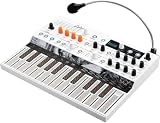
- 25-key Paraphonic Hybrid Hardware Synth Vocoder with Poly-aftertouch Flat Keyboard
- Digital Oscillators
- Modulation Matrix
- Analog Filters
- Arpeggiator
The result is not simply a computer replacing a voice. It is a sound source being articulated by speech. With a steady synthesizer carrier, a singer can make notes seem to talk. With noise or a more complex carrier, consonants and breath can become prominent. The carrier’s pitch largely determines the musical notes; the vocoder does not automatically correct the singer’s pitch.
How intelligible the output is depends on the number and behavior of the filter bands, the carrier, the singer’s articulation and the settings. A vocoder can convey recognizable words, but it can also blur them into a synthetic texture.
Bell Labs, Homer Dudley and the telephone problem
Vocoder history begins with communications engineering. Bell Laboratories was investigating speech acoustics and how to transmit speech efficiently over telephone networks. Rather than send every detail of the original sound wave, researchers asked whether they could transmit a compact description of speech and reconstruct it at the other end.
Homer Dudley was central to this work. His approach treated speech not as an indivisible recording but as a changing pattern that could be analyzed: which frequency regions were active, how strongly they were energized, and whether the sound was voiced or unvoiced. A receiver could use those changing parameters to drive a speech generator.
This offered a potential efficiency advantage, but it was a trade-off. The reconstructed speech could remain intelligible without retaining the original speaker’s full vocal character or fidelity. Bell Labs’ work developed within a broader research environment; the story is not simply one inventor independently creating every later speech coder or secure communications system. Dudley’s late-1930s work and public demonstrations made the principle visible, while later applications adapted it for different purposes.
The VODER was a performer’s instrument
At the 1939 New York World’s Fair, Bell Labs demonstrated the VODER, short for “Voice Operating Demonstrator.” It could produce speech-like sounds, but it was not an autonomous talking computer. An operator had to coordinate keys, controls and a foot pedal to shape the sound, including its pitch, voiced or unvoiced character, and resonances.
Rank #2

- Features 37 full-size keys for expressive performance and dynamic play
- Boasts a 2.8-inch full-color IPS LCD display for easy and intuitive sound editing
- Includes a loop recorder, making it a powerful tool for both production and performance
- Features a new vocal processor with harmonizer and hard-tuning functions for enhanced vocal effects
- Offers a vibrant makeover with a new categorization system for easier sound selection
The VODER and VOCODER are related but not interchangeable terms:
Free tools Windows power users keep installed
One-click scans. No signup required.
| Term | What it means |
|---|---|
| VODER | A manually operated speech synthesizer demonstrated publicly in 1939. Its operator generated speech-like sounds through coordinated controls. |
| VOCODER | A voice-analysis and synthesis approach that represents speech characteristics as control information for a speech generator or other carrier. |
| SIGSALY | A specialized Allied secure-voice communications system that used vocoder-related speech coding alongside cryptographic and synchronization systems. |
The VODER’s complexity is a useful corrective to the image of a machine simply “speaking.” It took human skill to make it communicate. Dudley described the vocoder in a 1939 Bell Laboratories Record article; a historical discussion of the VODER and speech technology is also available through the USPTO-hosted record.
SIGSALY: speech coding in a secure wartime network
During World War II, vocoder-related speech coding found a high-stakes application in SIGSALY, an Allied system for secure long-distance voice communications. It was associated with high-level conversations, including communications involving Franklin D. Roosevelt and Winston Churchill. The system is a powerful part of the vocoder’s history, but it should not be mistaken for a commercial vocoder plugged into a military radio.
The NSA’s history of secure voice coding describes SIGSALY as operating at about 1,200 bits per second, a very low speech data rate by modern standards. Its original equipment weighed roughly 55 tons and relied on vacuum-tube technology. Later generations of secure voice equipment became far smaller: the NSA account gives approximately 565 pounds for the KY-9 and around 100 pounds for the HY-2. It describes the KY-9 as using a 12-channel vocoder and the HY-2 as using 16 channels at 2,400 bits per second.
The key distinction: a vocoder is not encryption by itself. Speech coding represents and reconstructs speech in a changed form; it can make speech less natural or less recognizable. SIGSALY’s security depended on cryptographic protection and synchronized key material as well as speech coding. Calling it “a vocoder that encrypted Roosevelt’s calls” collapses several distinct parts of the system. The NSA’s account of secure voice coding provides further historical context.
Quick wins for a faster PC:
Repair Windows errors before they cause bigger problemsFix Now →Fix the driver behind crashes, sound loss and screen glitchesFind Drivers →So what was secret? Dudley’s work and the VODER were publicly discussed. The wartime system’s operational details and cryptographic context were sensitive. The secrecy belongs to the military implementation, not to the basic existence of vocoder research.
Rank #3

- Discover endless sweet spots between sonic universes and tear up the rulebook with an addictive hybrid synthesizer that invites you to play without consequences.
From communications tool to musical voice
The transition into music was indirect. Researchers had wanted to transmit speech more efficiently; musicians heard a way to make a voice sound detached from its singer, controlled by an instrument, or poised between human and machine.
In the early 1970s, Wendy Carlos and Robert Moog adapted synthesizer equipment to create a vocoder for work on the A Clockwork Orange soundtrack. They did not invent the vocoder, but their work showed how it could serve a composition and a film’s atmosphere, rather than a communications link. Apple’s history of the vocoder also traces the move into commercial musical instruments: the EMS Studio Vocoder was available in 1976, followed by the Sennheiser VMS 201 in 1977 and Roland VP-330 in 1979.
By the late 1970s, artists including Kraftwerk and Herbie Hancock were helping bring vocoded vocals into popular electronic music. Their uses were not all the same. The processed voice could suggest industrial modernity, turn a vocal line into a rhythmic hook, or make a singer sound like an instrument. Kraftwerk’s machine-human aesthetic made the technology especially legible as an idea: electronic processing did not only make a voice sound futuristic; it raised the question of where a human performance ended and a machine’s began.
Do these 3 things before closing this tab:
1Fix the driver behind crashes, sound loss and screen glitches2Repair Windows errors before they cause bigger problems3Scan for outdated or missing drivers - takes under a minuteIn funk, electro and hip-hop, the processed voice also became a rhythmic and identity-bearing element. Herbie Hancock used vocoded vocals in late-1970s electronic funk and jazz-fusion contexts. Afrika Bambaataa’s “Planet Rock” is an important marker in the relationship between electronic vocal sounds, electro and hip-hop. But popular accounts often call any robotic vocal a vocoder. Individual tracks may instead use a talkbox, harmonizer, sampling, ring modulation or other processing; exact recording claims require track-specific documentation.
Roland’s history of vocal harmonizers and vocoders and the broader musical overviews from iZotope and MusicTech trace the instrument’s spread across electronic music and pop. The important cultural change was not just that singers acquired a “robot effect.” Artists could use processing to invent a vocal identity that was neither simply natural nor wholly mechanical.
Vocoder, talkbox and Auto-Tune are different tools
| Tool | What it changes | How it works |
|---|---|---|
| Vocoder | The articulation and spectral movement of speech are imposed on a carrier. | An analyzer tracks the voice; a filter bank shapes a separate sound source. |
| Talkbox | An instrument’s sound is shaped by the performer’s mouth. | A tube sends sound into the mouth; the performer’s mouth acts as an acoustic resonator, and a microphone captures the result. |
| Auto-Tune or pitch correction | The pitch of a vocal performance. | Software detects and alters pitch. It does not, by itself, impose speech articulation on a synthesizer carrier. |
These effects can be combined, and recordings may use several kinds of processing. A talkbox can sound vocoded to a casual listener; a vocoder can be used subtly enough that it does not sound like the familiar robotic effect. The label should follow the documented process, not just the impression.
Rank #4

- Make Huge Sounds- Create deep, gritty bass, soaring leads, lush pads, and vintage sounds with up to 18 voices and powerful effects
- Built By a Legend- MiniNova’s synth engine was conceived, shaped, and refined by British synth legend Chris Huggett and has his five decades of passion, experience, and expertise behind it
- Gently Tweak or Instantly Warp- Subtly tweak your sounds with the knobs, or totally warp them with the Animate buttons, pitch, and modulation wheels
- Create Unique Vocals - Talk or sing into the mic and run your voice through the keyboard and effects engine. Use MiniNova’s secret weapon for the perfect vocal – VocalTune. Your voice will automatically be tuned to the notes you play on the keyboard
- Animate and Arpeggiate- Switch to 'Animate' mode and press one of the eight backlit buttons to trigger awesome performance functions or 'Arpeggiator' mode to jam with arpeggiator rhythms in real time
Why the limitations became the sound
In communications, the loss of naturalness was a cost to manage. In music, that cost could become the point. A reduced-bandwidth or coarse-filter sound could feel cold, blurred or machine-made. The less recognizable the singer’s natural timbre became, the more the voice could suggest an invented character: an electronic persona, a chorus of machines, or a human voice absorbed into an arrangement.
Recommended Free Tools
Several choices shape the result:
- Filter-band count: More bands can preserve more spectral detail and make speech clearer; fewer bands tend to sound more synthetic or blurred.
- Carrier sound: A pitched oscillator supplies stable musical tone; noise can make consonants and breath more audible. A carrier without enough useful high-frequency content may leave words hard to understand.
- Vocal performance: Clear articulation gives the analyzer more to work with. A vocoder cannot recover consonants the microphone never captures or turn an unarticulated performance into clear speech.
- Envelope response: Attack and release behavior affect how quickly the filter pattern follows the voice. Excessive smoothing can soften articulation.
- Pitch and notes: The carrier is a major source of output pitch. If it is played on the wrong notes, the words may still be recognizable but the result can sound musically wrong.
That is why “robot voice” is not a reliable technical description. Some such effects use vocoding; others rely on a talkbox, pitch processing, harmonization, spectral effects, samples or newer voice-transformation methods.
Trying a vocoder today
A modern setup usually needs a modulator (a microphone or recorded vocal) and a carrier (a synth or noise source), both routed to the vocoder. The precise routing labels differ between plug-ins and hardware, so consult the product’s manual for its inputs and monitoring path. A basic workflow is:
- Choose a vocoder, then create or select a carrier sound. A sustained, harmonically rich synth is a straightforward starting point.
- Send a microphone signal or vocal track to the vocoder’s analysis or modulator input.
- Route the carrier into its carrier input. Some plug-ins provide a built-in synth; others need an external instrument or audio route.
- Monitor the processed output, not just the dry vocal. If using a live microphone, wear headphones to avoid speaker feedback.
- Play the notes or chords you want the voice to follow. The carrier’s pitch usually determines the result’s pitch.
- If consonants disappear, try clearer articulation, a carrier with more high-frequency content, a higher band count or a higher unvoiced/noise level if the device provides one.
- Adjust band count and envelope response, then blend dry and processed signals if you want some of the original voice to remain.
If there is no effect, check that the microphone reaches the modulator input and that a carrier is actually reaching the carrier input. Receiving MIDI does not guarantee that the vocoder has carrier audio; receiving vocal audio alone may not produce a useful result either. Also check whether the DAW is monitoring a dry vocal in parallel with the processed output.
If the sound is thin, verify the carrier level and try a fuller source. If speech is muffled, consider band count, consonant articulation and the carrier’s high-frequency content. If the live microphone feeds back, use headphones and check for a direct-monitoring path that is sending sound back into the microphone. A vocoder is a signal-processing instrument, not a one-button pitch fixer or a synthesizer that necessarily creates a full sound from speech alone.
Choosing hardware or software
Software is usually the practical starting point for occasional studio vocals: it is easy to recall, automate and use on multiple tracks, and it may already be included in a DAW. Hardware makes sense when hands-on control, a self-contained performance setup or a keyboard-based workflow matters more than convenience and recall.
Best Value

- THE ORIGINAL POCKET SYNTHESIZER - Used by everyone from David Bowie to The White Stripes, this musical instrument is a great addition to your collection. A great gift for experienced musicians and beginners alike!
- ICONIC SOUND - The Stylophone original pocket operator features the same iconic, analog sound as the original, first released in 1968. The Stylophone is an iconic mini synth, known for its super-fun stylus, compact design, and unique retro sound with 3 Octaves and optional vibrato effect,
- EASY TO PLAY - This electronic keyboard operated synthesizer is played by tapping and sliding the connected stylus along the touch-sensitive metal surface. Each segment on the surface plays a different note. It’s easy to play, perfect for beginners and experienced musicians!
- PORTABLE & BATTERY-POWERED - At less than 12cm wide, the Stylophone synthesizer will fit right in your coat pocket. It runs on 3 x AA batteries, and features a built-in speaker and headphone socket – so you can play it everywhere you go.
- CONNECTIVITY - Connect the Stylophone to your computer and other gear to enhance your sound & music possibilities! Use a 3.5mm Stereo cable to connect into the line input on your PC, and use your preferred software to record and manipulate your Stylophone sounds.
| Need | Likely fit | Trade-off |
|---|---|---|
| Occasional vocal effect in a DAW | An existing DAW vocoder or a plug-in | Requires compatible host software and correct audio/MIDI routing. |
| Detailed studio editing and recall | Software | Licensing, activation and host compatibility vary by product. |
| Live keyboard performance | A hardware vocoder keyboard | Costs more, takes space and may require a microphone and cables. |
| Hands-on sound design | A vocoder with adjustable bands, carrier options and envelope controls | More controls can mean more setup and a steeper learning curve. |
| Minimal setup | Hardware with a built-in carrier and microphone input, or a plug-in with an integrated carrier | Check how the specific device handles monitoring and external inputs. |
For Logic Pro users, Apple documents the EVOC 20 as a software vocoder within Logic Pro; it is not a separately sold plug-in (Apple’s documentation). Softube lists its Vocoder as a dedicated plug-in with a built-in six-voice carrier, MIDI support and a freeze function; its listed formats include AU, VST, VST3 and AAX. The company’s current product page gives compatibility and licensing details, which should be checked before purchase because requirements can change.
Arturia’s Vocoder V is another software option. Its catalog displayed a $149 price during the August 2026 research pass, alongside a crossed-out $199 price; treat that as a time-sensitive promotional listing, not a permanent price.
For a physical instrument, Behringer describes its VOCODER VC340 as an analog vocoder and string-ensemble keyboard with 37 semi-weighted, velocity-sensitive full-size keys. It evokes the Roland VP-330-style format; it is not an original vintage Roland. No reliable current official price was established here, so check the manufacturer or an authorized retailer rather than relying on an outdated listing.
What’s actually slowing this PC down?
Pick the symptom - the matching free tool is one click away.
Korg’s original microKORG is marked discontinued on Korg’s product page, so it should not be presented as a new, generally available instrument; used-market condition and pricing vary. Korg also has a microKORG Crystal product page and a Mac and Windows microKORG software version that reproduces the original’s vocoder function. Check current availability, compatibility and price directly with Korg or a retailer. Vintage EMS and Roland instruments may appeal to collectors, but they are not the easiest first purchase for someone who only wants an occasional robotic vocal.
For a first attempt, use the vocoder already available in your DAW if it has one. That lets you learn the relationship between voice, carrier and articulation before deciding whether you need a dedicated plug-in or a live hardware instrument.
Quick Recap
Product prices and availability are accurate as of the date/time indicated and are subject to change. Any price and availability information displayed on Amazon at the time of purchase will apply.

