Phil Donahue, the pioneering daytime talk-show host who made the studio audience part of the conversation, died on August 18, 2024, at his Manhattan home. He was 88. His family said he died peacefully after a long illness; no specific medical cause was publicly disclosed.
Phil Donahue, the pioneering daytime talk-show host who turned studio audiences into active participants in television debate, died on August 18, 2024, at his Manhattan home. He was 88.
Donahue’s wife, actor and author Marlo Thomas, was with him, along with family members and grandchildren, according to contemporary statements from his publicist and family representative. They said he died peacefully after a long illness. No specific medical cause of death was publicly disclosed.
Why Phil Donahue changed daytime television
Before Donahue, a studio audience was often treated primarily as scenery or applause. On The Phil Donahue Show, audience members asked questions, challenged guests and helped determine the direction of the discussion. Their reactions were not an interruption to the program; they were a central part of it.
Recommended Free Tools
#1 Best Overall

- 1080p Resolution - Watch movies and TV shows in high-definition picture quality.
- LED-backlit LCD screen - With reliable and long-lasting LED lighting, this LCD screen delivers a wide range of colors and contrast for a memorable viewing experience.
- Watch what you want - Stream over 1.5 million movies and TV episodes. Watch favorites with subscriptions to Netflix, Prime Video, Disney+, and more. Subscription fees may apply.
- All your entertainment in one place - Watch live and free TV, play video games, and stream music.
- Smart and always getting smarter - Fire TV adds new Alexa skills, features, smart home capabilities, and voice functionality all the time.
That approach made Donahue one of the principal architects of the modern audience-driven daytime talk show. He did not invent television talk shows as a whole, but he pioneered and popularized a format in which a host, a guest and a room full of people could openly examine contentious subjects in a conversational setting.
The format gave daytime television room for discussions of politics, religion, race, gender, sexuality, abortion, health, consumer protection, war and other subjects that were often treated cautiously or avoided altogether. Donahue’s program was frequently associated with liberal or socially progressive topics, but its defining editorial characteristic was less a single partisan viewpoint than a willingness to bring controversial ideas before a live audience and let people question them directly.
His influence could later be seen throughout the daytime talk-show field, including in the work of Oprah Winfrey and other successors. The basic television grammar—one central subject, guests with competing perspectives, and audience members who participate rather than simply applaud—remains part of the genre he helped establish.
From Ohio radio to a national television institution
Born in Cleveland, Ohio, in 1935, Donahue graduated from the University of Notre Dame in 1957. He began his broadcasting career in radio and television, working at KYW in Cleveland, serving as a radio news director in Adrian, Michigan, and doing television news work in Dayton, Ohio.
In Dayton, he hosted the radio call-in program Conversation Piece. That experience became an important bridge to his television career: listeners were not merely receiving information but calling in, asking questions and shaping the conversation.
The Phil Donahue Show debuted locally on WLWD in Dayton on November 6, 1967. The program later expanded through Avco-owned stations and moved into national syndication at the end of the 1960s. Accounts differ slightly on whether to identify the national rollout as 1969 or 1970, so the broader description is the most useful: the show became a nationally syndicated program around that transition.
The program moved from Dayton to Chicago in 1974, where it developed much of its national identity. In 1985, it moved again, this time to New York City, and continued under the shorter title Donahue. Its original daytime run ended in 1996 after 29 years as a television institution.
Rank #2

- 720p resolution - View your favorite movies, shows and games in high definition.
- Alexa voice control - The Alexa Voice Remote lets you easily control your entertainment, search across apps, switch inputs, and more using just your voice. Press and hold the voice button and ask Alexa to easily find, launch, and control content, and even switch to cable.
- Access thousands of shows with Fire TV - Watch over 1.5 million streaming movies and TV episodes with access to thousands of channels, apps and Alexa skills, including Prime Video, Netflix, Hulu, HBO Max, YouTube, Apple TV+, Disney+, ESPN+, Sling TV, Paramount+, and other services right from this TV.*
- DTS Virtual-X Sound - An immersive sound format creates a three-dimensional sound experience with your TV’s speakers.
- Supports HDMI ARC - Sends audio directly from the HDMI jack to a compatible soundbar or AV receiver, removing the need for an extra cable.
Syndication also mattered creatively. A syndicated program was not bound to the same structure as a network-owned daytime show, giving Donahue more latitude to address subjects that could be difficult, politically sensitive or commercially risky.
The questions—and the subjects—that defined the show
Donahue’s archive reflects the breadth of American public debate in the late 20th century. The Television Academy’s oral-history material documents discussions involving civil rights, feminism, religion, same-sex couples raising children, censorship, white supremacist David Duke, Nazi leader Albert Speer, the Vietnam War, health and sexuality.
The archive also documents interviews and discussions involving figures such as Muhammad Ali, Joe Frazier, Johnny Carson, Bob Hope, Gloria Steinem, Anita Bryant, Jimmy Hoffa and Marlo Thomas. These references should be understood as part of the archive’s record of Donahue’s interviews and discussions, not as a claim that every person appeared in an identical full-length episode format.
What made such appearances distinctive was the setting. Donahue’s questions were important, but the audience often supplied the emotional and moral pressure of the program. A guest might be asked to explain a political position, defend a religious belief or respond to a personal story from someone sitting only a few feet away.
Donahue believed that exposing extreme ideas to public scrutiny could be more revealing than simply suppressing them. That principle helped explain both the program’s appeal and its occasional volatility. The show could be empathetic, confrontational, educational or chaotic, sometimes within the same hour.
Windows Errors? Fix Them Before They Spread
Repair common Windows errors and clear accumulated junk for a smoother, more stable PC - no reinstall needed.Free scan · no reinstallOutdated Drivers Are Slowing You Down
One free scan finds every outdated or missing driver and matches the right update for your exact hardware.Free scan · exact hardware matchHis brief return with MSNBC’s Donahue
Donahue returned to television with another program titled Donahue on MSNBC in 2002. It ran briefly into 2003 and should be regarded as a separate, short-lived chapter rather than a continuation of the original syndicated daytime show.
The program arrived amid debate over television news, political balance and corporate programming decisions, particularly during the period surrounding the Iraq War. Some accounts have attributed its cancellation solely to Donahue’s antiwar views, but the available record does not establish that as a definitive explanation. It is more accurate to describe the cancellation and its surrounding controversy as contested.
Rank #3

- Breathtaking picture: Sharp 4K brings out rich detail on our 55" flat screen TV, while the QLED screen and HDR10 create bright, accurate colors. Roku Smart Picture cleans up incoming TV signals, optimizes them, and chooses the right picture mode.
- Seamless streaming: With fast Wi-Fi and apps that launch in a snap, Roku Select Series TVs get you to your entertainment quickly. You get excellent picture quality, clear sound, automatic updates, and more. It’s simple to use. Hard to outgrow.
- TV, simplified: With setup that only takes minutes, a simple-to-navigate Home Screen, and an uncluttered remote control that does all you need—Roku makes it easier to watch the TV you love.
- A world of free entertainment: Enjoy a huge selection of free live TV, news, sports, movies, shows, and much more—all just a click away.
- More streaming, less searching: With personalized picks right on your Home Screen, quick access to the sports and entertainment you watch most, and fast and easy search in one place—the days of endless scrolling are over.
A career recognized with major honors
Donahue was inducted into the Television Academy Hall of Fame in 1993. The Academy’s Hall of Fame tribute cited 19 National Daytime Emmys for Donahue and his program by the time of that tribute. Later official references, including President Joe Biden’s 2024 statement honoring Donahue, commonly cite a total of 20 Emmys. The difference reflects the timing and counting used by the respective sources, not a reason to question the scale of his achievement.
In 2024, Biden awarded Donahue the Presidential Medal of Freedom. The presidential citation called him a trailblazing television icon and credited him with nearly 7,000 episodes and with changing the way Americans engaged in national conversation.
What’s actually slowing this PC down?
Pick the symptom - the matching free tool is one click away.
The 76th Emmy Awards later included Donahue in its In Memoriam segment, identifying him as a talk-show host and producer.
Phil Donahue and Marlo Thomas
Donahue met Marlo Thomas through his television program. They married in 1980 and remained together for 44 years, until his death. Thomas was with him at the time of his death, according to public reports.
Donahue had five children. His family asked that people wishing to honor him make donations in lieu of flowers to St. Jude Children’s Research Hospital or the Phil Donahue/Notre Dame Scholarship Fund.
His connection to Notre Dame also extended into educational philanthropy. University archival material documents the establishment of a Donahue Scholarship in the early 1990s, with preference for students pursuing communications-related careers. The historical record supports the connection between Donahue’s broadcasting career and the scholarship; current eligibility rules should be confirmed with the university rather than inferred from older archival descriptions.
Donahue beyond the talk show
For readers interested in Donahue’s own account of his life and career, Donahue: My Own Story is his autobiography. It was published in hardcover in the late 1970s or around 1980, with a Fawcett paperback edition following in 1981. Editions may now be encountered through used-book and rare-book sellers, so format, condition and availability can vary. Phil Donahue’s autobiography is the most direct place to begin for a first-person perspective.
Donahue also worked in documentary filmmaking. He produced and directed Body of War with Ellen Spiro, a documentary released in 2008. A Docurama/New Video DVD edition is documented, but current stock should not be assumed; copies may be limited to used or collector-market listings. Readers looking for Donahue’s documentary work should check the edition, seller and condition before buying.
There is no basis to promise a complete, currently available authorized box set or streaming archive of the original Donahue series. Episode rights and commercial availability can change, and individual online listings should be checked for authorization and completeness.
Rank #4
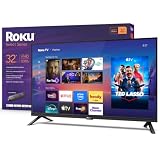
- Bright, clear picture: Bring entertainment to life on our 32" flat screen TV with bright 1080p Full HD—perfect for bedrooms, kitchens, and beyond. Roku Smart Picture cleans up incoming TV signals, optimizes them, and chooses the right picture mode.
- Seamless streaming: With fast Wi-Fi and apps that launch in a snap, Roku Select Series TVs get you to your entertainment quickly. You get excellent picture quality, clear sound, automatic updates, and more. It’s simple to use. Hard to outgrow.
- TV, simplified: With setup that only takes minutes, a simple-to-navigate Home Screen, and an uncluttered remote control that does all you need—Roku makes it easier to watch the TV you love.
- A world of free entertainment: Enjoy a huge selection of free live TV, news, sports, movies, shows, and much more—all just a click away.
- More streaming, less searching: With personalized picks right on your Home Screen, quick access to the sports and entertainment you watch most, and fast and easy search in one place—the days of endless scrolling are over.
A lasting television legacy
Phil Donahue’s achievement was not simply that he hosted a successful daytime program for nearly three decades. He changed who was allowed to speak in a television studio and what counted as a legitimate daytime subject.
Do these 3 things before closing this tab:
1Repair Windows errors before they cause bigger problems2Scan for outdated or missing drivers - takes under a minute3Clear out junk files and repair common Windows errorsBy giving audience members a meaningful role, he made ordinary people part of the program’s reporting, questioning and debate. By allowing difficult subjects into a mass-market format, he helped make daytime television a venue for conversations about social change, conflict and identity.
Later hosts adapted the formula in different ways, but the underlying idea remained recognizable: television did not have to speak only to an audience. It could also listen to one.
Frequently Asked Questions
When did Phil Donahue die, and what was the cause of death?
Phil Donahue died on August 18, 2024, at his Manhattan home at age 88. His family and publicist said he died peacefully after a long illness, but no specific medical cause was publicly disclosed.
Why was Phil Donahue important to television?
Donahue’s program made audience questions and reactions a central part of the format. That approach helped pioneer the audience-driven daytime talk shows later associated with hosts such as Oprah Winfrey.
When did The Phil Donahue Show run?
The original program debuted locally in Dayton on November 6, 1967, expanded into national syndication around 1969–1970, moved to Chicago in 1974 and New York in 1985, and ended its daytime run in 1996.
The Bottom Line
Phil Donahue died on August 18, 2024, at 88, after a long illness whose specific cause was not publicly disclosed. His enduring legacy is the audience-participation daytime format that made difficult public conversations part of mainstream television.
Quick Recap
Product prices and availability are accurate as of the date/time indicated and are subject to change. Any price and availability information displayed on Amazon at the time of purchase will apply.