Do these 3 things before closing this tab:
1Repair Windows errors before they cause bigger problems2Scan for outdated or missing drivers - takes under a minute3Clear out junk files and repair common Windows errorsSome links on this page are affiliate links: if you buy through them we may earn a commission, at no extra cost to you.
A monitor that goes black while its power light stays on usually has a signal-path problem, not a dead panel. Check the source, selected input, cable seating, and cable condition in that order, changing one variable at a time. Camera blackout is different: a mechanical shutter can make the viewfinder or rear screen go dark during exposure, while supported electronic-shutter modes can provide blackout-free viewing. The steps below separate those two problems and show when a cable swap is enough, when the source or dock is at fault, and when the monitor needs service.
What “image blackout” actually describes
The same phrase is used for two unrelated symptoms. In ordinary display use, image blackout means a monitor loses its picture, briefly or continuously, even though its power indicator remains lit. The likely path is the connection between the source device and the display: an input set incorrectly, a loose connector, a damaged cable, a graphics output, a dock, or the monitor’s input circuitry.
In photography, blackout can occur inside the camera while an image is being captured. A mechanical shutter physically interrupts the viewfinder image for the exposure. That behavior is not evidence of a failed monitor or cable. Some cameras offer blackout-free viewing with supported electronic-shutter settings, but the exact behavior depends on the model and shooting mode.
Recommended Free Tools
Classify the symptom before replacing anything
| What you observe | What it suggests | First check |
|---|---|---|
| Continuous black screen, power LED on | Input selection, cable, source output, or monitor signal circuitry | Open the monitor’s on-screen menu, verify the selected input, then reseat both cable ends |
| Brief black flashes during computer use | Intermittent contact, a marginal cable, a dock/GPU link renegotiation, or an application-specific mode | Note whether the flash affects every application and test a direct connection with another cable |
| “No signal” message | The monitor is powered but is not receiving a valid source signal | Switch to the correct HDMI, DisplayPort, or VGA input and test another source |
| Black picture only in one application | Application, playback-protection, driver, or full-screen mode issue rather than a dead panel | Check whether the desktop and monitor menu remain visible outside that application |
| Viewfinder or camera screen darkens exactly during capture | Potentially normal mechanical-shutter blackout | Check shutter type, flash use, and the camera’s model-specific blackout setting |
Write down whether the power light stays on, whether the monitor displays “No signal,” and whether the failure is continuous or momentary. That record prevents a cable fault from being confused with a camera feature or a monitor hardware failure.
Popular on Amazon

- CRISP CLARITY: This 23.8″ Philips V line monitor delivers crisp Full HD 1920x1080 visuals. Enjoy movies, shows and videos with remarkable detail
- INCREDIBLE CONTRAST: The VA panel produces brighter whites and deeper blacks. You get true-to-life images and more gradients with 16.7 million colors
- THE PERFECT VIEW: The 178/178 degree extra wide viewing angle prevents the shifting of colors when viewed from an offset angle, so you always get consistent colors
- WORK SEAMLESSLY: This sleek monitor is virtually bezel-free on three sides, so the screen looks even bigger for the viewer. This minimalistic design also allows for seamless multi-monitor setups that enhance your workflow and boost productivity
- A BETTER READING EXPERIENCE: For busy office workers, EasyRead mode provides a more paper-like experience for when viewing lengthy documents
Seven-step monitor diagnosis
Perform the checks in sequence. Change one variable at a time so you know which change altered the result.
1. Confirm power and wake the display
- Press the monitor’s power button once and verify that the power indicator is lit.
- Move the mouse or press a keyboard key to wake the computer and display.
- Press the monitor’s menu or joystick control. If the on-screen menu appears, the panel and its basic power system are operating; concentrate first on the incoming signal.
If the power indicator is off and the menu cannot appear, this is a power or monitor-startup problem rather than a simple no-signal condition. Check the outlet and power lead, then use the manufacturer’s service process.
2. Select the input that is physically connected
Use the monitor’s Input, Source, or equivalent button and select the port carrying the cable: HDMI, DisplayPort, or VGA. A monitor can remain powered and show a black screen simply because it is listening to a different port. After selecting the port, wait for the source to renegotiate before making another change.
Quick wins for a faster PC:
Repair Windows errors before they cause bigger problemsFix Now →Scan for outdated or missing drivers - takes under a minuteDriver Scan →Clear out junk files and repair common Windows errorsFree Scan →Also popular on Amazon

- CRISP CLARITY: This 22 inch class (21.5″ viewable) Philips V line monitor delivers crisp Full HD 1920x1080 visuals. Enjoy movies, shows and videos with remarkable detail
- 100HZ FAST REFRESH RATE: 100Hz brings your favorite movies and video games to life. Stream, binge, and play effortlessly
- SMOOTH ACTION WITH ADAPTIVE-SYNC: Adaptive-Sync technology ensures fluid action sequences and rapid response time. Every frame will be rendered smoothly with crystal clarity and without stutter
- INCREDIBLE CONTRAST: The VA panel produces brighter whites and deeper blacks. You get true-to-life images and more gradients with 16.7 million colors
- THE PERFECT VIEW: The 178/178 degree extra wide viewing angle prevents the shifting of colors when viewed from an offset angle, so you always get consistent colors
3. Reseat both ends of the signal cable
Turn off or sleep the source if the equipment requires it, then remove and firmly reconnect the cable at the monitor and at the computer, camera, dock, receiver, or other source. Inspect the plugs and sockets for bent pins, visible damage, dirt, or strain from a cable hanging at an angle. A connector that feels loose after insertion deserves special attention.
4. Switch the source or input
Dahua Technology’s 2024 monitor FAQ advises checking whether the device is powered off and replacing the signal source and signal line for a no-picture condition. Apply that guidance as a controlled test: connect the monitor to another known-working source, or move the source to another input on the monitor if both devices provide one. If the alternate source works, the original source, dock, or output port is implicated.
5. Substitute a known-good, correctly specified cable
Replace the existing cable with one already proven to work, or obtain a compatible HDMI cable for the equipment. Match the connector type, cable length, supported resolution, and required refresh rate to both devices. A cable swap is a diagnostic step, not a guarantee that the monitor will be repaired: a failed output, dock, or monitor input can produce the same symptom.
Also popular on Amazon
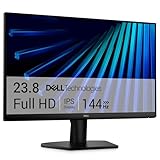
- Clear visuals. Fluid motion: A 144Hz refresh rate and 1ms MPRT deliver smooth, tear‑free motion across work, gaming, and streaming for clearer, more fluid viewing.
- Eye comfort: TÜV Rheinland 3‑star* certification reduces harmful blue light while preserving stunning color quality without compromise. *TÜV Rheinland 3-star eye comfort certification.
- Wide viewing angle: Get consistent views across a wide 178° /178° viewing angle.
- In-Plane Switching (IPS): See excellent color accuracy and consistency across wide viewing angles with In-plane Switching (IPS) technology.
- Ultra-thin bezels: Maximize your viewing experience with thin bezels.
6. Repeat the test without intermediate hardware
If the source normally passes through a dock, adapter, switch, capture device, or receiver, connect it directly to the monitor with the known-good cable. Keep the same resolution and refresh settings for the first comparison. A direct connection that works identifies the removed intermediary as the next item to troubleshoot.
What’s actually slowing this PC down?
Pick the symptom - the matching free tool is one click away.
7. Test another combination and record where the fault follows
Use a simple matrix: original source plus known-good cable, alternate source plus original cable, and alternate source plus known-good cable. Do not change several settings between tests. The result should point to the component that carries the failure:
- If the blackout follows one cable while sources and monitor ports work with another cable, replace that cable.
- If it follows one source or output port, update or service the source, graphics adapter, dock, or output connector.
- If every tested source and cable fails on one monitor, suspect the monitor’s input circuitry, video amplifier, video output stage, or an internal connection.
- If the monitor works with another display but not with this one, compare the selected input and the source’s output mode before concluding that the source is defective.
How to interpret the controlled-substitution results
| Test result | Most likely location of the fault | Next action |
|---|---|---|
| Known-good cable restores the picture | Original signal line or its connector | Replace the damaged or unreliable cable with one meeting the devices’ specifications |
| Another source works on the same monitor and cable | Original source output, dock, adapter, or source settings | Test the original source directly and inspect its output configuration |
| Another input on the monitor works | One monitor input or its connection | Use the working input temporarily and arrange monitor service if the failed input is required |
| Every source and cable fails on the monitor | Monitor video-input circuitry, amplifier, output stage, or internal connection | Stop swapping accessories and contact the manufacturer or a qualified repair technician |
| Blackout appears only during camera capture | Shutter operation or a camera setting | Check mechanical versus electronic shutter, flash behavior, and the model guide |
A repair reference for monitor faults lists video-input circuitry, video amplifiers, video output, and bad connections among possible causes of a persistent blank picture. Repeated cable changes therefore cannot rule out an internal failure when the symptom remains across controlled substitutions.
Also popular on Amazon

- CURVED FOR ENHANCED ENGAGEMENT: An immersive viewing experience with a curved monitor that wraps more closely around your field of vision; It creates a wider view, enhancing depth perception and minimizing peripheral distraction
- SMOOTH PERFORMANCE FOR SEAMLESS CONTENT: Stay in the action when playing games, watching videos, or working on creative projects; The 100Hz refresh rate reduces lag and motion blur so you don't miss a thing in fast-paced moments¹
- MORE GAMING POWER: Gain the edge with optimizable game settings; Color and image contrast can be adjusted to see scenes more vividly and spot enemies hiding in the dark; Game Mode adjusts any game to fill the screen so you can view every detail²
- KEEP IT EASY ON THE EYES: Care for your eyes and stay comfortable, even during long sessions; Advanced eye comfort technology certified by TÜV reduces eye strain by minimizing blue light and reducing irritating screen flicker²
- INCREASED VERSATILITY: Connect to more; Plug devices straight into your monitor for increased flexibility, making your computing environment even more convenient
When a black monitor needs service
Arrange manufacturer or professional service when the same failure remains with multiple sources and known-good cables, when the monitor menu is unstable or absent despite a lit power indicator, or when a connector is physically damaged. Do not open a powered display unless you are qualified to work on it. Displays contain hazardous voltages and stored energy even after unplugging; an external cable test is safer than removing the rear cover.
Give the technician a concise test record: the monitor model, source device, input used, whether the power LED stayed on, whether “No signal” appeared, which cables and ports were tested, and whether the fault was continuous or intermittent. This is more useful than reporting only that the screen “randomly goes black.”
Camera blackout: when it is normal
Camera blackout must be judged against the shutter mode, not against monitor troubleshooting rules. With a mechanical shutter, the camera interrupts the live view during the exposure. The viewfinder or rear screen may therefore go dark momentarily even though the camera is functioning correctly.
Also popular on Amazon

- 【INTEGRATED SPEAKERS】Whether you're at work or in the midst of an intense gaming session, our built-in speakers provide rich and seamless audio, all while keeping your desk clutter-free.
- 【EASY ON THE EYES】 Protect your eyes and enhance your comfort with Blue-Light Shift technology. This feature reduces harmful blue light emissions from your screen, helping to alleviate eye strain during long hours of use and promoting healthier viewing habits.
- 【WIDEN YOUR PERSPECTIVE】Our sleek minimal bezel design ensures undivided attention. The nearly bezel-free display seamlessly connects in a dual monitor arrangement, delivering an unobstructed view that lets you focus on more at once, completely distraction-free.
Sony’s ILCE-1M2 α1II Help Guide states: “During blackout-free shooting, the screen does not black out or drop frames and you can keep looking at the subject through the viewfinder or monitor while shooting images.” The same guide’s shutter table distinguishes mechanical-shutter operation, which has blackout, from supported electronic-shutter continuous shooting, which can be blackout-free. For that model, the table lists electronic-shutter continuous shooting up to 1/32000 second; that is a model specification, not a general blackout rate for all cameras.
Check these camera variables
- Shutter type: Change only between the mechanical and electronic options documented for your model, then compare the viewfinder behavior.
- Drive mode: Blackout-free operation may be limited to particular continuous-shooting modes rather than every single-shot setting.
- Flash use: Flash synchronization and exposure timing can alter what the viewfinder shows. Consult the camera’s guide for the selected flash and shutter combination.
- Model-specific limits: Do not assume that a blackout-free label on one camera applies to another model or to every frame rate.
If the screen remains dark between shots, shows an error, or fails independently of shutter operation, treat that as a camera fault and follow the camera maker’s support procedure. A brief, repeatable blackout that coincides exactly with mechanical-shutter actuation is fundamentally different from a monitor losing its signal.
Choosing a replacement HDMI cable without creating a new fault
The useful replacement is not simply the longest or cheapest cable. Confirm all four points before buying:
- Connector: Full-size HDMI, Mini HDMI, Micro HDMI, DisplayPort, or VGA must match the source and display. An adapter adds another possible contact failure.
- Length: Use the shortest practical run that reaches without tension. Excess length can make routing harder and can increase strain at the plugs.
- Resolution: The cable must support the resolution the source is actually configured to output.
- Refresh rate: High-refresh computer modes require a cable and ports rated for that mode; a picture that works at a lower setting may still fail at the intended refresh rate.
Keep the original cable until the test is complete. If the known-good cable fixes the blackout, label the failed one and remove it from service rather than returning it to the setup where it can create an intermittent fault later.
Fast decision path
- Is the power LED on? If no, troubleshoot power and startup. If yes, continue.
- Can the monitor menu appear? If no, suspect the monitor itself. If yes, continue.
- Does it say “No signal”? Select the connected input and reseat both ends of the cable.
- Does another source work? If yes, investigate the original source, dock, or output. If no, continue.
- Does a known-good cable work? If yes, replace the original cable. If no, suspect the monitor input path or source hardware.
- Does blackout occur only during camera capture? Check shutter mode and camera settings before calling it a defect.
This sequence isolates the inexpensive, reversible causes first while preserving a clear boundary for professional service. It also prevents a normal mechanical-shutter blackout from being “fixed” by replacing a perfectly good display cable.






Say something about this film