The Tool Desk
Outbyte Driver Updater FREEFix the driver behind crashes, sound loss and screen glitchesFind Drivers →Outbyte PC Repair FREERepair Windows errors before they cause bigger problemsFix Now →Some links on this page are affiliate links: if you buy through them we may earn a commission, at no extra cost to you.
Audubon Great Lakes, Indiana’s Department of Natural Resources (DNR), Indiana Audubon Society and the University of Illinois Urbana-Champaign (UIUC) tested two low-disturbance monitoring tools—autonomous recording units (ARUs) and environmental DNA (eDNA)—alongside Indiana’s established volunteer surveys. Field collection finished in June 2024 at 20 locations across nine wetlands. The announcement published on August 26, 2024, said analysis was still forthcoming, so it does not show whether either new method outperformed volunteers, improved population estimates or changed management decisions.
What the Indiana project set out to test
The study addressed a practical problem: many marsh birds are easiest to detect when people are in the field before sunrise, yet the birds themselves often remain hidden in dense vegetation. The partners compared three ways of finding them:
- Autonomous recording units: small, battery-powered, waterproof devices that record bird calls automatically.
- Environmental DNA metabarcoding: laboratory analysis of wetland water for DNA that birds leave behind.
- Volunteer-led surveys: trained observers who visit wetlands, listen and watch for birds, and use targeted playback of focal-species calls.
The project ran for two years. Researchers chose 20 monitoring locations in nine Indiana wetlands. Some sites already supported significant marsh-bird populations; others had restoration potential. Habitat information was collected at every site so that detections could eventually be related to the features birds use.
Recommended Free Tools
Audubon described the work as the first study of its kind to compare ARUs and eDNA with traditional volunteer surveys in this marsh-bird program. That description concerns the study design, not a published performance result.
Popular on Amazon

- 【PCM Recording and Automatic Noise Reduction】:This digital voice recorder is equipped with advanced dual noise reduction microphones and supports 1536 kbps PCM HD audio recording, ensuring crystal-clear sound capture in any environment. Recorder device with automatic noise reduction and voice-activated recording, the recorder only picks up the sound when there’s speech, reducing background noise,Excellent sound quality can meet the needs of students, journalists, music lovers and more people
- 【136GB Memory and Long Battery Life】Voice Recorder with Playback with 8GB built-in storage and includes a complimentary 128GB TF card, this digital voice recorder can hold up to 9775 hours of recordings in MP3 format or WAV format;Recorder for lectures with a built-in 1100mAh rechargeable lithium battery, this voice recorder can continuously record for up to 68 hours on a single charge, making it perfect for back-to-back meetings, interviews, or extended classroom sessions
- 【One Click Record and Save】: Our voice recorder supports one click recording and saving functions. Even when the product is in a powered-off state, simply push up the side recording button to immediately enter recording mode, and push down the recording button to save the recording. This allows for capturing as much information as possible.Easily transfer your recordings to your computer using the USB-C connection, allowing for fast and secure file management
- 【Easy-to-Use】This portable voice recorder is designed with a simple, user-friendly interface featuring a large, easy-to-read LCD screen. The voice-activated recording (VOR) feature makes hands-free operation a breeze. With one-touch recording, users can start or stop recording instantly, even during busy moments. A-B repeat function and password protection ensure that important segments are easily accessible and secure
- 【Portable and Durable Design】Designed with portability in mind, this lightweight screen recorder fits comfortably in your pocket or bag, weighing only 97 grams. Its sleek and durable metal casing ensures longevity and protection from everyday wear and tear. Whether you’re traveling, in the office, or attending a lecture, this compact recorder is always ready to capture clear, high-quality audio
Why secretive marsh birds need specialized monitoring
Marsh birds can call from deep cover, move through reeds without being seen, or remain silent while a surveyor is present. Stephanie Beilke, Senior Manager, Conservation Science at Audubon Great Lakes, explained the traditional difficulty this way: “Marsh birds prefer to stay hidden. Historically, we’ve only been able to monitor them by visiting their habitat, playing a recording of their call, and waiting to see if they call back,”
Indiana’s statewide marsh-bird monitoring program, which Audubon Great Lakes helped launch in 2018, depended on trained volunteer community scientists at the time of the announcement. Volunteers coordinated by Indiana Audubon and Indiana DNR went into the field before sunrise, watched and listened, and used targeted audio playback to elicit responses from focal species.
Audubon reported that marsh-bird populations have declined as healthy wetlands have been lost. Its 2024 announcement also said Indiana ranked fourth among states for wetland loss and that six wetland-dependent marsh-bird species were state-endangered, including Virginia Rail and King Rail. The announcement did not provide the underlying dataset or the year of the ranking, so those figures should be read as claims reported by Audubon rather than independently verified current statistics.
What’s actually slowing this PC down?
Pick the symptom - the matching free tool is one click away.
How the autonomous recording units worked
Scheduled listening instead of continuous staffing
The ARUs were designed to collect sound without a person standing beside the microphone for every survey. Each unit was small, battery-powered and waterproof. Researchers scheduled the devices to operate from 30 minutes before sunrise until three hours after sunrise, the period when marsh birds are most active according to the project description.
This schedule concentrates storage and analysis on the most useful part of the day rather than recording around the clock. It also gives the project a repeatable window: units at different wetlands can be programmed to cover the same morning period, while volunteers and staff are free to work at other locations.
Also popular on Amazon
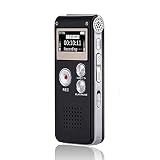
- 【Simple Operation】- switch on your voice recorder, one button for recording. press the "REC", start the recording, press "STOP", end the recording, press “PLAY”, listen what you just recorded, and then Press A-B, select your important section to repeat. Easy to playback with inner powerful speaker, support external sound speaker playback, let you enjoy superior recording quality.
- 【Clear Voice Record】- high quality recording with noise redution, you will get super clear recorded voice, the sensitive microphone help you to catch speaker's words in an interview, lectures, meetings.
- 【Voice Activated Recording】- automatic voice reduction function, it starts recording when sound is detected or turn to standby state, saving recording time and reduce power consumption.
- 【 Player Function】- this voice recorder can be used as an music player, you could enjoy the music after your tired study, meeting and so on. Also can function as a detachable data storage device.you can take along your favorite pictures and documents whenever you go.Simply cut-and-paste or drag-and -drop files to or from it via USB connection, the player will appear as a removeable drive in Windows.
- 【High quality and long time】 uses DSP noise reduction technology to filter out environmental noise, has high-quality recording, 【1536kbps】to restore the real scene. It can continuously record for more than 30 hours and play for 7 hours.
Turning recordings into possible species detections
After the units were retrieved, researchers processed the recordings with Cornell’s BirdNET research platform to identify bird sounds. The announcement did not name a recorder manufacturer or model, and it did not publish the number of hours recorded, the number of files processed, or the platform’s error rate in this study.
An audio detection is evidence that a recognizable call was recorded at a particular place and time. It is not automatically a population estimate. A silent recording may mean that a species was absent, quiet, outside the microphone’s effective range, masked by other sounds, or missed by the identification process. The eventual analysis would need to account for those possibilities.
What eDNA adds to bird monitoring
DNA left in wetland water
Environmental DNA sampling looks for genetic material that animals leave in their surroundings. In this project, researchers collected wetland water and analyzed it for bird DNA released through feathers, shed skin cells and other biological material. Metabarcoding can examine a sample for genetic signatures from multiple species rather than requiring a visible encounter with one bird.
UIUC Associate Research Scientist of Ornithology Anastasia Rahlin described the attraction of the method: “eDNA allows us to detect the presence of sensitive species of greatest conservation need in a very passive way. We can now detect these species without direct physical, behavioral or habitat disturbance.”
What a water sample can—and cannot—establish
For this study, eDNA was presented as a way to detect species presence from an environmental sample. The announcement did not report a detection rate, false-positive rate, false-negative rate or other accuracy measure for Indiana’s wetlands. It also did not say how long DNA remains detectable, how results vary with water movement, or whether a positive sample can be converted into a number of birds.
Also popular on Amazon

- CREATE CONTENT WITH BETTER SOUND – Capture clear stereo audio for videos, reels, tutorials, voiceovers, behind-the-scenes clips, and other content that needs more polished sound than your camera or phone alone.
- READY WHEN INSPIRATION HITS – Record songwriting sessions, rehearsals, acoustic performances, lessons, jam sessions, and live music with detailed sound that is easy to capture in the moment.
- CLEAR VOICES FOR PODCASTS AND INTERVIEWS – Record conversations, podcast episodes, lectures, meetings, notes, and interviews with natural stereo sound that helps voices come through clearly.
- CAPTURE REAL-WORLD SOUND – Record ambience, nature, room tone, sound effects, travel audio, and everyday environments for video, music production, creative projects, and documentation.
- PLUG IN FOR STREAMING AND CALLS – Connect via USB-C and use it as a microphone for livestreams, remote meetings, video calls, voiceovers, podcasts, and desktop or mobile recording.
Collecting water still requires people to visit a wetland, but the detection itself does not require observers to flush birds, watch a nest or play a call. That distinction matters for sensitive species and for habitats where repeated human presence could alter behavior.
How the three approaches differ
| Approach | Primary evidence | Person present during each detection? | Details reported for the Indiana project | What the announcement establishes |
|---|---|---|---|---|
| Autonomous recording units | Recorded songs and calls | No; units operate after deployment | Waterproof, battery-powered devices scheduled from 30 minutes before sunrise to three hours after sunrise; recordings processed with BirdNET | A repeatable acoustic record that can indicate a calling species at a time and place; no Indiana accuracy or comparative result was published |
| eDNA metabarcoding | DNA in wetland water from feathers, shed cells and other material | No for the detection itself; people must collect samples | Water samples collected at project locations and analyzed for bird DNA | Potential presence information without direct physical, behavioral or habitat disturbance; no Indiana detection or error rate was reported |
| Volunteer playback surveys | Direct observation and listening, including responses to targeted calls | Yes; trained volunteers visit before sunrise | Statewide program supported by Indiana Audubon and Indiana DNR; volunteers look and listen and use focal-species playback | Field observations made by trained community scientists; Audubon calls volunteers the program’s backbone |
The source gives no comparable costs, staffing totals, sensitivity estimates or error rates. It therefore cannot support ranking one method as the most effective.
Where and when the fieldwork happened
Across the two-year project, the team deployed ARUs and collected eDNA water samples at all 20 locations in the nine selected wetlands. Site selection combined two needs: documenting places with substantial marsh-bird populations and examining wetlands that could benefit from restoration.
Field data collection across Indiana was complete in June 2024, and the announcement said ARUs had been retrieved from every monitoring point. Habitat data collection was also complete. The next planned step was analysis beginning in the winter after the August 26, 2024, publication.
The project was funded through the federal State Wildlife Grant Program, administered by Indiana DNR and the U.S. Fish and Wildlife Service.
Also popular on Amazon

- Uncomparable Recording Quality: After the new upgrade, the EVISTR L357 digital voice recorder adopts a dynamic noise reduction microphone and PCM intelligent noise reduction technology to collect sound in 360°; adjustable 7 levels of recording gain to capture farther and lower sound; present you 1536kbps crystal clear high-quality stereo sound. It is a practical gift for students, teachers, businessmen, writers, and anyone who likes to record
- Memory Doubled-64GB High Capacity: L357 small audio recorder (3.86x1.2x0.47 inch) can store up to 4660 hours of recording files (32Kbps); configured with 500mAh battery and Type-C USB cable, faster charging, 3 hours fully charged for 32 hours of continuous recording and 35 hours of continuous playback. Made of metal, beautifully crafted, and durable, it is a professional recording device that is constantly upgraded and can meet your needs for long-term high-quality and high-efficiency recording
- Easy to Operate & Powerful: EVISTR digital recorder just 2 buttons: press rec to start recording immediately; press save button to save recording. You can choose the recording format as wav/mp3; EVISTR voice recorder with playback support A-B repeat, playback, rewind, and variable speed playback; can set to record in time slots and auto-record to customize your recording schedule. The optimized menu interface is clearer and provides you with more intuitive and efficient navigation of functions
- Voice Activated Recorder: Enable AVR voice activation function, adjust 7 levels of voice control sensitivity, recorder for lectures only when the teacher is talking, capture human voice clearly and accurately, and won't let you miss any important details of the conversation. And the recorder will stop recording when no one is talking, reducing silent segments, saving your playback time and disk space, widely used in classrooms, meetings, interviews, lectures, and other occasions
- Simple and Efficient File Management: The recording files are named by the specific time when you start recording, which is easy for you to identify and find quickly, and the numbers of the file names correspond to the year, month, day, hour, minute and second in order (YYYY-MM-DD-HH-MM-SS). You can delete all recordings with one click or transfer the recording files to your computer with the included Type-C cable. (Windows and Mac compatible)
Why the comparison matters for volunteers and agencies
ARUs and eDNA were proposed as ways to fill gaps when volunteers and agency staff cannot be in every wetland at the right time. An ARU can remain in place through multiple mornings without asking a person to travel before dawn for each recording session. A water sample can provide another line of evidence when a bird is present but unseen or silent during a visit.
Neither proposal was presented as a replacement for people. Stephanie Beilke said, “Our dedicated group of volunteer monitors are the backbone of our Marsh Bird monitoring program,” and Indiana DNR State Ornithologist Allisyn-Marie Gillet said the partnership would help maintain the long-term program. Volunteers also supply context that an automated file or laboratory result cannot provide by itself: notes about water levels, vegetation, weather, behavior and what was actually observed in the field.
A combined design can make the evidence more useful. For example, a volunteer observation can help verify an acoustic identification; an ARU can reveal calls outside a person’s short visit; and habitat measurements can show whether detections cluster in wetlands with particular vegetation or water conditions. The Indiana study was organized to examine those relationships, but the announcement did not publish the analysis.
Independent reader supportYour contribution helps us test, update, and keep practical guides available for everyone.What the habitat measurements are intended to show
Researchers recorded habitat data at every site, with the goal of identifying characteristics marsh birds favor. Those measurements are expected to support management recommendations, including recommendations relevant to King Rail. Gillet said the data would inform habitat-restoration efforts by Indiana DNR and other Indiana land managers.
Free tools Windows power users keep installed
One-click scans. No signup required.
Habitat information can put a detection in context. A call, DNA signal or volunteer sighting tells researchers that evidence of a species occurred at a location; habitat measurements can help explain why that location is suitable and which conditions might be protected or restored. The announcement did not list the individual habitat variables, assign a preference to any one feature, or report a restoration prescription.
Also popular on Amazon

- 【One Click Record and Save】This voice recorder features instant one-click recording and saving. Even when powered off, simply push up the side button to start recording and push down to save. Designed with ergonomic controls, this digital voice recorder ensures fast operation so you never miss important moments—perfect as a voice recorder with playback, mini recorder device, or portable recorder for interviews, lectures, and field work
- 【64GB Memory & High-Capacity Battery】Equipped with a built-in 64GB TF card, this recorder device stores up to 4,600 hours of recordings. Its 600mAh battery supports up to 48 hours of continuous use (MP3 at 32kbps). Ideal for students, journalists, and professionals, this tape recorder portable mini excels in lectures, meetings, interviews, and even for paranormal sound research
- 【PCM Recording & Automatic Noise Reduction】Capture audio in MP3 and WAV format with up to 1536kbps PCM quality. Advanced noise reduction minimizes background sounds, delivering crystal-clear playback on headphones or professional gear. This makes it an excellent audio recorder, digital audio recorder, or sound recorder for music creation, interviews, and high-detail sound archiving
- 【Voice-Activated Recorder, Big Screen & Password Protection】The voice activated recorder automatically starts/stops when sound reaches your set level, helping save storage and battery. A large 1.44-inch screen offers easy navigation, while password protection safeguards your files—perfect for storing personal memos and important audio files when using it as a dictaphone voice recorder or recording device for professional use
- 【Multi-Function Recorder】This versatile digital recorder supports internal and external recording, file segmentation, scheduled recording, A-B loop playback, MP3 music, and bookmarking. Functions as a USB storage drive and MP3 player with quick transfer via USB cable. Great as a pocket recorder, lecture recorder, mini voice recorder, or recording devices for travel and daily use
What was known—and not known—when the announcement appeared
Established by the August 2024 announcement
- The four-part partnership involved Audubon Great Lakes, Indiana DNR, Indiana Audubon Society and UIUC.
- Fieldwork covered 20 locations across nine wetlands over two years.
- ARUs were retrieved from all monitoring points after collection ended in June 2024.
- Recordings were processed with BirdNET, and water samples were analyzed for bird DNA.
- Habitat data collection was complete, with analysis expected to begin that winter.
Not established by that announcement
- Which method detected more species or produced more reliable detections.
- Whether ARUs or eDNA outperformed volunteers.
- Any change to population estimates, trend estimates or endangered-species status.
- Detection accuracy, false-positive or false-negative rates, costs, staffing requirements or recorder specifications.
- Final habitat associations or completed restoration recommendations.
Those limits are important because a study can complete sampling without yet having a validated comparison. The announcement described the evidence being gathered, not the final result of the test.
How to interpret the methods in practice
Use ARUs when time and coverage are the main constraint
ARUs are most useful when managers need standardized listening windows across multiple wetlands or want to monitor without keeping a surveyor on site. Their weaknesses are equally practical: batteries, weather, microphone placement, background noise and automated identification all affect what can be recovered from a recording. Indiana’s announcement did not quantify those effects.
Use eDNA when a nonintrusive presence signal is valuable
eDNA can be attractive for species that are difficult to see or that may be disturbed by repeated playback and close approach. Results depend on careful sampling, laboratory controls and interpretation of how DNA moves through water. The Indiana project announcement established the sampling concept but supplied no performance statistics.
Quick wins for a faster PC:
Fix the driver behind crashes, sound loss and screen glitchesFind Drivers →Clear out junk files and repair common Windows errorsFree Scan →Keep volunteers in the monitoring system
Volunteer surveys provide direct, place-based observations and a trained human assessment of conditions that sensors and laboratory assays may miss. They also sustain a statewide monitoring network. The project’s premise was complementary coverage: automated and molecular tools could fill gaps while volunteers remain central to the program.
What happens next for Indiana marsh-bird conservation
The next scientific task after the 2024 collection was to compare the three evidence streams and relate them to habitat measurements. A useful evaluation would need to report how often each method detected the same species, where methods disagreed, how uncertain each detection was, and whether any approach improves trend monitoring over repeated seasons. None of those comparative findings appears in the announcement.
For land managers, the practical payoff would be evidence-based guidance on which wetlands to protect, which habitat features to restore and how to allocate future monitoring effort. For volunteers, the outcome could be a clearer role alongside sensors and laboratory testing rather than a substitution for field participation. Until final results are published, the defensible conclusion is that Indiana completed a broad, deliberately paired data-collection effort—not that a new technology has already proved superior.






Say something about this film