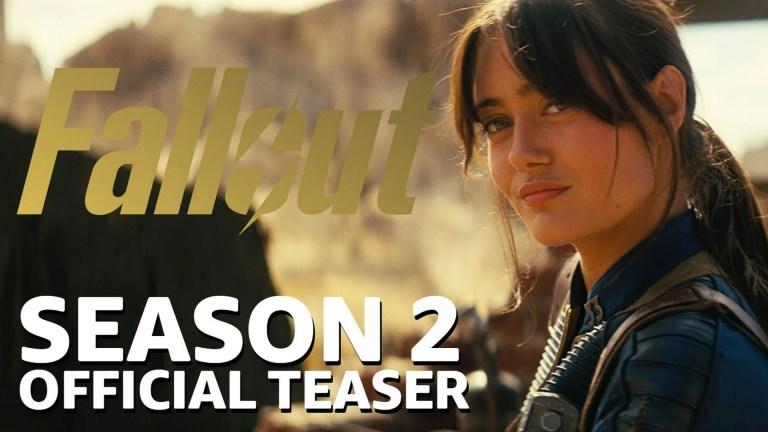
Short answer: the Fallout television series is canon to the same continuity as the games. It is not a remake of Fallout: New Vegas or an adaptation of one game’s campaign. Instead, it tells an original story in the established universe, with its main present-day events beginning in 2296—after Fallout 76, Fallout, Fallout 2, Fallout 3, Fallout: New Vegas, and Fallout 4.
Season 1 returns to the games’ West Coast roots around Los Angeles and the New California Republic. Season 2 then creates the clearest direct connection yet by moving into the Mojave and New Vegas, roughly fifteen years after the events of Fallout: New Vegas. You do not need to play the games to understand the show, but the games—especially New Vegas—provide important historical and political context.
Spoiler warning: this guide discusses the show’s timeline, Shady Sands, the NCR, Season 2’s setting, and the unresolved question of which New Vegas ending remains canon.
The official Fallout timeline at a glance
The easiest way to place the show is chronologically. The games establish different regions and periods of post-nuclear history, while the television series continues that history in 2296.
Windows Errors? Fix Them Before They Spread
Repair common Windows errors and clear accumulated junk for a smoother, more stable PC - no reinstall needed.Free scan · no reinstallOutdated Drivers Are Slowing You Down
One free scan finds every outdated or missing driver and matches the right update for your exact hardware.Free scan · exact hardware match| Year | Entry | Primary setting | Connection to the show |
|---|---|---|---|
| 2077 | The Great War | Worldwide | The nuclear exchange that creates the post-apocalyptic world, vault system, and pre-war mythology seen throughout the series. |
| 2102 onward | Fallout 76 | Appalachia, including West Virginia | The earliest major game-era setting, showing the first generation of survivors and rebuilding efforts after the bombs. |
| 2161 | Fallout | Southern California | Introduces the original West Coast setting, major factions, creatures, and themes that remain important to the show. |
| 2241 | Fallout 2 | Northern California | Expands the political history of the West Coast and the New California Republic’s broader background. |
| 2277 | Fallout 3 | Capital Wasteland and Washington, D.C. | A separate East Coast story, but still part of the same world and continuity. Its vault, Brotherhood, and post-war concepts remain part of Fallout’s shared history. |
| 2281 | Fallout: New Vegas | Mojave Wasteland | The most important game for understanding Season 2’s Mojave setting, factions, landmarks, and political tensions. |
| 2287 | Fallout 4 | Commonwealth and Boston | The latest game in Bethesda’s published mainline chronology before the television story. |
| 2296 | Fallout Season 1 | Greater Los Angeles and the surrounding wasteland | The show’s primary present-day story takes place after the major game narratives listed above. |
| 2296 and later | Fallout Season 2 | Mojave Wasteland and New Vegas | The television continuity revisits the region made famous by Fallout: New Vegas. |
This is a historical order, not necessarily the best order for a new player. The older games have very different interfaces and systems, and the show was designed to work as an entry point without requiring prior game knowledge.
#1 Best Overall

- Fallout 4 - Gaming Poster (Vault-Tec / Vault Boy - Surface - Never, Vault - Forever) - Unframed
- Vault Boy
- LARGE 24" x 36" WALL SIZE UNFRAMED POSTER: Eye-catching design fills your wall with inspiration and color. Perfect for creating a bold visual centerpiece on any wall
- VIBRANT, HIGH-RESOLUTION PRINT: Printed on high-quality paper with bold colors and sharp detail that pop in any lighting - creating a professional, premium look.
- READY TO HANG OR FRAME: Fits standard 24" x 36" frames, making display quick and easy.
Is the Fallout show really canon?
Yes. Bethesda has stated that the events of the television series are canon to the Fallout universe. The production was not treated as a separate film or television continuity that borrowed the franchise’s name and imagery. It was developed as another story within the established world.
That does not mean the show adapts one particular game or confirms every possible outcome a player can create. Fallout games are built around player choice: protagonists can support different factions, resolve conflicts in different ways, and leave regions in competing political states. The show preserves that role-playing structure by establishing shared history while leaving some individual campaign outcomes deliberately flexible.
In practical terms, the show and games share the same broad timeline, world history, factions, technologies, creatures, and post-war consequences. The television series adds new characters and events rather than replacing the player characters from the games.
Free tools Windows power users keep installed
One-click scans. No signup required.
Why the show is not an adaptation of Fallout: New Vegas
The presence of the Mojave, New Vegas, the NCR, Mr. House, and other familiar elements does not make the series a television version of Fallout: New Vegas. The show’s principal characters—Lucy MacLean, Maximus, and Cooper Howard, also known as the Ghoul—are original television protagonists. They are not versions of the player character or substitutes for the protagonists of any particular game.
This choice solves a major adaptation problem. A game such as New Vegas can allow the player to choose between the NCR, Caesar’s Legion, Mr. House, and an independent route led through Yes Man. A television series needs its own fixed cast and narrative, but it does not need to declare that every viewer’s game ended the same way. The show can inherit the consequences of the Mojave’s history without turning one player’s campaign into the only valid version.
Todd Howard has described the preferred approach as an original story in the established Fallout world. That is why the correct description is canon continuation, not remake, retelling, or direct quest adaptation.
How Season 1 connects to the games
Season 1 uses the franchise’s established institutions and vocabulary rather than translating a specific game mission to the screen. Its world includes the familiar logic of vault experiments, Vault-Tec’s pre-war influence, ghouls, power armor, the Brotherhood of Steel, the Enclave, the New California Republic, super mutants, deathclaws, and the wider corporate and political history of the wasteland.
Quick wins for a faster PC:
Scan for outdated or missing drivers - takes under a minuteDriver Scan →Repair Windows errors before they cause bigger problemsFix Now →Fix the driver behind crashes, sound loss and screen glitchesFind Drivers →Those are not merely visual references. They connect the show to a setting that the games have developed over decades. The show’s vault stories fit into the franchise’s long-running examination of social experiments and controlled communities. The Brotherhood remains a technologically focused military organization with regional differences. Ghouls continue to occupy the uncomfortable space between human survival and the physical consequences of radiation. The NCR and its history place the series firmly in the West Coast tradition established by the first two games and expanded by New Vegas.
Rank #2

- Great wall decor or perfect gift idea!
- Poster Exactly Size:12 inch x 18 inch poster
- High quality poster printing, quality guaranteed!
- Brand New Item.Great Collectible.
- Perfect for your home, office, or a gift
The setting matters particularly because the original Fallout, Fallout 2, and the NCR’s history are rooted in California. Season 1 therefore returns to one of the franchise’s foundational regions instead of using only generic post-apocalyptic imagery. A viewer who has played the earlier West Coast games will recognize a long historical shadow behind the show, but the television plot remains understandable on its own.
The Shady Sands and NCR continuity question
Season 1 raises one of the most significant continuity questions by depicting the destruction and decline of Shady Sands. That is important because Fallout: New Vegas, set in 2281, presents Shady Sands and the New California Republic as major West Coast institutions.
The show does not establish that New Vegas has been erased from continuity. The simplest explanation is chronological: the game takes place in 2281, while the show’s present-day story takes place in 2296. Fifteen years separate those settings, leaving room for major political and military events between them.
Recommended Free Tools
What remains unresolved is the complete sequence of events linking the Mojave, the fall of Shady Sands, and the NCR’s later condition. The show establishes that the West Coast has suffered a profound upheaval, but it has not explained every political consequence in a definitive historical account. The exact chain of events is part of the continuing mystery rather than evidence of two incompatible timelines.
This distinction is important. “Shady Sands changes or falls before the television story” is a canon fact established by the show. “The show invalidates everything that happened in New Vegas” is not. Bethesda’s post-show material continues to treat the NCR and New Vegas as relevant background.
Season 2’s direct connection to New Vegas
Season 2 is the strongest bridge between the television series and a particular game. The story moves into the Mojave Wasteland and New Vegas, the region that serves as the setting for Fallout: New Vegas. Official companion material points viewers toward the game’s NCR–Caesar’s Legion conflict, the Strip, Mr. House, Yes Man, Securitrons, and the Mojave’s distinctive creatures as useful background.
For viewers wanting the closest game context, Fallout: New Vegas is the obvious choice. It is not required homework, and playing it will not reveal every television plot point. It does, however, explain why the Mojave is politically unstable, why the Strip matters, how the NCR and Caesar’s Legion understand the region differently, and why figures such as Mr. House and Yes Man are important to the area’s history.
The relationship can be summarized in four points:
- It is a chronological connection. The game’s 2281 setting precedes the show’s 2296 Mojave storyline by roughly fifteen years.
- It is a geographic connection. Season 2 uses the Mojave and New Vegas rather than merely mentioning them from a distance.
- It is an institutional connection. The Strip, Securitrons, Mr. House, the NCR, and Caesar’s Legion are part of the region’s established political vocabulary.
- It is not a plot requirement. Season 2 tells an original television story with its own protagonists and does not assume that every viewer has completed the game.
Prime Video’s listed regional schedule identifies Season 2 as an eight-episode season released between December 16, 2025, and February 4, 2026. Streaming catalogs and regional availability can change, so check the current local listing before you watch Fallout.
Rank #3

- This Trends Fallout 4 - Vault Life Wall Poster uses high-resolution artwork and is printed on PhotoArt Gloss Poster Paper which enhances colors with a high-quality look and feel
- High-quality art print is ready-to-frame or can be hung on the wall using poster mounts, clips, pushpins, or thumb tacks
- Officially Licensed wall poster
- Easily decorate any space to create the perfect decor for a party, bedroom, bathroom, kids room, living room, office, dorm, and more
- Perfect size for any room; poster is 22.375" x 34"
Does the show make one Fallout: New Vegas ending canon?
Not completely, based on the currently established material. New Vegas is built around competing outcomes. The player can support the NCR, Caesar’s Legion, Mr. House, or an independent New Vegas route, and the game’s ending reflects those choices.
The television continuity can show what the Mojave looks like fifteen years later without declaring every detail of one player’s campaign to be the universal answer. Bethesda’s official companion material discusses multiple New Vegas paths, including the Mr. House and Yes Man routes, rather than presenting a single uncomplicated ending as the only accepted history.
That leaves room for a later episode or official statement to establish specific facts. Until then, writers and viewers should avoid saying that the show has definitively confirmed a House victory, NCR victory, Legion victory, or independent victory unless the series clearly does so. The durable conclusion is narrower and safer: New Vegas happened in the shared continuity, its political history matters, and some player-choice details remain open.
Where Fallout 76, Fallout 3, and Fallout 4 fit
Fallout 76: the earliest major game-era setting
Fallout 76 begins in 2102, twenty-five years after the Great War, in Appalachia. It takes place far earlier than the television series and follows an earlier stage of post-war society, when rebuilding, faction formation, experimentation, and the first attempts to establish new communities are still developing.
Its relevance to the show is mainly historical and thematic. The series does not require knowledge of Appalachia to follow Lucy, Maximus, or the Ghoul, and Fallout 76 is not a direct prequel to their story. It is the best choice for readers who want to see the world closer to the bombs’ aftermath. It is also the correct chronological starting point among the major game settings.
Fallout 3: a separate East Coast story
Fallout 3 takes place in 2277 in the Capital Wasteland around Washington, D.C. Its story is geographically separate from the show’s California and Mojave narratives. That does not make it a different continuity. The Brotherhood of Steel, vault concepts, post-war institutions, and broader franchise history remain part of the same universe.
For a show viewer, Fallout 3 is most useful as a look at how the Brotherhood and wasteland societies developed on the East Coast. It is not the game to choose first if your main interest is Season 2’s New Vegas material.
What’s actually slowing this PC down?
Pick the symptom - the matching free tool is one click away.
Fallout 4: the most accessible modern introduction
Fallout 4 is set in 2287 in the Commonwealth around Boston, nine years before the television story’s 2296 present. It is not a direct narrative prequel, but it is an especially useful modern introduction to vault experimentation, settlements, power armor, ghouls, Brotherhood conflict, and the first-person open-world format associated with Bethesda’s later games.
Rank #4

- This Trends Fallout 4 - Nuka Cola - Zap That Thirst! Wall Poster uses high-resolution artwork and is printed on PhotoArt Gloss Poster Paper which enhances colors with a high-quality look and feel
- HIGH QUALITY ART PRINT is ready-to-frame or can be hung on the wall using poster mounts, clips, push pins, or thumb tacks
- OFFICIALLY LICENSED wall poster
- PERFECT SIZE for any room; poster is 22.375" x 34"
- EASILY DECORATE any space to create the perfect decor for a party, bedroom, bathroom, kids room, living room, office, dorm, and more
If you want a modern open-world entry rather than an exact geographic match for the show, Fallout 4 is the strongest recommendation. It gives newcomers a broad understanding of how a Bethesda-developed Fallout game works while remaining earlier than the series in the official chronology.
Independent reader supportYour contribution helps us test, update, and keep practical guides available for everyone.Which game should you play first?
There is no single best order for every reader. Choose according to whether you want direct Season 2 context, modern gameplay, or a history lesson.
| Your goal | Recommended starting point | Why |
|---|---|---|
| Understand Season 2’s Mojave setting | Fallout: New Vegas | It is the direct regional and political predecessor, with the Strip, NCR, Legion, Mr. House, Yes Man, and Securitrons. |
| Start with a modern open-world game | Fallout 4 | It is a newer, accessible introduction to vaults, power armor, settlements, ghouls, and the Brotherhood. |
| Experience the earliest major game-era setting | Fallout 76 | It begins in 2102 and shows Appalachia much closer to the Great War. |
| Follow the broad historical chronology | Fallout 76, Fallout, Fallout 2, Fallout 3, New Vegas, Fallout 4, then the show | This follows the established game dates before reaching the television era. |
| Study the franchise’s West Coast foundations | Fallout, Fallout 2, New Vegas, then the show | This emphasizes California, the NCR, and the political history most relevant to the series. |
The chronological route is historically neat but not necessarily the smoothest introduction. The first two games are older computer role-playing games with interfaces and mechanics that differ substantially from the later first-person titles. A practical route for most viewers is to play New Vegas first if Season 2 is the priority, or Fallout 4 first if modern presentation matters more.
What is confirmed—and what remains open?
Confirmed
- The television series is canon within the Fallout continuity.
- It is an original story, not a retelling of an existing game campaign.
- The main present-day events begin in 2296.
- Fallout 76, Fallout, Fallout 2, Fallout 3, Fallout: New Vegas, and Fallout 4 occur earlier in the established chronology.
- Season 1 returns to the West Coast and engages with the history of the NCR and Shady Sands.
- Season 2 moves into the Mojave and New Vegas, connecting directly with the setting and factions of Fallout: New Vegas.
Still not fully settled
- The exact canonical outcome of every player decision in New Vegas.
- The complete political and chronological chain between the events of New Vegas, the destruction of Shady Sands, and the NCR’s later condition.
- Whether future episodes or games will clarify every unresolved West Coast event.
Common timeline mistakes to avoid
- Calling the show a New Vegas remake. It shares a region and history with the game, but its characters and plot are original.
- Assuming that one game ending must explain everything. The show can preserve the importance of a game without making every player choice universally canonical.
- Treating Shady Sands as proof that New Vegas was erased. The fifteen-year gap between 2281 and 2296 allows major events to occur after the game.
- Using an older game-only timeline as evidence that the show is non-canon. A timeline published before the television series naturally cannot list later television events. Later canon statements and post-show material establish the show’s place.
- Confusing chronological order with recommended play order. Starting with Fallout 76 is historically correct, but New Vegas or Fallout 4 may be a better practical introduction.
The simplest way to understand the continuity
Think of the show as a new chapter rather than a screen version of an old one. The games establish the Great War, the vault system, regional powers, the NCR, the Brotherhood, the Mojave, and the choices that shaped each wasteland. The television series then tells a new story in that world, first in Southern California and later in the Mojave.
That structure lets both formats remain meaningful. The show has room for original characters and dramatic revelations, while the games retain their branching outcomes and player agency. The timeline is shared even when every local decision is not fixed to one universal answer.
Frequently Asked Questions
Is the Fallout TV show canon to the games?
Yes. Bethesda has confirmed that the television series is canon within the same Fallout universe. It is an original story rather than an adaptation of one game.
Do I need to play Fallout: New Vegas before watching Season 2?
No. Season 2 is designed to work as its own television story. Playing New Vegas is optional, but it provides useful context for the Mojave, New Vegas Strip, NCR, Caesar’s Legion, Mr. House, Yes Man, and Securitrons.
Do these 3 things before closing this tab:
1Repair Windows errors before they cause bigger problems2Fix the driver behind crashes, sound loss and screen glitches3Clear out junk files and repair common Windows errorsWhich Fallout: New Vegas ending is canon in the show?
No single complete ending has been definitively established by the currently available material. The show confirms that New Vegas and its history matter, while some player-choice outcomes remain flexible.
Where does Fallout Season 1 fit in the timeline?
Its principal present-day story takes place in 2296, after Fallout 76, Fallout, Fallout 2, Fallout 3, Fallout: New Vegas, and Fallout 4. Its West Coast setting also connects it to the original games and the NCR’s history.
The Bottom Line
Bottom line: the Fallout show is a canon continuation of the games, set primarily in 2296. Season 1 builds on the West Coast history of Fallout, Fallout 2, and the NCR, while Season 2 is the closest television connection to Fallout: New Vegas. Play New Vegas for the strongest Season 2 context, choose Fallout 4 for the most approachable modern introduction, and do not assume that the series has selected one definitive ending for every player’s Mojave campaign.
Quick Recap
Product prices and availability are accurate as of the date/time indicated and are subject to change. Any price and availability information displayed on Amazon at the time of purchase will apply.
The Tool Desk
Outbyte Driver Updater FREEScan for outdated or missing drivers - takes under a minuteDriver Scan →Outbyte PC Repair FREEClear out junk files and repair common Windows errorsFree Scan →