Recommended Free Tools
Some links on this page are affiliate links: if you buy through them we may earn a commission, at no extra cost to you.
Eric Melrose “Winkle” Brown (1919–2016) was a Royal Navy Fleet Air Arm pilot and test pilot whose career joined wartime naval flying, dangerous experimental work and the systematic evaluation of captured German aircraft. His most clearly documented first came on 3 December 1945, when he made the first jet aircraft carrier landing and take-off aboard HMS Ocean in a de Havilland Sea Vampire, registration LZ551/G. Guinness World Records and the Royal Navy credit him with flying 487 aircraft types.
Those figures explain why Brown is remembered as Britain’s most extraordinary pilot, but they do not tell the whole story. His importance lies in the combination of breadth, carrier experience, test-pilot judgment and the records he left behind. The totals also need careful wording: authoritative accounts count different kinds of carrier movement, so a single unsourced “carrier record” can be misleading.



Who was Eric “Winkle” Brown?
Brown joined the Fleet Air Arm in 1939, at the beginning of the Second World War, and remained a naval aviator until retiring from the Royal Navy in 1970. His service covered operational flying, test work and the assessment of aircraft that Britain had captured from Germany. That combination put him in cockpits ranging from familiar naval machines to unfamiliar experimental and enemy designs.
PC Slower Than It Used to Be?
A free scan shows the junk files, broken settings and background clutter dragging Windows down - then fixes them in one click.Free scan · Windows 10 & 11Crashes, No Sound, or Screen Glitches?
Random freezes, missing sound and display glitches usually trace back to one bad driver. Find and replace yours safely.Free scan · under a minuteA Fleet Air Arm pilot had to understand more than how an aircraft behaved in ordinary flight. Carrier operations demanded precise approaches, controlled deck landings, rapid decisions around arresting gear and catapults, and the ability to judge an aircraft’s limits while the ship moved beneath it. Brown’s later test work added another layer: he had to discover what a new or captured aircraft could do without confusing a machine’s characteristics with a pilot’s assumptions.
Popular on Amazon

- Used Book in Good Condition
The Royal Navy’s 2016 tribute described him as one of the most accomplished British aviators in history. Rear Admiral Keith Blount, identified there as Rear Admiral Fleet Air Arm, called Brown “widely acknowledged as the world’s finest test pilot.” That is Blount’s assessment, not a measurable global ranking, but it captures the standing Brown held among naval aviation professionals.
Why the nickname and reputation endure
“Winkle” became inseparable from Brown’s public identity, yet the nickname is only the surface of the story. His reputation rests on a documented naval career, a record-setting jet operation and an extraordinary range of aircraft experience. Guinness and the Royal Navy both report 487 aircraft types flown, a number that places Brown’s achievement in a different category from the more familiar record of hours flown or combat victories.
“Aircraft types” means the count refers to distinct designs or variants recorded in his flying career, not 487 individual airframes and not necessarily 487 separate production models in the same technical sense. The figure is best presented as the count used by Guinness World Records and the Royal Navy, rather than expanded into a claim about every aircraft he ever touched.
What’s actually slowing this PC down?
Pick the symptom - the matching free tool is one click away.
The 3 December 1945 jet-carrier first
What happened aboard HMS Ocean
On 3 December 1945, Brown flew a Sea Vampire from HMS Ocean in the operation recognized as the first jet aircraft landing on an aircraft carrier. Guinness World Records identifies him as the first man to land and take off a jet aircraft from a carrier; the Royal Navy gives the same date, ship and aircraft. Guinness records the Sea Vampire’s registration as LZ551/G.
The achievement was significant because a jet’s speed, acceleration, approach characteristics and fuel demands differed from those of the propeller aircraft then used at sea. A carrier landing leaves little room to correct a poor approach, and the deck is a moving, confined landing surface rather than a long runway. Demonstrating that a jet could be brought aboard and launched again supplied practical evidence for the future of naval aviation.
Also popular on Amazon
Why the event mattered beyond the record
The flight was not simply a publicity stunt. It tested whether a jet could fit into the operational cycle of a carrier: approach, engage the arresting system, stop safely, prepare for launch and depart. Brown’s work helped make the idea of jet-powered carrier aviation credible at a time when navies were deciding how quickly to move beyond piston-engine aircraft.
Brown later summarized the danger of experimental flying in stark terms: “It was like playing Russian roulette and test pilots were routinely killed.” The Royal Navy reproduced that statement in its tribute. It explains why the first jet landing should be understood as a high-risk test event, not merely a ceremonial first.
Quick wins for a faster PC:
Repair Windows errors before they cause bigger problemsFix Now →Fix the driver behind crashes, sound loss and screen glitchesFind Drivers →How many aircraft did Brown fly?
The answer normally given is 487 aircraft types. Both the Royal Navy and Guinness World Records use that number. It is the strongest concise answer to the question, “How many aircraft did Eric Brown fly?”
The number should not be turned into a claim that Brown flew every type in identical conditions. His logbooks covered operational, test and evaluation flying, and the aircraft came from different nations and technological eras. The significance is the breadth of designs he was able to assess, especially when combined with his carrier qualifications and test-pilot responsibilities.
| Measure | Figure | How to state it accurately |
|---|---|---|
| Aircraft types flown | 487 | Reported by the Royal Navy in 2016 and by Guinness World Records. |
| First jet carrier landing and take-off | 3 December 1945 | Sea Vampire LZ551/G aboard HMS Ocean. |
| Royal Navy combined carrier movements | 4,678 | The Royal Navy’s 2016 tribute describes this as carrier take-offs and landings combined. |
| Royal Navy separate carrier counts | 2,407 take-offs; 2,271 safe landings | Listed in a Royal Navy collection article published in 2016. |
| Guinness carrier-landing count | 2,407 landings | Guinness World Records’ figure for carrier landings. |
Why the carrier totals do not match
Three authoritative figures appear in accounts of Brown’s carrier record, and they count different things. The Royal Navy’s commemorative tribute gives 4,678 carrier take-offs and landings as a combined total. A separate Royal Navy article lists 2,407 take-offs and 2,271 safe landings. Guinness lists 2,407 carrier landings.
Also popular on Amazon
The published accounts do not explain the discrepancy, so it is not safe to subtract one number from another or present them as competing measurements of exactly the same category. The 4,678 figure is a combined movement total as that article phrases it; the 2,407 and 2,271 figures are separated into take-offs and landings; Guinness uses a landing count. A careful biography attributes each number to its source and preserves the wording.
For readers comparing records, the useful question is not “Which single number is the real one?” but “What event is being counted?” A take-off, a landing, a safe landing and a combined take-off-and-landing movement are not interchangeable labels.
Brown’s wartime and postwar test work
Fleet Air Arm service
Brown entered the Fleet Air Arm in 1939 and spent the war years in naval aviation. His work was grounded in the practical demands of operating from ships, where aircraft handling, deck procedures and weather margins could determine whether a sortie ended safely. That operational background later informed the way he approached test flying.
Captured German aircraft
After the Second World War, Brown tested captured German aircraft. Evaluating an enemy design required more than noting speed or armament. A test pilot had to determine how the aircraft responded through its flight envelope, how its systems affected handling and where its strengths and weaknesses lay compared with Allied machines. Brown’s experience made him a valuable interpreter of unfamiliar technology.
The work also broadened the historical record of aviation. Brown was not confined to one manufacturer, one nation or one engine generation. His logbooks document a pilot moving between radically different designs and turning those flights into usable technical knowledge.
Do these 3 things before closing this tab:
1Scan for outdated or missing drivers - takes under a minute2Clear out junk files and repair common Windows errors3Fix the driver behind crashes, sound loss and screen glitchesAlso popular on Amazon
What made him an exceptional test pilot?
Operational judgment
Carrier flying gave Brown a disciplined sense of approach speed, alignment, deck movement and recovery options. Those skills mattered when he tested aircraft whose handling qualities were not yet fully understood. A test pilot must identify a problem early enough to survive it and describe it clearly enough for engineers to fix it.
Range rather than a single specialty
Many famous pilots are associated with one aircraft, one war or one record. Brown’s distinction was range. The 487-type figure reflects repeated adaptation: learning a cockpit, controls, engine response and landing behavior quickly, then making a reliable judgment. The breadth is especially notable because it included naval aircraft, experimental machines and captured German designs.
Risk accepted deliberately
Brown’s “Russian roulette” description should not be read as evidence that test flying was random. The danger came from incomplete knowledge, mechanical uncertainty and the need to explore an aircraft’s limits. Professional test work reduces those risks through planning, instrumentation, staged trials and disciplined reporting, but it cannot remove them.
Independent reader supportYour contribution helps us test, update, and keep practical guides available for everyone.Brown’s influence after active flying
The Royal Navy reported that Brown was consulted on the design of Britain’s new aircraft carriers. Its 2016 account says his expertise informed the design of the Queen Elizabeth-class carriers and the F-35B Lightning II. That is the Royal Navy’s account of his influence, rather than an independently measured percentage of design decisions, but it shows that his value continued beyond the cockpit.
His practical knowledge connected early jet-carrier experiments with later carrier aviation. The technologies changed dramatically, yet the design questions remained familiar: how aircraft approach a ship, how pilots recover safely, how deck operations are arranged and how a carrier supports a demanding aircraft cycle.
Also popular on Amazon
Where Brown’s papers and medals are kept
In November 2016, the Royal Navy reported that Brown’s medals, photographs and log books had been acquired for the nation and given a home at the Fleet Air Arm Museum. Those materials matter because they preserve the working record behind the headline statistics. A logbook can show what “487 types” represents in practice; photographs and medals place the flights in their professional and historical context.
The report establishes the collection’s placement. It does not establish current museum opening hours, display status or visitor arrangements, so those details should be checked directly with the museum before planning a visit.
Brown in his own words and in memory
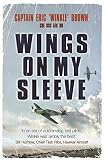
Brown’s autobiography, Wings on My Sleeve, is the most direct way to follow his career in his own voice. Hachette’s Orion catalogue lists a 2007 paperback edition with ISBN 9780753822098. The catalogue information identifies that edition; it does not establish current stock, price or differences between later editions.
The Smithsonian National Air and Space Museum, in its 2016 remembrance, quoted a phrase from Brown’s memoir in which he said he “had an aeroplane strapped to [his] rear end.” The bracketed wording is part of the museum’s reproduction. The line conveys the physical immediacy of his work: for a test pilot, the aircraft was not an abstract design but a machine attached directly to the pilot’s survival.
A concise timeline
- 1919: Eric Melrose Brown is born.
- 1939: He joins the Royal Navy’s Fleet Air Arm.
- Second World War: He serves as a naval aviator during wartime operations.
- Postwar period: He tests captured German aircraft and continues experimental aviation work.
- 3 December 1945: He makes the first jet aircraft carrier landing and take-off aboard HMS Ocean in Sea Vampire LZ551/G.
- By the end of his flying career: The Royal Navy and Guinness record 487 aircraft types flown.
- 1970: He retires from the Royal Navy.
- 2016: He dies; the Royal Navy reports that his medals, photographs and log books have been placed at the Fleet Air Arm Museum.
What “Britain’s most extraordinary pilot” really means
The label is defensible when it is tied to the evidence rather than treated as a formal ranking. Brown combined an unusually broad aircraft total with deep carrier experience, a historic jet first and decades of test-pilot work. He also left a documentary legacy in logbooks, photographs, medals and memoir.
The fairest description is therefore specific: Eric “Winkle” Brown was a Royal Navy Fleet Air Arm pilot and test pilot who flew 487 aircraft types, performed the first jet carrier landing and take-off on 3 December 1945, and helped turn dangerous new aircraft into understood, usable technology. That combination—not one isolated number—is why his career remains extraordinary.






Say something about this film