CDs were standardized at roughly 74 minutes because Sony and Philips chose a 12-centimeter disc whose physical and digital design could reliably carry that much audio—and because a complete performance of Beethoven’s Ninth Symphony provided a compelling target. The famous Beethoven explanation is part of the story, not the whole story. The original standard-capacity format is commonly cited as allowing up to about 74 minutes 33 seconds, while later CD-Rs commonly reached 80 minutes.
The short answer: Beethoven helped set the target
The compact disc was not designed with a magical 74-minute limit. Sony and Philips were developing a common digital-audio format in the late 1970s, balancing disc size, recording density, error correction, manufacturing tolerances and compatibility with production equipment.
Philips later presented the duration as a decision to fit a complete performance of Beethoven’s Ninth Symphony on one disc. That account became the format’s memorable origin story. Kees Schouhamer Immink, a Philips engineer involved in the work, disputed the idea that Beethoven alone determined the result, emphasizing instead the technical and corporate negotiations behind the specification (engineering account).
The most defensible conclusion is simple: Beethoven supplied an important target or negotiating argument; engineering choices made the target practical.
#1 Best Overall
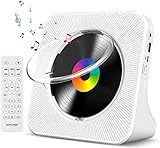
- Multi-functional CD Player: 1.Desktop CD Player, 2.Bluetooth 5.0 HiFi Speaker, 3. FM Radio, 4.TF card Music Player, 5.USB Flash Drive Player, 6. 3.5mm Audio Player. Support CD,CD-R,CD-RW,MP3,WMA.
- Dual Mode Bluetooth CD Player: It's a Bluetooth transmitter and receiver. Built-in dual Hi-Fi Bluetooth speakers, which can be connected with Bluetooth-enabled devices such as mobile phone or tablet. It will work as a wired speaker. As Bluetooth transmitter, it can be connect with your Bluetooth earphone or speaker.
- Desktop Design & Designed with a clear display screen: Desktop design with update also can as a Bluetooth transmitter, one plays all multiple functions of remote control. Easy to stand on the desk without Assembly or other support. Built-in LCD display shows track number, play time, and mode – always keep your music in view.
- Wired Speaker: Connect the CD player to other external wired devices such as mobile, tablet or laptop via 3.5mm male-to-male audio cable, it will work as a wired speaker. (Notice: Remote control does not included batteries)
- Great Gift: This Gueray CD Player is a perfect gifts for everyone. It supports remote control within 5 meters, A-B repeat, suitable for language learning, prenatal education / antenatal training, early education, FM radio broadcast.
What the Beethoven story actually says
In the popular version, Sony executive Norio Ohga wanted one disc to contain an entire Ninth Symphony. Some retellings also credit his wife, but that detail is not sufficiently established to present as fact.
Philips’ historical account says the companies examined available recordings and identified a particularly long 1951 performance conducted by Wilhelm Furtwängler, lasting approximately 74 minutes (Philips-history account). The point was practical as much as symbolic: uninterrupted playback mattered for symphonies, opera, live recordings and concept albums. Requiring a disc change in the middle of a major work would have weakened the new format’s appeal.
Beethoven’s Ninth itself does not have one fixed runtime. Performances vary with conductor, orchestra, historical period, tempo and performance practice; some last around 65 minutes and others exceed 74. The cited recording was a duration target, not a property of Beethoven’s score.
Rank #2
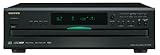
- Plays Audio CDs, MP3 CDs, CD-R/RWs
- Power requirements: AC 220–230 V, 50/60 Hz, Power consumption (standby): 4 W; Power supply Two (AA/R6) batteries (1.5 V x 2)
- Before plugging in the unit for the first time, read the following carefully: AC outlet voltages vary from country to country. Make sure that the voltage in your area meets the voltage requirements printed on the unit’s rear panel (e.g., AC 230 V, 50 Hz or AC 120 V, 60 Hz). Power supply rating AC 120 V 60 Hz (North American model); AC 230 V 50 Hz (Other than North American models)
- 6 disc CD changer and change up to 5 discs without stopping playback
- Optical and coaxial digital audio outputs; VQA (Vector Quantize Audio) Conversion Technology, Audio D/A ; Converter (DAC): 24-bit/192kHz
Why the disc became 12 centimeters
Early proposals were smaller. Philips considered a disc of about 11.5 centimeters that could hold roughly an hour, while Sony favored a larger format. Reports of the negotiations also mention proposals around 10 centimeters before the 120-millimeter standard emerged (historical overview).
Quick wins for a faster PC:
Fix the driver behind crashes, sound loss and screen glitchesFind Drivers →Clear out junk files and repair common Windows errorsFree Scan →A larger disc provided more spiral-track length and therefore more room for audio, but it also meant more material, packaging and transport space. A smaller disc would have been more compact yet offered less playing time and less margin for a long classical work. The 12-centimeter choice was consequently a Sony–Philips compromise involving market strategy, existing manufacturing interests and technical reliability—not simply a tribute to Beethoven.
How engineering turned physical space into minutes
A CD stores digital audio data, not minutes. Standard uncompressed stereo PCM audio uses 44,100 samples per second, 16 bits per sample and two channels:
Rank #3

- Plays All Formats - The Portable CD Player is easy to use and plays back your favourite Music CD, CD Audio books, Kids CD Disc, Recordable CDs CD-R, or ReWritable CDs CD-RW. NOTE: Does not support the MP3 CD's.Number of discs : 1
- Music On The Go - With the 60 Second Anti Skip protection CD Walkman. Do not let your everyday life interrupt your music! Take it with you on the bus! or While you take a walk outside (Please allow music to play for at least 60 seconds before moving for best performance)
- Connect to Your Speaker or Car - Using the INCLUDED 3.5mm Aux in cable you can easily connect your Deluxe CD Players for home to your favourite speaker, or car! Just ensure your device or Car has a 3.5mm AUX in or LINE in connection
- Long Battery Life - The discman CD player Uses 2 x AA Batteries (Batteries not included) – or You can power your portable cd players using the INCLUDED AC USB Cable (Smartphone USB wall adapter – NOT INCLUDED). The Deluxe Personal CD Player is the perfect Mini CD Player you will ever need Listen to your favourite CD Audiobooks
44,100 × 16 × 2 = 1,411,200 bits per second
The disc must also store synchronization information, modulation, track organization and error-correction data. Those systems allow a player to recover music despite dust, scratches, manufacturing variation and imperfect tracking. Usable playing time therefore depends on the amount of physical information that can be recorded and the overhead required to make it dependable.
Density versus reliability
During development, eight-to-fourteen modulation (EFM) improved recording efficiency. Engineers could have used the available density to pursue a much longer disc, but Immink’s account describes a more conservative design. Track pitch changed from approximately 1.45 to 1.6 micrometers and user-bit length from approximately 0.5 to 0.6 micrometers, trading theoretical capacity for manufacturing and playback margin (Immink’s technical history).
Do these 3 things before closing this tab:
1Repair Windows errors before they cause bigger problems2Scan for outdated or missing drivers - takes under a minute3Clear out junk files and repair common Windows errorsHigher density might have produced more minutes on the same disc, but tighter tolerances would have increased sensitivity to scratches, contamination, component variation and tracking errors. A commercially successful standard had to work across mass-produced players, not just in an ideal laboratory.
Rank #4
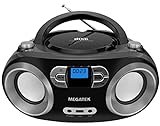
- Simple & Stylish – Large buttons, top dials, and backlit LCD for easy use. Portable, compact design fits any space—perfect for home, shop, or on-the-go music.
- Crisp Stereo Sound – Dual 3" front-firing speakers deliver clear, balanced stereo sound, with 5 EQ modes for customized audio effects.
- Top-Loading CD Player – Plays CDs, CD-R/RWs, CD-G, audiobooks, and MP3/WMA discs, with shuffle, repeat, and resume functions for flexible playback.
- FM Radio – Digital FM tuner with 30 station presets for news, talk, and music programming. Note: AM not supported.
- Bluetooth Wireless – Enjoy wireless playback from your smartphone, tablet, or laptop. Note: No transmitter function.
The U-matic connection
Early digital audio masters were stored on U-matic videotape systems. Their relevant mastering capacity was approximately 72 minutes, making the low-to-mid-70-minute range a practical production benchmark during the transition to optical audio (Wired’s format history). U-matic did not single-handedly determine the CD limit, but existing equipment helped shape what was convenient and achievable.
What “74 minutes” means in the Red Book standard
The Red Book is the Sony–Philips specification for Compact Disc Digital Audio. It defines physical and logical details such as modulation, error correction, track organization and playback requirements—not merely a duration (Yale engineering resource).
For the original 120-millimeter, standard-capacity audio CD, the commonly cited maximum is approximately 74 minutes 33 seconds. “74 minutes” is the rounded consumer description. Albums can be shorter, and a release may use space for pregaps, indexing or hidden tracks, so not every disc approaches that maximum.
What’s actually slowing this PC down?
Pick the symptom - the matching free tool is one click away.
Best Value

- 🌷【HIGH DEFINITION PICTURE QUALITY】This DVD player adopts 1080P technology, allowing you to experience higher definition picture quality and perfect sound.
- 🌷【MULTIMEDIA SUPPORTED】Direct play in formats: CD,DVD,VCD,CD-R/RW,DVD-R/+R,DVD+RW/-RW, MP3,JPEG,SVCD(Blu-ray DVD not supported);It is Region free.
- 🌷【DVD PLAYER HDMI】This region-free DVD player easily inserts and plays MP3/WMA digital audio and JPEG picture files recorded on a USB flash drive,Upgraded to support up to 128GB (FAT32 format only, NTFS/exFAT not supported.) making it a high-quality DVD player for all your entertainment needs!
- 🌷【IMPORTED MOVEMENT】This all-region DVD player with hdmi is equipped with an original imported movement with fast reading, error correction and anti-shock functions, which can load the discs in advance to enhance your movie watching experience
- 🎁【PERFECT GIFT】This dvd player for tv is made of high quality material, well made, stylish and generous appearance, it is the best gift for your relatives and friends.
Why many CDs later held 80 minutes
Later recordable media commonly offered 80 minutes, corresponding broadly to 700 MB discs rather than the approximately 650 MB associated with 74-minute media (capacity overview). Manufacturers increased usable capacity through later density and layout refinements while keeping the media playable in many existing drives and players.
An 80-minute CD-R is therefore a later capacity extension, not evidence that the original designers simply overlooked six minutes. The original specification prioritized broad manufacturing and playback margins. Compatibility with 80-minute discs depends on the player’s optical pickup, servo tolerances, firmware and how close the recorded area reaches the outer edge.
What about overburning?
Special recording methods can push beyond ordinary CD-R limits, but overburning is a compatibility gamble. A write may fail, the disc may be unreadable in some players, and recording near the outer edge can raise reliability concerns. It is not equivalent to a universally supported capacity standard.
What is established and what remains disputed?
| Question | Best-supported answer |
|---|---|
| Was Beethoven part of the story? | Yes. Philips’ official history links the playing time to fitting a complete Ninth Symphony performance, and the story was an influential public explanation. |
| Did Beethoven alone determine the capacity? | Not established. Immink’s engineering account emphasizes disc size, density, reliability, production equipment and negotiations. |
| Why 12 centimeters? | It was the physical basis for the desired capacity and part of a Sony–Philips format compromise. |
| Why approximately 74 minutes? | The result of the selected track geometry, bit density, coding, error correction and manufacturing margins, with Beethoven providing an important target or rationale. |
| Why do later discs hold 80 minutes? | Later CD-R designs used higher-capacity recording layouts; compatibility is not guaranteed for every older player. |
Why one disc mattered commercially and musically
An uninterrupted disc avoided stopping a symphony to change media, splitting an opera into awkward sections or interrupting a live performance. It also offered more continuous playing time than the roughly 20-minute-per-side expectation of many LPs, strengthening the CD’s launch as a convenient alternative (Yale engineering resource).
Still, not every Ninth Symphony fits on a 74-minute disc. A release may need an edit, a second disc, a shorter pause or an 80-minute edition when the chosen performance runs long.
Quick Recap
What to remember
- 74 minutes is a rounded description of the original standard-capacity audio CD.
- 74:33 is the commonly cited maximum for that original format, not a universal physical law.
- Beethoven’s Ninth helped supply a persuasive whole-work target, but the symphony has no single runtime.
- Engineering and negotiation—12-centimeter diameter, coding, density, error correction, production equipment and reliability—determined how that target became a consumer standard.
- 80-minute CD-Rs are later, denser media and may not work in every older player.
Product prices and availability are accurate as of the date/time indicated and are subject to change. Any price and availability information displayed on Amazon at the time of purchase will apply.