Recommended Free Tools
Some links on this page are affiliate links: if you buy through them we may earn a commission, at no extra cost to you.
No. The DNA comparison involving former priest A. Joseph Maskell did not solve Sister Catherine Ann Cesnik’s murder. Baltimore County Police said in May 2017 that Maskell was excluded as a contributor to DNA preserved from the crime scene. An exclusion means the tested profile did not match Maskell; it does not identify the person who left the DNA or prove who killed Cesnik.
Cesnik disappeared in Baltimore County on November 7, 1969, and her body was found on January 3, 1970. Public reporting through 2023 continued to describe the homicide as unsolved. The allegations surrounding Maskell help explain why investigators tested his DNA, but they must be kept separate from evidence that establishes a homicide perpetrator.



The direct answer: a non-match, not a solution
Investigators hoped a DNA comparison could clarify whether A. Joseph Maskell, a former Catholic priest who had become central to public discussion of the case, contributed biological material preserved from the crime scene. Baltimore County Police exhumed Maskell on February 28, 2017, under an order from the State’s Attorney and obtained a sample for testing. Bode Cellmark Forensics compared that profile with the preserved crime-scene DNA.
The Tool Desk
Outbyte PC Repair FREERepair Windows errors before they cause bigger problemsFix Now →Outbyte Driver Updater FREEScan for outdated or missing drivers - takes under a minuteDriver Scan →On May 17, 2017, police announced that Maskell was excluded as a contributor to the tested profile. Contemporary coverage by CBS Baltimore and The Washington Post reported that result. It did not produce a name, a new suspect or a conclusion about the killer’s identity.
Popular on Amazon
The distinction matters. A comparison can answer whether a particular person contributed to a particular tested profile. It cannot, by itself, show who else contributed the material, whether that material came from the killer, or whether a person excluded from one profile had no other possible connection to the crime. The public record does not establish whose DNA was preserved or whether it belonged to the assailant.
What happened to Sister Catherine Ann Cesnik
Cesnik was a Catholic nun and teacher in the Baltimore area. On the evening of November 7, 1969, she left her residence for a shopping trip and disappeared. Her body was discovered in Lansdowne, Maryland, on January 3, 1970. The autopsy attributed her death to a blow to the head. The dates and reported cause of death are summarized in the Baltimore County Police timeline, hosted by the Archdiocese of Baltimore: Sister Catherine Ann Cesnik case timeline.
Because the killing occurred decades before modern forensic databases and current DNA techniques, any preserved biological material became potentially important. Preservation does not guarantee that a sample is complete, uncontaminated or linked to the attacker. It only means investigators had material they could compare with a reference sample when better testing became available.
Also popular on Amazon
Why investigators tested Maskell
Maskell entered the public story through allegations made by former students in the 1990s. Several former students accused him of sexual abuse. One survivor said Maskell showed her Cesnik’s body before it was discovered. That account helped renew attention to the murder and made Maskell a person investigators and journalists scrutinized.
Those statements require precise attribution. They are accounts and allegations, not a judicial finding that Maskell killed Cesnik. The 2023 report by the Maryland Office of the Attorney General identifies Maskell among clergy accused of child sexual abuse and provides institutional context, but it does not establish that he committed Cesnik’s homicide. The report is available at the Attorney General’s report on child sexual abuse in the Archdiocese of Baltimore.
Testing Maskell’s remains was therefore a way to check a specific evidentiary proposition: did his DNA match the preserved profile? It was not a finding that he was the killer, and the eventual exclusion was not a finding that every allegation about him was false. Abuse allegations, a witness account and homicide evidence are different categories of information and should not be collapsed into one conclusion.
Also popular on Amazon
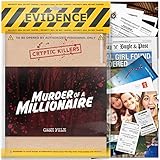
- BEST COLD CASE FILE GAME AVAILABLE - Murder of a Millionaire - A murder has been committed in the town of Redmond, UK. The body of Chloe Whittle, a millionaire lottery winner, was found with a deadly stab wound to the chest. Play detective to crack this gripping unsolved case, and bring the criminal to justice.
- 29 PIECES OF PHYSICAL EVIDENCE - Inside the case file, you'll find newspaper articles, crime scene investigation photographs, receipts, betting slips, police reports, train times, CCTV footage, phone/text records, a coroners report, a map, witness statements, photographs and more.
- SEARCH THROUGH A POLICE INBOX - In addition to the physical evidence supplied inside of the box, you'll need to access an online police officer's inbox to prove the suspects innocent or guilty - but it's not easy...you'll need to be a smart investigator to gain access!
- A GREAT NIGHT IN - With approximately 2 hours of game play (depending on your skill level) and a difficulty rating of 3.5/5 this "whodunnit" style thriller will provide a fun night in for all who choose to participate. If you can't crack the case without a secret clue, hints and answers are available online.
- MADE FOR INDIVIDUALS, COUPLES, GROUPS & PARTIES - Murder mystery lovers and CSI fans will love this challenging brain teaser. It's perfect for teens or adults looking for a fun night in at home - whether you're looking for an interactive "couples night" experience, an immersive family games night, or a fun dinner party with friends.
The 2017 DNA comparison, step by step
- Exhumation: On February 28, 2017, Baltimore County Police exhumed Maskell pursuant to a State’s Attorney order and collected a reference sample. The police timeline records that investigative step.
- Laboratory comparison: Bode Cellmark Forensics compared Maskell’s DNA profile with DNA preserved from the Cesnik crime scene.
- Reported result: On May 17, 2017, police said Maskell was excluded as a contributor to the tested profile. CBS Baltimore’s report and WBAL-TV’s coverage described the announcement.
- What followed: The announcement did not identify another contributor or resolve the murder. Later public reporting continued to classify the case as unsolved.
“Excluded” is a laboratory conclusion about the comparison performed. It means the genetic characteristics in Maskell’s reference sample were inconsistent with the profile tested from the scene. It does not mean the laboratory identified a different person. A person can be excluded from one biological profile while the source of that profile remains unknown.
What the DNA result does—and does not—prove
| Question | What the public record supports | What it does not establish |
|---|---|---|
| Did Maskell contribute to the tested DNA profile? | Police said he was excluded as a contributor. | It does not establish that he had no other connection to the crime. |
| Who left the DNA? | The available reports do not name the contributor. | The result does not identify the killer or another suspect. |
| Was the DNA left by the killer? | The material was preserved from the crime scene. | The public sources do not establish that the tested profile belonged to the assailant rather than another person. |
| Did the test close the case? | No. Reporting in 2023 still described Cesnik’s homicide as unsolved. | The result is not a complete reconstruction of the crime. |
These limits are especially important in decades-old cases. A crime-scene profile may reflect direct contact, innocent contact, secondary transfer or an unknown circumstance. Without a confirmed source and a complete account of how the material was recovered, a non-match cannot answer every investigative question.
The case timeline
| Date | Event | Evidence status |
|---|---|---|
| November 7, 1969 | Cesnik left her residence for an evening shopping trip and disappeared. | Documented in the police timeline and contemporaneous case history. |
| January 3, 1970 | Her body was found in Lansdowne, Maryland. | The autopsy attributed death to a blow to the head. |
| 1990s | Former students brought abuse allegations against Maskell into public and legal attention; one survivor described being shown Cesnik’s body before discovery. | Attributed allegations and witness account, not a court finding that Maskell committed the murder. |
| February 28, 2017 | Police exhumed Maskell and obtained DNA for comparison. | Official investigative action recorded in the police timeline. |
| May 17, 2017 | Police announced that Maskell was excluded as a contributor to preserved crime-scene DNA. | A specific DNA exclusion; no killer identified. |
| 2023 | Associated Press reporting continued to describe Cesnik’s killing as unsolved. | Authorities also said they did not believe Pamela Conyers’s separately solved homicide was connected. |
How to understand the allegations without overstating them
The allegations against Maskell explain the investigative interest in his DNA, but they do not substitute for homicide proof. Former students’ accounts should be described as allegations or testimony attributed to the people who made them. The survivor’s statement that Maskell showed her Cesnik’s body is a reported account; it is not an independently established finding that he killed Cesnik or knew the killer’s identity.
Also popular on Amazon
Similarly, the Maryland Attorney General’s 2023 report documents the broader abuse crisis in the Archdiocese and names Maskell among accused clergy. It should not be cited as a murder conviction, a forensic match or a statement of motive. No source cited here establishes a motive for Cesnik’s killing.
Independent reader supportYour contribution helps us test, update, and keep practical guides available for everyone.What is known about the case today
The latest relevant public status report identified here is an Associated Press article from 2023, which described Cesnik’s homicide as unsolved: AP reporting on the 1969 case and a separate exhumation. That report also said authorities did not believe Pamela Conyers’s later-solved homicide was connected to Cesnik’s case.
That status does not mean no investigative work has occurred since the 2017 announcement. It means the public reporting cited here did not document a solved case, a confirmed killer or a newer official conclusion. The DNA comparison remains one result within an open historical investigation, not its final answer.
Also popular on Amazon
Why the “could solve” headline persists
Before the laboratory result, a headline saying a dead priest’s DNA “could solve” the murder accurately described an investigative possibility: if Maskell’s profile had matched the preserved material, it might have provided a significant lead. Once police announced an exclusion, that conditional wording became outdated as a description of the outcome.
The accurate present-tense formulation is narrower: investigators tested Maskell because of his connection to allegations and witness accounts, and the test excluded him from the particular DNA profile examined. The headline should not be read as evidence that the test produced a match or solved the homicide.
How documentaries fit into the public understanding
The case received renewed attention through the documentary series The Keepers, which examined Cesnik’s life, death and the allegations involving clergy and former students. A documentary can bring witnesses, archival material and competing interpretations to a broad audience, but it is not itself a DNA report or a court judgment. Viewers should distinguish what a program presents as testimony from what police or a laboratory established.
What’s actually slowing this PC down?
Pick the symptom - the matching free tool is one click away.
The same discipline applies to online discussions. A repeated theory is not a confirmed fact; a person’s proximity to the story is not proof of participation; and a DNA exclusion should not be converted into either exoneration from every conceivable role or proof that someone else committed the crime.
A practical guide to reading new claims about Sister Cathy’s case
- Check the date: A claim from 2017 may describe the original DNA announcement, while a later report may describe a separate investigative development.
- Identify the exact test: Ask whose reference sample was compared, what material was tested and whether the result was a match, exclusion or inconclusive finding.
- Separate source categories: Police statements, laboratory results, witness accounts, civil allegations and documentary commentary do not carry the same evidentiary weight.
- Look for a named official conclusion: A confirmed arrest, charge or forensic identification should be attributed to the responsible authority, not inferred from speculation.
- Keep the unknowns visible: Unless authorities identify the contributor and explain the DNA’s relationship to the attack, the killer’s identity remains unresolved.
The unresolved questions
The public record leaves several core questions unanswered: Who contributed the preserved DNA? Was that person the attacker? What happened to Cesnik between her disappearance and the discovery of her body? Did anyone with knowledge of the crime provide a reliable account? The 2017 comparison answered only one limited question about Maskell and one tested profile.
Those unanswered questions are why the case remains historically significant and why careful language matters. The documented timeline, the reported cause of death, the exhumation and the DNA exclusion are solid points. The identity of the killer, a proven motive and a connection between the tested DNA and the assailant are not established by the sources cited here.






Say something about this film