Recommended Free Tools
Some links on this page are affiliate links: if you buy through them we may earn a commission, at no extra cost to you.
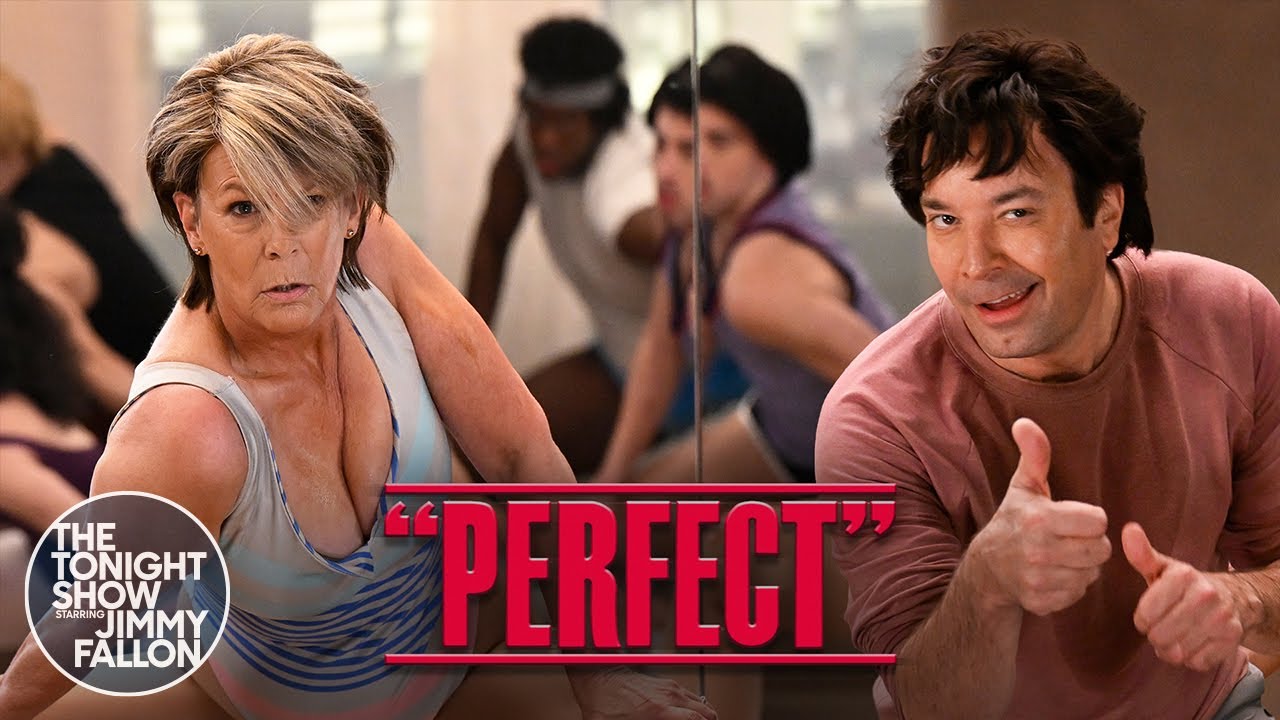
Jamie Lee Curtis and Jimmy Fallon revisit the famous aerobics scene from Curtis’s 1985 film Perfect in a Tonight Show Starring Jimmy Fallon sketch published January 9, 2025. The segment begins with previously unseen extended footage of Curtis and John Travolta’s original routine, then turns that memory into an escalating late-night parody: pizza arrives, a champagne tower appears, a dove emerges from Fallon’s shorts and defibrillator paddles bring another participant back into the class. Curtis supplies the recognizable instructor intensity; Fallon is the deliberately awkward comic counterpart. It is a nostalgia sketch built around a real film scene, not a newly discovered full movie sequence.
| Element | What viewers see | Key fact |
|---|---|---|
| Original scene | Jamie Lee Curtis and John Travolta in an aerobics routine from Perfect | The 1985 film’s sequence runs more than five minutes |
| Tonight Show setup | Curtis and Jimmy Fallon introduce an “extended” version | The official video was published January 9, 2025 |
| Parody structure | Curtis leads while Fallon struggles through an increasingly chaotic class | Pizza, a champagne tower, a dove and defibrillator paddles are reported gags |
| Contemporary bridge | Fallon sends Curtis a workout video recorded on an iPhone | The phone premise contrasts with the 1985 film’s pre-smartphone setting |
What exactly did Jamie Lee Curtis and Jimmy Fallon recreate?
The pair recreated the aerobics number associated with Perfect, the 1985 film in which Curtis plays an aerobics instructor opposite Travolta. The original passage is an unusually extended workout-and-dance sequence for a feature film, lasting more than five minutes according to LateNighter’s report. Curtis’s return is therefore specific: she is revisiting her own screen performance, not impersonating an anonymous 1980s fitness teacher.



On the program, Fallon tells Curtis that more material exists and says, “There’s actually more footage that’s never been seen before.” The official Tonight Show video, titled “Jamie Lee Curtis and Jimmy Recreate ‘Perfect’ Aerobic Fitness Scene,” uses that line as the entry point. The show presents footage of Curtis and Travolta’s routine before moving into newly staged comedy with Curtis and Fallon. The distinction matters because the clip combines archival-looking film material with a present-day sketch rather than revealing an entire lost section of Perfect.
Outdated Drivers Are Slowing You Down
One free scan finds every outdated or missing driver and matches the right update for your exact hardware.Free scan · exact hardware matchPC Slower Than It Used to Be?
A free scan shows the junk files, broken settings and background clutter dragging Windows down - then fixes them in one click.Free scan · Windows 10 & 11Curtis repeats the visual language viewers associate with the movie: the instructor’s forward-facing posture, emphatic hip movements, direct eye contact and intense commitment to the workout. Fallon occupies the partner’s position, but his job is not to reproduce Travolta’s screen presence. He becomes the audience’s comic proxy, trying to remain inside a polished routine while the premise keeps adding impossible interruptions.
Popular on Amazon
Where does the original aerobics scene come from?
The source is Perfect (1985), a film built around Curtis’s aerobics-instructor character and Travolta’s character. The fitness sequence is remembered for its period-specific choreography, camera-facing poses and sensual, highly controlled studio energy. It belongs to the film’s 1980s world, where a workout class can also function as a dramatic and erotic performance.
That context explains why the Tonight Show recreation is recognizable within seconds. Curtis does not need to explain the movie’s premise before beginning the movement vocabulary. Viewers who know the scene can identify the instructor persona from the stance, timing and gestures; viewers who do not can still read the setup as a deliberately heightened 1980s workout. The sketch gets its first laugh from recognition before any prop appears.
The original sequence is also useful as a baseline. Its length gives the parody room to pretend that the class has continued far beyond a normal film number. Its earnestness gives Fallon something to disrupt. And its two-person structure lets the new version preserve a visual relationship while changing the power dynamic: Curtis remains the commanding teacher, while Fallon is visibly the less capable participant.
Is the “extended version” actually new footage from Perfect?
The program presents previously unseen extended footage of Curtis and Travolta’s aerobics scene as the setup, but the available reporting does not independently establish the footage’s complete provenance or indicate that a full alternate cut of the film has been released. The safest description is that the broadcast introduces material identified as an extended version, then uses it to launch a new parody.
That distinction prevents two common misunderstandings. First, the segment is not simply a re-upload of the 1985 scene. Second, the comic material with Fallon is not footage from the original movie. The older film material supplies the archival surprise; the modern shoot supplies the escalation.
Fallon’s announcement is part of the joke’s architecture. “There’s actually more footage that’s never been seen before” sounds like a television discovery, encouraging viewers to settle in for a longer piece of movie history. The class then keeps going until the premise becomes absurd. The audience moves from “I remember this” to “how long can this possibly continue?”
What happens in the Tonight Show sketch?
The sketch follows a clear progression from faithful callback to physical-comedy overload.
The Tool Desk
Outbyte PC Repair FREERepair Windows errors before they cause bigger problemsFix Now →Outbyte Driver Updater FREEScan for outdated or missing drivers - takes under a minuteDriver Scan →- The discovery. Fallon tells Curtis that more footage exists. The show frames the material as an archival extension of the famous scene, giving the recreation a reason to begin.
- The handoff. Curtis returns to the instructor role, and Fallon takes the male participant’s position. Her authority is immediate; his discomfort supplies the contrast.
- The class refuses to end. Instead of stopping after a familiar sequence, the routine continues as though the original film number had no natural endpoint. This lets the sketch stack new beats without abandoning the recognizable choreography.
- Food enters the workout. A pizza is delivered during the exercise. The interruption turns a disciplined fitness environment into a late-night service gag while Curtis continues to behave as if the class remains professional.
- The celebration escalates. Curtis pours from a champagne tower. The elegant, excessive prop pushes the scene farther from a realistic workout and deeper into a deliberately overstuffed parody.
- Fallon produces a dove. He releases a dove from his shorts, a visual gag that makes his role as the chaotic foil unmistakable. The bird is not part of Perfect’s original choreography; it is one of the modern sketch’s surprise objects.
- The medical finale. Curtis uses defibrillator paddles to reanimate a body, and the revived figure joins the aerobics class. The gag treats the routine as so relentless that even death becomes another transition into the next count.
The exact order is less important than the mechanism: each prop violates the rules of a normal class, while Curtis’s commitment to the instructor persona keeps the scene legible. Her straight-faced authority gives Fallon permission to become increasingly ridiculous.
Also popular on Amazon
Why is Fallon’s iPhone workout video part of the joke?
Contemporary reports describe Fallon sending Curtis a video of himself working out on an iPhone. The device gives the sketch a bridge between the remembered movie and the way people now record, send and replay performance clips. An iPhone could not have been a prop in the 1985 production world, so its appearance instantly marks the new material as contemporary.
The phone also reframes the recreation as a conversation between generations of media. Perfect supplied a fixed film image: a carefully staged routine watched in a theater or on a home video. Fallon’s phone video is portable, self-conscious and addressed directly to Curtis. He is not merely entering her old scene; he is auditioning for it through a piece of personal media.
That premise makes the sketch accessible even to viewers who have never seen the film. The phone explains why Fallon is trying to demonstrate his readiness, while Curtis’s response establishes that the test is not going to be judged gently. For viewers who do know Perfect, the technology joke adds a visible before-and-after contrast without pretending that the original movie used modern devices.
How does Curtis’s performance differ from Fallon’s?
Curtis functions as the keeper of continuity. Her costume cues, posture, hip thrusts and instructor intensity recall the performance people associate with the film. She understands that the more seriously she treats the class, the funnier the intrusions become. The performance is therefore not a loose impression; it is a deliberate return to a persona she originated.
Fallon functions as the disruption. Travolta was Curtis’s original scene partner, but Fallon is not asked to reproduce Travolta’s charisma or physical precision. He invites the audience to watch a late-night host strain inside a routine that was designed to look effortless. His awkwardness is a feature of the writing, not evidence that the sketch is attempting a shot-for-shot remake.
The contrast changes the scene’s power dynamic. In the film, the two performers belong to the same dramatic world. In the sketch, Curtis has seniority, memory and command of the choreography, while Fallon is a willing intruder. Their mismatch lets the program honor the original image while making clear that this is a new comic performance.
What is faithful to Perfect, and what is deliberately changed?
A useful comparison separates fidelity from parody instead of asking whether the sketch is an exact recreation.
| Category | Perfect reference | Tonight Show change |
|---|---|---|
| Performer relationship | Curtis’s instructor performs opposite John Travolta | Fallon replaces the male partner as a comic foil |
| Movement | Extended, period-specific aerobics choreography | Curtis repeats recognizable gestures while the routine becomes increasingly impossible |
| Technology | A 1985 film’s pre-smartphone production world | Fallon’s iPhone workout video supplies a present-day setup |
| Props | Fitness equipment and the controlled studio environment | Pizza, champagne, a dove and defibrillator paddles turn exercise into spectacle |
| Tone | Earnest 1980s sensuality and dramatic performance | Self-aware late-night escalation and physical comedy |
| Ending logic | A film scene with a normal dramatic endpoint | The class keeps absorbing interruptions until revival becomes another dance cue |
This comparison shows why calling the segment a “recreation” is accurate but incomplete. Curtis recreates the movement vocabulary and character posture; the surrounding situation is designed to collapse under comic pressure. The sketch protects the memory of the original by letting the audience see exactly where the new version departs from it.
Also popular on Amazon
Why does the parody work as nostalgia rather than a simple remake?
The first pleasure is recognition. The opening footage and Curtis’s physical return identify the source before the sketch explains it. Viewers who remember the movie get the satisfaction of seeing a familiar image restored; newcomers receive enough visual information to understand that the routine has a specific history.
The second pleasure is embodied nostalgia. Curtis herself performs the movements, rather than handing the role to an impersonator. Her presence carries the authority of the original performance, and even small choices—how she faces the camera, how she cues a partner, how firmly she holds a pose—make the callback feel personal.
The third pleasure is controlled degradation. The workout begins with recognizable discipline, then pizza, champagne, a bird and medical equipment steadily erode its rules. Because Curtis refuses to abandon the instructor’s seriousness, the audience can track the joke’s escalation. Each new object is funny partly because the class has already established what does not belong in it.
Do these 3 things before closing this tab:
1Fix the driver behind crashes, sound loss and screen glitches2Repair Windows errors before they cause bigger problems3Scan for outdated or missing drivers - takes under a minuteThe fourth pleasure is archival novelty. The claim of extended footage gives the broadcast a reason to revisit an old cultural object without treating it as a static clip. The show appears to open a historical door, then walks through it carrying modern television’s appetite for bigger props and faster reversals.
How should you watch the original and the recreation together?
Watch the official Tonight Show video first if you want the surprise of the setup, then revisit the relevant Perfect sequence to identify the repeated gestures. If you begin with the film, you will notice the parody’s changes immediately; if you begin with the sketch, the archival footage explains why Curtis’s return feels more specific than a generic 1980s spoof.
- Track Curtis’s instructor cues. Note where she faces the camera, how she marks time and how she directs the partner. These are the details the recreation preserves.
- Separate the archival and new material. The Curtis-Travolta footage belongs to the film reference; the Fallon material belongs to the 2025 television sketch.
- Watch the props as structural beats. Pizza, champagne, the dove and the paddles are not random decorations. Each one raises the cost of maintaining a serious class.
- Compare the partners. Travolta’s role belongs to the film’s dramatic world. Fallon’s role is to expose the mechanics of the callback by struggling inside it.
- Notice the media shift. The iPhone video turns a remembered movie routine into something that can be sent directly to its original performer.
The comparison is most rewarding when you resist the idea that one version must replace the other. The film supplies the source image and period tone; the sketch supplies commentary on memory, celebrity and the way television turns an old scene into a shared joke.
What was Jamie Lee Curtis promoting when she appeared?
Curtis appeared on The Tonight Show while promoting The Last Showgirl. The aerobics recreation was one part of a larger interview, not a standalone announcement that she was returning to an aerobics project.
Quick wins for a faster PC:
Repair Windows errors before they cause bigger problemsFix Now →Fix the driver behind crashes, sound loss and screen glitchesFind Drivers →The appearance also carried difficult real-world context. Curtis discussed devastating fires in her Pacific Palisades neighborhood and encouraged support for the American Red Cross. That conversation sits alongside the playful callback, so the segment can feel celebratory and emotionally complicated at the same time: Curtis is revisiting a beloved career memory while addressing a disaster affecting her community.
Also popular on Amazon

- Approx. Size: 27 x 40 Inches - 69cm x 102cm
- Size is provided by the manufacturer and may not be exact
- The Amazon image in this listing is a digital scan of the poster that you will receive
- Perfect Style A 27 x 40 Inches Poster
- Packaged with care and shipped in sturdy reinforced packing material
According to LateNighter, Curtis later described the shoot in an Instagram post, writing that she “suited up and showed up for work.” She also acknowledged that making comedy amid a profound tragedy was complicated. Her comment does not cancel the joke; it explains the responsibility she felt in participating and keeps the recreation connected to the circumstances of the interview.
Independent reader supportYour contribution helps us test, update, and keep practical guides available for everyone.Is this a new scene from the movie?
No. The film is Perfect, released in 1985, and its original aerobics scene pairs Curtis with Travolta. The 2025 item is a Tonight Show sketch that uses footage identified as an extended version of that scene before staging a new comic continuation with Fallon.
Calling it a new movie scene would blur three different things: the original feature, the previously unseen material presented as part of the television setup, and the freshly performed parody. Keeping those layers separate is the clearest way to describe what viewers are watching.
What’s actually slowing this PC down?
Pick the symptom - the matching free tool is one click away.
What should viewers know about the clip’s release date?
The official video and the contemporaneous LateNighter report are dated January 9, 2025. That date establishes when the recreation was published and reported; it is not a view-count milestone, ratings figure or measure of audience size.
No verified Nielsen rating, audience survey or permanent viral-view total is established by the available material. The clip’s significance comes from the performers, the recognizable source scene and the construction of the gag—not from an invented popularity statistic.
Why does the original scene still support this kind of callback?
The sequence has a rare combination of recognizability and excess. It is long enough to function as a miniature set piece, visually distinctive enough to identify from a few movements and emotionally heightened enough to make a flat imitation unnecessary. A shorter or less stylized scene would not give the parody as much room to play.
Its period specificity also makes the contrast visible. The original belongs to a moment when aerobics, sensual performance and cinematic glamour could occupy the same space without an ironic frame. The Tonight Show version keeps the costume and choreography cues but adds the audience’s awareness that the image is being remembered, replayed and deliberately overfilled.
Free tools Windows power users keep installed
One-click scans. No signup required.
Finally, Curtis’s participation changes the emotional temperature. The sketch is not only making fun of an old film. It is allowing the performer who created the image to revisit it on her own terms, with enough confidence to preserve the pose and enough distance to let a dove, a champagne tower and a defibrillator break the spell.
Also popular on Amazon

- High Quality Poster Printed on Finest Archival double weight museum display Paper
- 24x36 inch poster artfully rolled in tissue & shipped in our custom mailing tube
- Special Movie and Classic TV Memories our speciality this poster has it all!
- Perfect for your media room, home décor or a unique special gift!
- Iconic movie cult television moments make striking wall décor!
What is the simplest way to describe the recreation?
It is a nostalgia sketch built in two stages. First, The Tonight Show points viewers toward the Curtis-Travolta aerobics scene from Perfect and presents previously unseen extended footage as a discovery. Then Curtis and Fallon transform that reference into an intentionally excessive workout in which every interruption makes the class less plausible and the callback more entertaining.
Curtis provides continuity, Fallon provides comic friction, and the props provide escalation. The result respects the original scene enough for its gestures to remain visible while changing the tone from 1980s dramatic sensuality to self-aware late-night absurdity.
Frequently Asked Questions
Should I watch Perfect before the Tonight Show clip?
You do not need prior knowledge to follow the sketch, because the setup identifies the aerobics scene and Curtis’s role. Watching the film sequence afterward is useful for spotting which poses and instructor cues Curtis carries over before the parody starts breaking its own rules.
Does John Travolta appear with Curtis in the new television segment?
Travolta appears in the archival material from the original scene, while Jimmy Fallon performs the new partner role. The casting change is central to the joke because Fallon is playing an intentionally awkward foil rather than reproducing Travolta’s performance.
What is the dove gag in the aerobics recreation?
During the escalating workout, Fallon releases a dove from his shorts. It is one of the newly staged comic props in the television sketch, not part of the 1985 film routine.
Why is the iPhone mentioned in coverage of a 1985 movie scene?
The phone belongs to the modern setup: reports describe Fallon sending Curtis a video of himself working out on an iPhone. It provides an obvious time marker separating the late-night premise from the film’s pre-smartphone production world.
Where does the defibrillator moment occur?
Near the finale, Curtis uses defibrillator paddles to revive a body, and the revived figure joins the class. The beat completes the sketch’s progression from ordinary exercise to deliberately impossible spectacle.






Say something about this film