Do these 3 things before closing this tab:
1Clear out junk files and repair common Windows errors2Scan for outdated or missing drivers - takes under a minute3Repair Windows errors before they cause bigger problemsFor a GStreamer H.264 loop stream, match the video bitrate to the output resolution and frame rate, use CBR, and set x264enc’s key-int-max to about two seconds of frames: 60 at 30 fps or 120 at 60 fps. For a non-interactive 24/7 loop, YouTube’s normal latency mode is usually the steadier choice. The settings below are based on YouTube and GStreamer documentation checked on October 3, 2026; they are not a tested launch line, and local plugin support varies.
Recommended settings at a glance
- Video: H.264, progressive scan, square pixels, with resolution and frame rate chosen for the source material and channel.
- Rate control: CBR. Choose the H.264 live-ingest bitrate from the table below, then allow reliable upload capacity for audio and network variation.
- Keyframes: target one every two seconds. For x264enc, translate that interval into frames at the pipeline’s actual frame rate.
- Audio: AAC is the straightforward RTMP/RTMPS choice; YouTube lists stereo at 44.1 kHz and 128 Kbps.
- YouTube latency: choose normal for a loop that does not need real-time interaction. Consider low or ultra-low only when audience interaction justifies their trade-offs.
- Transport: YouTube recommends RTMPS. Verify that the installed GStreamer sink supports it before using a secure ingest endpoint.
YouTube’s live encoder requirements and bitrate values below were checked October 3, 2026. They apply to H.264 live ingest, not video uploads or other codecs. YouTube Live encoder settings
Choose the H.264 bitrate for your output
Set the pipeline’s output resolution and frame rate first; then use YouTube’s recommended video bitrate for that exact combination. Values are in Mbps and cover video only.
| Resolution | Frame rate | Recommended H.264 video bitrate |
|---|---|---|
| 2160p | 60 fps | 50 Mbps |
| 2160p | 30 fps | 42 Mbps |
| 1440p | 60 fps | 34 Mbps |
| 1440p | 30 fps | 21 Mbps |
| 1080p | 60 fps | 17 Mbps |
| 1080p | 30 fps | 14 Mbps |
| 720p | 60 fps | 8 Mbps |
| 720p | 30 fps | 8 Mbps |
| 480p | 30 fps | 4 Mbps |
| 360p | 30 fps | 3 Mbps |
In x264enc, bitrate is measured in kbit/sec. For example, 1080p30’s 14 Mbps corresponds to 14,000 kbit/sec for that property. Its documented default is 2048 kbit/sec; that is a default, not a YouTube recommendation. Do not apply the H.264 figures to H.265/HEVC or AV1, which have different recommendations. GStreamer x264enc reference
What’s actually slowing this PC down?
Pick the symptom - the matching free tool is one click away.
#1 Best Overall

- 【AMD Ryzen 7330U】 – The Efficiency-Tuned Powerhouse,AMD Ryzen 7330U (Zen 3, SMT, 4C/8T) in KAMRUI P2 mini PC crushes rivals: Intel i3-10110U (2C/4T, 2019) and N95 (4 efficiency cores, no HT, single-channel memory). Vs predecessor Ryzen 3 4300U (4C/4T): ~50% faster single-core, ~46% multi-core, 8MB L3 cache (vs 4MB). Beats both Intel chips hugely in multi-core, making heavy multitasking, coding, data work smooth at just 15W TDP. High-end power in a cool, efficient box.
- 【AMD Radeon Graphics】– Triple 4K Vision & Fluidity,The integrated Radeon Graphics (based on the modern Vega architecture with 6 CUs) is a visual beast, outclassing the iGPU offerings from both AMD's prior generation and Intel. The Intel UHD Graphics (i3-10110U/N95) struggles with single-channel memory and low execution units, crippling its gaming performance and barely handling basic 4K video without stuttering. While the older Radeon Vega 5 (4300U) was decent, our 7330U's Radeon Graphics (6 CUs) pushes the boundaries, delivering higher graphics clock speeds (up to 1.8GHz) and significantly better rendering capabilities. It can drive triple 4K@60Hz displays with zero lag, edit photos/videos.
- 【Generous Storage & Easy Expansion】The KAMRUI Pinova P2 mini desktop computers comes with 16GB LPDDR4X RAM (higher frequency, lower power) for buttery‑smooth multitasking, and a 256GB M.2 SSD for blazing fast boot‑up, quick file transfers, and no more long loading screens. It also features two storage expansion slots (1x M.2 2280 SATA/NVMe PCIe 3.0 slot + 1x M.2 2280 SATA slot), supporting up to 4TB total (not included). You’ll have all the space you need for projects, media, and important data.
- 【Triple 4K Display Output】The KAMRUI Pinova P2 mini desktop pc is equipped with HDMI 2.0 ×1 + DP 1.4 ×1 + USB 3.2 Gen2 Type‑C ×1 (with DP Alt Mode), enabling simultaneous triple 4K@60Hz output. Whether for home entertainment, remote work, or conference room presentations, it delivers an immersive visual experience. Two USB 3.2 Gen2 Type‑A ports (up to 10Gbps – 21x faster than USB 2.0) make data transfers and device expansion a breeze.
- 【USB 3.2 Gen2 Type‑C: 10Gbps & Versatile Connectivity】The USB 3.2 Gen2 Type‑C port on the KAMRUI P2 small pc supports 10Gbps data transfer speeds and can also output DisplayPort 1.4 video. Together with Gigabit LAN, Wi‑Fi, and Bluetooth, you get a fast, flexible, and productive connected environment – wired or wireless.
A bitrate recommendation cannot compensate for an unreliable connection. YouTube advises testing with representative audio and motion and monitoring stream-health messages. Moving footage can need more than a static test pattern reveals. YouTube Live encoder settings
Set x264enc key-int-max for a two-second GOP
YouTube recommends a two-second keyframe frequency and says the interval should not exceed four seconds. GStreamer’s x264enc key-int-max property counts frames, so calculate it from the output frame rate rather than copying a value from another pipeline.
Rank #2
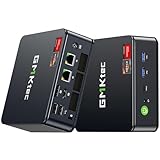
- Office Gaming Mini PC - UPGRADED GMKtec Nucbox M5 Ultra Series is equipped with the powerful AMD Ryzen 7 7730U processor, 8 Cores/16 Threads, Base 2.00GHz (Power Saving Quiet Mode) with Turbo Boost up to 4.50GHz (Performance Mode) in BIOS settings, Based on the ZEN 3+ architecture, this small but powerful mini pc delivers satisfying results in productivity, office work, and gaming. 35% Performance increase over AMD Ryzen 5 7430U/ Ryzen 7 5700U, 5600U, 5560U, 5500U.
- 32GB DDR4 RAM & 512GB PCIe SSD - Installed with DDR4 32GB RAM Dual Channel (2x16GB), the Nucbox M5 Plus mini pc support expansion to 64GB RAM. Featured with 512GB M.2 2280 PCIe 3.0 SSD, support dual slot expansion to 4TB SSD. (Upgrades not included)
- DUAL NIC LAN 2.5G RJ45 - Fast Network Speeds: Enjoy up to 2500Mbps data transmission speed without worrying about lagging. Ideal for working, gaming, and surfing the internet. Great for Untangle, Pfsense or as a server office PC.
- Mini Desktop Computer with 4K Triple Screen Display - Nucbox M5 Ultra integrates AMD Radeon Graphics 8 Cores 2000 MHz GPU to deliver powerful graphics processing power to easily handle the demands of complex design software, 4K@60Hz UHD video editing, and playback. It can connect to 3 display screens simultaneously.
- Fast Internet WiFi 6E + BT5.2 Connection - GMKtec Mini PC with WiFi-6E Wireless, have 2.5G/5G/6G triple band, more faster and lower latency. Bluetooth 5.2 allowing you more quickly to connect other wireless devices (headset, mouse, keyboard, etc.) Interface features 2*USB3.2 ports, 2*USB2.0 ports, 1*HDMI 2.0 port(4K@60Hz), 1*USB-C port(PD/DP/DATA), 1*DP Port, 1*Audio 3.5mm (HP&MIC), 1*DC Power Port.
| Output frame rate | key-int-max for about two seconds |
|---|---|
| 30 fps | 60 |
| 60 fps | 120 |
These values are the arithmetic conversion of two seconds into frames. Set the output caps and frame rate before settling the GOP value. A value of zero means automatic in x264enc; for a predictable target, set an explicit frame count. The four-second ceiling is YouTube’s limit, not the preferred target. GStreamer x264enc reference · YouTube Live encoder settings
Understand the two kinds of latency
Encoder latency inside GStreamer
Encoder latency is delay introduced before frames leave the local pipeline. GStreamer’s x264enc documentation warns that default settings may buffer frames and add latency. It documents tune=zerolatency as a possible workaround, while warning that it affects encoding quality. Treat it as a trade-off to evaluate with your content, not a free improvement.
Rank #3

- 【AMD Ryzen 3 5300U CPU: Outperforms N150 & 3500U】 BOSGAME E5 mini PC is powered by the TSMC 7nm FinFET architecture AMD Ryzen 3 5300U processor (4 Cores, 8 Threads, up to 3.8GHz boost, 6MB total cache). Compared to low-end Intel N150 or 3500U chips which only have 4 single threads and throttle under load, the 5300U delivers over 30% faster multi-core speed. Run 30+ browser tabs, large Excel sheets, and Zoom meetings simultaneously without system lag.
- 【8GB DDR4 RAM & 256GB NVMe SSD Storage】 Installed with high-speed 8GB DDR4 dual-channel memory and a fast 256GB M.2 2280 SSD, eliminating slow boot times and application loading delays. To accommodate growing data requirements, the upgradeable hardware design features dual SODIMM slots that allow you to expand memory up to 64GB RAM, ensuring smooth operation during heavy multitasking.
- 【High-Capacity Dual M.2 SSD Storage Expansion】 Never worry about running out of space for your business files. In addition to the pre-installed 256GB system drive, the motherboard houses an extra empty internal M.2 2280 NVMe PCIe 3.0 slot. This allows you to easily add a second solid-state drive for up to an additional 2TB of storage capacity (upgrades not included) without needing to remove or reinstall the original operating system.
- 【Radeon 6-Core Graphics & Triple 4K Displays】 Integrated with official AMD Radeon Graphics (6 Graphics Cores, 1500 MHz frequency) for casual gaming, photo editing, and crisp 4K media decoding. Featuring 1x HDMI 2.0 port, 1x DisplayPort, and 1x Full-Function Type-C port, the E5 outputs true 4K@60Hz resolution to three monitors at once. This multi-screen setup eliminates constant window-switching for traders, programmers, and office workers.
- 【Dual 2.5GbE LAN Ports for Advanced Networking】 Experience fast wired network transmission speeds up to 2500Mbps without lagging or buffering. The integration of dual 2.5 Gigabit Ethernet ports (powered by Realtek RTL8125 controller) makes this compact computer an exceptional hardware choice for tech enthusiasts. Easily configure it into software routers, hardware firewalls (pfSense, OpnSense), home NAS servers, or local homelabs.
Latency in the encoder can also cause other branches or queues to fill and block a pipeline. GStreamer identifies queue sizing or a multiqueue arrangement as possible pipeline-level remedies. Audio and video branches need sensible synchronization and queue behavior; changing only the YouTube latency mode will not fix a pipeline that is blocked locally. GStreamer x264enc reference
Viewer latency on YouTube
YouTube’s latency selection affects the viewer experience and buffering risk; it is separate from GStreamer’s encoder tuning.
Rank #4

- 12th Intel Alder Lake N95 Processor – The GMKtec G3 S Mini PC is powered by the 12th Gen Intel N95 processor with 4 cores, 4 threads, 6MB cache and a burst frequency up to 3.4GHz. Compared with N100/N5105/N5100/N5095, the N95 delivers up to 36% overall performance improvement. Perfect for routine tasks, office work, and home entertainment, this compact mini desktop is more convenient than traditional bulky PCs.
- 8GB RAM & 256GB SSD Storage – Pre-installed with 8GB DDR4 memory and a fast 256GB M.2 2242 SSD, the G3 S mini desktop offers quicker startup, smoother multitasking, and faster file transfers. Enjoy seamless performance whether you’re working on multiple applications, browsing, or streaming content.
- Rich Interfaces & Connectivity – The G3 S mini computer comes equipped with USB 3.2 (up to 10Gbps), dual HDMI 2.0 (4K@60Hz), and a 3.5mm audio jack. With support for WiFi 5, Bluetooth 5.0, and Gigabit Ethernet (RJ45 1000MbE), it connects easily with monitors, projectors, printers, office equipment, and other peripherals, making it versatile for both home and business use.
- Dual 4K Display Support – Featuring upgraded Intel UHD Graphics (up to 1000MHz), the G3 S supports 4K video playback and AV1 decoding for a smooth viewing experience. With dual HDMI outputs, you can connect two 4K@60Hz displays simultaneously, enabling efficient multitasking for work and entertainment.
- GMKtec WARRANTY - GMKtec offers a 1-year limited GMKtec's warranty for each mini PC, starting from the date of the purchase. All defects due to design and workmanship are covered. With a professional after sales team always ready to attend to your needs, you can simply relax and enjoy your mini PC.
| YouTube mode | When it fits | Trade-off or qualification |
|---|---|---|
| Normal | Streams without planned audience interaction | Supports all resolutions and live features. |
| Low | Some audience interaction | YouTube describes most viewers as experiencing less than 10 seconds; 4K is not supported. |
| Ultra-low | Real-time interaction | YouTube describes most viewers as experiencing less than five seconds; buffering is more likely and 4K is not supported. |
The latency figures are YouTube’s typical descriptions, not guarantees for an individual viewer or network. A continuous music, scenic, or ambient loop normally does not need an immediate response, so normal latency is a sensible default. If chat, polls, or synchronized participation are central to the broadcast, weigh low latency against its resolution limits; ultra-low prioritizes immediacy further while increasing buffering risk. YouTube latency settings
Independent reader supportYour contribution helps us test, update, and keep practical guides available for everyone.Build the GStreamer-to-YouTube pipeline
The general topology is a looped or decoded video source, video conversion and caps, H.264 encoding, H.264 parsing, and FLV multiplexing. In parallel, decode or provide audio and encode it as AAC; send the muxed output to YouTube’s RTMP(S) ingest. The exact launch line depends on the media source, installed GStreamer version and plugins, stream-key handling, and sink protocol support.
- Confirm the local elements and properties. Check which source, decoder, converter, encoder, parser, muxer, audio encoder, and network sink are installed. Their availability and behavior depend on the local build.
- Set output caps. Specify the actual video resolution and frame rate, then choose the matching bitrate and two-second
key-int-maxframe count. - Configure audio and synchronization. Use an audio format YouTube accepts and make sure audio/video branches can progress without queues filling behind encoder latency.
- Connect the encoded streams to the muxer. The GStreamer
flvmuxelement multiplexes streams into FLV. GStreamer flvmux reference - Choose and verify the transport. YouTube recommends RTMPS, the secure extension of RTMP. The documented
rtmpsinksends data to a streaming server via RTMP and accepts a URL through itslocationproperty; do not assume that every installed sink supports secure RTMPS identically. GStreamer rtmpsink reference · YouTube Live encoder settings - Test before relying on the loop. Use representative audio and motion, inspect YouTube stream health, and confirm that the stream remains stable through the intended source loop.
Keep the YouTube stream key private. The documentation supports this pipeline shape, but does not establish a universal launch command for every plugin build or RTMPS configuration.
Troubleshoot common problems
- Video looks soft or YouTube reports bitrate trouble: confirm the output resolution and frame rate, then check that the H.264 bitrate matches YouTube’s live table. Ensure the available upload capacity can carry the video, audio, and connection variation.
- Keyframe interval is wrong: remember that
key-int-maxis a frame count. Use 60 at 30 fps or 120 at 60 fps for a two-second target; check the actual negotiated output frame rate. - Pipeline latency grows or stalls: x264enc may buffer frames, and its latency can fill queues on other branches. Review queue sizing and synchronization; test
tune=zerolatencyonly if its quality trade-off is acceptable. - Stream fails to connect over a secure URL: verify the installed sink’s protocol support and plugin version. The documented RTMP sink behavior does not prove that a particular build accepts RTMPS.
- Viewers report buffering after choosing ultra-low latency: assess whether real-time interaction is worth the higher buffering risk; normal latency is the more stable fit for a non-interactive loop.
- Test stream appears healthy but the real loop does not: repeat the test with representative movement and audio, then review YouTube stream-health messages rather than relying on a static test pattern.
Or let it run in the cloud
If the goal is a YouTube loop that continues while your computer is off, StreamNeo is a cloud alternative: upload a recording or build a playlist, add your YouTube stream key, and go live. It loops uploaded videos rather than broadcasting a live camera. Nothing has to stay on at home; any quality up to 4K 60fps streams as uploaded at one flat price per slot, with automatic recovery if YouTube drops the stream. The first day is free with no card. Monthly billing is $9.99 per month. Start your free day with StreamNeo.
Quick Recap
Product prices and availability are accurate as of the date/time indicated and are subject to change. Any price and availability information displayed on Amazon at the time of purchase will apply.