Quick wins for a faster PC:
Clear out junk files and repair common Windows errorsFree Scan →Scan for outdated or missing drivers - takes under a minuteDriver Scan →There is no official WWE ranking of its greatest rosters. This countdown makes an editorial case for ten especially compelling roster snapshots, weighing depth beyond headline stars, singles and tag-team strength, established names alongside rising talent, faction-driven rivalries, and the historical moment. The first entry means WWE in calendar year 2002—a year of major change, not a claim that every name listed shared one roster at the same time.
How this countdown defines a “best” roster
Roster quality is not the same as having one famous champion. A strong roster offers credible matches across the card, memorable pairings and factions, and a mix of proven stars and wrestlers who are still becoming stars. These ten entries are snapshots from different points in WWE history, not a statistically ranked comparison; the available sources do not establish a common measure of roster depth or a definitive list.
| # | Preview | Product | Price | |
|---|---|---|---|---|
| 1 |

|
Mattel WWE “Hollywood” Hulk Hogan Action Figure, Main Event Series #165 | $12.99 | Buy on Amazon |
| 2 |

|
Mattel WWE Toy Vehicle & Rey Mysterio Action Fgure Set | $39.99 | Buy on Amazon |
| 3 |

|
Mattel WWE Jey USO Play & Display Action Figure | $12.99 | Buy on Amazon |
The snapshots below emphasize documented stars, factions and turning points. Where a year spans major changes, the entry says so rather than treating the roster as fixed.
10. 2002: WWE’s roster in transition
WWE’s own timeline places 2002 within its 2001–2005 “Postwar Era.” The year is a strong choice for this list because it captures the beginning of a new structure and several pivotal arrivals and returns—not because it can be shown to have had the deepest roster. WWE’s company timeline dates the brand extension to March 25, when the Board of Directors instituted the split and the first draft assigned 60 Superstars across the two brands. The Rock went to SmackDown, while The Undertaker went to Raw.
#1 Best Overall
- Fan Favorites! WWE action figures bring Superstars to life in 6-inch scale.
- TrueFX Technology! Each figure is detailed with a life-like face for added collectability.
- Dynamic Posing! Fans can recreate signature moves with 14 points of articulation.
- Play and Display! Reenact favorite WWE Main Event matches or create new rivalries and moves.
- Super Collectible! WWE fans can find their favorite Superstar figures (each sold separately, subject to availability).
That makes “the 2002 roster” an imprecise phrase: the year’s talent was divided across brands, and the lineups changed as the year went on. The same timeline records John Cena’s SmackDown debut on June 27, Rey Mysterio’s arrival on July 25, and Shawn Michaels’ return to the ring on August 25. Brock Lesnar took the Undisputed WWE Championship to SmackDown, after which Raw created the World Heavyweight Championship. These are meaningful markers of a changing company, but they do not establish a complete, date-specific ranking of every division.
The year also brought major star and faction matchups. WWE’s timeline describes the nWo’s arrival and WrestleMania X8’s Rock–Hogan match. Taken together, 2002’s case rests on transition, recognizable headliners and emerging talent—not on treating a year of shifting brand rosters as a single static lineup.
9. 2001: WWE and the Invasion-era collision
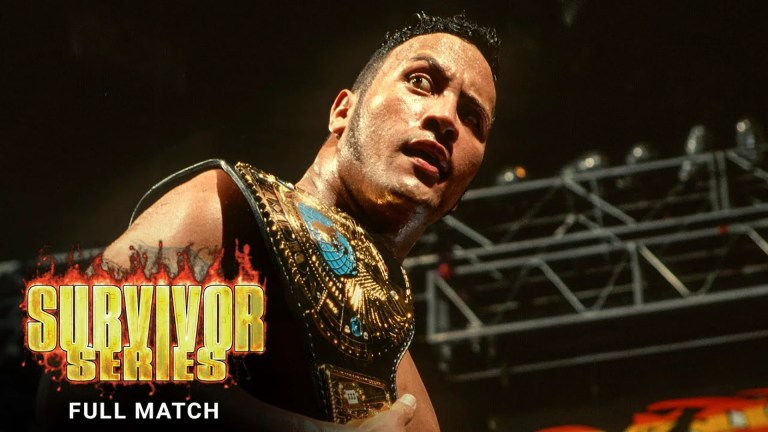
The 2001 Survivor Series account on WWE’s timeline offers a vivid measure of the star power gathered for the company’s conflict with the Alliance. WWE’s team included The Rock, Chris Jericho, Kane, The Undertaker and Big Show; the Alliance side included Steve Austin, Kurt Angle, Booker T and Rob Van Dam.
That match is evidence of a remarkable concentration of recognizable names on one card, not proof that every part of the roster was equally deep. Its strength as a snapshot is the collision of established WWE headliners with talent associated with the rival Alliance, at the close of a major company transition.
8. 2003: Evolution, Goldberg and a new generation of headliners
WWE’s timeline dates Evolution’s official start to Randy Orton joining Ric Flair, Triple H and Batista in 2003, and also notes Goldberg’s arrival on Raw. The combination gives the year a compelling blend: established stars anchoring a faction while younger members gained a platform alongside them.
Evolution is a strong example of how faction storytelling can make a roster feel interconnected, creating potential matchups and rivalries across several levels of the card. The documented milestones support that case for star power and faction strength; they do not supply a full roster snapshot or establish balance across every division.
7. 2004: Eddie Guerrero’s championship moment
WWE’s company timeline records Eddie Guerrero winning the WWE Championship in 2004. His title win gives the year a defining top-of-card milestone and illustrates the value of a roster that can place a distinctive performer at the center of its biggest story.
Rank #2
- Roll down to the ring with the Lucha Low Rider vehicle.
- Includes a WWE Main Event Rey Mysterio action figure with advanced articulation.
- Recreate iconic entrances with the Lucha Low Rider hydraulics action.
- Rey Mysterio can enter the match with the vehicle's launching action.
- Ride into matches with real rolling wheels.
The evidence cited here establishes that milestone, rather than a complete list of the year’s contenders or the strength of its tag and women’s divisions. That makes 2004 a meaningful entry for its documented championship history, while leaving any broader claim about roster balance unproven.
6. The Attitude Era: DX and faction identity
WWE dates Stone Cold Steve Austin’s King of the Ring moment to June 23, 1996, describing it as an unofficial start to the Attitude Era. One of the era’s clearest faction markers is D-Generation X. WWE says Shawn Michaels and Triple H revealed their allegiance in summer 1997; later members included Billy Gunn, Road Dogg and X-Pac. WWE describes DX as the Attitude Era’s most popular faction.
DX’s appeal is evidence of a memorable group and its star power, not a stand-in for the whole roster. WWE’s 2019 Hall of Fame announcement named Triple H, Shawn Michaels, Chyna, Road Dogg, Billy Gunn and X-Pac as inductees for the faction. Triple H said, “Being a part of DX remains one of the highlights of my career and it is truly an honor to be inducted into the WWE Hall of Fame alongside my closest friends.” The announcement describes DX as originally formed in 1997.
5. 2002–2005: The Postwar Era’s changing landscape
WWE’s “Postwar Era” label covers 2001–2005, a span with more than one roster configuration. It is useful context for the entries above, but not a single roster to rank as though its lineup stayed constant. The brand extension of 2002 divided talent between Raw and SmackDown, while WWE’s timeline records further milestones in 2003 and 2004, including Goldberg’s Raw arrival, Evolution’s start and Guerrero’s championship win.
This stretch earns consideration for the range of documented star and faction developments. But a claim that it was superior in depth to another era would require comparable, dated roster evidence across divisions; the cited milestones alone cannot settle that question.
Do these 3 things before closing this tab:
1Repair Windows errors before they cause bigger problems2Scan for outdated or missing drivers - takes under a minute3Clear out junk files and repair common Windows errors4. The nWo’s WWE arrival: a ready-made rivalry
WWE says Hulk Hogan, Scott Hall and Kevin Nash arrived in WWE after WCW closed in 2001 and were positioned against The Rock and Steve Austin. That setup brought a famous faction into direct opposition with two of WWE’s defining stars, giving the period a built-in rivalry with major names on both sides.
The nWo’s presence strengthens the case for star power and faction-driven storytelling. It does not, by itself, show that the roster was balanced across the full card or that the faction’s prominence represented every division.
Rank #3
- Fan Favorites! WWE action figures bring Superstars to life in 6-inch scale.
- TrueFX Technology! Each figure is detailed with a life-like face for added collectability.
- Dynamic Posing! Fans can recreate signature moves with 14 points of articulation.
- Play and Display! Reenact favorite WWE Main Event matches or create new rivalries and moves.
- Super Collectible! WWE fans can find their favorite Superstar figures (each sold separately, subject to availability).
3. 1997 and the rise of D-Generation X
DX deserves its own place as a roster-shaping moment as well as an Attitude Era faction. WWE’s profile traces its founding allegiance to Shawn Michaels and Triple H in summer 1997, then identifies Billy Gunn, Road Dogg and X-Pac among the later lineup. The group’s changing membership connected several recognizable performers through one enduring identity.
WWE’s Hall of Fame announcement confirms the six named inductees—Triple H, Shawn Michaels, Chyna, Road Dogg, Billy Gunn and X-Pac—and dates the faction’s original formation to 1997. Its Hall of Fame recognition and WWE’s description of it as the era’s most popular faction make DX a strong historical marker, though neither is a measurement of overall roster depth.
2. The Four Horsemen: a faction benchmark, not a WWE roster
The Four Horsemen are an important comparison point for faction strength, but their history must be kept distinct from WWE’s. WWE’s profile says the group formed during an interview in January 1986. It describes a spring 1988 lineup of Ric Flair, Arn Anderson, Tully Blanchard, Barry Windham and JJ Dillon, which WWE says controlled every major NWA title in that configuration.
That is an NWA achievement, not a WWE roster accomplishment. It belongs in a discussion of wrestling factions because it illustrates the power of a tightly defined group of stars; it should not be used to claim that a particular WWE year was stronger. Arn Anderson summarized the group’s philosophy this way: “It’s four individuals thinking singularly, acting collectively.”
1. The strongest case is a set of snapshots, not a single winner
The entries make different kinds of cases. The 2001 Survivor Series team lists show concentrated star power; 2002 stands out as a brand-split transition; 2003 documents a prominent faction and Goldberg’s arrival; and 2004 has Guerrero’s championship milestone. DX and the nWo demonstrate how factions can generate major rivalries, while the Four Horsemen offer an earlier NWA benchmark rather than a WWE roster comparison.
Those examples make “best” a matter of what a fan values: main-event names, depth across the card, factions, new stars, or a historic turning point. WWE’s public timeline and faction profiles document notable events and groups, but they do not publish a canonical greatest-roster list or provide comparable scores for these eras. A more precise answer needs a date-specific roster snapshot and the same division-by-division criteria applied to every candidate.
Free tools Windows power users keep installed
One-click scans. No signup required.
Quick Recap
Product prices and availability are accurate as of the date/time indicated and are subject to change. Any price and availability information displayed on Amazon at the time of purchase will apply.