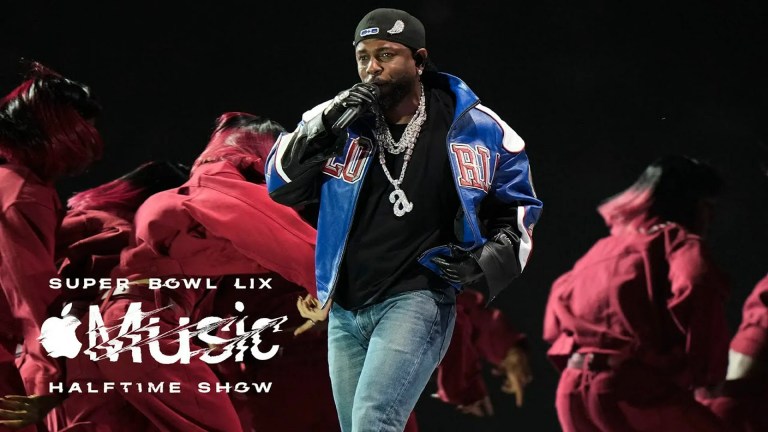
Kendrick Lamar’s Super Bowl LIX halftime show was controversial because it turned a personal rap feud, a heavily edited diss track, and a critique of American respectability into a mass-audience spectacle. On February 9, 2025, Lamar performed “Not Like Us”—the song at the center of his feud with Drake—before an audience of approximately 133.5 million viewers.
The performance was not controversial for one reason alone. Its impact came from the collision of several things that are rarely placed on the same stage: serious disputed allegations in a rap battle, broadcast censorship, Drake’s pending lawsuit against Universal Music Group, Samuel L. Jackson’s Uncle Sam character, Serena Williams’s cameo, and Lamar’s deliberately Black and Compton-rooted artistic identity.


The short answer: a censored diss track still made Drake the subject of the halftime show
The defining controversy was Lamar’s decision to perform “Not Like Us,” the 2024 diss track that became the public climax of his feud with Drake. The song contains serious accusations about Drake’s conduct toward younger women. Those are claims made in a rap battle, and Drake has disputed them; they should not be presented as established facts.
By bringing the song to the Super Bowl, Lamar moved the dispute from hip-hop audiences and online arguments to the largest mainstream entertainment platform in the United States. He appeared to ask whether the audience was ready, then said Drake’s name while smiling toward the camera. Even though the televised lyrics were edited, viewers understood exactly who the song was aimed at.
#1 Best Overall
That made the performance feel like more than a medley of popular songs. To supporters, Lamar had claimed the Super Bowl stage without separating his success from the conflict that helped define his recent career. To critics, he used a family-oriented event to settle scores and spotlight a feud that many casual viewers had not been following.
Why “Not Like Us” carried unusual legal and reputational weight
Most halftime-show songs are chosen because they are broadly recognizable. “Not Like Us” was recognizable for a more complicated reason: it was both a massive hit and an aggressive attack on another superstar.
The song’s allegations were especially sensitive because they concerned Drake’s alleged behavior toward younger women and, as later legal filings summarized them, accusations of criminal conduct. Again, the existence of those accusations in the lyrics does not establish that they are true. Drake’s legal action focused on how the song was promoted, not on a judicial finding that Lamar’s claims had been proven.
In January 2025, Drake sued Universal Music Group, alleging that the company promoted “Not Like Us” despite the song’s allegedly defamatory accusations. The complaint described in the available court reporting did not make Lamar the principal defendant. Nevertheless, the lawsuit made the planned performance more legally and reputationally sensitive: the song was about to be heard by the biggest audience of Lamar’s career.
What’s actually slowing this PC down?
Pick the symptom - the matching free tool is one click away.
That context changed how viewers interpreted even small choices. Lamar’s smile, the apparent mention of Drake’s name, the timing of the song, and the crowd’s response could all be read as part of a public victory lap. The performance did not resolve the lawsuit or prove either side’s claims. It did, however, turn an active legal and cultural dispute into a live television event.
The lyrics were censored, but the edits became part of the spectacle
Lamar did not perform an unedited version of “Not Like Us.” The Super Bowl’s broadcast standards and family-oriented audience made changes expected, particularly for a song containing profanity and unusually serious personal accusations. Several explicit phrases were omitted or altered, including some of the wording most likely to create legal and reputational problems.
Yet censorship did not remove the controversy. It made the missing words noticeable. The song’s structure remained recognizable, Lamar’s delivery identified the track, and the crowd supplied some of the absent language. Viewers could hear the boundaries of the broadcast even when they could not hear every lyric.
Rank #2
This produced an unusual contradiction:
- The performance was safer for television because the most explicit wording was removed or changed.
- The meaning remained clear because the song, its target, and its most recognizable musical cues were intact.
- The omissions attracted attention because audiences knew what was missing and sometimes filled in the gaps themselves.
Some viewers assumed the edits were a direct response to Drake’s lawsuit. Others treated them as ordinary network censorship or a strategic compromise by Lamar and the production team. The reliable conclusion is narrower: the televised rendition was materially edited. Public reporting does not fully establish how responsibility was divided among Lamar, the production, the network, and rights holders, so it would be inaccurate to claim that the NFL formally banned a specific lyric or that Drake personally stopped Lamar from saying his name.
Quick wins for a faster PC:
Clear out junk files and repair common Windows errorsFree Scan →Scan for outdated or missing drivers - takes under a minuteDriver Scan →Samuel L. Jackson’s Uncle Sam turned the show into a commentary on respectability
Samuel L. Jackson appeared as Uncle Sam, dressed in red, white, and blue. Rather than simply introducing songs, the character interrupted and commented on Lamar’s performance. He warned Lamar against being too loud, reckless, or “ghetto,” and urged him to play by the rules.
That framing gave the halftime show a second storyline. Uncle Sam could be read as the nation, the establishment, or the cultural gatekeeper speaking to a Black artist on one of America’s most visible stages. The character’s instructions evoked the pressure on Black performers to make themselves acceptable to mainstream audiences: be successful, but not too confrontational; be authentic, but not too threatening; represent your community, but in a form that institutions can comfortably package.
Lamar’s response was not a straightforward political speech. The critique was built into the staging. The show placed national imagery around an artist whose language, musical history, and visual identity came from Compton and the West Coast. The result was a performance that could function as commercial entertainment while also questioning who gets to define what “American” culture is allowed to look and sound like.
That interpretation is artistic, not a literal claim that the NFL or the United States government censored Lamar. Uncle Sam was a character in the show, and the symbolism came from the contrast between the character’s commands and Lamar’s refusal to make the performance culturally neutral.
The stage emphasized Black and West Coast identity
Lamar’s halftime show did not present him as a generic pop headliner. Its dancers, choreography, stage geometry, red-white-and-blue costuming, and West Coast references connected the spectacle to Los Angeles, Compton, and Black American cultural history.
That choice mattered because the Super Bowl is designed to reach people far beyond a performer’s core audience. Lamar could have minimized the regional and cultural context of his music in favor of a smoother crossover presentation. Instead, the show made that context visible. National symbols surrounded a performer whose aesthetic emerged from communities that mainstream institutions have often policed, sanitized, or treated as controversial.
Rank #3

- 96-page wirebound book
- 12 staves per page
- Music Notation Guide.
Supporters saw the result as layered and strategically subversive. They argued that the performance used the NFL’s platform without allowing the platform to erase Lamar’s identity or history. Critics found it coded, self-serious, politically suggestive, or less conventionally celebratory than a typical halftime show.
Those reactions should not be reduced to a simple partisan argument. Much of the disagreement was about the role of a halftime show itself. Is it primarily a crowd-pleasing medley, or can it also be a symbolic argument about race, power, legitimacy, and the institutions presenting it? Lamar’s performance deliberately tested that boundary.
Why Serena Williams’s cameo was interpreted as a Drake taunt
Serena Williams appeared during “Not Like Us” and performed a dance commonly known as the Crip Walk. The moment immediately attracted attention because Williams is from Compton, like Lamar, and has previously been publicly connected to Drake.
In the context of the song, many viewers interpreted the dance as a deliberate taunt toward Drake or as a public celebration of Lamar’s victory in their feud. The timing made that reading difficult to avoid: Williams’s appearance happened during the track most directly associated with the conflict.
There was also a more direct cultural explanation. Williams and Lamar share a Compton connection, and the dance linked the performance to West Coast identity. Williams later indicated that Lamar asked her to take part and referenced her earlier public dancing after winning Olympic gold. That account does not eliminate the Drake-related interpretation, but it cautions against treating the cameo as proof of a private motive that has not been documented.
The strongest reading is therefore twofold. Williams’s cameo worked as a Compton and West Coast statement, while its placement in “Not Like Us” gave it an obvious resonance with the Drake feud. The show did not need to explain the joke for audiences familiar with the conflict to understand it.
Free tools Windows power users keep installed
One-click scans. No signup required.
The performance blurred protest, spectacle, and triumph
Lamar’s show was controversial partly because it refused to settle into one category. It was simultaneously:
Rank #4

- 【The Perfect Sheet Music Notebook】The size of the sheet music notebook is 29.7*21cm/11.7*8.27inch. 50 sheets total, 100 pages. With 11 staff lines per page. Our sheet music notebooks are designed for when inspiration strikes. Jot down the perfect melody with our staff paper notebook. It's perfect for professionals, students and beginners, no matter what kind of music you're notating.
- 【Exquisite and durable music notebook】Our staff paper notebook is hardcover and double coil bound to ensure the protection of all of your music sheets. You can do your daily songwriting without worrying about paper damage.
- 【Includes music learning materials】You will see more than just a blank music sheet notebook. We provide basic music theory chart, piano keyboard & staff notation guide. It helps you learn about music faster and create songs better.
- 【Easy to use】Music notebook can be tiled 180 degrees on piano and music stands. Both sides are writable and easy to use.
- 【Wide use】Great for kids, students, song writers, music lovers, and professionals. Music manuscript for Pianist, Guitarist, Musician, Songwriter, and Composer.
- A major commercial entertainment event built for a huge television audience.
- A showcase for Lamar and collaborators including SZA, rather than only a presentation of the Drake conflict.
- A public celebration of Lamar’s success in the feud, with “Not Like Us” as its climax.
- An artistic critique of respectability, cultural control, and the pressure placed on Black performers.
These purposes sometimes reinforced one another and sometimes pulled in opposite directions. The more clearly the performance celebrated “Not Like Us,” the more it looked like a personal attack being granted institutional legitimacy. The more symbolic the Uncle Sam character and stage design became, the less the show resembled a conventional, apolitical halftime concert.
That hybridity explains why reactions were polarized. Some viewers wanted a broadly accessible celebration and saw the feud as self-indulgent. Others believed the refusal to neutralize Lamar’s history was precisely the point. A performer from Compton had been invited onto one of the most commercial stages in the country, and he used that stage to remain recognizably himself—even when that self-presentation was uncomfortable.
The enormous audience magnified every decision
The NFL reported that Lamar’s halftime performance averaged approximately 133.5 million viewers, a 3 percent increase over Usher’s 2024 halftime performance. Guinness World Records subsequently listed it as the largest television audience for a Super Bowl halftime performance at that point. Such records can change as later broadcasts occur, so the figure should be treated as a historical record for the performance rather than automatically described as the current all-time record.
The Tool Desk
Outbyte PC Repair FREERepair Windows errors before they cause bigger problemsFix Now →Outbyte Driver Updater FREEFix the driver behind crashes, sound loss and screen glitchesFind Drivers →The scale explains why the moment traveled so far beyond rap culture. Viewers who knew the Lamar-Drake battle experienced “Not Like Us” as a new chapter in a highly public rivalry. Viewers unfamiliar with the feud encountered a celebratory song containing recognizable but partially censored references to a specific person. The same performance was therefore an introduction for casual audiences and a symbolic rematch for rap fans.
A diss track in a club, on a streaming service, or at a concert can remain within a particular musical context. At the Super Bowl, it becomes part of a national conversation involving people who may not know the history behind the lyrics. That conversion from niche context to mass spectacle was the central source of the show’s cultural stakes.
Independent reader supportYour contribution helps us test, update, and keep practical guides available for everyone.What the controversy was—and what it was not
It is too narrow to say the controversy was simply about profanity. Halftime-show edits are routine, and the available reporting supports the narrower point that “Not Like Us” was altered for broadcast. The performance remained controversial because the edits preserved enough of the song’s target and meaning for the underlying conflict to stay visible.
It is also inaccurate to describe the show only as a political protest. The political and racial symbolism was an important artistic feature, but the performance was also a commercial show, a career celebration, a display of Los Angeles identity, a platform for collaborators, and a highly visible chapter in a rap battle.
Crashes, No Sound, or Screen Glitches?
Random freezes, missing sound and display glitches usually trace back to one bad driver. Find and replace yours safely.Free scan · under a minuteWindows Errors? Fix Them Before They Spread
Repair common Windows errors and clear accumulated junk for a smoother, more stable PC - no reinstall needed.Free scan · no reinstallBest Value

- This music Leather magazine notebook is designed for musicians/music lovers/singers who find inspiration in the notebooks they record every day. Each kind of charm represents the beauty of music, creativity and art. Let these cute little charms keep you entertained as you practice, perform, and show the world your talents!
- What the music feels like sounds like a leather magazine notebook and it would be a wonderful personalized gift for a singer/musician. Great birthday present, singing present,This music leather magazine notebook is tailor-made for you. It's small and gives you a lot of room to write with your current ideas.
- EASY TO CARRY: The notebook is small 5.8" x 8.4 inch 200 Pages, which is very convenient so that you can take it everywhere with you when you are on travel or vacations! It does not take up space!
- HIGH QUALITY: Excellent quality leather looks antique and rustic, soft, smooth, but no smells. The classic design style of this notebook never goes out of fashion, which makes it used for a long time.
- Package:Each notebook comes in a high quality box and ready for gift giving. Any question please feel free to contact us.
Nor should viewers treat the staging as a confirmed statement from Lamar about every individual visual. Uncle Sam can reasonably be interpreted as an establishment or respectability figure, but that interpretation should not be presented as Lamar’s literal explanation unless he or the production team explicitly provides one. Similarly, Serena Williams’s cameo had a documented creative request and a clear Compton connection, even though the Drake-related reading was plainly part of its public meaning.
A brief timeline of why the moment was so charged
- 2024: Lamar and Drake’s feud becomes a major public rap battle, with “Not Like Us” emerging as Lamar’s defining diss track.
- January 2025: Drake sues Universal Music Group, alleging that the company promoted allegedly defamatory accusations in the song.
- February 9, 2025: Lamar performs at the Apple Music Super Bowl LIX halftime show, including an edited version of “Not Like Us.”
- After the performance: Court filings and reporting record the halftime appearance and its approximately 133.5 million viewers, while debate continues over censorship, symbolism, the cameo, and the meaning of the performance.
Why the controversy lasted beyond the broadcast
The show gave different audiences different reasons to keep arguing. Drake supporters saw an enormous platform being used to amplify accusations that Drake disputes. Lamar supporters saw a rare instance of a diss track surviving the restrictions of a family broadcast while still communicating its target. Cultural critics focused on Uncle Sam, the racial politics of respectability, and the question of whether a Black artist could use a corporate stage without being absorbed by it. Other viewers simply thought the performance was too inward-looking for the Super Bowl.
All of those reactions connect to the same underlying tension: the halftime show tried to be universally legible while retaining meanings that depended on specific cultural knowledge. The song had to be edited for the broadest possible audience, yet the performance made its omissions and references conspicuous. Lamar was presented by a major American institution, yet the staging questioned the institution’s rules. Serena Williams’s appearance was a local and cultural gesture that also functioned as a feud-related message. The show was polished spectacle, but it was not culturally neutral.
Recommended Free Tools
Frequently Asked Questions
Was Kendrick Lamar’s performance of “Not Like Us” censored?
Yes. The televised performance omitted or altered several explicit phrases. The song and its target remained recognizable, and reporting noted that the crowd supplied some of the missing words. Public evidence does not establish that the NFL formally banned one specific lyric or that Drake personally prevented Lamar from using his name.
Did Drake stop Kendrick Lamar from performing “Not Like Us”?
There is no reliable evidence in the reviewed reporting that Drake stopped the performance. Drake sued Universal Music Group in January 2025 over the alleged promotion of defamatory accusations in the song, but the halftime show went ahead in edited form.
What did Samuel L. Jackson’s Uncle Sam character represent?
The character is widely interpretable as a representation of America, the establishment, or a cultural gatekeeper telling Lamar to follow mainstream rules. It is best understood as artistic commentary on respectability and institutional control, not proof that the NFL or the government literally dictated Lamar’s performance.
How many people watched Kendrick Lamar’s halftime show?
The NFL reported an average audience of approximately 133.5 million viewers. It was described as the most-watched Super Bowl halftime show at the time, and Guinness World Records later listed it as the largest television audience for a Super Bowl halftime performance. Later broadcasts could change that record.
Do these 3 things before closing this tab:
1Fix the driver behind crashes, sound loss and screen glitches2Repair Windows errors before they cause bigger problems3Scan for outdated or missing drivers - takes under a minuteThe Bottom Line
Bottom line: Kendrick Lamar’s Super Bowl halftime show became controversial because it made a disputed rap battle impossible to ignore while embedding that battle inside a commentary on race, respectability, American identity, and institutional power. “Not Like Us” was edited, but not neutralized; the Drake lawsuit raised the stakes, Uncle Sam made the cultural critique visible, and Serena Williams’s cameo added another layer of Compton and feud-related meaning. With roughly 133.5 million people watching, a performance that might otherwise have remained a hip-hop story became a national spectacle.
Quick Recap
Product prices and availability are accurate as of the date/time indicated and are subject to change. Any price and availability information displayed on Amazon at the time of purchase will apply.