The Tool Desk
Outbyte Driver Updater FREEScan for outdated or missing drivers - takes under a minuteDriver Scan →Outbyte PC Repair FREERepair Windows errors before they cause bigger problemsFix Now →Some links on this page are affiliate links: if you buy through them we may earn a commission, at no extra cost to you.
The best camera for live music depends on the venue and the job: the Sony FX3 is the strongest fit for video-first work in dark clubs, the Panasonic GH7 suits long sets and multi-camera rigs, and the Nikon Z6III, Fujifilm X-H2S, and Canon EOS R6 Mark III offer distinct strengths for hybrid, fast-motion, and still-photo-focused shooters. For any of them, lens speed, recording reliability, and a usable audio plan matter at least as much as headline resolution.
This shortlist is an editorial use-case ranking for U.S. buyers, based on specifications and manufacturer claims available on August 16, 2026—not a hands-on comparative test. Body choice is only part of the budget: a fast lens, suitable cards, spare power, audio gear, and support may determine whether the camera can deliver a complete set.
Quick comparison: which camera fits your show?
| Camera | Sensor | Best fit | Video highlights | Recording and audio considerations | Main drawback |
|---|---|---|---|---|---|
| Sony FX3 / FX3A | Full frame | Dark venues and video-first production | Internal 10-bit 4:2:2; 4K/120p | Built-in fan; XLR workflow with compatible handle | No built-in EVF; costly video-focused system |
| Panasonic Lumix GH7 | Micro Four Thirds | Long sets, value-conscious multi-camera setups | 5.7K modes, 4K/120p, internal ProRes options | Fan-cooled design; optional accessory-dependent 32-bit-float audio | Less high-ISO latitude than the full-frame picks |
| Nikon Z6III | Full frame | Hybrid shooting and internal RAW | Internal 6K/60p RAW; 4K/120p | Official comparison lists up to 125 minutes in a specific H.265 setup; dual card slots | RAW demands storage and post-production capacity |
| Fujifilm X-H2S | APS-C, stacked sensor | Fast movement, panning, and a compact reach-oriented kit | Internal 6.2K/30p and 4K/120p | Up to 240 minutes at 4K/60p claimed by Fujifilm under its stated conditions | Less suited than full frame to the very darkest clubs |
| Canon EOS R6 Mark III | Full frame | Concert photographers who also need serious video | Internal 7K; up to 7K/59.94p Canon RAW Light | Canon specifies up to six hours below 100 fps under relevant conditions | RAW and 7K workflows use substantial storage and editing resources |
Body-only pricing for four models is not established here as a dependable current U.S. figure. Canon announced a $2,799 estimated body-only U.S. retail price for the R6 Mark III in November 2025; that is a launch MSRP signal, not a guaranteed August 2026 selling price (Canon announcement).
Do these 3 things before closing this tab:
1Clear out junk files and repair common Windows errors2Fix the driver behind crashes, sound loss and screen glitches3Repair Windows errors before they cause bigger problemsWhat matters most when recording live music?
A concert combines dark or rapidly changing light, bright spotlights, colored LEDs, moving performers, long takes, loud sound, and positions that may be far from the stage. Fast pans, strobes, and moving lights can also reveal rolling-shutter distortion. A failed take is rarely repeatable, so reliable focus, thermal behavior, power, media, and audio usually matter more than choosing the largest resolution number.
#1 Best Overall

- 【2026 Latest 8K ULTRA HD & 88MP Video Camera】This video camera records videos up to 8k resolution at 15FPS, and captures 88MP High-resolution Image with advanced 6-axis gyroscope autofocus. The 8K video camera definitely producing sharp, clear images and smooth, stable video recording. Built-in 3 inch touch screen youtube camera supports 270°rotation and 18X digital zoom, which allows you to capture and records with precision.
- 【8K Wifi Camcorder & IR Night Vision】Our 8K video cameras supports WiFi fast transmission, download "iSmart DV2" APP, then simply connected your camcorder with Android /IOS smartphone and tablets. Then you can fast view, browse, share, transfer images and videos via mobile devices without any annoyed cable, you can also remote control the camera by App. Just press ''OK'' button, this YouTube camera with IR night vision, you can capture black and white photos or videos in dimly lit or dark environments.
- 【Webcam Function & External Microphone】8K Vlogging camera supports used for live streaming and video calling. Just simply connected our 8k camcorder with computer through the usb cable comes with package and choose ‘‘PC Camera’’ to enter webcam mode, and choose ‘‘General UVC Camera’’ on external camera of social media software. The external microphone reduce wind noise and eliminate background noise effectively.
- 【Lens Hook & Handheld Stabilizer & Remote Control】Our 8K Digital Video Camera comes with lens hook for blocking excess light, not only protect your camcorder lens from accident break, also keep your images avoid overexposed. Fordable stabilizer allow you recording stable 8K video from different angle. This 8k YouTube camera with 2.4G wireless technology, you can remote control the digital video recorder within 60 feet from different direction.
- 【Multifunctional 8K Camcorder & After-Sale Support】8K digital camera has many powerful features, like pause function, face detection, slow motion, continuously shooting, time-lapse recording, selfie, anti-shake, self-timer, time-lapse shooting, recording while charging, date stamp, USB 2.0 and up to 256GB SD card(SD Card not included), support tripod and LED light (tripod and LED light not included).Please refer to the user manual for detailed instructions on each button's functions.
- Low light and lens speed: A fast lens and good exposure can matter more than switching between recent camera bodies. Full frame can offer cleaner high-ISO footage, but a slow lens or badly underexposed image wastes that advantage.
- Recording endurance: Check the exact codec, frame rate, temperature limits, card, power option, and file behavior for the mode you intend to use. A manufacturer maximum is not a guarantee for every setup.
- Autofocus under stage light: Face and eye detection may behave differently under colored, flashing, or low-contrast lighting. Test the actual lens and settings if possible; have a manual-focus fallback.
- Audio workflow: A camera body does not replace a sound plan. A console feed, ambient track, headroom, and synchronization can make more difference to the finished concert film than a higher-resolution mode.
- Total system: Include lenses, media, batteries, audio accessories, and support when comparing bodies. High-bitrate modes can require costly cards and more demanding editing hardware.
Full frame, APS-C, or Micro Four Thirds?
Full frame: prioritize dark venues and shallow depth of field
Full frame is attractive for dark clubs, wide shots in tight rooms, cleaner high-ISO footage, and pronounced background separation. It often means larger, more expensive lenses, and shallow depth of field can make keeping a moving performer sharp more difficult. It does not automatically outperform a smaller format if its lens is slower or exposure is poor.
APS-C: balance reach, size, and motion handling
The X-H2S pairs a 26.1-megapixel stacked APS-C sensor with internal 6.2K/30p and 4K/120p recording. Fujifilm cites readout speeds up to 1/180 second and up to seven stops of IBIS under its stated testing; it uses one CFexpress Type B slot and one UHS-II SD slot. Fujifilm also claims up to 240 minutes of 4K/60p recording under specified conditions. See the X-H2S product details and movie specifications.
Micro Four Thirds: reach and practical video tools
The GH7 can make long telephoto coverage and multi-camera production more manageable in size and cost. Its smaller sensor has less comparative high-ISO advantage in very dark venues than the full-frame choices, but it is not unusable in low light: a fast f/1.7 lens, sensible exposure, and a reasonably lit stage can deliver strong footage. Its video features include 5.7K modes, 4K/120p, internal ProRes options, and a built-in fan; cited independent coverage describes no fixed recording-time limit, which should not be confused with immunity to heat, power, or card limits (TechRadar coverage).
1. Sony FX3 / FX3A: best overall for video-first concert work
The FX3 is the most natural pick here for a solo operator prioritizing dark-venue video, continuous autofocus, and video-specific handling. Sony describes the FX3A as a compact full-frame Cinema Line camera with S-Cinetone, 4K/120p, internal 10-bit 4:2:2 recording, and XLR audio through its handle (Sony FX3A). The FX3 specifications list multiple internal 10-bit 4:2:2 XAVC modes and 4K/120p (Sony specifications).
Where it fits
- Dark clubs, concert films, music videos, and hybrid handheld/gimbal shooting.
- Operators who value continuous AF and a video-focused interface over a still-photo-first body.
- Shoots where the compatible handle’s XLR workflow is useful.
What to budget and accept
The FX3 has no built-in electronic viewfinder, and its body ergonomics may benefit from a cage, handle, or monitor. Its full-frame lens system can make the complete kit expensive. Consider a 16–35mm f/2.8 for wide stage and crowd views, a 24–70mm f/2.8 for general coverage, or a 70–200mm f/2.8 when you are far from the stage. Fast 35mm, 50mm, or 85mm primes are useful in small, dim clubs. See Sony’s lens range.
Rank #2

- 4K ULTRA HD FOR MUSICIANS AND CREATORS – Captures stunning 4K video with a 150° wide-angle lens and five field-of-view settings, making it ideal for concert recordings, rehearsals, and live performances.
- X/Y MICS RATED TO 120DB SPL – Handles up to 120dB SPL, ensuring your audio stays clean and distortion-free whether you're recording a quiet acoustic set or a loud live performance.
- HDR WITH 12 SCENE PRESETS – Automatically adjusts exposure and contrast for any lighting environment, from bright stage lights to dimly lit venues, so your footage always looks its best.
- ONE CABLE TO STREAM ON YOUTUBE, TWITCH & MORE – Stream directly to YouTube, Twitch, Facebook, and more with a simple USB connection, making it the perfect all-in-one solution for musicians who want to broadcast live.
- POCKET-SIZED WITH A BUILT-IN TRIPOD MOUNT – Lightweight and pocket-sized with a built-in tripod mount, making it easy to set up anywhere for practice sessions, live shows, or video content creation.
2. Panasonic Lumix GH7: best for long sets and multi-camera value
The GH7’s built-in fan, broad video mode selection, stabilization, and smaller-system appeal make it a compelling long-form camera for worship, rehearsal, theater, and event production. Internal ProRes options, 5.7K modes, and 4K/120p are useful when the production actually needs them; high-bitrate formats can increase storage, battery, and media demands. A compatible accessory is required for the optional 32-bit-float audio workflow; it is not a capability of the bare body in isolation. Specs and independent coverage are summarized by TechRadar.
Where it fits
- Full-set recording and locked-off tripod angles.
- Two- or three-camera systems where compact telephoto lenses help control kit cost and size.
- Users who value video tools and stabilization more than maximum high-ISO performance.
Lens choices
For wide-to-normal coverage, consider a 10–25mm f/1.7; for stage coverage, a 25–50mm f/1.7 or 35–100mm f/2.8; for more reach, a 50–200mm. Panasonic’s Lumix lens range is a starting point for checking current options and compatibility.
Recommended Free Tools
3. Nikon Z6III: best full-frame hybrid with internal RAW
The Z6III combines a 24.5-megapixel full-frame sensor with internal 6K/60p RAW, 4K/120p, USB power support, line-in audio support, and dual card slots (CFexpress/XQD plus UHS-II SD). Nikon specifies up to eight stops of in-body stabilization under its stated testing and describes subject detection for nine categories; its low-light AF figure reaches -10 EV under specified test conditions. The partially stacked sensor is designed to improve readout speed. Details and operating qualifications appear in Nikon’s Z6III overview.
Recording-time caveat
Nikon’s comparison lists a maximum internal recording time of 125 minutes in a particular H.265 configuration, subject to temperature, card, and external-power conditions. It is not a promise that every resolution, codec, or frame rate will run for that duration. Internal RAW also produces large files and increases the workload for storage and editing.
Where it fits and lenses
Choose it if you need full-frame low-light performance, stills as well as video, or internal RAW without moving to a larger cinema body. A 24–120mm f/4 suits flexible coverage in a well-lit venue; the 24–70mm f/2.8 is a stronger option for darker rooms; a 70–200mm f/2.8 VR S helps from distant positions. Nikon’s NIKKOR Z lens range lists system options. CFexpress media adds cost, and users should account for RAW file sizes before choosing that workflow.
Rank #3

- Capture Pro-Quality Video and Audio: The Zoom Q2n-4K Handy Video Recorder Record stunning UHD 4K video at 30 fps or crisp 1080p60 HD video with HDR, ensuring your performances are always well-exposed. The Q2n-4K's stereo X/Y mics, with up to 24-bit/96 kHz audio recording and 120 dB SPL handling, deliver crystal-clear sound that's perfect for musicians, capturing every detail from a whisper to a roar.
- Wide-Angle Lens for Flexible Shooting: Zoom Q2n-4K Handy Video Recorder Featuring a 150° f/2.8 wide-angle lens and 12 scene modes including Concert Light, Jazz Club, and Outdoor, the Q2n 4K adapts effortlessly to any lighting condition. Whether you're onstage or in the studio, the color LCD screen and one-button recording simplify setup and operation, ensuring you always capture the perfect shot.
- Versatile Connectivity Options: Connect external mic via the 3.5mm stereo input, monitor audio with the headphone/line-level output, or transfer files via micro-USB to your computer or iOS device (adapter required). Use micro-HDMI to view recordings on HDTVs, or stream live to Facebook, YouTube, or Twitch, transforming your Q2n-4K Handy Video Recorder into a high-quality webcam or USB microphone.
- Portable and Reliable: Powered by two AA batteries for up to 30 minutes of UHD 4K recording, the Q2n-4K Handy Video Recorder is designed for musicians on the move. Its compact size and tripod mount compatibility make it easy to set up anywhere, while the 'Camera Off' audio mode lets you capture performances with pristine stereo sound, perfect for demos and live recordings.
- Bundle Includes: Zoom Q2n-4K Handy Video Recorder + 4x AA Batteries with Charger + Memory Card microSDXC Extreme Pro 64GB + Cleaning kit + Straps + Travel Bag + Diginerds USB Card Reader, SD/microSD + Micro HDMI Cable To HDMI 6Ft
4. Fujifilm X-H2S: best APS-C option for fast motion
The X-H2S is the shortlist’s motion-oriented APS-C choice. Its stacked sensor and fast readout make it a strong fit for panning across a stage, energetic performers, and festival coverage, while its smaller system can offer more apparent reach for a given focal length than full frame. It records internal 6.2K/30p and 4K/120p with 10-bit 4:2:2 options; Fujifilm claims up to seven stops of IBIS. See the product page and specifications.
Where it fits and lenses
It suits fast performers, outdoor events, and shooters already invested in Fujifilm X lenses who want an action-capable camera without full-frame lens size. The XF 16–55mm f/2.8 is a general-purpose zoom, while the XF 50–140mm f/2.8 offers stage reach. The XF 18–120mm gives run-and-gun range with a slower aperture; fast 23mm, 33mm, or 56mm primes are useful in clubs. Check Fujifilm’s lens lineup.
Trade-offs
APS-C is not as advantageous as full frame in the darkest rooms, and challenging stage-light autofocus still merits testing. Some high-bitrate modes require CFexpress Type B media; confirm the card rating against the chosen recording mode.
5. Canon EOS R6 Mark III: best for serious stills and video
The R6 Mark III is the hybrid choice for concert photographers moving into video or event shooters who want one body for both. Canon lists internal 7K recording, up to 7K/59.94p 12-bit Canon RAW Light, and 10-bit 4:2:2 HEVC options. For modes below 100 fps, Canon specifies a maximum recording time of up to six hours under relevant conditions; actual limits depend on resolution, frame rate, codec, temperature, power, and settings. Check the product page and support specifications for the exact mode you plan to use.
Where it fits and what it costs to run
Its full-frame hybrid design and Canon autofocus ecosystem suit creators who need high-resolution reframing and dependable stills alongside motion. The video workflow is less specialized than the FX3’s, and 7K or RAW modes require substantial storage and editing capacity. Fast RF lenses can raise the total system cost: a 24–70mm f/2.8 is a useful general zoom, a 70–200mm f/2.8 reaches distant stages, and a 50mm f/1.2 or 85mm f/1.2 suits low-light portrait-like coverage. See Canon’s RF lenses.
Rank #4
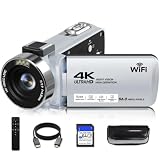
- 【56MP 4K Ultra HD & 18X Digital Zoom】This 4k camcorder captures smooth, high-resolution 4K Ultra HD videos that keep every frame sharp and true to life, and 56.0-megapixel photos that show fine textures, bright colors and small details clearly. The video camcorder paired with an F/2.0 large aperture for sharp details and vivid colors. 18X digital zoom lets you easily focus on distant subjects, making this digital camcorder perfect for daily life, travel, or short video creation.
- 【3.0-Inch 270°Rotatable Touchscreen】Featuring a 3.0-inch touchscreen with 270° free rotation, this camcorder offers flexible framing for selfies, low-angle shots, and group photos. The intuitive touch control design makes operation simple, allowing vloggers and beginners to master this 4k camcorder video camera quickly. No more awkward button fumbling—just tap, rotate, and shoot seamlessly with this user-friendly video camera.
- 【IR Night Vision & Multi-Shooting Modes】Press the “OK” button to activate the infrared filter. This night vision digital camcorder delivers high-contrast black & white video even in total darkness, providing clearer, more detailed footage than standard low-light color mode. It also supports multiple practical modes including slow motion, loop recording, time-lapse, and continuous shooting, meeting diverse creative needs for day and night scenarios.
- 【WiFi Transfer & Remote Control】Built-in WiFi enables easy connection to your mobile phone for fast file transfer and shooting control. You can instantly transfer all your videos and photos from the camcorder video camera to your phone, so you can share your favorite moments with friends or post them on social media anytime, anywhere, without the hassle of using cables or card readers. It comes with a remote control that supports remote shooting and video recording, offering hands-free convenience for solo creators, group shots, or scenarios where you need to avoid camera shake.
- 【Webcam for Live Streaming & TV Playback】Connect via USB-C cable to instantly use this camcorder as a webcam for live streaming or video calls. It also supports HDMI interface for direct TV playback, letting you share wonderful videos with family and friends on the big screen. Whether you’re live streaming on social media or hosting a home movie night, this 4k camcorder adapts to every scene effortlessly, and this digital camcorder’s dual-function design adds extra value for daily use.
Choose by venue and production job
| Your priority | Best fit | Reason |
|---|---|---|
| Dark club and video-first operation | Sony FX3 | Full-frame, video-focused design, fan, 4K/120p, and a compatible XLR-handle workflow |
| Long continuous sets | Panasonic GH7 | Fan-cooled design and extensive video features; still plan for power, media, and heat |
| Full-frame hybrid with internal RAW | Nikon Z6III | Internal 6K/60p RAW, stabilization, and dual-card workflow |
| Fast motion and compact reach | Fujifilm X-H2S | Stacked APS-C sensor and fast readout |
| Concert stills plus video | Canon R6 Mark III | Hybrid feature set and Canon AF ecosystem |
| Budget-conscious multi-camera production | Panasonic GH7 | Smaller-format lens system can leave more room in the budget for multiple bodies, audio, and support |
| Rear-of-venue reach | GH7 or X-H2S | Smaller sensors provide more apparent reach for a given focal length; framing and depth-of-field characteristics still differ |
| Locked-off balcony wide shot | Any shortlisted body that meets the recording-mode and lens needs | Tripod stability, power, media, and reliable focus can matter more than sensor format |
Plan for a complete recording, not just a camera body
Choose lenses for your position
- Wide stage or crowd view: A 16–35mm f/2.8 on full frame is useful when you can work close; equivalent framing on smaller formats requires different focal lengths.
- General coverage: A 24–70mm f/2.8 balances context and performer shots on full frame.
- Far from the stage: A 70–200mm f/2.8 is a common full-frame option; smaller-format systems can offer more apparent reach from a smaller lens.
- Very dark clubs: Fast 35mm, 50mm, or 85mm primes can gather more light than a slower zoom, at the cost of framing flexibility.
Get usable sound
Ask permission to take a feed from the venue mixing console, and ask the engineer about signal level, connector, and whether the feed includes effects or audience microphones. Record a separate ambient or audience microphone when possible, leave headroom for sudden peaks, and keep the camera microphone as a scratch or emergency track. Monitor for clipping before the performance. Synchronize tracks with timecode, a clap, or another clear reference. The FX3’s XLR route uses its compatible handle; Nikon supports line-in audio and XLR accessories; GH7 32-bit-float capability depends on the appropriate accessory. A field recorder, cables, adapters, and backup track belong in the budget.
Calculate media before the show
| Video bitrate | Approximate storage per hour |
|---|---|
| 200 Mbps | 90 GB |
| 400 Mbps | 180 GB |
| 1,000 Mbps | 450 GB |
These are bitrate calculations and exclude container overhead and additional audio tracks. Check the selected mode’s card requirements; inexpensive or underspecified media can cause recording stoppages or failed offloads. For a critical performance, multiple appropriately rated cards are safer than putting everything on one card.
Provide stable power and support
- Start with a fully charged battery and carry spares, even if using USB power. Confirm whether the body can operate while charging and whether the selected external supply provides the needed output.
- Use a tripod for a locked-off wide shot, a monopod in crowded audience positions, and a gimbal only where movement and venue rules make it practical.
- A cage or shoulder support can help with long lenses and external monitoring. Keep airflow around fan-cooled bodies; do not block vents with a cage or airtight cover.
- Use a safety tether when operating above or near a crowd, and check venue rules before bringing a rig or light.
Recording settings checklist
- Frame rate: 23.98/24p gives a cinematic motion cadence; 29.97/30p is a flexible general-purpose choice; 59.94/60p gives smoother motion and allows half-speed playback on a 30p timeline. Reserve 120p for selected slow-motion cutaways because it demands more light, storage, and processing.
- Shutter: Start around 1/50 second for 24p or 1/125 second for 60p, then test. LED refresh, strobes, regional power frequency, and motion style can call for a different shutter or variable-shutter adjustment.
- Exposure: Use manual exposure when stage conditions permit. Use zebras or waveform monitoring to protect faces and bright clothing or spotlights; do not expose only for the dark background, and avoid relying on heavy shadow lifting later.
- White balance: A locked setting usually makes multiple cameras easier to match than auto white balance that shifts with changing stage colors. Highly saturated lighting may lack color information that no white-balance setting can recover.
- Focus: Test face/eye AF with the actual lens. For a locked-off shot, consider a smaller focus area or manual focus; pre-focus on a likely stage position if AF struggles.
- Before record: Confirm codec, card speed and capacity, battery or external power, audio levels, focus behavior, camera airflow, and a safe card-change or backup-camera plan.
Troubleshoot common concert-recording failures
The camera overheats or stops
High frame rates or RAW, warm ambient conditions, direct stage light, blocked airflow, and accessories that add heat can contribute. If a warning appears, stop before shutdown if possible, switch to a lower frame rate or bitrate, remove unnecessary accessories, and improve airflow. For a performance that cannot be repeated, a second body is a safer plan than assuming any one camera will cover the entire show.
Autofocus hunts
Reduce the AF area, use face/eye detection only when the performer is reliably visible, or switch to manual focus with peaking. Pre-focus on a likely position and avoid sweeping through bright spotlights when tracking becomes unstable.
Audio clips
Lower input gain, verify whether the feed is mic- or line-level, and leave headroom for cheers and drum transients. A separate safety track recorded lower and a venue feed paired with an ambient microphone reduce dependence on a single source.
Best Value

- The Zoom Q2n-4K Handy Video Recorder pairs high-resolution UHD 4K video capture with up to 24-bit/96 kHz audio recording. Five FOV (field-of-view) settings and one-button recording enable you to easily capture yourself and/or your bandmates, whether for disseminating to your social media accounts or for reviewing a rehearsal or performance
- The XM-55 Shotgun Microphone Kit from includes a supercardioid condenser microphone and a wealth of accessories designed for use with video cameras and DSLRs. The off-axis signal attenuation provides focused audio pickup. The XM-55 features durable aluminum-alloy construction for indoor and outdoor use. It includes long and short (on-camera) audio cables with multiple connectors to support XLR, 1/8" (3.5mm) and 1/4" jacks.
- It comes with the 64GB Memory Card. For professionals working with today's cutting-edge photography and video equipment, Transcend's Class 10 SDXC/SDHC UHS-I cards provide an incredible level of performance and vast storage capacity to meet the demands of high-resolution image capture and full HD video recording. Additionally, the top-tier MLC NAND flash chips inside provide consistent long-life durability and endurance.
- This Zoom Q2n-4K Ultra High Definition Handy Video Recorder comes with a kit which includes the following, 1 Pro Shotgun Microphone Kit w/ Case and Accessories, 64GB Memory Card and a 3pc Cleaning Kit taking your Recording sessions to a whole new level.
- Full year warranty provided by Zoom.
LEDs flicker or band
Fixture refresh rate, shutter speed, power frequency, scan behavior, and pulse-width dimming can all contribute. Test shutter options during soundcheck and use anti-flicker or variable-shutter tools where available. If the problem persists, coordinate with the lighting operator; a higher frame rate is not a universal fix.
Footage looks noisy despite a full-frame body
Check for a slow lens, underexposure, excessive shadow lifting, an unnecessarily fast shutter, poor spectral quality from stage lights, or heavy cropping. A fast lens and sound exposure technique can improve the result more than changing between recent full-frame bodies.
A take is longer than the card or file can handle
Verify the exact codec’s file and card behavior, enable relay or dual recording where supported, use suitably rated media, and plan a safe change point. For a critical uninterrupted performance, consider two cameras rather than relying on a single long take.
Free tools Windows power users keep installed
One-click scans. No signup required.
Do you need 6K or 7K?
Higher resolution can help with reframing, but it also raises storage needs, editing load, card cost, and often power or heat demands. A stable, well-exposed 4K/60p recording is more useful than an overheated or underexposed 7K take. Select the mode for the delivery and crop flexibility you actually need, not the largest specification in the menu.
Frequently Asked Questions
Can I record a whole 90-minute set on one camera?
Possibly, but verify the exact recording mode’s time behavior, heat performance, card capacity, and power plan before the show. Manufacturer maximums apply only to specified conditions; a second angle is the safer option when missing footage is unacceptable.
Should I record in log?
Use log when you can expose carefully and have time for color grading. If fast turnaround matters, a more ready-to-use profile such as Sony S-Cinetone may simplify delivery; whichever profile you choose, protect highlights and test the look under the venue’s lighting.
How many cameras do I need for a concert?
One camera can cover a performance, but it cannot provide a second angle or protect against every focus, power, media, or heat failure. A locked-off wide camera paired with a tighter operated camera adds coverage and a backup recording.
Quick wins for a faster PC:
Scan for outdated or missing drivers - takes under a minuteDriver Scan →Repair Windows errors before they cause bigger problemsFix Now →Quick Recap
Product prices and availability are accurate as of the date/time indicated and are subject to change. Any price and availability information displayed on Amazon at the time of purchase will apply.

