Free tools Windows power users keep installed
One-click scans. No signup required.
Some links on this page are affiliate links: if you buy through them we may earn a commission, at no extra cost to you.
Hidden Spotify app references reported in June 2025 pointed to “Lossless,” FLAC, and audio up to 24-bit/44.1 kHz. They were a credible sign of development—not proof of a release date, a new paid tier, or final specifications. Spotify later launched Lossless for eligible Premium listeners, confirming the central clue while leaving some of the leak-era speculation behind.
What the Spotify app code revealed
In June 2025, reporting on Spotify app code surfaced interface text and references for a prospective Lossless option. The material reportedly included “Lossless music, now in Premium,” FLAC, a ceiling of 24-bit/44.1 kHz, and notices about track availability, network stability, compatible equipment, downloads, and Spotify Connect. The report described hidden app material; Spotify had not yet made a public launch announcement.
That distinction matters. App code can reveal work in progress, but it does not establish that a feature is complete, when or where it will launch, or how it will be sold. References to Premium did not prove whether Lossless would be included with existing plans or attached to a new tier. The leak did not confirm the often-discussed “Music Pro” or “Supremium” names, an extra fee, or universal device support.
Crashes, No Sound, or Screen Glitches?
Random freezes, missing sound and display glitches usually trace back to one bad driver. Find and replace yours safely.Free scan · under a minutePC Slower Than It Used to Be?
A free scan shows the junk files, broken settings and background clutter dragging Windows down - then fixes them in one click.Free scan · Windows 10 & 11A long wait after Spotify HiFi
The code leak landed in the shadow of a much older promise. In February 2021, Spotify announced Spotify HiFi, describing plans for CD-quality lossless audio on compatible devices and Spotify Connect-enabled speakers. Spotify’s original announcement set expectations, but the feature did not arrive then. The 2025 code references were notable because they suggested Spotify was preparing a concrete Lossless experience years after that announcement—not because they resolved its timing or commercial details.
#1 Best Overall

- IMPORTANT - READ THIS! Due to changes to Spotify’s platform, Spotify will no longer be supported on Mighty beginning April 21, 2027.**
- TAKE AMAZON MUSIC UNLIMITED & AMAZON MUSIC PRIME OFFLINE - Mighty downloads your streaming music allowing you to listen anytime, anywhere, without a screen or connection. Amazon Music Unlimited or Amazon Music Prime required.
- 8+ HOUR BATTERY - long enough for your longest walks, a week's worth of bedtime stories, or multiple trips to the gym.
- 1000+ SONGS - plenty of space for your many playlists, podcasts, and audiobooks.
- BLUETOOTH AND WIRED CONNECTIONS - Mighty works with Bluetooth headphones and speakers. Mighty also has a 3.5mm headphone jack for wired listening.
What “24-bit,” “44.1 kHz,” and FLAC mean
FLAC stands for Free Lossless Audio Codec. It compresses audio without discarding audio data, so decoding a FLAC file reproduces the encoded digital audio. The codec name alone does not specify the recording’s resolution, source master, or audible quality.
Bit depth describes the digital representation of each audio sample; sample rate is how many samples are recorded each second. Spotify’s stated maximum of 24-bit/44.1 kHz means 24-bit audio sampled 44,100 times per second. CD audio is generally 16-bit/44.1 kHz, so the sample rate is the same, while the bit depth differs. More bit depth can provide greater production headroom, but it does not guarantee that a recording will sound better to every listener.
Spotify’s key qualification is up to 24-bit/44.1 kHz. That is not a promise that every track is available at that resolution or that every playback path delivers it. Nor is it the same maximum sample rate as services that document 24-bit/96 kHz or 24-bit/192 kHz options. Calling Spotify’s offering simply “hi-res” without explaining the ceiling can mislead readers.
Quick wins for a faster PC:
Scan for outdated or missing drivers - takes under a minuteDriver Scan →Repair Windows errors before they cause bigger problemsFix Now →Rank #2

- No Setup, Just Play: Preloaded with Spotify, Spotify Kids, Amazon Music, Pandora, Deezer, TIDAL, and YouTube Music; save time and enjoy your favorite songs, audiobooks, and podcasts the moment you power on
- Hear Every Detail, Feel Every Note: HiBy Music preloaded for lossless playback; customizable modes adapt to your style; pure, uninterrupted sound keeps you immersed in music you love
- Open Stories, Dive In: Audible, Libby, and LibriVox preloaded; enjoy rich sound, free library books, and classic tales anytime for an easy, immersive storytelling experience
- Clearer Sound, Smoother Play: 12nm CPU powers stable performance; hardware-level FLAC/APE decoding reveals richer details in every track
- Stay Synced, Play Seamless: Android 14 with Google Play keeps apps updated automatically; your playlists, favorites, and subscriptions follow you across phone, tablet, and player
What happened after the leak
The central prediction proved accurate. On September 10, 2025, Spotify officially announced Lossless listening for Premium, with streaming up to 24-bit/44.1 kHz FLAC. Spotify said on October 6 that the feature had reached Premium users in more than 50 markets. Its support guidance describes the quality limit and notes that availability and playback depend on factors such as device compatibility and connection. “More than 50 markets” is broad availability, not a guarantee that the feature is available to every account or device worldwide.
So the 2025 code was a meaningful technical clue, and in retrospect it correctly foreshadowed Spotify’s launch. It did not validate every rumor attached to the long-delayed HiFi story. Spotify’s official launch language is Lossless on eligible Premium access, not a confirmed, separately priced “Spotify HiFi” subscription.
How to try Lossless—and check the playback path
- Update Spotify. Feature availability and menu labels can vary by app version, platform, and market.
- Choose Lossless in audio or media-quality settings. Spotify’s support instructions describe selecting the quality in the app. Exact menu wording and placement may differ on iOS, Android, desktop, and other platforms.
- Check the receiving device when using Spotify Connect. Select the quality for the connected device if that option is available, then look for Spotify’s Lossless indicator during playback. Spotify Connect’s Lossless information describes compatible playback and the indicator.
- Use a suitable connection and output device. Stable Wi-Fi can help avoid interruptions. Wired headphones or speakers, or a compatible network streamer or receiver, are more appropriate for preserving a lossless path than assuming ordinary Bluetooth earbuds will do so.
- Check track and account availability. A missing setting, a track without a lossless version, or an unsupported device can prevent the expected result. The “up to” specification is a ceiling, not a track-by-track guarantee.
Bluetooth is not a simple yes-or-no test: device and codec combinations vary, but Bluetooth commonly adds a lossy encoding stage. A Lossless label in Spotify does not by itself prove that lossless data reaches wireless headphones. Conversely, a cable does not automatically make a system bit-perfect: the phone or computer’s operating-system mixer, digital-to-analogue converter (DAC), equalization, normalization, or other processing can still alter output.
Rank #3
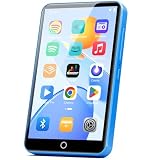
- 【Android 9.0 MP3 Music Player】The bluetooth MP3 player come with an 8-core MTK chip to make the music player respond faster and run more smoothly. This bluetooth music player comes pre-installed with many of the most popular online music Apps, including Spotify, Pandora, Deezer, Amazon music, etc.
- 【Great Solution to Stream Music】Built-in powerful audio decoding chip and superb circuit optimization technology, which can better convert the source code into the most original sound, providing HIFI-level sound effects close to the original. Compatible with most music formats, including MP3, WAV, FLAC, APE, OGG, M4A, AAC, WMA, etc.
- 【2GB RAM & 16GB storage】Our android MP3 player built in 2GB RAM and 16GB storage, supports to expand external storage up to 512GB, which can easily hold thousands of music, this can greatly satisfy your need to store more songs, videos, audiobooks.
- 【High-performance MP4 Player】This MP4 player with bluetooth and wifi is equipped with a 4" full-touch IPS screen and HiFi sound module, supports 720p, 1080p HD video playback, supported video formats are RM, RMVB, FLV, MP4, DAT, MKV, MPG, MOV, TS, and so on, can be played directly without conversion, which can bring you an unparalleled viewing experience.
- 【MP3 Player with Bluetooth & Wifi】This Wifi MP3 player supports wireless network connection, allowing you to download APP, listen music, videos playback online and surf the web. Feature with stable and fast two-way Bluetooth connection technology, which supports stereo and dual-channel audio for a latency-free connection to headphones, speakers or other playback devices.
Data use, storage, and buffering
Lossless streams and offline downloads use more data and storage than lower-quality compressed audio. Spotify’s support material warns about the increased demand; the 2025 leak coverage cited roughly 1 GB per hour as an estimate, not a fixed rate for every listener. Actual use varies with the audio, compression, selected resolution, buffering, and connection.
For context, uncompressed stereo 24-bit/44.1 kHz PCM is about 2.12 megabits per second before container or network overhead. FLAC compresses that data by a variable amount. Spotify streams are not always at the maximum resolution, so that raw figure should not be read as a guaranteed streaming rate. If your mobile data is limited, use Wi-Fi for streaming or downloads, and check available storage before saving Lossless music offline. If playback stutters, a higher bandwidth demand or unstable Wi-Fi or cellular connection may be responsible; try a steadier network or a lower quality setting.
Independent reader supportYour contribution helps us test, update, and keep practical guides available for everyone.Will it sound better?
Lossless describes what happens to audio data during compression; it is not a promise of a dramatic audible upgrade. A well-encoded 320 kbps stream may sound indistinguishable from a lossless version to many listeners in ordinary conditions. Perceived differences depend on the source master, playback equipment, room or listening environment, volume matching, hearing, and the care taken in comparing versions. A different master can make a bigger difference than the codec or nominal resolution.
Rank #4

- 🎅【Multifunctional】Portable MP3 player with Bluetooth 5.0 and WiFi, preloaded with Spotify, Apple Music, Audible, Amazon Music, Deezer. Built-in FM radio, video player, voice recorder, e-book reader, ideal for streaming music, offline videos and e-reading.
- 🎅【Stable Connectivity】Upgraded Bluetooth and WiFi ensure fast pairing with headphones, car stereos, mobile phones. Zero lag, stable connection for home, workouts, running, commuting and travel.
- 🎅【HiFi Lossless Audio】HiFi lossless music player with built-in speaker, supports MP3/FLAC/AAC/WAV/APE/OGG/WMA. Features lyric sync, custom playlists, adjustable EQ for crisp, immersive sound.
- 🎅【4-inch HD Touch Display】The mp4 player supports 1080P video playback (RMVB/MP4/MKV/FLV) no conversion needed. Powerful CPU for lag-free operation, one-key lock and screenshot for easy use. adjustable EQ for crisp, immersive sound.
- 🎅【Large Storage & Long Battery】80GB storage (2GB RAM+16GB ROM+64GB expandable), 2000mAh Type-C rechargeable battery. Up to 40hrs music playback, 3-5 months standby, perfect for outdoor travel and daily use.
That does not make lossless pointless. Listeners may value avoiding lossy compression, and a compatible wired or networked system can preserve the source data more directly. But there is no universal guarantee that changing the setting will produce a clearly audible improvement—particularly if Bluetooth or another processing stage changes the signal downstream.
How Spotify’s published maximum compares
| Service | Officially documented lossless or hi-res ceiling | Practical distinction |
|---|---|---|
| Spotify | Up to 24-bit/44.1 kHz FLAC on eligible Premium access. | Lossless integrated with Spotify Premium and its discovery, playlist, and Connect ecosystem; the published sample-rate ceiling is lower than those below. |
| Apple Music | ALAC from 16-bit/44.1 kHz up to 24-bit/192 kHz, according to Apple’s support documentation. | Higher stated maximum resolution, but output depends on device compatibility and playback setup. |
| TIDAL | Up to 24-bit/192 kHz HiRes FLAC on Max, subject to supported content and partners, according to TIDAL’s support page. | Higher stated maximum and FLAC support; check track and device compatibility. |
Higher numbers do not automatically mean better sound. The more useful questions are whether the service has the album you want in lossless form, works with your equipment, supports the listening and download habits you care about, and fits your preferred playlists and discovery tools. Spotify may suit someone who already values its ecosystem and wants Lossless without moving their library. Apple Music or TIDAL may appeal to listeners seeking higher documented maximum resolutions, provided their devices and content support them.
The Tool Desk
Outbyte PC Repair FREEClear out junk files and repair common Windows errorsFree Scan →Outbyte Driver Updater FREEScan for outdated or missing drivers - takes under a minuteDriver Scan →Verdict: an accurate clue, not a complete confirmation
The June 2025 app-code discovery was real evidence of Spotify preparing Lossless playback, and the later Premium rollout confirmed its most important clues: FLAC and up to 24-bit/44.1 kHz. The leak did not prove a launch date, extra charge, new tier, or 192 kHz support. For listeners today, the practical question is less whether the code was right than whether Lossless is available on their account, for the track and device they use, and whether the full playback chain preserves it.
Quick Recap
Product prices and availability are accurate as of the date/time indicated and are subject to change. Any price and availability information displayed on Amazon at the time of purchase will apply.

