The Tool Desk
Outbyte PC Repair FREERepair Windows errors before they cause bigger problemsFix Now →Outbyte Driver Updater FREEFix the driver behind crashes, sound loss and screen glitchesFind Drivers →Sally Ride became the first American woman to fly in space on June 18, 1983, aboard the space shuttle Challenger. Her legacy reaches beyond that milestone: she carried out technical work on two shuttle missions, served on investigations into the Challenger and Columbia disasters, and spent her later career advancing science education. It is also a more complicated story of public scrutiny and private life, including a 27-year partnership with Tam O’Shaughnessy that became widely acknowledged after Ride’s death.
Who was the first American woman in space?
Sally Ride was the first American woman to fly in space. She launched aboard Challenger on STS-7 on June 18, 1983, as a mission specialist. She was 32. The distinction is specifically American: Soviet cosmonaut Valentina Tereshkova had flown in space in 1963, almost 20 years earlier. NASA’s history of STS-7 places Ride’s achievement in that longer chronology.
| # | Preview | Product | Price | |
|---|---|---|---|---|
| 1 |

|
Sally Ride: America's First Woman in Space | $11.05 | Buy on Amazon |
| 2 |

|
Who Was Sally Ride? | $6.18 | Buy on Amazon |
| 3 |

|
I am Sally Ride (Ordinary People Change the World) | $10.90 | Buy on Amazon |
| 4 |
|
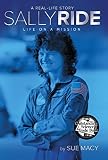
Sally Ride: Life on a Mission (A Real-Life Story) | $7.99 | Buy on Amazon |
| 5 |
|
Sally Ride (Little People, BIG DREAMS, 110) | $14.04 | Buy on Amazon |
Ride’s selection reflected a change in who could enter the astronaut corps. In 1978, NASA chose her as one of six women in its first astronaut class to include women. The group was selected from 8,000 applicants alongside 29 men. Shuttle-era recruitment expanded astronaut selection beyond pilots, opening the way for women to qualify as mission specialists. NASA Science’s biography and NASA’s historical account describe the class and the selection context.
What did Ride do on her space missions?
STS-7: a working mission specialist
Ride’s first flight was not simply a symbolic appearance. STS-7 deployed communications satellites and conducted experiments. Ride operated the shuttle’s robotic arm to deploy and retrieve the Shuttle Pallet Satellite, SPAS-01. Her role was technical as well as historic. NASA’s STS-7 history details the mission work.
Outdated Drivers Are Slowing You Down
One free scan finds every outdated or missing driver and matches the right update for your exact hardware.Free scan · exact hardware matchPC Slower Than It Used to Be?
A free scan shows the junk files, broken settings and background clutter dragging Windows down - then fixes them in one click.Free scan · Windows 10 & 11#1 Best Overall
STS-41G: a second flight
In 1984, Ride flew again, aboard STS-41G. Two spaceflights make clear that her place in NASA’s story was not limited to a one-time first. NASA’s biography of Ride and NASA Science profile record both missions.
Why was Ride’s first flight a complicated public moment?
The achievement arrived amid questions that exposed assumptions about women in a traditionally male institution. Before launch, reporters asked Ride about reproduction and makeup, according to the National Women’s History Museum. Ride later reflected on the attention: “It’s too bad this is such a big deal. It’s too bad our society isn’t further along.”
Rank #2
Ride understood that the milestone carried expectations beyond the mission itself. In an interview marking the 25th anniversary of her flight, she said: “The fact that I was going to be the first American woman to go into space carried huge expectations along with it.” The quote appears in NASA Science’s profile. The tension is central to her legacy: a significant achievement could open doors and still be received through gendered questions and scrutiny.
How did Ride contribute after leaving NASA?
Investigating shuttle disasters
After the 1986 Challenger accident, Ride served on the Rogers Commission, the presidential commission that investigated the disaster. She later served on the board investigating the Columbia disaster. These roles placed her in the difficult work of examining failures in the shuttle program, not only celebrating its accomplishments. NASA’s Ride biography and NASA Science profile record her service.
Rank #3
Teaching and building science education
Ride left NASA and joined the University of California, San Diego, as a professor of physics in 1989. She also advised on space policy and worked to encourage girls and young women to take part in science, technology, engineering and mathematics. In 2001, Ride and colleagues founded Sally Ride Science to support that work; NASA says the organization is now part of UC San Diego. NASA’s biography describes her post-NASA career.
Ride’s educational work connected visibility with opportunity: children need to see people like themselves doing science, but they also need encouragement to pursue it. Her partner, Tam O’Shaughnessy, recalled Ride’s words: “Sally liked to say, ‘You can’t be what you can’t see.’” NASA quoted O’Shaughnessy at a 2023 commemoration. NASA’s account of that event also quotes Deputy Administrator Pam Melroy: “The girls and young women of that era saw a woman breaking the ultimate glass ceiling. She was more than just history. She was one of us, and she was all of us.”
Ride also wrote science books for children about space exploration, Earth and the solar system. NASA’s STS-7 history notes that work. NASA Science reproduces her advice to students: “Keep interested in science and do well in your math and science classes. Science and math education is critical to our country’s future.” NASA Science’s profile attributes the quote to Ride.
Independent reader supportYour contribution helps us test, update, and keep practical guides available for everyone.What is known about Ride and Tam O’Shaughnessy?
Ride and O’Shaughnessy were life partners for 27 years. Their relationship was not publicly known in the same way during Ride’s career; after Ride died, accounts acknowledged their partnership. The National Women’s History Museum discusses their relationship, and NASA described the 27-year partnership in its 2023 account of Ride’s legacy. The public record supports saying that their relationship became more openly recognized after her death; it does not establish that everyone around Ride was unaware of it during her lifetime.
Best Value
How is Ride’s legacy remembered?
Ride died of pancreatic cancer in 2012, aged 61. In 2013, she posthumously received the Presidential Medal of Freedom. NASA’s biography and the National Women’s History Museum document those milestones.
Her story holds together several distinct contributions: the first American woman’s spaceflight, substantive mission work, public service after two shuttle disasters, and sustained science education. The complications matter too. Ride’s achievement was treated as a gendered spectacle, while a central relationship in her life was more openly acknowledged after her death. Commemorative language describes her impact, but the sources cited here do not quantify how many people she inspired or measure the present-day effects of her legacy.
Quick Recap
Product prices and availability are accurate as of the date/time indicated and are subject to change. Any price and availability information displayed on Amazon at the time of purchase will apply.