What’s actually slowing this PC down?
Pick the symptom - the matching free tool is one click away.
Some links on this page are affiliate links: if you buy through them we may earn a commission, at no extra cost to you.
UHD delivers the most potential detail, but it is not automatically the best choice. For a large 4K television with close seating, genuine 4K content, HDR support and a reliable connection, UHD can look spectacular. For many laptops, tablets, phones and ordinary living rooms, HD is the better balance of clarity, compatibility, data and cost. SD remains useful when bandwidth, storage, device age or source quality matter more than fine detail.
SD, HD and UHD at a glance
| Format | Typical consumer resolution | Best fit | Main compromise |
|---|---|---|---|
| SD | 360p or 480p | Small screens, weak connections, data saving and older material | Soft or visibly pixelated on a large modern television |
| HD | 720p or 1080p (Full HD is commonly 1920 × 1080) | Everyday streaming, laptops, tablets and most living rooms | Less fine detail than UHD on a large or close-viewed screen |
| UHD/consumer “4K” | 3840 × 2160 | Large 4K displays, close seating, films, sports and detailed games | Higher data, equipment and subscription demands; benefit may be subtle |
These labels describe image dimensions, not complete picture quality. YouTube classifies 360p/480p as typical SD, 720p–1080p as HD and 2160p as UHD. In consumer television, “4K” usually means 3840 × 2160 UHD; professional cinema 4K can use different dimensions.
What the labels actually mean
SD: efficient, compatible and sometimes sensible
Standard definition uses the least bandwidth and storage. It can be the right choice for a small phone window, background viewing, mobile data, an unstable connection or a poorly preserved documentary whose “HD” version is merely an enlarged copy. On a modern television, however, SD scaling makes faces, captions and fine textures look soft.
HD: the practical default
HD is a substantial improvement over SD without UHD’s extra demands. Good 1080p is normally sharp enough for a laptop, tablet or typical television viewed from a sofa. It is also more widely supported and often costs less. HD does not imply HDR: a title can be HD SDR or HD HDR.
#1 Best Overall
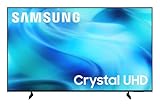
- CRYSTAL PROCESSOR: Powerful processor enhances colors and sharpens details for a vibrant 4K viewing experience. Experience every shade of color as it was meant to be seen in dazzling 4K. Plus, make your movies, TV shows, games and sports look even better with powerful 4K upscaling.
- ENDLESS FREE CONTENT: Watch 2,700+ free streaming options, including 750+ subscription-free channels on Samsung TV Plus. Enjoy news, sports, movies, kids' shows and reality TV — all without a subscription. Discover endless entertainment with new content added regularly, tailored to your mood and interests.*
- MOTION XCELERATOR: Experience clear picture and smooth motion in games and sports. Enjoy smooth motion and clear visuals with technology that estimates and adjusts frame transitions in real time. Whether gaming or watching sports, enjoy up to 4K 60Hz performance that brings every play, move and scene to life with realistic clarity and motion.
- COLOR BOOSTER: Supercharge your color. From fiery reds to sparkling blues, make every color come to life with intensity. Color Booster transforms your content into a visual masterpiece.
- 4K UPSCALING: Upgrades what you watch to crisp 4K clarity. Upgrade your favorite shows, movies and more. Experience incredible details and clarity in every frame, even from lower-quality sources, with advanced upscaling technology.
UHD: four times the pixels of 1080p
Consumer UHD uses 3840 × 2160 pixels—four times the pixel count of 1920 × 1080. That extra information is easiest to see on a large screen, at a shorter viewing distance, or in footage rich in foliage, landscapes, text, fabric and other fine textures. A 4K badge describes the delivery format, not necessarily the camera capture or mastering path. A film may originate from a 2K intermediate, an old scan or an upscaled master.
Resolution is only one part of picture quality
HDR and resolution answer different questions. Resolution counts pixels. HDR expands the range of brightness, contrast and color. Apple distinguishes HDR, HDR10+, and Dolby Vision; the latter formats can use dynamic metadata to adjust scenes or frames on compatible systems. A well-mastered HD HDR presentation can look more convincing than a heavily compressed UHD SDR stream.
Also consider bitrate, codec, the original master, black levels, peak brightness, color accuracy, viewing angles, reflection handling and motion processing. Dark scenes, smoke, water, confetti and film grain expose compression quickly. A high-quality 1080p panel can look better than a poor 4K panel with weak contrast or inaccurate HDR tone mapping.
When will UHD look visibly better?
- Screen size: larger displays reveal more of UHD’s fine detail.
- Viewing distance: sitting closer makes additional pixels easier to resolve; from far across a room, HD may appear almost identical.
- Content: nature documentaries, sports, detailed productions and games benefit more than soft, low-detail footage.
- Source quality: native 4K capture or a high-quality film scan preserves more detail than a simple upscale.
- Vision and preferences: visual acuity and sensitivity to detail vary, so there is no universal “sit exactly this far away” rule.
A 4K television can upscale HD and SD, but upscaling estimates missing pixels; it cannot recreate detail absent from the source. Good HD may look clean, while poor SD can reveal artifacts more clearly after enlargement.
Rank #2

- 4k Ultra HD (2160p resolution): Enjoy breathtaking HDR10 4K movies and TV shows at 4 times the resolution of Full HD, and upscale your current content to Ultra HD-level picture quality.
- High Dynamic Range: Provides a wide range of color details and sharper contrast, from the brightest whites to the deepest blacks.
- All-in-one: Get right to your good stuff. With Fire TV, you can enjoy a world of entertainment from apps like Prime Video, Netflix, Disney+, Hulu, and HBO Max. Plus, stream for free with Fire TV Channels, Pluto TV, Tubi, and more. Access over 1.8 million movies and TV episodes. Subscriptions may be required. Feature and content availability may vary.
- Smart Home: Your smart home hub. Pair Fire TV with compatible smart home devices to see live camera feeds, use AirPlay, control your lighting and thermostat, and more.
- Free Content: Stream for free. Access over 1 million free movies and TV episodes from popular ad-supported streaming apps like Fire TV Channels, Tubi, and Pluto TV. Subscriptions may be required. Feature and content availability may vary.
When HD is the smarter choice
Choose HD when your screen is small or viewed from a normal distance, UHD costs substantially more, your connection is shared or capped, or the title is casual background viewing. HD is often the best value for everyday documentary watching because it preserves clarity while reducing buffering risk and data use.
When SD still makes sense
SD is a rational compromise for a weak or congested connection, limited mobile data, offline downloads where storage is scarce, an older television, a small preview window or archival material with no genuinely better master. It is not equal to UHD, but uninterrupted playback can be a better real-world experience than a constantly buffering high-resolution stream.
Bandwidth, data and device requirements
UHD normally uses more data and needs a steadier connection, but speed figures are provider-specific. YouTube recommends a consistent 15 Mbps for UHD. Netflix cites at least 15 Mbps for Ultra HD in its Roku and Xbox guidance. Apple recommends 25 Mbps for 4K streaming and says playback can automatically fall back to a lower quality. These are not universal guarantees: household congestion, Wi-Fi interference, router placement, simultaneous users and ISP conditions also matter.
The Tool Desk
Outbyte Driver Updater FREEScan for outdated or missing drivers - takes under a minuteDriver Scan →Outbyte PC Repair FREERepair Windows errors before they cause bigger problemsFix Now →To see native UHD, the display must be 4K-capable. A non-4K television may receive, downscale or trigger a lower-quality stream depending on the service and device. Apple TV 4K works with HD televisions, but Apple requires a 4K HDR television for 4K HDR viewing. Plans, regional licensing, apps, streaming boxes and HDMI/HDCP compatibility can limit availability. Apple also notes that a 4K version may not be downloadable even when it streams.
Rank #3
- CRYSTAL PROCESSOR: Powerful processor enhances colors and sharpens details for a vibrant 4K viewing experience. Experience every shade of color as it was meant to be seen in dazzling 4K. Plus, make your movies, TV shows, games and sports look even better with powerful 4K upscaling.
- ENDLESS FREE CONTENT: Watch 2,700+ free streaming options, including 750+ subscription-free channels on Samsung TV Plus. Enjoy news, sports, movies, kids' shows and reality TV — all without a subscription. Discover endless entertainment with new content added regularly, tailored to your mood and interests.*
- MOTION XCELERATOR: Experience clear picture and smooth motion in games and sports. Enjoy smooth motion and clear visuals with technology that estimates and adjusts frame transitions in real time. Whether gaming or watching sports, enjoy up to 4K 60Hz performance that brings every play, move and scene to life with realistic clarity and motion.
- COLOR BOOSTER: Supercharge your color. From fiery reds to sparkling blues, make every color come to life with intensity. Color Booster transforms your content into a visual masterpiece.
- 4K UPSCALING: Upgrades what you watch to crisp 4K clarity. Upgrade your favorite shows, movies and more. Experience incredible details and clarity in every frame, even from lower-quality sources, with advanced upscaling technology.
A practical decision guide
| Your situation | Best default |
|---|---|
| Large 4K television, close seating and strong internet | UHD, preferably with well-supported HDR |
| Typical living-room television | HD is sufficient; choose UHD when the premium is modest |
| Phone, tablet or small laptop | HD; SD when saving data is important |
| Weak, unstable or shared connection | HD or SD for reliable playback |
| Detail-rich film, sports or documentary | UHD if the source and display genuinely support it |
| Older or poorly preserved material | The best-looking available master, often HD or SD |
| Gaming | UHD only if its frame-rate and latency trade-offs suit the game |
| Text-heavy or accessibility-focused viewing | Use the sharpest comfortable setting, but prioritize scaling, contrast and readable text |
If UHD is not appearing
- Confirm that the specific title offers UHD and that your plan or purchase includes it.
- Check that the television is natively 4K and that the app and streaming device support UHD.
- Set output to 4K or Auto and playback quality to Auto or High where required.
- Check the HDMI port, HDCP requirements and cable. Roku specifies a compatible 4K television with an HDCP 2.2 port and a High Speed HDMI cable for 4K playback.
- Measure the connection during playback, not only the advertised ISP speed.
- Reduce congestion, move closer to the router or use Ethernet.
- Restart the app, streaming device and router, then check for service or licensing restrictions.
For example, Netflix’s Roku requirements include a qualifying Ultra HD plan, compatible 4K television and device, HDCP 2.2, at least 15 Mbps and Auto or High streaming quality.
If UHD looks worse than HD
Compare the same scene with identical picture settings. A UHD stream may use heavier compression, a different master or poorly handled HDR. Excessive sharpening, motion smoothing, inaccurate tone mapping or a display that is not bright enough for HDR can also hurt the image. A badge may describe what is offered, not the quality currently delivered; adaptive streaming can fall back to HD during congestion.
Bottom line
Pick the highest quality your source, screen, device chain, connection, budget and viewing distance can usefully support. UHD is the best technical option for large-screen, close-up viewing of genuine high-quality content. HD is the strongest all-around choice for most everyday screens and households. SD remains valuable when efficiency, compatibility or reliable playback matters more than maximum detail.
Quick wins for a faster PC:
Scan for outdated or missing drivers - takes under a minuteDriver Scan →Clear out junk files and repair common Windows errorsFree Scan →Fix the driver behind crashes, sound loss and screen glitchesFind Drivers →Frequently Asked Questions
Does 4K always mean HDR?
No. UHD and HDR are separate features; a title can be 4K SDR, 4K HDR, HD HDR or HD SDR.
Rank #4

- 4k Ultra HD (2160p resolution): Enjoy breathtaking HDR10 4K movies and TV shows at 4 times the resolution of Full HD, and upscale your current content to Ultra HD-level picture quality.
- High Dynamic Range: Provides a wide range of color details and sharper contrast, from the brightest whites to the deepest blacks.
- All-in-one: Get right to your good stuff. With Fire TV, you can enjoy a world of entertainment from apps like Prime Video, Netflix, Disney+, Hulu, and HBO Max. Plus, stream for free with Fire TV Channels, Pluto TV, Tubi, and more. Access over 1.8 million movies and TV episodes. Subscriptions may be required. Feature and content availability may vary.
- Smart Home: Your smart home hub. Pair Fire TV with compatible smart home devices to see live camera feeds, use AirPlay, control your lighting and thermostat, and more.
- Free Content: Stream for free. Access over 1 million free movies and TV episodes from popular ad-supported streaming apps like Fire TV Channels, Tubi, and Pluto TV. Subscriptions may be required. Feature and content availability may vary.
Can an HD television play a UHD stream?
Some services or devices downscale it or automatically select HD, but an HD panel cannot display native 4K detail.
Does a faster internet plan guarantee UHD?
No. Service eligibility, device support, Wi-Fi conditions, household congestion and the title’s license also affect playback.
Do I need an expensive HDMI cable?
No. You need a cable and port that meet the required bandwidth and HDCP standard; premium branding alone does not improve picture quality.
Quick Recap
Product prices and availability are accurate as of the date/time indicated and are subject to change. Any price and availability information displayed on Amazon at the time of purchase will apply.

