The Tool Desk
Outbyte Driver Updater FREEFix the driver behind crashes, sound loss and screen glitchesFind Drivers →Outbyte PC Repair FREEClear out junk files and repair common Windows errorsFree Scan →Overlanding is self-reliant travel to remote destinations, with the journey and exploration as the main objective. Off-roading is the technical activity of driving over challenging terrain. An overland trip may include difficult off-road trails, and an off-road outing may include camping, but the labels describe different priorities: sustained travel and self-sufficiency versus terrain and driving challenge.
The difference in one sentence
Overlanding is a form of travel. Off-roading is a form of driving.
The distinction is about the dominant purpose of the trip, not a strict vehicle category. Someone crossing a remote region while carrying food, water, shelter, navigation equipment and repair supplies is overlanding even if much of the route is on ordinary roads. Someone spending an afternoon testing traction, clearance and vehicle control on mud, rocks or sand is off-roading even if the outing involves no overnight stay.
There is substantial shared territory. An overlander can be an off-roader when a route reaches a technical trail, while an off-roader can camp or travel between trail systems. Enthusiasts may reasonably describe themselves as campers, adventure travelers, explorers and off-roaders at the same time.
#1 Best Overall

- 4 IN 1 TOW STRAP KIT: This towing strap set includes 1 tow strap (3in x 20ft , Orange), 2pcs 3/4" D-ring shackles and 1pcs storage bag.
- RECOVERY STRAP: Our Heavy Duty Tow Strap made from high-level Polyester, Lab Tested and Certified 35,000lbs Break Strength!
- D RING SHACKLES: Ultra-safe D-ring shackle with electro galvanized coating and silicon bumper protector. Lab Tested and Certified 45,000lbs Capacity!
- Versatile Applications: Rugged and top quality, works well with full-size pickups, ATV, SUV, UTV and even boats! This recovery set is ideal for towing large trucks, pulling heavy equipment; An essential tool for off-roaders.
- All-Weather Towing: Our weather-resistant tow strap is perfect for emergency roadside use, maintaining their integrity in rain, snow, or ice, making them a must-have for your vehicle's toolkit.
What overlanding means
A journey-first definition
The Overland Expo Foundation defines overlanding as “Self-reliant travel to remote destinations, where the journey itself is the primary goal.” Overland Expo uses similar wording, describing self-sufficient vehicle or adventure-motorcycle travel in which the journey is the goal. The emphasis is on reaching places and experiencing the route rather than simply conquering an obstacle.
“Remote” does not necessarily mean that every mile is technically difficult. A route can combine paved highways, graded gravel, forest roads and demanding tracks. What makes it overlanding is the sustained, self-supported trip and the destination or exploration it enables.
Self-sufficiency is central
Overlanders plan to operate away from normal services for an extended period. That generally means carrying:
- Food and a way to store or prepare it
- Drinking water and a method of managing the supply
- Shelter and sleeping equipment
- Navigation tools and route information
- Tools, spare parts and basic repair capability
- Recovery equipment for situations in which the vehicle cannot proceed under its own traction
The exact load depends on the route, season, vehicle and available resupply points. The principle is independence: the trip should not depend on finding a shop, hotel, fuel station or recovery service at every stage.
Recommended Free Tools
Typical trip pattern
Overlanding commonly involves long-distance or multi-day travel, but there is no universal minimum distance or number of nights. A short expedition can still be overlanding if it is remote and self-supported; a long drive between cities is not automatically overlanding if it does not involve that style of exploration and independence.
What off-roading means
A terrain-first activity
Off-roading is the deliberate use of a vehicle on surfaces and routes that are rougher or less controlled than ordinary roads. Dirt, mud, gravel, sand and rocks are common examples. The objective may be learning vehicle control, completing a trail, testing equipment or overcoming specific obstacles.
The NWCG glossary defines an off-road vehicle as “Any motorized vehicle designed for, or capable of, cross-country travel on or immediately over land, water, sand, snow, ice, marsh, swampland, or other terrain.” That broad definition describes capability and operating environment; it does not require a camping trip or a particular duration.
Rank #2

- AMERICAN OWNED, FAMILY OPERATED - Join the Rhino USA Family and Support a Father/Son Business With the Best USA-Based Customer Support.
- ULTIMATE STATIC STRAP - Crafted from Durable Polyester, Our Weather-Resistant Strap Ensures Long-Lasting Performance, Superior Strength, and Reliable Protection During Recovery Situations
- USED FOR FLAT RECOVERY - Ideal for Towing or Pulling Vehicles that are Stuck on Flat Surfaces, Providing a Reliable Solution for Recovering Vehicles Without Damaging Them.
- TRIPLE REINFORCED ENDS - High Tensile Loop Ends Provide Protection Against Wear and Tear, Abrasion, and Load Stress, Ensuring Durable and Secure Connection Points When Recovering
- REAL LIFETIME REPLACEMENT - All Rhino USA Products Come With a Lifetime Replacement. If you Encounter any Issues, We'll Ensure You're 100% Satisfied With a Replacement or Refund.
Short outings are common
An off-road session can last minutes or hours and can take place close to home, at a managed riding area or on a trail network. The driver may return to a base, trailer or nearby lodging the same day. Because the activity is centered on terrain, the trip does not inherently require the food, water and shelter load associated with extended overland travel.
Free tools Windows power users keep installed
One-click scans. No signup required.
Driving technique and obstacles
Off-roading often focuses on the technical demands of the route: maintaining traction, choosing a line, controlling speed, managing wheel placement and using the vehicle’s clearance and articulation. Recovery equipment may be important, particularly where mud, steep grades, loose sand or rocks can stop a vehicle, but the outing’s purpose remains the driving challenge.
Overlanding and off-roading compared
| Comparison point | Overlanding | Off-roading |
|---|---|---|
| Primary goal | Reach remote places and experience the journey through self-reliant travel. | Drive over challenging terrain, improve technique or complete obstacles. |
| Typical duration | Often long-distance or multi-day, with the vehicle supporting the trip. | May be a short outing lasting minutes or hours. |
| Terrain | Can include paved roads, gravel and difficult trails; technical difficulty is not the defining feature. | Rough surfaces and obstacles such as dirt, mud, sand, gravel and rocks are central. |
| Supplies | Food, water, shelter, navigation, repair and recovery supplies for extended travel. | Equipment suited to the terrain and recovery needs; an extended support load is not inherent. |
| Vehicle priorities | Reliability, fuel range, payload, navigation, shelter and the ability to repair or recover the vehicle. | Traction, ground clearance, wheel articulation, suspension and torque. |
| Route choice | Selected for the destination, exploration and sustainable progress. | Selected for the driving challenge or terrain experience. |
| Legal concern | Every road or trail must be open to the vehicle class being used. | The same designated-route and vehicle-class rules apply. |
Is overlanding just off-roading?
No. Off-roading can be one component of an overlanding journey, but it is not the whole definition.
Consider two trips. In the first, a driver spends three hours working through a muddy trail, then returns home. That is off-roading. In the second, a traveler spends several days crossing a remote area, carrying water, food, shelter and navigation equipment. The route includes a paved approach, gravel roads and one rocky trail. That is overlanding, even though only part of the journey is technically off-road.
The reverse is also possible: a group may camp near a trail and spend the day practicing difficult obstacles. Camping adds an overnight element, but the dominant purpose can still be off-roading if the technical driving is what defines the outing.
How vehicle preparation differs
Preparing for overlanding
Overland preparation starts with dependable travel over the whole route, not maximum performance on one obstacle. Priorities include:
- Reliability: Mechanical condition matters because a failure far from services can end the trip.
- Range: Fuel planning must account for distance between supplies and the possibility of detours or slow terrain.
- Payload: The vehicle must safely carry people, water, food, shelter, tools and recovery equipment.
- Navigation: Route information and navigation tools support travel where ordinary road signs or mobile coverage may be limited.
- Shelter: Sleeping and weather protection are part of the travel system.
- Repair and recovery: The crew needs a way to address routine problems and move the vehicle when traction is insufficient.
Adding equipment without checking payload, reliability and access can make an overland vehicle less useful. The objective is a balanced system that can travel, camp and recover safely over the intended route.
Rank #3
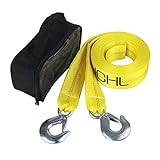
- 2 inch x 20 feet Yellow High Strength Polyester Strap, 20,000Lb Break Strength Capacity
- Extra heavy-duty tow strap made from high tensile strength nylon which makes the product to withstand pressure. 20,000 lbs towing capacity ensures that you can tow just about anything you need.
- Universal Use: Heavy duty tow strap 3"*20 ft, 20,000 LB capacity making it reliable for all possible needs. There's a wide range of uses for Vehicle towing, Pickup Trucks, ATV, SUV .Also you can use it as a tree saver strap or winch extension strap.
- 2 forged safety hooks with retaining clips, ZINC coated finish on hooks offer three times more corrosion resistance.
- Storage Bag: come in a storage bag, Roll up the strap and secure in place in free storage bag. JCHL Team strive to provide you highest quality products and best service, 100% satisfaction guarantee.
Preparing for off-roading
Off-road setup concentrates on how the vehicle interacts with difficult ground. Common priorities are:
- Traction on loose, wet or uneven surfaces
- Ground clearance to reduce contact with obstacles
- Wheel articulation so tires can remain in contact with the ground
- Suspension suited to the expected terrain
- Torque and controllable power for climbs, ruts and obstacles
- Recovery equipment appropriate to the vehicle and trail
That equipment can also help an overlander, but it does not replace the range, payload, shelter and resupply planning required for a remote journey.
Does overlanding require a 4×4?
No. Overlanding is defined by self-reliant travel and the journey, not by a four-wheel-drive label. Adventure motorcycles and vehicles using ordinary roads can fit the definition, and a route may not require four-wheel drive at all.
A 4×4 can be valuable when the planned route includes mud, sand, rocks, steep grades or seasonal conditions that reduce traction. It is a route and risk decision rather than a universal entry requirement. Choose a vehicle that is reliable, has enough carrying capacity for the people and supplies, and can handle the roads and trails legally available to you.
Likewise, a highly capable 4×4 is not automatically an overland vehicle. If it is used for short technical sessions without self-supported travel, the activity is off-roading.
What gear do you need for overlanding?
Gear should follow the route, climate, duration and resupply plan. A practical overland kit is built around five functions.
Living away from services
- Food and food-storage equipment
- Enough drinking water for the planned section, with a margin for delays
- Shelter and sleeping equipment suited to expected conditions
These items allow the crew to remain at the destination or along the route rather than ending the trip when normal services disappear.
Rank #4

- Our 2 inch x 20 feet Heavy Duty Tow Strap made from High Strength Polyester, which is more durable and UV resistant as well as for 10% MAX stretch while under load 26,000Lb Break Strength Capacity
- Extra heavy-duty tow strap made from High Strength Polyester which makes the product to withstand pressure. 26,000lbs towing capacity ensures that you can tow just about anything you need.
- Universal Use:There's a wide range of uses for Vehicle towing, Pickup Trucks, ATV, SUV .Also you can use it as a tree saver strap or winch extension strap.The towing strap works in all climates, and will not stretch, shrink
- Storage Bag: come in a storage bag, Roll up the strap and secure in place in free storage bag.
- JCHL Team strive to provide you highest quality products and best service, 100% satisfaction guarantee.
Finding the route
- Navigation tools and current route information
- A way to confirm position and follow the legal route
- Backup information in case the primary navigation method fails
Navigation is not only about avoiding getting lost. It helps the traveler distinguish a planned route from a closed road, a private track or a trail restricted to a different vehicle class.
Keeping the vehicle moving
- Tools and basic repair supplies
- Recovery equipment matched to the vehicle and recovery points
- Spare parts or consumables for likely failures
The right kit depends on the vehicle and trip. Carrying equipment that cannot be safely used can create additional risk, so every traveler should understand the equipment before leaving.
What gear matters most for off-roading?
Off-road equipment is selected for the obstacles and surface conditions expected on the trail. Traction, clearance, articulation, suspension and torque determine how the vehicle approaches terrain. Recovery equipment is also important when a vehicle loses traction or cannot safely continue.
What’s actually slowing this PC down?
Pick the symptom - the matching free tool is one click away.
Unlike overlanding, an off-road outing does not inherently require a shelter, extended food supply or large water load. Those items become relevant when the outing includes camping or remote travel, which moves the trip toward the overlap between the two activities.
Independent reader supportYour contribution helps us test, update, and keep practical guides available for everyone.Choosing the right activity for your goal
Choose off-roading when the driving challenge is the point
Off-roading is the closer fit if you want to practice vehicle control, explore difficult surfaces, work through obstacles or improve your understanding of traction and vehicle dynamics. A managed trail area or a short legal route can provide that experience without committing to a multi-day expedition.
Choose overlanding when travel and exploration are the point
Overlanding fits better when you want to reach remote destinations, link multiple areas into one route and remain self-sufficient between services. The most important planning questions concern distance, resupply, shelter, navigation, reliability and what you will do if the vehicle needs repair or recovery.
Use both when the route demands both
Many trips are deliberately mixed. An overland itinerary can use ordinary roads to cover distance, then include an off-road section to reach a campsite, viewpoint or remote destination. In that case, plan for both systems: the self-sufficiency of overlanding and the traction and recovery demands of off-roading.
Do these 3 things before closing this tab:
1Repair Windows errors before they cause bigger problems2Fix the driver behind crashes, sound loss and screen glitches3Clear out junk files and repair common Windows errorsBest Value

- Our traction rope provides 35,000 LBS of breaking strength, making it an ideal tool for hauling trucks, off-road vehicles, and heavy equipment. The total length of 30 feet and a width of 3 inches make it perfect for any job.
- Our Shackle Hitch Receiver, 3/4 D Ring Shackles (2pcs) are well-filled and reinforced, allowing the belt to withstand high tension and wear at the connection points. This helps to extend the life of the belt and protect your equipment.
- Our tow strap is an essential tool for off-roaders, emergency personnel, farmers, or anyone needing to haul heavy objects. It can be used to easily remove fallen trees, stumps, shrubs, and debris in an emergency, saving you the expenses paid to professionals and waiting for rescue time.
- HORUSDY straps make off-road travel easy and enjoyable. You can pull out stuck cars through the traction belt, making it a great tool for any off-roading enthusiast.
- We provide a lifetime warranty to guarantee a 5-star experience.
How to classify your own trip
- Identify the main objective. If the destination and journey matter most, start with the overlanding category. If the obstacles and terrain are the attraction, start with off-roading.
- Estimate the time away from services. A short, controlled outing points toward off-roading; sustained travel with multiple nights or remote sections points toward overlanding.
- Map the surfaces. Note paved roads, gravel, mud, sand, rocks and any sections where weather could change the route.
- List the support load. Food, water, shelter, navigation, repair and recovery requirements reveal whether the vehicle is being used as a travel base or primarily as a trail machine.
- Check capability and payload. Confirm that the vehicle can carry the people and equipment while handling the planned terrain.
- Confirm legal access. Use only roads and trails designated open to the relevant vehicle class, and check current closures and permits before departure.
Legal access and responsible route planning
Neither label gives permission to drive anywhere. Access rules vary by jurisdiction, land manager and vehicle class. Minnesota’s ORV plan, for example, states that motor-vehicle access is permitted on routes designated open to OHVs and highway-licensed vehicles on the applicable map. That illustrates the basic rule: a route must be designated for the vehicle being used.
Before a trip, verify the current map, route designation, seasonal closures, permit requirements and any restrictions on camping or fires. A route that appears on an old track file may be closed, private or unsuitable for your vehicle. If conditions change, turn around rather than treating the overlanding objective or off-road challenge as a reason to ignore the rule.
Common mistakes and how to avoid them
Confusing vehicle capability with trip readiness
A vehicle may have impressive clearance or traction yet lack the payload, range, shelter or reliability needed for a remote journey. Match preparation to the complete itinerary, not to one dramatic obstacle.
Planning only the difficult section
Overlanders sometimes focus on a trail and overlook the ordinary-road distance, fuel gaps, weather and resupply points around it. Build the plan from departure to return, including delays and alternate routes.
Quick wins for a faster PC:
Repair Windows errors before they cause bigger problemsFix Now →Scan for outdated or missing drivers - takes under a minuteDriver Scan →Clear out junk files and repair common Windows errorsFree Scan →Assuming every unpaved road is legal
Unpaved does not mean public or open. Confirm the designated route and vehicle class with the relevant land manager before driving.
Carrying recovery equipment without a recovery plan
Recovery gear is useful only when it is compatible with the vehicle, attached to suitable recovery points and used by people who understand the procedure. Learn its operation before the trip and avoid creating a second hazard during a recovery.
Using the labels as rigid identities
The categories describe the dominant purpose of a trip. You do not have to choose a permanent identity: the same person can go off-roading on one weekend and overlanding on another.
Bottom line for beginners
Start with the experience you want. For technical driving and difficult obstacles, begin with legal off-road routes and learn vehicle control and recovery fundamentals. For remote exploration, plan an overland trip around reliability, range, payload, navigation, shelter, food, water and repair capability; add technical trails only when the vehicle and crew are ready for them.
Quick Recap
Product prices and availability are accurate as of the date/time indicated and are subject to change. Any price and availability information displayed on Amazon at the time of purchase will apply.






Say something about this film