Do these 3 things before closing this tab:
1Scan for outdated or missing drivers - takes under a minute2Clear out junk files and repair common Windows errors3Fix the driver behind crashes, sound loss and screen glitchesSome links on this page are affiliate links: if you buy through them we may earn a commission, at no extra cost to you.
Google’s NotebookLM—announced as Gemini Notebook on July 16, 2026—can turn your documents into a podcast-style discussion called an Audio Overview. You can also join a newly generated overview and ask its AI hosts questions by voice. That interactive option is currently English-only; a shared or downloaded audio file is for listening, not joining the conversation.
Use it to explore and review source material, not as a one-click podcast publishing studio. Here’s how to make an interactive overview, improve its source material, and work around its limits.
What changed—and what “interactive podcast” means
The feature’s official name is Audio Overview. It produces an AI-hosted discussion based on material in a notebook. In Interactive mode, you can join a newly generated overview, ask the hosts a spoken question, hear an answer based on the notebook’s sources, and then return to the original discussion.
Free tools Windows power users keep installed
One-click scans. No signup required.
Google announced on July 16, 2026 that NotebookLM is being renamed Gemini Notebook. Google says the product remains a standalone research tool while connecting more closely with the Gemini app and Search. The rename is rolling out, so you may still see “NotebookLM” in the interface or in help pages and older tutorials. Google’s announcement explains the name change.
#1 Best Overall

- 【PCM Recording and Automatic Noise Reduction】:This digital voice recorder is equipped with advanced dual noise reduction microphones and supports 1536 kbps PCM HD audio recording, ensuring crystal-clear sound capture in any environment. Recorder device with automatic noise reduction and voice-activated recording, the recorder only picks up the sound when there’s speech, reducing background noise,Excellent sound quality can meet the needs of students, journalists, music lovers and more people
- 【136GB Memory and Long Battery Life】Voice Recorder with Playback with 8GB built-in storage and includes a complimentary 128GB TF card, this digital voice recorder can hold up to 9775 hours of recordings in MP3 format or WAV format;Recorder for lectures with a built-in 1100mAh rechargeable lithium battery, this voice recorder can continuously record for up to 68 hours on a single charge, making it perfect for back-to-back meetings, interviews, or extended classroom sessions
- 【One Click Record and Save】: Our voice recorder supports one click recording and saving functions. Even when the product is in a powered-off state, simply push up the side recording button to immediately enter recording mode, and push down the recording button to save the recording. This allows for capturing as much information as possible.Easily transfer your recordings to your computer using the USB-C connection, allowing for fast and secure file management
- 【Easy-to-Use】This portable voice recorder is designed with a simple, user-friendly interface featuring a large, easy-to-read LCD screen. The voice-activated recording (VOR) feature makes hands-free operation a breeze. With one-touch recording, users can start or stop recording instantly, even during busy moments. A-B repeat function and password protection ensure that important segments are easily accessible and secure
- 【Portable and Durable Design】Designed with portability in mind, this lightweight screen recorder fits comfortably in your pocket or bag, weighing only 97 grams. Its sleek and durable metal casing ensures longevity and protection from everyday wear and tear. Whether you’re traveling, in the office, or attending a lecture, this compact recorder is always ready to capture clear, high-quality audio
Calling an Audio Overview a podcast is a useful shorthand, but it is not a complete podcast-production service. It does not promise an RSS feed, branded hosts, music, episode artwork, editing controls, or distribution. Think of it as a source-based audio explainer you can listen to—and, in the right setup, question.
What you need
- A Google account and access to NotebookLM/Gemini Notebook in a supported country or territory. Availability can depend on age, local requirements, account type, and rollout.
- Relevant source material you have permission to use.
- The web version for the most reliable access to creation and configuration controls. The mobile app supports listening, including offline playback, but may not expose every feature.
- English selected for the Audio Overview if you want Interactive mode. Audio Overviews support more than 80 languages, but interactive voice conversations are currently limited to English.
Google’s availability and source guidance covers supported accounts and regions.
Sources that work—and why curation matters
You can add PDFs, Google Docs, Google Slides, web URLs, public YouTube videos, audio files, text and Markdown files, pasted text, and sources discovered through the product. Audio files are transcribed. For a web page, NotebookLM imports text rather than reproducing the whole page; for YouTube, it relies on the transcript, so a video without usable speech may not provide the material you expect. Copy-protected PDFs can fail, and a source can exceed the word limit even when its page count looks modest. See Google’s source-import details.
Rank #2

- 【One Click Record and Save】This voice recorder features instant one-click recording and saving. Even when powered off, simply push up the side button to start recording and push down to save. Designed with ergonomic controls, this digital voice recorder ensures fast operation so you never miss important moments—perfect as a voice recorder with playback, mini recorder device, or portable recorder for interviews, lectures, and field work
- 【64GB Memory & High-Capacity Battery】Equipped with a built-in 64GB TF card, this recorder device stores up to 4,600 hours of recordings. Its 600mAh battery supports up to 48 hours of continuous use (MP3 at 32kbps). Ideal for students, journalists, and professionals, this tape recorder portable mini excels in lectures, meetings, interviews, and even for paranormal sound research
- 【PCM Recording & Automatic Noise Reduction】Capture audio in WAV format with up to 1536kbps PCM quality. Advanced noise reduction minimizes background sounds, delivering crystal-clear playback on headphones or professional gear. This makes it an excellent audio recorder, digital audio recorder, or sound recorder for music creation, interviews, and high-detail sound archiving
- 【Voice-Activated Recorder, Big Screen & Password Protection】The voice activated recorder automatically starts/stops when sound reaches your set level, helping save storage and battery. A large 1.44-inch screen offers easy navigation, while password protection safeguards your files—perfect for storing personal memos and important audio files when using it as a dictaphone voice recorder or recording device for professional use
- 【Multi-Function Recorder】This versatile digital recorder supports internal and external recording, file segmentation, scheduled recording, A-B loop playback, MP3 music, and bookmarking. Functions as a USB storage drive and MP3 player with quick transfer via USB cable. Great as a pocket recorder, lecture recorder, mini voice recorder, or recording devices for travel and daily use
Before generating audio, remove duplicates and outdated material, and avoid mixing unrelated documents. The hosts can only work with the notebook’s contents: a confident-sounding overview cannot correct incomplete, biased, or contradictory sources. If a project has distinct topics, split it into separate notebooks or deselect sources that do not belong in the discussion.
Create an interactive Audio Overview
- Open or create a notebook. In NotebookLM/Gemini Notebook, start a notebook for the topic or open one you already use.
- Add and review sources. Import the documents, pages, or transcripts you need. Check which sources are selected before generating; exclude material that could distract from the question.
- Open Studio. Choose Audio Overview to open its generation controls.
- Choose a format and language. Deep Dive is a detailed discussion between two hosts. The Brief gives key takeaways in under two minutes with one speaker. The Critique offers constructive criticism of material such as an essay or design. The Debate presents multiple perspectives in a formal back-and-forth. Available controls can vary; choose English for Interactive mode.
- Select Interactive mode. This must be enabled when you generate the overview. An older recording cannot be converted into an interactive one afterward.
- Give the hosts a focus. Add a concise instruction about what to emphasize, the intended audience, or the desired level of detail.
- Generate and play the overview. Wait for generation to finish, then start playback.
- Select Join when it appears. Ask your question aloud when prompted. The hosts respond, then the original overview resumes.
Google’s Audio Overview help page describes the formats and interactive controls. Labels or availability can differ by account, language, and product surface.
Prompts and questions that make the discussion useful
A prompt can steer emphasis, but it is guidance, not a guarantee that the system will follow every instruction perfectly. Try one specific direction rather than a long list:
Rank #3
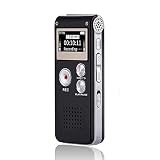
- 【Simple Operation】- switch on your voice recorder, one button for recording. press the "REC", start the recording, press "STOP", end the recording, press “PLAY”, listen what you just recorded, and then Press A-B, select your important section to repeat. Easy to playback with inner powerful speaker, support external sound speaker playback, let you enjoy superior recording quality.
- 【Clear Voice Record】- high quality recording with noise redution, you will get super clear recorded voice, the sensitive microphone help you to catch speaker's words in an interview, lectures, meetings.
- 【Voice Activated Recording】- automatic voice reduction function, it starts recording when sound is detected or turn to standby state, saving recording time and reduce power consumption.
- 【 Player Function】- this voice recorder can be used as an music player, you could enjoy the music after your tired study, meeting and so on. Also can function as a detachable data storage device.you can take along your favorite pictures and documents whenever you go.Simply cut-and-paste or drag-and -drop files to or from it via USB connection, the player will appear as a removeable drive in Windows.
- 【High quality and long time】 uses DSP noise reduction technology to filter out environmental noise, has high-quality recording, 【1536kbps】to restore the real scene. It can continuously record for more than 30 hours and play for 7 hours.
- Study: “Treat this as an exam review. Define technical terms and emphasize likely test questions.”
- Research comparison: “Compare the methods and conclusions in Sources 1 and 3. Explain where they disagree.”
- Business briefing: “Explain the three findings a project lead should know, and distinguish evidence from recommendation.”
- Beginner explanation: “Explain the most important findings for a beginner and define each technical term before using it.”
- Critical review: “Flag claims supported by only one source and identify important evidence the material leaves out.”
- Scope control: “Discuss only the sources published after 2024. Avoid repeating background information.”
During playback, questions such as “Can you explain that more simply?”, “Which source supports that claim?”, “What is the strongest objection?”, or “Give me a real-world example” turn listening into an oral Q&A. This works best for clarifying or comparing material in the notebook, not for treating the hosts as an unrestricted call-in show.
Accuracy: use the audio as an orientation, not the final word
NotebookLM is designed to ground its responses in notebook sources, but Google warns that Audio Overviews are AI-generated and can contain factual inaccuracies, glitches, unexpected speaker switches, or even an unexpected third voice. A smooth, conversational delivery is not proof that a claim is correct.
- Start with primary sources where possible, and remove outdated or conflicting documents.
- If a point matters, ask about its supporting source in NotebookLM’s text chat, where source citations are available.
- Open the original document and check the passage before publishing, citing, or acting on a claim.
- Do not use an overview as a substitute for professional medical, legal, financial, or safety advice.
For a documentary researcher, student, or educator, the audio is a quick way into a packet of material. It should not replace reading the evidence or checking how the sources support a conclusion.
Rank #4

- BUNDLE INCLUDES: Zoom H1essential Handy Recorder, 32GB microSDHC Card, Lavalier Condenser Microphone, Furry Microphone Windscreen, 4 AAA Batteries and Cloth (6 Items)
- 32-BIT FLOAT: With 32-bit float recording, you never have to adjust levels. The H1essential captures every nuance of your sound ensuring high-quality audio with every take.
- LOUD AND CLEAR: The onboard X/Y microphones capture clean audio up to 120 dB SPL, equivalent to the sound of a high-performance engine.
- BIG FEATURES: The H1essential has advanced features such as overdubbing, pre-record, auto record, and playback speed adjustment.
- FOR STORYTELLERS: Podcasters can mount the H1essential on a tripod for sit down conversations or use ‘mono mode’ for on-the-go interviews.
Sharing, downloading, and mobile listening
You can share an Audio Overview link, share its notebook subject to access settings, or download the audio file. Sharing is not the same as sharing an interactive session: recipients can listen to a shared or downloaded overview, but they cannot join it and ask the hosts questions. Link access may depend on the notebook being shared appropriately; only owners and editors can make generated audio publicly available or manage access. If the overview is deleted, its share link stops working. Public notebook sharing is disabled for Workspace Enterprise and Education accounts under Google’s current guidance.
Google’s mobile app supports listening to Audio Overviews, including offline playback, and sharing content into NotebookLM from other apps. Because the app may have feature limitations, use the web version to create and configure an interactive overview if you cannot find those controls on mobile. See Google’s mobile app announcement and the current Audio Overview guidance.
Quick wins for a faster PC:
Fix the driver behind crashes, sound loss and screen glitchesFind Drivers →Repair Windows errors before they cause bigger problemsFix Now →Scan for outdated or missing drivers - takes under a minuteDriver Scan →Limits and plan choice
Google’s listed standard limits include 100 notebooks, up to 50 sources per notebook, up to 500,000 words per source, and local uploads up to 200 MB. The standard tier currently includes 50 chat queries and three Audio Overviews per day. Audio Overview quotas listed for paid plans are:
Best Value

- SIMPLE SETUP, PRO-QUALITY RESULTS – Record in 32-bit / 96kHz for clear, detailed sound, perfect for interviews, podcasts, and everyday recording.
- TWO XLR/TRS INPUTS FOR ANY SOURCE – Two XLR/TRS combo inputs let you connect microphones, instruments, and more for versatile recording setups.
- WAVEFORM DISPLAY SO YOU ALWAYS KNOW YOUR LEVELS – OLED waveform display makes it easy to monitor levels and ensure clean recordings at a glance.
- 3.5MM IN AND OUT FOR ADDED FLEXIBILITY – 3.5mm stereo input and headphone output let you monitor audio and connect external devices for added flexibility.
- SDXC SUPPORT UP TO 1TB – Supports SDXC cards up to 1TB, giving you plenty of space for extended sessions and high-quality recordings.
| Plan level | Audio Overviews per day |
|---|---|
| Standard | 3 |
| Plus | 6 |
| Pro | 20 |
| Ultra, 20 TB | 100 |
| Ultra, 30 TB | 200 |
These figures come from Google’s standard limits and plan quota documentation. Quotas can change, may reset on a rolling 24-hour basis, and may vary by account or region. Check the live plan and account information before subscribing; prices and features differ across markets.
For occasional study sessions or document briefings, the standard allowance is a reasonable place to start. Consider a higher tier if you routinely regenerate several versions, work across larger source libraries, or repeatedly hit the daily cap. Interactive mode is not presented as requiring a paid plan; upgrading is mainly relevant to higher limits and other plan benefits, not to basic experimentation.
Fix common problems
- No Join or Interactive mode: Make sure you selected Interactive mode before generating a new overview. It cannot be added to an existing recording. Set the output language to English, try the web version, and check whether you have reached your generation limit. If you are working in a notebook you do not control, access permissions may also affect what you can generate; ask its owner for appropriate access.
- A source will not import: Check for a file over 200 MB, a source beyond 500,000 words, PDF copy protection, a missing YouTube transcript, or a page hidden behind a login or subscription. Web pages with dynamically loaded or inaccessible text may not import as expected.
- The overview wanders into irrelevant material: Deselect unrelated sources, remove duplicates, split topics into notebooks, or give a narrower instruction. A Brief or Critique may fit better than a broad Deep Dive.
- Audio glitches or sounds wrong: Playback may have delays, glitches, or speaker changes. Regenerate if useful, but do not assume a cleaner take is more accurate; verify any important statement against the source.
- You have hit the daily cap: Wait for the quota to reset or check your plan’s current limits. A paid tier may be useful for frequent generation, but occasional users may not need one.
For users who need a polished, branded, publicly distributed podcast, Audio Overview is a starting point rather than the finished production workflow. Editing, music, artwork, hosting, and RSS distribution require additional tools and human review. For exploring and actively questioning a set of documents, however, Interactive mode makes the source summary more useful than passive playback alone.
PC Slower Than It Used to Be?
A free scan shows the junk files, broken settings and background clutter dragging Windows down - then fixes them in one click.Free scan · Windows 10 & 11Outdated Drivers Are Slowing You Down
One free scan finds every outdated or missing driver and matches the right update for your exact hardware.Free scan · exact hardware matchQuick Recap
Product prices and availability are accurate as of the date/time indicated and are subject to change. Any price and availability information displayed on Amazon at the time of purchase will apply.

