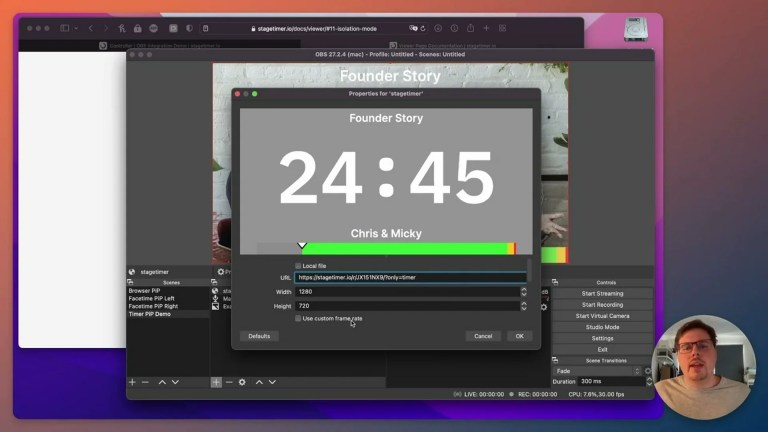
For a single prerecorded video going directly to YouTube Live, start with OBS. It can play a local media source in a scene, encode the output, and send it to YouTube. NGINX RTMP is a server and relay layer—not a required OBS component—and is worth adding only when you need self-managed routing or an intermediate ingest point. Neither setup, by itself, guarantees an unattended 24/7 loop.
OBS and NGINX RTMP do different jobs
| Question | OBS-first setup | NGINX RTMP in the pipeline |
|---|---|---|
| What is it? | A desktop application for scenes, sources, encoding, and sending a stream. | Server software for receiving, relaying, or distributing RTMP streams. |
| Best fit | One operator wants to send a local video source directly to YouTube. | A self-managed relay, routing layer, or server-side streaming arrangement is needed. |
| What must be configured? | A scene and source, YouTube destination, output settings, and the computer and network running OBS. | An encoder upstream, NGINX and its RTMP module, server and network configuration, and the onward relay path. |
| Operational trade-off | Fewer components, but the host, source, network, and OBS process still need monitoring and recovery planning. | More control over the relay path, with additional server administration, security, monitoring, and failure points. |
For the direct OBS workflow, see the OBS Studio Overview Guide. The NGINX RTMP module project documents server-side RTMP functionality; it is not a YouTube policy source.
How to loop a prerecorded video on YouTube Live with OBS
The basic path is video file → OBS scene and encoder → YouTube Live. YouTube supplies the live event and stream key; OBS supplies the media source and encoded output. Labels can vary by OBS version, so check the current interface and help pages if a control has moved.
- Create the YouTube live stream. In YouTube Studio, use the encoder workflow to set up the live stream and obtain its stream key. Follow YouTube’s current account requirements and event setup. Keep the key private: anyone with access to it may be able to send video to that stream. See YouTube’s encoder workflow.
- Configure OBS for YouTube. In OBS, open Settings → Stream, select YouTube if you are using its built-in service, and connect or enter the stream key as prompted. Use a custom server only when your chosen ingest arrangement requires it. The OBS overview covers service and custom-server configuration.
- Add the prerecorded video as a source. In the scene’s Sources panel, add a media source, select the file, and enable looping if you want it to repeat when playback reaches the end. Confirm the source is visible in the preview and that any required audio is present. Verify the loop behavior in your installed OBS version rather than assuming that starting the stream also starts or repeats the media correctly.
- Set the output to suit your video and connection. In Settings → Video and Settings → Output, choose resolution, frame rate, encoder, bitrate, and keyframe interval in line with current YouTube recommendations and the computer’s encoding capacity and stable upload bandwidth. YouTube’s settings guidance is at Choose live encoder settings, bitrates, and resolutions. Avoid copying numbers from an old guide: recommendations and available encoder choices can change. OBS notes that 60 fps can be more demanding than 30 fps; if the computer or connection cannot sustain the chosen output, reduce the load and test again.
- Test before the real broadcast. Start a test stream and check video, audio, source transitions, synchronization, YouTube stream health, and what happens when the media reaches its end. Confirm that the stream key points to the intended event and that the output is stable for the duration you need. OBS recommends testing before the first live stream in its Quick Start Guide.
When to add NGINX RTMP
Put NGINX between an encoder and its destination only when the server layer solves a specific problem—for example, a self-controlled relay or server-side routing requirement. In that design, OBS or another encoder sends a feed to the server, and NGINX handles it according to the server configuration. You remain responsible for deploying and securing the server, configuring the path, monitoring it, and handling failures.
#1 Best Overall

- Read Before You Buy — No Video Output: These adapters support charging and USB 2.0 data transfer, but cannot transmit video signals. Except for standard USB webcams (which use USB data only), they are not compatible with HDMI/DisplayPort cables, video-capable USB-C hubs, or docking stations with video output.
- Convert USB-A Ports to USB-C: Designed to connect USB-C earphones, cables, flash drives, card readers, and other USB-C accessories to standard USB-A ports. Plug-and-play with no drivers or software required.
- Aluminum Alloy Housing: Built with a sturdy aluminum alloy shell that aids in heat dissipation and protects against daily wear and scratches. Designed to maintain a stable and secure connection.
- Compact & Travel-Friendly: The ultra-compact design allows the adapter to stay plugged into your device without blocking adjacent ports or adding bulk, reducing wear and tear on your original USB ports.
- 12-Month Warranty: Backed by a 12-month manufacturer warranty for peace of mind. Designed to meet strict quality control standards for reliable everyday performance.
If you have one video, one operator, and one YouTube destination, NGINX usually adds work without replacing OBS’s need to provide the encoded feed. Treat it as infrastructure, not as a turnkey video-loop controller. The project’s module documentation describes the server component; deployment details depend on the environment.
Starting automatically is not the same as running reliably
OBS documents the --startstreaming launch parameter. It can tell OBS to begin streaming when launched, but it does not establish that a source will loop indefinitely, that every failure will be recovered, or that YouTube will accept any particular continuous-stream pattern. The host operating system must launch the application, and separate supervision or scheduling may be needed to restart it after a failure. OBS’s Launch Parameters guide notes that automated or scheduled Windows launches need the working directory set to the OBS executable folder.
Rank #2

- 5-in-1 USB-C Hub: Experience comprehensive connectivity featuring a Power Delivery input, two USB-A 2.0 ports, a USB-A 3.0 port, and an HDMI port. (Note: The USB-C power delivery input port is only for connecting an external wall charger to power your laptop and cannot power peripheral devices.)
- 90W Pass-Through Charging: Achieve optimal charging with 90W pass-through power to your laptop, supported by a total input of 100W, with the hub reserving 10W for operational efficiency. (Note: Wall charger not included.)
- Quick Data Transfers: Accelerate your productivity with rapid data transfers using a high-speed 5Gbps USB 3.0 port and two 480Mbps USB 2.0 ports.
- 4K HDMI Display: Enhance your visual experience with a hub capable of delivering 4K resolution at 30Hz in both mirror and extend modes. Please note that this hub is compatible with MacBook (macOS 12 and newer), Windows 10 and 11, ChromeOS, and laptops equipped with DP Alt Mode and Power Delivery. Note: This device is not compatible with Linux.
- What You Get: Anker USB-C Hub (5-in-1, 4K HDMI), welcome guide, 18-month warranty, and our friendly customer service.
For unattended operation, test the whole chain: source availability, OBS startup, stream connection, reconnection behavior, and restart behavior after closing or interrupting the application. A relay server also needs its own monitoring and recovery plan. The official YouTube encoder and settings pages explain setup and encoder guidance, but they do not establish a loop-specific maximum duration or a blanket policy ruling for continuous prerecorded streams. Check current YouTube live-stream instructions and encoder settings, and make sure the material you stream complies with YouTube’s current rules, including copyright and reused-content requirements. Do not infer permission for a particular loop from the fact that an encoder can transmit it.
Troubleshooting a prerecorded YouTube stream
- Dropped frames or a disconnection: OBS identifies dropped frames as a sign that the connection is unstable or cannot sustain the selected bitrate; excessive drops can disconnect the stream. Check the selected server and bitrate, use wired networking where possible, and investigate Wi-Fi, router or modem, drivers, VPN or security software, and other parts of the network path. See OBS Stream Connection Troubleshooting.
- Video plays once instead of repeating: Check the media source’s loop setting and observe the transition at the file’s end during a test. Do not assume that a launch parameter or an active YouTube event controls local source playback.
- Picture, sound, or synchronization is wrong: Check the selected source, its audio settings, OBS output settings, and the YouTube preview or stream health. Test the full playback path rather than relying only on OBS’s local preview.
- Encoding overload or unstable output: Reduce resolution or frame rate, choose an encoder the computer can sustain, or lower bitrate if the upload link cannot maintain it. Recheck the relevant current YouTube encoder recommendations after changing settings.
- NGINX relay does not reach YouTube: Check each hop independently: whether the encoder reaches the configured server path, whether NGINX is configured to receive and relay that feed, and whether the onward destination and network path are correct. Adding a server creates another component to diagnose.
- Automation starts, then stops: Check the operating system’s scheduled launch and working directory, the OBS process, source-file availability, and reconnection or restart behavior.
--startstreamingstarts streaming; it is not a process supervisor.
Or let it run in the cloud
If you want a prerecorded video or playlist to keep a YouTube channel live without leaving a computer on, StreamNeo runs the playback in the cloud. Upload your recording or build a playlist, add your YouTube stream key once, and go live. Nothing has to stay on at home; the uploaded video streams at its original quality up to 4K 60fps for one flat price per slot, with no re-encode or quality tiers. StreamNeo automatically recovers if YouTube drops the stream. The first day is free with no card required. Monthly pricing is $9.99 per month. For Indian creators, UPI is supported. Start the free day with StreamNeo.
Quick Recap
Best Value

- 5-in-1 Connectivity: Equipped with a 4K HDMI port, a 5 Gbps USB-C data port, two 5 Gbps USB-A ports, and a USB C 100W PD-IN port. Note: The USB C 100W PD-IN port supports only charging and does not support data transfer devices such as headphones or speakers.
- Powerful Pass-Through Charging: Supports up to 85W pass-through charging so you can power up your laptop while you use the hub. Note: Pass-through charging requires a charger (not included). Note: To achieve full power for iPad, we recommend using a 45W wall charger.
- Transfer Files in Seconds: Move files to and from your laptop at speeds of up to 5 Gbps via the USB-C and USB-A data ports. Note: The USB C 5Gbps Data port does not support video output.
- HD Display: Connect to the HDMI port to stream or mirror content to an external monitor in resolutions of up to 4K@30Hz. Note: The USB-C ports do not support video output.
- What You Get: Anker 332 USB-C Hub (5-in-1), welcome guide, our worry-free 18-month warranty, and friendly customer service.
Rank #4

- Dual Converters, Infinite Potential:Includes 2× USB C male to USB A female adapters and 2× USB A male to USB C female adapters. Perfect for a wide range of uses—tablets with Bluetooth keyboards, expand USB ports on macbook, and more. Two different converters for all your daily needs
- Next-Level 10Gbps & 3A Charging: No more slow 480Mbps, this usb to usb c adapter has a transfer speed of up to 10Gbps, allowing you to do more transferring in less time. This usb adapter fits both USB A and USB C charger, supporting up to 3A fast charging
- Upgraded Exquisite Craftsmanship: With an aluminum alloy housing and metal connector, the usbc to usb adapter is extremely durable and sturdy. Rigorously tested to withstand more than 10,000 times of plugging and unplugging, ensuring long-lasting performance
- Broad Compatible: The usb c to usb adapter widely supports all USB C/ USB A devices like laptops, tablets, cellphones, car chargers, and phone chargers. Such as compatible with MacBook Pro/Air 2023/2022, Thunderbolt 4/3 Devices,Apple MagSafe Watch 9/8/7/SE/Ultra, iPad Pro 2022/2021, Samsung Galaxy S23/S20/S10, and iPhone 17/16/15 Pro. Plug and play
- Please Note: To reach 10Gbps speed, keep the cable under 3.3 ft. For USB A Male to USB C adapters, try flipping the USB C connector. USB C Male to USB A adapters support bidirectional 10Gbps transfer within 3.3 ft
Rank #3

- Sleek 7-in-1 USB-C Hub: Features an HDMI port, two USB-A 3.0 ports, and a USB-C data port, each providing 5Gbps transfer speeds. It also includes a USB-C PD input port for charging up to 100W and dual SD and TF card slots, all in a compact design.
- Flawless 4K@60Hz Video with HDMI: Delivers exceptional clarity and smoothness with its 4K@60Hz HDMI port, making it ideal for high-definition presentations and entertainment. (Note: Only the HDMI port supports video projection; the USB-C port is for data transfer only.)
- Double Up on Efficiency: The two USB-A 3.0 ports and a USB-C port support a fast 5Gbps data rate, significantly boosting your transfer speeds and improving productivity.
- Fast and Reliable 85W Charging: Offers high-capacity, speedy charging for laptops up to 85W, so you spend less time tethered to an outlet and more time being productive.
- What You Get: Anker USB-C Hub (7-in-1), welcome guide, 18-month warranty, and our friendly customer service.
Product prices and availability are accurate as of the date/time indicated and are subject to change. Any price and availability information displayed on Amazon at the time of purchase will apply.