There is no universal winner. An LED panel is usually the faster, broader source when you are working close to a subject, in a shallow room, or with a small crew. A COB (chip-on-board) light is a concentrated source that gives you more directional control and accepts a wide range of modifiers. Add a softbox or umbrella with diffusion and a COB can produce a soft, cinematic interview key. Your decision should follow the desired shadow quality, room depth, setup time, power, and ability to support modifiers—not the fixture label alone.
What the two light types actually do
LED panels spread the emitting surface
An LED panel places many light-emitting diodes across a relatively large face. That larger face produces broad illumination at close range, so the light can look even without an additional modifier. The trade-off is that the fixture itself can be harder to reshape: you may need flags, grids, or careful positioning to keep light off a background. Panels are often practical when the interview must be assembled and moved quickly. Manufacturer comparisons describe them as useful for close-range softness and compact locations; read the guidance from SmallRig and Westcott as workflow advice, not laboratory testing.
COB fixtures behave like concentrated point sources
A COB light concentrates its LEDs into a small emitting area. Bare, it creates a harder, more directional beam than a similarly powered broad panel. That concentration is useful when you need reach, a controlled pool of light, or separation between a subject and a background. The fixture becomes a system: its reflector, softbox, umbrella, grid, Fresnel lens, or other compatible modifier determines the final size and shape of the source. The basic distinction is summarized in SmallRig’s comparison.
Which is better for a documentary interview?
Choose the panel when speed, a shallow footprint, and broad close-range light matter more than elaborate shaping. Choose the COB when you can reserve space for a stand and modifier and want to decide precisely where the beam lands. Either fixture can produce an attractive key; the room and modifier often matter more than the category name.
#1 Best Overall

- 【MULTIPLE COLOR TEMPERATURE & ADJUSTABLE BRIGHTNESS】There are 3 Color temperatures (2800K, 4800K & 6500K) which offer different lighting atmosphere; This Studio Light is equipped with 356 Led beads which offers a stable and ample output of 15W. Features a high CRI of 97+ for precise color rendering. Adjust the brightness in a range of 10 to 100% with button up and down on remote to meet different photography circumstances, offering extra lighting for your works.
- 【LIGHT PANEL & POWER CABLE】The 10” (25.5 cm) x 7.8” (19.8 cm) LED light panel with compact design allows you to carry around conveniently with durable storage bag. Thickened light shell works a diffusion, making the lighting more softer. Ideal USB port for powering the device with 5V, 2A DC wall charger(not include) or power bank. Comes with USB-C adapters that allows you to power the device with cell phone or laptop.
- 【HEIGHT ADJUSTABLE TRIPOD】The tripod of the video light adopts durable but lightweight aluminum with powder sprayed layer, looks chic and classic. The light stand can be raised up to 60”. Folded size 17", perfect to store and carry. Adjust the height flexibly with 3 screw knobs loosen and tighten. Attach and detach the light panel easily with the 1/4" threads on the top of the tripod. Loosen the screw on side to rotate the light panel angle in range of 180°, tighten it when get suitable angle.
- 【WIDE APPLICATION】Essential equipment for Photo Studio, Video Recording, Photography, Low Angle Close Shooting, Portrait, Live Stream, Vlogging taking, Youtube Podcast Applications. Light weight and durable design allow you to carry around conveniently and move easily.
- 【Package List & Customer Service】There will be 2 LED studio light panels with cable. adjustable tripod stand for each light panel, 1 user manual, 1 storage bag, 2 USB-C adapters. Whatever issues you meet during the usage or any defects arise, rest assured that we are here to assist you.
| Production condition | A panel may suit | A COB may suit |
|---|---|---|
| Fast setup in a shallow room | Broad output and compact placement can reduce setup steps. | It works if there is enough depth for a stand, reflector, and modifier. |
| Soft key with minimal rigging | The broad face can be used close to the subject with little extra hardware. | Add a softbox or umbrella and diffusion; the modifier becomes the large apparent source. |
| Directional key or background separation | Use flags or careful placement to control spill. | A reflector, grid, Fresnel, or other compatible modifier can narrow and shape the beam. |
| Location power | Verify the exact panel’s battery input and expected runtime. | A documented documentary setup used a V-mount battery; compatibility still depends on the chosen fixture. |
This table condenses manufacturer guidance from Westcott, Westcott University, Godox, and Ulanzi. It is not a controlled, model-matched brightness test. No general panel-versus-COB efficiency or output figure has been established across the categories.
Start with the interview look, not the fixture
Define the shadow edge
Decide whether you want a gentle transition across the face or a more pronounced, directional key. A large source close to the interviewee wraps around facial contours and produces softer-edged shadows. A small, undiffused COB produces a harder transition. A panel may look soft because its emitting surface is broad, but moving it farther away makes that surface appear smaller and the shadows harder.
Map the room depth
Measure the distance from the camera position to the subject, then leave room for the light stand, modifier, and operator. In a shallow office or hallway, a panel can fit beside the camera without pushing furniture or crew into the background. A COB with a deep softbox or umbrella may require substantially more clearance. If the subject is near a wall, account for reflected spill and the risk of brightening the background.
Check ambient light before choosing output
Window light, practical lamps, and overhead fixtures all affect the required output and color balance. A panel placed close can be adequate when ambient levels are low and the interview is framed tightly. A COB with a modifier may lose output through diffusion, so determine whether it can reach the planned subject distance at the selected color temperature. Compare actual fixture specifications at the distance and setting you will use; category labels do not provide a reliable brightness comparison.
How to set up a panel for a documentary interview
- Control the existing room light. Turn off mismatched overheads when possible, close blinds, or flag a window so the panel remains the dominant key. If you must keep daylight, set the panel’s color temperature to match the scene and check skin tones through the camera.
- Place the panel just off the camera axis. Start around 30 to 45 degrees to one side and slightly above the interviewee’s eye line. The exact angle is a creative choice; watch the catchlight, nose shadow, and the brightness of the far cheek.
- Move the panel close before raising power. A close source appears larger and usually looks softer. Keep it outside the frame and leave enough clearance for the subject to move naturally.
- Feather the beam. Aim the panel slightly past the face so the edge of the beam crosses the subject. This can reduce a hot spot on the cheek and limit spill on a nearby wall. Use flags if the fixture has no integrated control.
- Balance the background separately. If the wall is too bright, move the panel, add negative fill, or flag the spill rather than simply lowering exposure on the face. If the background is too dark, a separate low-level source or a reflector may be more controllable than turning the key toward the wall.
- Secure the stand and cables. Sandbag the stand, tape or cover cable runs, and check that a door, chair, or interviewee cannot strike the fixture. Compact does not mean risk-free.
This workflow reflects the quick, broad-source use described by Westcott and the shallow-space guidance from Ulanzi. Confirm the panel’s actual controls, mounting method, and output at your working distance.
Rank #2

- 【MULTIPLE COLOR TEMPERATURE & ADJUSTABLE BRIGHTNESS】Provide 3 Color temperatures (2900K, 4800K & 7000K)to create various lighting atmosphere; This Upgraded Studio Light which is equipped with 352 Led beads to make the light more ample and avoid unnecessary shadows. Features a high CRI of 97+ for precise color rendering. Adjust the brightness in a range of 10 to 100% with button up and down on remote to meet different photography circumstances, offering extra lighting for your works.
- 【LIGHT PANEL & POWER CABLE】Extended LED light panel with compact design allows you to carry around conveniently with our durable storage bag. Extended light panel provide a larger area of light which will be more softer. Comes with 5V, 2A AC adapters that make the light output stable and continuous.
- 【HEIGHT ADJUSTABLE TRIPOD】The tripod of the video light adopts durable but lightweight aluminum with powder sprayed layer, looks chic and classic. The light stand can be raised up to 61”. Folded size 17", perfect to store and carry. Adjust the height flexibly with 3 screw knobs loosen and tighten. Attach and detach the light panel easily with the 1/4" threads on the top of the tripod. Loosen the screw on side to rotate the light panel angle in range of 180°, tighten it when get suitable angle.
- 【WIDE APPLICATION】Essential equipment for Photo Studio, Video Recording, Photography, Low Angle Close Shooting, Portrait, Live Stream, Vlogging taking, Youtube Podcast Applications. Light weight and durable design allow you to carry around conveniently and move easily.
- 【Package List & Customer Service】There will be 2 LED studio light panels with cable, adjustable tripod stand for each light panel, 1 user manual, 1 storage bag, 2 AC adapters. Whatever issues you meet during the usage or any defects arise, rest assured that we are here to assist you.
How to make a COB light soft enough for an interview
Use a large modifier
The reliable way to soften a COB is to increase the apparent size of the source. Mount a softbox, shoot through an umbrella, or bounce the beam into a suitable surface. Bring the modifier close enough that it is large relative to the interviewee; moving it farther away makes it look smaller and increases shadow contrast. A deep modifier can also help keep the beam off the room, but its length increases the required stand footprint.
Documented documentary configuration
In its documentary interview case, Westcott University describes a COB set to 5600K used with a 53-inch deep umbrella and diffusion. That is a documented example, not a universal prescription. It demonstrates the principle: the COB supplies a concentrated source, while the umbrella and diffusion create the large, soft emitting surface that lights the face.
Position the modifier for flattering falloff
Place the center of the soft source slightly above and to the side of the interviewee, then angle it down toward the face. Rotate or “feather” the modifier so its brightest center passes just in front of the subject; the softer edge can illuminate the face while reducing background spill. Watch the far-side cheek and eye socket as you adjust. Small changes in height and angle often matter more than a large power change.
Windows Errors? Fix Them Before They Spread
Repair common Windows errors and clear accumulated junk for a smoother, more stable PC - no reinstall needed.Free scan · no reinstallCrashes, No Sound, or Screen Glitches?
Random freezes, missing sound and display glitches usually trace back to one bad driver. Find and replace yours safely.Free scan · under a minuteUse diffusion deliberately
Diffusion costs output, so expect to raise the COB’s intensity or move it closer. Keep diffusion taut and secure; loose fabric can catch air or enter the frame. Check that the softbox speed ring or umbrella mount is rated for the fixture and that the stand can carry the combined load. Godox’s documentary guidance likewise treats the COB, modifier, stand, and battery as one location system rather than as separate purchases.
Controlling spill, contrast, and background reflections
When a COB gives you an advantage
A concentrated source can be narrowed with a reflector, grid, Fresnel lens, or other manufacturer-approved modifier. This is useful when the interviewee is close to a wall, when you want the background to remain dark, or when a practical lamp must stay visible without being washed out. Greater punch can also help when the key must travel across a larger room, although the achievable result depends on the fixture, modifier, distance, and ambient level.
Rank #3

- Desktop panel light kit: 9" LED video key light with 58 warm and 58 cool LEDs, 10W max output, 600 lux / 0.5 m, CRI 95+; includes mini tripod, cold shoe adapter, USB cable, and 4000mAh rechargeable built in lithium battery; carry bag not included
- Enhanced precise control: Use knobs to fine tune brightness and color temperature in 1% steps; 0% to 100% dimming, 3200K-5600K CCT adjustment; key light for portraits, product, food photography, studio photoshoots, podcast video recording, streaming
- Longer battery shooting: Built in 3.7V 4000mAh lithium battery runs up to 1.5 h and fully charges in about 2 h, supports both Type C and Micro USB ports charging; USB to USB C cable is included; fully charge before first use for better battery longevity
- Camera cold shoe setup: 1/4" cold shoe adapter mounts the fill light on DSLR or camcorder; as photography accessories and gear compatible with Canon Nikon Sony Fujifilm mirrorless digital cameras; 180° front and back tilt for desired shooting angle
- All metal mini desktop tripod: Included tabletop stand extends up to 8.6 inches (22 cm), rugged and rust resistant; making this small LED video panel light for YouTube TikTok content vlogging, desk Zoom calls, makeup artists, and table selfie lighting
How to control a panel
A panel can still be controlled. Move it closer and angle it away from reflective surfaces, add flags, or place black fabric or foam board on the spill side. Some panels accept grids or barn doors; others do not. Do not assume accessories are interchangeable. Check the manufacturer’s mount and the panel’s frame dimensions before ordering a modifier.
Use bounce when it solves a specific problem
A white beadboard can redirect light into shadow areas or provide a gentle fill without adding another powered fixture. Litepanels describes beadboard as a way to bounce light for interviews and documentaries. Place it on the shadow side, adjust its angle, and remove it if the fill erases the shape you want. A black surface can serve the opposite purpose by absorbing light and increasing contrast.
Quick wins for a faster PC:
Repair Windows errors before they cause bigger problemsFix Now →Fix the driver behind crashes, sound loss and screen glitchesFind Drivers →Power, batteries, and rigging on location
Mains power
Confirm the fixture’s voltage range, cable length, connector, and power draw before arriving. Locate outlets without crossing the camera or interviewee path. Carry properly rated extension cables and secure every run. A fixture that works in a studio may be impractical in a historic building, vehicle, or remote location if no safe outlet is nearby.
Battery operation
Battery support varies by model. Godox’s documentary example documents V-mount use, but that does not establish compatibility for every COB or panel. Verify the battery plate, required voltage, supported capacity, and whether the light can charge while operating. Estimate runtime from the fixture’s stated draw at your intended intensity; do not infer runtime from the battery’s headline watt-hours alone.
Stand and modifier load
A COB with a deep softbox, umbrella, diffusion, and grid places more leverage on a stand than a bare panel. Use a stand with an appropriate load rating, spread the legs fully, add a sandbag, and orient the heaviest part over a leg. Outdoors, wind can turn a large modifier into a sail; shelter it, lower it, or choose a smaller setup. Check every mount before the subject sits down.
Rank #4

- 【12W 600LUX/0.5M Soft and Even Lighting】 RALENO panel light features edge-lit technology and 4-layer diffusers that create soft, uniform lighting without glare, making it ideal for video conferences, photography, and live streaming. Delivers 600LUX at 0.5 meter, perfect for crisp, well-lit photos and videos, yet gentle on skin tones—no harsh Tip: To maintain good lighting, please use a 5V/3A adapter
- 【80-Minute Battery Life】 This camera light features a built-in rechargeable battery that lasts up to about 80 minutes on full brightness, keeping you illuminated wherever you go. And with the ability to use while charging, as well as USB and Type-C power supply options. A USB C charging cable is included for added convenience
- 【Multifunctional Mini Stand】 Our newly upgraded video light package adds a mini stand, whose minimum height is 3.74 inches (9.5 cm) and the maximum extends to 7.09 inches (18 cm) for increased shooting height. Now you can easily use it for video conferencing as well as handheld shooting. This versatile light can be used for both photography and video conferencing fill lighting
- 【Unlock precise lighting adjustments】Dial in your exact lighting with dual knobs for brightness (0-100%) and color temperature (2500K-6500K), both adjustable in precise 1% increments. With 116 high-brightness lamp beads, you'll have the perfect lighting to show your best self
- 【Portable Lighting】 This portable video light is ideal for outdoor use, with a built-in battery and Type-C charging for easy on-the-go use. Plus, it's lightweight and very thin,mso you won't even notice it in your bag
Should you combine a panel and a COB?
A mixed kit can be sensible when each fixture has a different job. GVM describes a hybrid approach using a COB as the key and panels for fill or background. In practice, the COB can provide the shaped key while a panel supplies low-level fill, a hair-light substitute, or illumination for a practical area. Treat this as a possible workflow, not a universal recommendation: two fixtures mean more stands, cables, control decisions, and failure points. Match color temperature and verify that both lights can be dimmed finely enough for the intended ratio.
Recommended Free Tools
A buying and rental checklist
- Mounting standard: identify the fixture’s modifier mount or umbrella receptacle. Confirm that the softbox, grid, reflector, or Fresnel you plan to use is designed for it.
- Included reflector: a COB may ship with a reflector that changes beam angle and output. Know whether it is required for safe operation or only one optional configuration.
- Output information: look for measurements at a stated distance, modifier, and color setting. Do not compare an unmodified COB figure with a diffused panel figure as if they were equivalent.
- Color control: check the available color-temperature range, bi-color adjustment, RGB functions if relevant, and whether changing color affects output.
- Power options: verify mains operation, battery plate, connector, cable requirements, and expected runtime at your working intensity.
- Physical footprint: measure the packed and operating dimensions of the light, modifier, stand, and diffusion. A modifier that fits the case may not fit the room.
- Noise and heat: determine whether the fan is audible at interview distance and whether the fixture needs clearance for ventilation.
- Safety hardware: include a stand with a suitable load rating, sandbags, cable covers, and a backup plan if a battery or ballast fails.
These checks are more useful than choosing by “panel” or “COB” alone. Compatibility is model-specific, and the available guidance does not establish cross-brand interchangeability.
Independent reader supportYour contribution helps us test, update, and keep practical guides available for everyone.Troubleshooting common interview-lighting problems
The face is bright but the background is washed out
First move the key closer and lower its intensity rather than moving it farther away; a closer source can maintain softness while reducing the amount of room it illuminates. Feather the modifier past the face, flag the spill, or add negative fill on the wall side. With a panel, repositioning and flags may be the only practical controls. With a COB, try a grid or narrower reflector if approved for that fixture.
The COB looks harsh even through diffusion
Check the modifier’s size and distance. A small softbox placed far away is still a relatively small source. Bring it closer, use a larger box or umbrella, and keep the diffusion layer evenly stretched. Recheck the subject’s movement range and stand stability after moving the light.
The panel looks flat
Move it farther to the side or higher, then add a controlled reflector or beadboard on the shadow side instead of filling from the front. Reduce ambient room light that is lifting the shadows. If the panel has a built-in diffusion layer, remove it only if the manufacturer permits and if the harder look is intentional.
Best Value
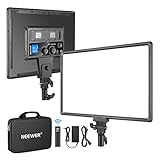
- Wide Application: The 14.8"×10.5" large, 1"/25mm thick LED video light panel provides continuous, non flickering soft light for video and photo photography. NL288 portable lighting kit offers key light for portraits, studio photoshoots, YouTube/TikTok/podcast videography, filming, social media live streaming, online conferences, video calls, Zoom calls, etc. It is a suitable lighting equipment for various professions such as content creators, influencers, makeup artists, live streamers
- 2.4G Remote Control: 2.4G remote control features 4 groups (A/B/C/ABC) and 40 channels (1–40) to let you operate multiple lights simultaneously without even moving a muscle.
- Bi-Color & Dimmable: Customize light effects by adjusting brightness and color temperature via two knobs on the back. LCD screen makes you see parameters clearly. High Luminance (1400 lux at 1m) and CRI (97+) ensure all your shots perfectly lit and have great color rendering.
- Two Power Options: Powered by an AC power adapter (included) or two rechargeable NP-F550 / NP-F970 Li-ion batteries (NOT included)
- Package Contents: NL-288ARC LED panel light, 2.4G remote control, AC power adapter, mount bracket, carrying bag, user manual
Skin tones change between takes
Lock the fixture’s color setting, disable automatic camera white balance, and identify daylight or tungsten sources that may be entering the frame. Mixed color can be a creative choice, but it should be repeatable. Record the selected Kelvin value and dimmer setting so a moved interview can be rebuilt quickly.
The light or modifier keeps drifting
Tighten the mount, center the load over the stand, add a sandbag, and shorten the boom or arm. A large umbrella or softbox can move when a door opens or an air-conditioning system starts. If the location is exposed to wind, reduce the modifier size or relocate indoors rather than relying on a lightly weighted stand.
The battery dies before the interview ends
Estimate runtime from the actual draw and intensity, then carry a charged spare or a mains fallback. Test the battery plate and cable under load before the shoot. Do not assume that a battery that powers a panel will power a COB; voltage, connector, and protection requirements must match the fixture.
Practical choices for typical documentary situations
Small office, one operator, ten-minute setup
A panel close to the subject is often the least disruptive choice. Place it just off camera, flag the wall side, and use the room’s existing practicals only after checking their color. If the panel cannot provide enough level at the chosen distance, a small COB with a compact softbox can work, but reserve extra time for the stand and modifier.
What’s actually slowing this PC down?
Pick the symptom - the matching free tool is one click away.
Interview against a reflective or nearby wall
Favor the fixture that gives you the most controllable beam. A COB with a grid or narrower modifier can keep the wall from becoming a bright patch. A panel can work if you can place flags between it and the wall; measure the available gap before committing to the setup.
Large room with a subject separated from the background
A COB’s concentrated beam and modifier options can help the key reach the interviewee while preserving background falloff. Place the subject far enough from the wall to create separation, then adjust the modifier and angle so the key does not create unwanted reflections. Confirm output at the actual subject distance rather than relying on a category assumption.
Remote location with no reliable mains supply
Choose the fixture with a verified battery solution, then plan for spare batteries, charging, and safe cable management. The V-mount configuration documented by Godox is one example; your selected model may use a different plate or voltage. A panel’s lower setup complexity may outweigh the COB’s shaping advantages when every accessory adds weight.
A repeatable decision process
- Write down the intended shadow quality and how much spill the background can tolerate.
- Measure the subject-to-background distance, camera position, and the space available for a stand and modifier.
- List the ambient sources you will keep, remove, or match, then determine the required color setting.
- Choose the simplest fixture that can create the look at the real working distance.
- Verify mount, modifier, stand load, battery input, and runtime for that exact model.
- Build a short test: record a face, background, catchlight, skin tone, and sound with the fixture at the planned settings.
- Pack a recovery option—a reflector, beadboard, flag, spare battery, or mains adapter—based on the most likely failure.
The bottom line for documentary crews
Use an LED panel when broad close-range light, a small footprint, and rapid repositioning are the priorities. Use a COB when directional control, background separation, and modifier choice justify the additional rigging. A COB is not inherently hard, and a panel is not inherently soft: apparent source size, diffusion, distance, and spill control determine the image. The documentary example using a 5600K COB, 53-inch deep umbrella, and diffusion shows how a concentrated fixture can become a soft key; a panel remains the faster solution when the room and schedule leave little space for that build. Compare the exact fixtures under the exact conditions you will shoot, because the available manufacturer guidance does not provide a universal head-to-head output test.
Quick Recap
Product prices and availability are accurate as of the date/time indicated and are subject to change. Any price and availability information displayed on Amazon at the time of purchase will apply.






Say something about this film