Recommended Free Tools
The safest general setup is layered: put every card in a properly sized soft sleeve first, then choose a rigid holder, binder page, display case, or storage box according to the card’s purpose. Use top loaders for ordinary individual-card storage, binders for organized sets, one-touch holders for display, and cardboard boxes for larger inventories. If you are sending cards to PSA, switch to PSA’s submission format: a sturdy flexible pouch such as Card Saver I, not a top loader, hard acrylic case, or screw-down holder.
This guide follows the uses described by Panini America’s 2023 collector checklist and PSA’s submission and security guidance. It separates everyday protection from grading preparation, because the best holder for storage is not necessarily the holder a grading company wants to receive.
Start with a protection layer, not a display case
A trading card is exposed whenever it is handled, moved, sorted, or stored beside other cards. The first defense is a soft, transparent sleeve that creates a barrier between the card surface and fingers, cardboard, plastic, and neighboring cards. Panini describes penny sleeves as protection for cards kept in cardboard boxes and as an added layer when a valuable card is placed in a sturdier case.
Think of protection as a task-based system rather than a contest to find one perfect product:
Free tools Windows power users keep installed
One-click scans. No signup required.
#1 Best Overall
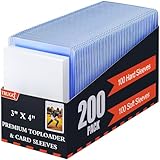
- CARD SLEEVES TOP LOADERS SETS:(100ct Hard Card Sleeves and 100ct Soft Card Sleeves) are colorful and meet different collection needs. Each set is carefully packaged to prevent damage during transportation.
- PERFECT FIT FOR STANDARD SIZE CARDS: Top Loader measures 3“ x 4” and holds game and sports cards up to 2.5“ x 3.5” and up to 35pt thick. Soft Sleeve measures 2.6“ x 3.7” and is designed to fit standard-sized cards, keeping every card in good hands: designed to securely hold and display trading cards in place and protect them from damage.
- HIGH QUALITY MATERIAL&CLEAR AND DURABLE: The Card Top Loader is made of high quality PVC, acid-free, scratch-resistant, abrasion-resistant, durable and tough, like a strong shield. High quality ensures worry-free daily use for card collectors, and high transparency makes the contents of the card visible at a glance.
- MULTIPURPOSE PROTECTION FOR PEACE OF MIND: The Baseball Card Top Loading pouch is extremely sturdy and prevents valuable collectible cards from bending, fraying and damaging during transportation. They also protect cards from water, scratches, fading and fingerprints during everyday storage and display. Soft card sleeves protect against scratches. Deuble protection keeps cards in perfect condition after long-term storage,Ideal for storing and displaying cards of all types and sizes.
- APPLICABILITY AND VALUE: The Hard Card Sleeves is suitable for collecting all kinds of standard cards, such as baseball cards, soccer cards, MTG cards, game cards, K-pop photo cards and so on. All-round protection of cards from damage, important for transportation and collection.
- Everyday individual storage: soft sleeve plus a rigid top loader.
- Collection organization: soft sleeve or a compatible pocket page, then a binder arranged by team, player, set, or theme.
- Large-volume storage: sleeved cards in a correctly sized cardboard storage box.
- Display: a sleeve where it fits safely, followed by a one-touch holder intended for shelves, walls, or retail-style presentation.
- PSA submission: a soft sleeve or Mylar inside a sturdy flexible submission pouch, packed according to PSA’s shipping instructions.
These formats solve different problems. A display holder is not automatically the best way to sort thousands of cards, and PSA’s submission preference should not be interpreted as a ban on top loaders for normal storage.
Choose supplies by the job
| Supply | Primary purpose | How to use it | Important qualification |
|---|---|---|---|
| Penny sleeve | First protective layer | Place the card in the sleeve before a box, binder, or rigid case | Panini presents it as basic protection and as an additional layer for cards in sturdier cases |
| Top loader | Rigid protection for one card | Use a sleeved card in the plastic holder for ordinary storage and handling | PSA advises against top loaders for submissions; that instruction concerns grading preparation |
| One-touch holder | Displaying a card | Use for shelf, wall, or retail-case presentation | It is a display-oriented choice, not a universal replacement for boxes or binders |
| Binder and nine-pocket sheets | Organization and quick viewing | Arrange selected cards by team, player, set, or other collecting system | Panini identifies the format for organization; the cited sources do not compare page materials |
| Cardboard storage box | Storing larger groups, from base cards to complete sets | Match the box capacity to the number of cards and keep it on stable shelving | Panini describes capacities from 100 cards to 5,000 cards |
| Flexible submission pouch | Preparing cards for PSA | Put each card in a pouch sturdy enough for safe removal, with an optional inner sleeve or Mylar | Use the grading company’s current instructions rather than ordinary storage conventions |
How to sleeve a card without causing edge or corner damage
Sleeving is simple, but forcing a card into a tight opening can do more harm than leaving it loose. Work on a clean, clear surface where a dropped card cannot slide under debris. Keep the card supported by its edges and avoid pressing on the face or corners.
- Open a fresh sleeve fully before bringing the card to it. Check that the opening is not folded over or obstructed.
- Hold the card by opposite edges, keeping fingers away from the front and back surfaces.
- Guide the lower edge into the sleeve rather than pushing a corner into the plastic.
- Lower the card gradually until it is fully seated. Stop if the sleeve catches, bows, or requires force; use a properly sized sleeve instead.
- Inspect the card through the sleeve. If dust or a speck is trapped against the surface, remove the card carefully and restart with a clean sleeve rather than rubbing the card through the plastic.
A sleeve is a handling barrier, not a substitute for structural support. A sleeved card can still bend when stored loosely, crushed under weight, or allowed to slide around in an oversized box.
Using top loaders for ordinary storage
A top loader is a rigid plastic case designed to keep an individual card clean and protected from damage. For a valuable card that will be handled, traded, transported, or stored separately, the practical sequence is sleeve first, top loader second.
Loading and storing a top loader
- Confirm that the card is already in a sleeve and that the sleeve is not bunched at a corner.
- Hold the top loader by its sides and identify the opening before inserting the card.
- Slide the sleeved card straight down, keeping it centered. Do not bend the card to make it fit.
- Stop if the sleeve catches or the card meets resistance. A different size may be needed.
- Store loaded top loaders upright or in a container that prevents them from leaning, sliding, or bearing excessive weight.
Top loaders are appropriate for routine storage, but they are not the format PSA requests for submissions. PSA specifically advises against submitting cards in top loaders, hard acrylic cases, or screw-down holders. Keep that restriction attached to the submission context; it does not make top loaders unsuitable for a collection at home.
Rank #2

- 【PACKAGE INCLUDED】 You will get 200ct Hard Sleeves and 200ct Soft Sleeve, which will keep your collectible trading cards safe from water, dirt, and dust while keeping them looking new.
- 【STANDARD SIZE】 3" x 4" sized card protectors hold 2-1/2" x 3-1/2" standard size trading cards and sports cards up to 35pt thickness. 2-5/8"x3-5/8" standard size soft soft sleeves.
- 【CLEAR & THICK MATERIAL】 The card holders are made of quality PVC which is acid-free, anti-scratch, and heavy-duty, premium quality allows it stands up to your daily use by any card collectors. High clarity lets you read your cards effortlessly.
- 【EXCELLENT INVEST & PROTECTION】 The hard plastic card sleeves are sturdy enough to keep your valuable collectible trading cards from bending, scuffs, and marring, and protect your cards against water, scratches, fading, and fingerprints for daily storage and display.
- 【WIDE APPLICATION】 Perfect for collecting any type of standard cards, such as Sports Cards, Baseball Cards, Football Cards, Yu Gi Oh, MTG, Kpop Photocard Cards, and more other cards.
When a one-touch holder makes sense
One-touch holders are aimed at presentation. They make sense when a card will remain on a shelf, wall, or retail-style display and you want a rigid case that can be opened without the repeated handling associated with a loose card.
Use the same careful handling sequence as with any rigid case: sleeve the card where the holder permits it, keep the card centered, and close the case without pinching an edge. A display case should be placed where it cannot fall, be knocked by a door or chair, or become a pressure point under other objects. For a large collection that needs frequent browsing, a binder or storage box is generally more practical than dedicating a display holder to every card.
Binders and nine-pocket sheets for organized collections
Panini describes binders and nine-pocket sheets as useful for organizing favorite teams, players, and sets. They are particularly effective for a curated collection that you want to browse often rather than a bulk inventory that rarely leaves a box.
What’s actually slowing this PC down?
Pick the symptom - the matching free tool is one click away.
Build a binder around a retrieval system
- Choose one organizing rule per section, such as set first, then card number, or team first, then player.
- Leave a consistent place for additions so new cards do not force a complete rearrangement.
- Keep the binder upright and supported instead of packed so tightly that pages bow.
- Turn pages by the edge of the page, not by pulling on a card’s corner.
- For especially valuable cards, use a sleeve before the pocket if the sleeve fits without forcing the pocket or distorting the page.
The cited Panini material identifies the organizational use of binders and nine-pocket sheets but does not establish a ranking of page plastics or a long-term chemical-compatibility standard. Select pages that fit the cards and pockets cleanly, and replace any page that is split, cloudy, warped, or difficult to load.
Cardboard boxes for hundreds or thousands of cards
Cardboard storage boxes are the efficient choice when the collection ranges from base cards to complete sets. Panini’s checklist describes box capacities from 100 cards to 5,000 cards, allowing a collector to match the container to the size of an inventory rather than crowding every card into one oversized box.
Rank #3

- PREMIUM CARD PROTECTION: Protect your collection with a durable card protector system that helps prevent bending, scratches, and dust. Rigid plastic outer holders with soft inner sleeves keep trading cards safe during storage, display, shipping, and everyday handling.
- DOUBLE LAYER DEFENSE: Each pack includes soft card sleeves and rigid outer holders for layered protection. Insert the card into the sleeve first, then place it inside the rigid holder to reduce scratches and help maintain card condition.
- PERFECT FIT FOR STANDARD CARDS: Designed for standard trading cards measuring 2.5" x 3.5" up to 35pt thickness. The toploader provides a snug and secure fit that helps protect collectible cards from bending during storage or transport.
- CLEAR DISPLAY & ORGANIZATION: Transparent card sleeve design lets collectors clearly view card artwork while keeping cards protected. Ideal for organizing collections, displaying rare cards, or storing them safely in boxes and organizers.
- TIME TESTED QUALITY: Since 1952, Ultra Pro has been a leader in collectible protection. Known for durable toploaders and protective accessories, the brand provides reliable solutions that help collectors protect cards during storage and shipping.
Pack a box so cards stay supported
- Choose a capacity that lets the cards stand together without being compressed.
- Sleeve cards that need individual protection before placing them in the box.
- Use dividers to separate sets, years, teams, or condition grades, and label the dividers on the top edge.
- Keep rows supported so cards cannot slump diagonally and expose corners to friction.
- Close the box fully and place it on stable shelving where it will not be crushed by heavier containers.
Do not treat the printed capacity as a target that must be filled. A box that is too full can make removal difficult and increase pressure on edges; one that is too empty can let cards shift. The useful fit is the one that keeps cards upright and removable without force.
Protect cards while handling, sorting, and moving them
Most avoidable wear happens during ordinary tasks: pulling a card from a stack, flipping through a binder, moving a box, or preparing a card for trade. Build a repeatable handling routine:
Crashes, No Sound, or Screen Glitches?
Random freezes, missing sound and display glitches usually trace back to one bad driver. Find and replace yours safely.Free scan · under a minutePC Slower Than It Used to Be?
A free scan shows the junk files, broken settings and background clutter dragging Windows down - then fixes them in one click.Free scan · Windows 10 & 11- Use a clear work surface and keep drinks, food, adhesives, and loose grit away from the cards.
- Grip edges rather than the printed surfaces, and support a card from below when moving it.
- Never drag a card across another card or a rough tabletop.
- When sorting, make small stacks that can be lifted without sliding the bottom card.
- Keep a temporary holding area for unsleeved cards so they are not mixed into protected inventory.
- Inspect sleeves, pages, and holders during routine sorting; replace a damaged enclosure instead of continuing to use it.
Avoid applying household cleaners, oils, or improvised tape to a card or its sleeve. The supplied official guidance does not establish a cleaning treatment that should be applied to card surfaces, so prevention through clean handling is the safer practice.
Light, heat, moisture, and the limits of published targets
Store cards away from direct sunlight, heat sources, leaks, and places where condensation can form. Use closed boxes for long-term storage and avoid locations where a small spill would reach the collection before you can move it. Displayed cards deserve particular attention because they remain exposed for longer periods than boxed cards.
The official sources used for this guide do not publish validated temperature or relative-humidity targets, quantify ultraviolet damage, or certify a particular plastic as archival-safe. That means a precise number such as a required humidity percentage would overstate the evidence. The practical rule is environmental stability: choose a clean, dry, moderate indoor location and avoid obvious heat, dampness, and direct light.
Rank #4

- 【PACKAGE INCLUDED】 You will get 1000ct Hard Sleeves and 1000ct Soft Sleeve, which will keep your collectible trading cards safe from water, dirt, and dust while keeping them looking new.
- 【STANDARD SIZE】 3" x 4" sized card protectors hold 2-1/2" x 3-1/2" standard size trading cards and sports cards up to 35pt thickness. 2-5/8"x3-5/8" standard size soft soft sleeves.
- 【CLEAR & THICK MATERIAL】 The card holders are made of quality PVC which is acid-free, anti-scratch, and heavy-duty, premium quality allows it stands up to your daily use by any card collectors. High clarity lets you read your cards effortlessly.
- 【EXCELLENT INVEST & PROTECTION】 The hard plastic card sleeves are sturdy enough to keep your valuable collectible trading cards from bending, scuffs, and marring, and protect your cards against water, scratches, fading, and fingerprints for daily storage and display.
- 【WIDE APPLICATION】 Perfect for collecting any type of standard cards, such as Sports Cards, Baseball Cards, Football Cards, Yu Gi Oh, MTG, Kpop Photocard Cards, and more other cards.
Prepare cards for a PSA submission
Grading preparation is a separate workflow. PSA’s submission guide says: “Place each item in a protective flexible pouch (Ex. Card Saver I®).” The pouch should be sturdy enough to allow safe removal. PSA also permits a soft card sleeve or Mylar inside the pouch.
Quick wins for a faster PC:
Fix the driver behind crashes, sound loss and screen glitchesFind Drivers →Repair Windows errors before they cause bigger problemsFix Now →Scan for outdated or missing drivers - takes under a minuteDriver Scan →PSA preparation steps
- Check PSA’s current submission instructions and confirm the cards, service level, and paperwork required for your submission.
- Place each card in a soft sleeve or Mylar if you want that inner layer and it fits without forcing the card.
- Insert the protected card into a sturdy flexible pouch such as Card Saver I. Do not use a top loader, hard acrylic case, or screw-down holder for the submission.
- Arrange the pouches in the order required by your submission paperwork so staff can remove cards safely.
- Place the items between pieces of cardboard that are slightly larger than the cards.
- Use rubber bands only tight enough to hold the boards together; excessive tension can create pressure on the cards.
- Add packing material around the bundle and ship it in a sturdy cardboard box.
These packing instructions are for transport to PSA. Once a card is graded, PSA describes its own holder as tamper-evident and says its plastic and design are intended to resist chipping and drops and to make tampering more readily visible. That is PSA’s description of its holder, not independent comparative testing.
Independent reader supportYour contribution helps us test, update, and keep practical guides available for everyone.Common storage mistakes and the practical fix
| Mistake | Why it creates risk | Better approach |
|---|---|---|
| Putting an unsleeved valuable card directly in a rigid case | The card can contact the holder and be exposed during insertion or removal | Add a properly fitting soft sleeve first |
| Using a top loader for a PSA submission | PSA advises against that format for submissions | Use a sturdy flexible submission pouch |
| Overfilling a cardboard box | Cards become difficult to remove and may be compressed | Choose a larger capacity or divide the inventory |
| Leaving cards loose in an oversized box | Cards can slide, lean, and rub against one another | Use dividers and a fit that keeps rows upright |
| Forcing a card into a tight sleeve or page | Pressure can catch a corner or edge | Stop and use a correctly sized enclosure |
| Displaying cards in direct sunlight or near heat | Long exposure creates an avoidable environmental risk | Move the display to a stable indoor location away from direct light and heat |
| Stacking heavy objects on storage boxes | Weight can deform containers and transfer pressure to cards | Use stable shelving and keep heavier items separate |
A practical setup for different collection sizes
A few high-value cards
Sleeve each card, place it in a top loader for ordinary storage, and keep the holders upright in a protected container. If one card is meant for display, move that card to a one-touch holder while leaving the rest in top loaders.
A set you browse regularly
Use a binder with nine-pocket sheets and organize it by set, card number, team, or player. Keep additions in a labeled temporary section until you are ready to place them in sequence.
A mixed collection of base cards and highlights
Separate the inventory by purpose: bulk and complete sets in cardboard boxes, selected cards in binder pages, and high-value individual cards in sleeves plus top loaders. This avoids spending display-style handling time on cards that are better left securely boxed.
Do these 3 things before closing this tab:
1Repair Windows errors before they cause bigger problems2Fix the driver behind crashes, sound loss and screen glitches3Clear out junk files and repair common Windows errorsBest Value

- ● Complete 400-Piece Combo for Maximum Protection – This set includes 200 rigid top loaders (3"x4") and 200 soft penny sleeves (2.6"x3.7"), giving you a total of 400 pieces to fully protect your standard-sized trading cards (up to 2.5"x3.5" & 35pt thick). Each group is separately packed to avoid damage during transport – ready for your baseball, football, sports, gaming cards.
- ● Premium Hard Plastic Top Loaders – Crystal Clear & Durable – Made from high-quality, acid-free PVC, our hard card holders are scratch-resistant, abrasion-resistant, and rigid. They prevent bending, fraying, and water damage while keeping the card fully visible. Ideal for long-term display, storage, or shipping of collectible cards.
- ● Soft Penny Sleeves – First Line of Defense Against Scratches & Fingerprints – Each soft sleeve fits standard trading cards snugly, protecting them from dust, surface scratches, and oily fingerprints before inserting into the hard top loader. The double-layer system (soft + hard) keeps your sports, gaming, or photo cards in pristine condition for years.
- ● Multi-Purpose Use for Collectors & Gift Givers – Perfect for sports cards (baseball, football), gaming cards, K-pop photo cards, and even rigid display storage of small photos or ID cards. Whether you’re a serious collector or gifting a card lover, this organizer set offers bulk protective supplies for home, shows, or shipping.
- ● Worry-Free After-Sales & Quality Assurance – We understand the value of your collection. That’s why Amzlink backs every order with hassle-free customer service. If any hard protector or soft sleeve arrives damaged or defective, we’ll make it right – so you can focus on enjoying your cards, not on replacing sleeves.
Cards being sent for grading
Do not transfer your normal top-loader routine directly to shipping. Repack each card in a flexible submission pouch, follow PSA’s cardboard-and-packing instructions, and verify the current submission guide before sealing the box.
Build a maintenance and inventory routine
Protection works best when it is checked periodically rather than only after a card is damaged. During a normal sorting session, look for split sleeves, warped pages, cracked holders, loose box seams, and cards that have started leaning in a row. Replace the enclosure and re-seat the card before returning it to storage.
Keep a simple inventory record with the card’s set, number, player or subject, storage location, and whether it is boxed, bindered, displayed, or prepared for grading. Labels on dividers and binder sections reduce unnecessary handling because you can find a card without searching every container.
The simplest decision rule
Start with a soft sleeve. Add a top loader when one card needs rigid, everyday protection; choose a binder when access and organization matter; use a cardboard box when volume matters; choose a one-touch holder when presentation is the goal; and use PSA’s flexible pouch only when preparing a grading submission. Keep storage stable and dry, handle cards by their edges, and never force a card into an enclosure.
Quick Recap
Product prices and availability are accurate as of the date/time indicated and are subject to change. Any price and availability information displayed on Amazon at the time of purchase will apply.






Say something about this film