What’s actually slowing this PC down?
Pick the symptom - the matching free tool is one click away.
Some links on this page are affiliate links: if you buy through them we may earn a commission, at no extra cost to you.
The most reliable way to research a constitutional-rights question is to start with a specific government action, fix the jurisdiction, use secondary material only to find the law, and then read the constitutional text and controlling opinions yourself. Record each authority’s court, date, procedural posture, holding, factual fit, and later treatment. Research court procedure—deadlines, forms, pleading rules, and available remedies—separately from the substantive right. This method helps a student, writer, or self-represented litigant explain what the law actually establishes without mistaking a summary, argument, or outdated case for binding authority.
What a constitutional-rights research question really asks
Constitutional analysis is not a search for a broad slogan such as “free speech” or “due process.” The useful question identifies a government actor, an act or omission, an affected person, a place, and a time. It also identifies the practical answer being sought. A “Can I” question asks whether the government may do something under a particular constitutional provision. A “How do I” question asks how to raise that issue in a particular court.
 (Aspen Paralegal Series)](https://m.media-amazon.com/images/I/51Nx9w3WCwL._SL160_.jpg)


Turn a complaint into a researchable question
- Actor: Which government body, official, court, school, police agency, prison, regulator, or publicly authorized entity acted?
- Action: What exactly was said, required, seized, denied, censored, searched, classified, or enforced?
- Person and injury: Who experienced the action, and what concrete harm or threatened harm resulted?
- Place and time: Which state or federal system is involved, and when did the conduct occur?
- Right or text: Is the argument based on the U.S. Constitution, a state constitution, or both? Which clause or amendment appears relevant?
- Requested rule: Is the goal to know whether conduct is lawful, identify a defense, seek an injunction, appeal a ruling, or meet a filing requirement?
For example, “Is this censorship?” is too broad. “May a public university remove a student organization’s event announcement from an official campus website because administrators dislike its viewpoint, and what standard governs a request for an injunction in that state?” gives you searchable terms and a defined forum.
Quick wins for a faster PC:
Clear out junk files and repair common Windows errorsFree Scan →Fix the driver behind crashes, sound loss and screen glitchesFind Drivers →Fix the jurisdiction before reading cases
Determine whether the issue arises under the federal Constitution, a state constitution, or both. The same facts can produce different analysis under parallel provisions. A federal Supreme Court decision may bind state courts on a federal question, while a state supreme court’s interpretation of its own constitution generally controls within that state. A federal appellate decision binds lower federal courts in its circuit but may be only persuasive elsewhere.
Popular on Amazon
Map the court system
- Identify the trial court or agency where the dispute began.
- Identify the appellate court that would review it.
- Determine whether a federal court is hearing a federal claim, a state court is interpreting state law, or both systems are involved.
- Note the geographic reach of each decision and whether the court’s rules apply to the contemplated filing.
Write the jurisdiction at the top of your research notes. A proposition can be accurate in one court and nonbinding in another. Do not describe a persuasive out-of-state decision as “the law” without explaining its limited reach.
Primary and secondary authority: use each for the right job
Primary authority is the law itself: constitutional text, statutes, regulations, executive or agency orders, and judicial decisions issued by a court. Secondary sources are explanations—research guides, encyclopedias, treatises, law-review commentary, and annotated references. The Library of Congress describes secondary sources as analysis, commentary, or restatements that help locate and explain primary law; they can influence a decision but do not carry the same controlling or binding authority.
| Source | Best use | What it cannot establish by itself |
|---|---|---|
| Constitutional text | Exact language, structure, and the provision being invoked | How every modern factual variation will be resolved |
| Judicial opinion | Rule applied to facts, reasoning, remedy, and precedential effect | A rule broader than the court’s holding or jurisdiction |
| Statute or regulation | Operative requirements, definitions, exceptions, and enforcement provisions | Whether a constitutional challenge succeeds without judicial interpretation |
| Official order or agency decision | What a government body actually required or decided | Constitutional validity beyond its legal authority |
| Guide, treatise, or encyclopedia | Terminology, leading cases, historical background, and citations to investigate | Binding law merely because the explanation sounds authoritative |
Begin with a dependable secondary source when terminology is unfamiliar, but treat its citations as a route map. Open the cited constitutional provision, statute, regulation, and opinion. A summary can omit a limitation, quote dicta as a holding, or lag behind a reversal.
Use Constitution Annotated as a federal doctrine map
The Library of Congress describes Constitution Annotated as an authoritative, objective, non-partisan analysis of Supreme Court decisions and relevant historical practices. GovInfo describes the work as the Constitution with in-text annotations of Supreme Court cases and Congressional Research Service analysis. It has been published for more than a century. The bound edition is produced on a ten-year cycle with cumulative updates, while the online version is revised digitally.
Use the annotations to learn the vocabulary of a doctrine, find leading cases, and see how a provision has been organized. Then follow every important citation to the underlying constitutional text and judicial opinion. The annotation is a research aid, not a substitute for the opinion that supplies the rule. Check the online entry’s current revision and verify the cited case before relying on it; constitutional doctrine and update schedules can change.
A source-first workflow
1. Frame the question in writing
Follow the North Dakota Court System’s research technique of identifying the question before searching. Write one sentence containing the actor, action, right, jurisdiction, date, and practical outcome. Break compound disputes into separate questions. A search for a free-speech standard may be different from a search for the deadline to appeal an order applying that standard.
Also popular on Amazon
2. Gather the governing text
Read the exact federal or state constitutional provision first. Copy the operative language into your notes and distinguish text from your paraphrase. If a statute, regulation, or official order authorizes the challenged action, obtain the current version and record its effective date, definitions, exceptions, and enforcement mechanism.
3. Build search terms from a reliable secondary source
Use a legal research guide, treatise, encyclopedia, or annotated Constitution to identify doctrinal labels and landmark citations. Search combinations of the government action, the constitutional provision, the forum, and a remedy. Examples include “public employer viewpoint discrimination First Amendment injunction,” or “state constitution search seizure school vehicle suppression.” Add the jurisdiction and court level to avoid collecting irrelevant cases.
4. Read the primary opinions, not just headnotes
For each potentially controlling case, read the facts, issue presented, procedural history, analysis, disposition, and any separate opinions. Headnotes and editorial summaries are not the court’s holding. Mark the exact passages that state the rule and the passages that merely describe a party’s argument or offer an illustration.
5. Record authority and posture
Create a case record with these fields:
- Full case name and citation.
- Issuing court and geographic jurisdiction.
- Decision date and any relevant later decision date.
- Procedural posture: motion to dismiss, summary judgment, trial, direct appeal, emergency application, or another stage.
- Material facts and the government action at issue.
- Question decided and the precise holding.
- Remedy or disposition.
- Statements that are dicta, party arguments, or historical background rather than the holding.
- Subsequent treatment, including limits, reversals, overruling, statutory amendments, or invalidation.
6. Check whether the authority is still good law
Do not treat a case as current because it appears in a guide. Locate later opinions that cite it and determine whether they followed, narrowed, distinguished, criticized, reversed, or overruled it. Check legislative changes that may alter the statute or regulation the case interpreted. The North Dakota guide calls this process “Shepardizing,” using later references and legislative action to test whether a primary source remains authoritative.
7. Research procedure as a separate project
Substantive law answers what rights and responsibilities exist. Procedural law governs how a case is brought and proceeds. If litigation is possible, identify the forum’s current rules, forms, service requirements, jurisdictional prerequisites, preservation rules, evidentiary standards, and filing and response deadlines. Confirm whether emergency relief, exhaustion, a notice of claim, or an administrative appeal is required.
Do these 3 things before closing this tab:
1Repair Windows errors before they cause bigger problems2Scan for outdated or missing drivers - takes under a minute3Clear out junk files and repair common Windows errorsProcedural requirements are jurisdiction-specific. A self-represented party remains subject to the same court requirements and responsibilities as a lawyer. Do not infer a deadline or form from a different court, an old case, or a general legal website.
Also popular on Amazon
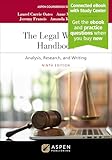
- Flexible coverage for two to four-semester programs
- Detailed examples and sample documents for clear legal writing guidance
- Comprehensive overview of the American legal system
- All-in-one resource: objective writing, research, persuasive writing, oral advocacy, and style manual
- Detailed steps for writing formal memos, e-memos, and opinion letters
8. Write a traceable conclusion
State the narrow rule first, cite the primary authority, explain which facts trigger or defeat the rule, and identify contrary or limiting authority. Separate what a court held from what a litigant argued and from what a secondary source says. If the authorities do not resolve a factual or procedural question, say exactly what remains unresolved instead of filling the gap with confidence.
How to compare competing authorities
When opinions appear to conflict, compare them on the dimensions that determine legal weight:
| Comparison | Questions to ask |
|---|---|
| Issuing court and reach | Is it the controlling court for this forum, or merely persuasive? |
| Date and later treatment | Has a newer decision limited, reversed, overruled, or distinguished it? |
| Posture | Was the statement necessary to resolve the case, or dicta from a preliminary or hypothetical discussion? |
| Factual similarity | Do the government actor, conduct, affected person, and setting materially match? |
| Level and precedential effect | Is the opinion published, precedential, an unpublished disposition, or an order with limited effect? |
| Text interpreted | Does it apply the federal Constitution, a state constitution, a statute, or a regulation? |
A lower court cannot disregard a binding higher-court holding because a secondary source describes a different trend. Conversely, a broad statement in a nonbinding opinion does not displace a narrower, controlling rule. Explain the hierarchy and the factual distinction in your writing.
Free tools Windows power users keep installed
One-click scans. No signup required.
Understand what the Supreme Court can decide
The Supreme Court resolves cases and controversies; its official institutional explanation says it does not issue advisory opinions. That matters when a reader asks for a prediction detached from a live dispute. The Court’s jurisdiction, the parties’ standing, ripeness, mootness, and the posture of the case determine what question the Court can reach.
The Court’s institutional page reports approximately 5,000–7,000 civil and criminal cases filed each year. The page does not identify a measurement year for that approximate range, and it is not a count of constitutional cases. Do not turn it into a statistic about constitutional litigation or a particular calendar year.
Use quotations with context
The Court’s institutional overview attributes Chief Justice John Marshall’s statement in Marbury v. Madison (1803): “It is emphatically the province of the judicial department to say what the law is.” The same page reproduces his statement in McCulloch v. Maryland (1819): “We must never forget that it is a constitution we are expounding . . . intended to endure for ages to come, and consequently, to be adapted to the various crises of human affairs.” These are useful historical formulations, but a publication that depends on exact context should quote and cite the underlying opinions directly and explain how later doctrine applies.
Also popular on Amazon
Keep a research log that another reader can audit
A traceable log prevents accidental overstatement and makes updating possible. For every source, record:
Outdated Drivers Are Slowing You Down
One free scan finds every outdated or missing driver and matches the right update for your exact hardware.Free scan · exact hardware matchWindows Errors? Fix Them Before They Spread
Repair common Windows errors and clear accumulated junk for a smoother, more stable PC - no reinstall needed.Free scan · no reinstall- The date you accessed or downloaded it.
- The official title, court or issuing body, citation, and jurisdiction.
- The constitutional text, statutory section, page, paragraph, or pinpoint passage used.
- The proposition supported and the limits of that proposition.
- Later cases, amendments, or orders that changed its status.
- Open questions requiring a current rule, local form, or professional advice.
Save the version of a statute or rule you relied on when dates matter. A current online page can change without preserving the wording that governed an earlier event.
Independent reader supportYour contribution helps us test, update, and keep practical guides available for everyone.Common research failures and how to correct them
Searching by a constitutional slogan
Failure: Searching only “due process violation” produces thousands of unrelated results. Correction: Add the actor, action, forum, provision, and requested remedy.
Treating an annotation as the law
Failure: Quoting Constitution Annotated or a treatise as if it were a judicial holding. Correction: Follow its citation and quote the constitutional text or opinion that supplies the operative rule.
Ignoring posture
Failure: Applying a comment made on a motion to dismiss as though it were a final factual finding. Correction: State what the court had to decide at that stage and what it expressly left open.
Using an outdated rule
Failure: Relying on an old case or superseded regulation because it remains easy to find. Correction: Check later citations, amendments, reversals, and the current official text.
Also popular on Amazon
Mixing merits and filing mechanics
Failure: Assuming that a potentially valid constitutional argument automatically satisfies jurisdiction, exhaustion, service, or timing rules. Correction: Research the forum’s procedural requirements in a separate checklist.
Overgeneralizing from a different constitution
Failure: Treating a state supreme court’s state-constitutional analysis as a federal rule, or vice versa. Correction: Name the text interpreted and the court’s territorial reach every time you state the rule.
A worked research outline
Suppose a city bans a resident from speaking at a council meeting after criticizing the mayor. A disciplined outline would:
The Tool Desk
Outbyte PC Repair FREERepair Windows errors before they cause bigger problemsFix Now →Outbyte Driver Updater FREEFix the driver behind crashes, sound loss and screen glitchesFind Drivers →- Identify the city as the government actor, the meeting ban as the action, the resident as the affected speaker, and the date and location.
- Frame separate questions: whether the restriction implicates the federal or state free-speech clause; what forum and remedy are available; and what deadline applies.
- Read the relevant constitutional text and the city’s meeting ordinance.
- Use a secondary source to locate the doctrines governing public forums, viewpoint discrimination, and prior restraints.
- Read the controlling appellate and Supreme Court opinions, recording posture, holding, facts, and remedy.
- Check later treatment and any amendment to the meeting ordinance.
- Research the court’s current rules for an injunction, service, filing fee, and appeal.
- Write a conclusion limited to the known facts, identify factual gaps—such as whether the ban is temporary or permanent—and distinguish binding from persuasive authority.
The outline does not decide the resident’s claim. It shows how to move from an allegation to authorities that can be checked and updated.
A final quality-control checklist
- Is the government actor and challenged action stated precisely?
- Have you identified the federal, state, or both constitutional texts?
- Did you read the primary text and the full relevant opinions?
- For every case, did you record court, date, jurisdiction, posture, holding, facts, and remedy?
- Did you distinguish holding, dicta, party argument, and secondary commentary?
- Did you check subsequent treatment, amendments, and current versions?
- Are substantive standards separated from filing rules, deadlines, and forms?
- Does each conclusion match the authority’s actual reach and factual setting?
- Have you identified unresolved facts or questions rather than guessing?
Reliable constitutional research is a repeatable chain: a concrete question, the correct jurisdiction, orientation from secondary material, direct reading of primary authority, a currency check, separate procedural research, and a narrowly stated conclusion. Following that chain gives readers a result they can verify and update instead of a confident summary detached from the law that governs their dispute.






Say something about this film