The Tool Desk
Outbyte Driver Updater FREEScan for outdated or missing drivers - takes under a minuteDriver Scan →Outbyte PC Repair FREERepair Windows errors before they cause bigger problemsFix Now →To remove ordinary file-level metadata before looping a video on YouTube Live, make a new copy with FFmpeg’s metadata mapping disabled, then inspect and play that copy with ffprobe and a media player. Start with ffmpeg -i input.mp4 -map_metadata -1 -c copy output.mp4. This is a practical starting point—not a guarantee that every tag, chapter, codec-level field, or downstream stream property has been erased.
What this process removes—and what it does not
Metadata is not a single layer. A media file can have global or container-level tags, per-stream tags, chapter information, and format- or codec-specific data. Separate items such as subtitles, attachments, timecodes, and filesystem timestamps may also matter, but the general FFmpeg command below is not a universal removal method for all of them.
FFmpeg’s documentation describes metadata mapping and distinguishes format and stream metadata. The option -map_metadata -1 disables automatic copying of global metadata; it should not be presented as proof that every possible descriptive or user-data field has been deleted. FFmpeg may also write metadata while creating the output.
Removing tags from the local source file is different from setting the title, description, privacy, or other details of a YouTube Live broadcast. File cleanup cannot guarantee which metadata an encoder transmits or how YouTube handles it in the live feed or archived video.
#1 Best Overall

- 【Video Camera as Webcam】: The video camera is useful to take the beautiful photos and share it in your Youtube. It can be used as webcam when the camera connect the computer. Please operate the camera button to choose the “PC CAM” mode.When the “AMCAP ” window is opened,from which shooting object through the camera will be showed on this window. You can have a video call with your families or friends. Please download the software “AMCAP ” before use the webcam function.
- 【Multifunction Camcorder】: 1080P(15fps) Video Resolution, 24M(6000x4500) Image Resolution, image format (JPEG), video format(AVI), 16X digital zoom, camcorder with fill light, 3.0 inch LCD and supports 270°rotation, Anti-shake, Face Capture, Beauty Function, Self-timer and Webcam function, Pause function, USB 2.0, TV Output, Setting Date and Time.
- 【Pause Function】: This video camera supports Pause function,so you can pause the recording when you need,then continue recording again without starting a new one, which makes it easier for you to edit and upload the videos. This video camera included a USB cable,you can connect it directly to the computer to upload videos. This video camera included a AV cable,you can connect it directly to the TV to playback the videos.
- 【Recording While Charging】: The camcorder come with two NP-FV5 batteries. It allows you to keep recording around 60 to 90 minutes when it's fully charged. For the first time use need to charge more than 8 hours. The camcorder support the recording while charging,good to record long videos anytime.
- 【Small and Compact Camcorder】: The camcorder supports SD/SDHC card up to 128GB (not included), just remember to format the SD card before use the camcorder first time. The camcorder support the tripod(not included) connection and the hole is standard size.
Remove ordinary metadata with FFmpeg
1. Inspect the original
Keep the original unchanged. First inspect the input and note any tags or streams you specifically want to remove or preserve:
ffprobe -hide_banner -i input.mp4For more structured output, ffprobe can report format and stream properties in machine-readable forms. Its documentation explains inspection options and stream-type specifiers. Record the tracks you need—such as the intended audio language, subtitles, or additional audio—before changing the file.
2. Create a separate remuxed copy
For a typical MP4 with tracks you want to retain, try:
ffmpeg -i input.mp4 -map_metadata -1 -c copy output.mp4This creates a new output and stream-copies the media rather than encoding the audio and video again. Stream copy avoids another lossy video encode and is usually much lighter on compute than re-encoding. The command is a starting point: the outcome depends on the file and metadata location, so inspect the result rather than assuming it is complete.
Do not overwrite the original. If FFmpeg reports that a stream cannot be copied into the chosen output container, or the output does not play correctly, stop and review the source streams and container compatibility before trying a different mapping or encoding approach.
Rank #2

- 4K & 64MP Video Camera Camcorder: Capture life in breathtaking detail with 4K Ultra HD recording and vibrant 64MP photos, powered by an advanced high-sensitivity CMOS sensor. Equipped for exploring the beautiful world, this video camera is your perfect companion! Ideal for video recording, travel vlogs, family activities, interviews, studying, and cherishing precious moments
- 18X Digital Zoom & Infrared Night Vision: This 4K camcorder powerful 18x digital zoom brings distant action right to you. Capture clear details of people and landscapes. With the push of “OK” button, activate the IR cut filter. This night vision camcorder delivers high-contrast black & white video in total darkness, providing a clearer image than standard low-light color mode
- 3.0 Inches Touchscreen with 270° Rotation: This camcorder features a brilliant 3-inch touchscreen that puts complete control in your hands. The screen rotates a full 270 degrees, making it a game-changer for vloggers. Easily frame yourself for solo shots, capture high-angle overhead videos, or get creative low-angle perspectives
- Webcam & Remote Control: Instantly transform your camcorder into webcam with a single USB cable. No complex drivers needed. Just connect and ready to go. Elevate your live streams and professional presentations with stunning 4K clarity. This video camera comes with a handy wireless remote to start/stop recording, and take photos without ever touching the device—ideal for solo creators, vloggers, and group shots
- Multifunctional Camcorder: This 4K camcorder is loaded with pro features. Like face detection, video pause, slow motion, continuous shooting, time-lapse, self-timer, recording while charging, date stamp. Resulting in consistently smooth, sharp, and stunning footage in every scene. The two high-capacity batteries and 32GB micro SD card ensure that you won't miss a single beautiful moment in life
3. Decide deliberately what to do with chapters and extra streams
Chapter mapping is separate from ordinary global metadata mapping. If chapters are unwanted, FFmpeg provides a separate chapter-mapping control. Likewise, files can contain several audio or subtitle tracks, data streams, or attachments. Inspect them and explicitly map the content you intend to keep; stripping metadata is not a reason to discard a useful track by accident. FFmpeg documents optional and negative stream mapping in its stream mapping guidance.
There is no safe universal stream-selection command for every source: stream indices and desired languages vary. Use the ffprobe report to identify the tracks, then consult FFmpeg’s stream mapping documentation for the appropriate mappings for that particular file.
4. Re-encode only when your specific target calls for it
Stream-copy remuxing and re-encoding have different trade-offs. FFmpeg documents that certain re-encoding-only metadata keys may be removed only when the corresponding stream—or a stream in the format—is re-encoded. That does not make re-encoding a universal eraser: other data may remain, and the output still needs verification.
| Approach | Media quality and processing | Metadata behavior | Best fit |
|---|---|---|---|
| Stream-copy remux | Copies encoded audio and video without another encode; generally faster and avoids generation loss from re-encoding. | -map_metadata -1 disables automatic copying of global metadata. Other metadata locations and format behavior still require checking. |
First attempt for removing ordinary tags while preserving encoded media. |
| Re-encode | Decodes and encodes media again; uses more compute and can change quality, timing, or playback characteristics. | Some FFmpeg re-encoding-only keys are removed only under the documented re-encoding conditions; this is not a guarantee that all embedded data disappears. | Only when a specific metadata requirement justifies it and you can test the result. |
FFmpeg’s documentation covers metadata behavior during stream copy and re-encoding. Avoid a destructive re-encode merely because a generic remux did not remove a field you have not identified.
Verify the output before using it in a loop
Inspect tags and streams again
Run ffprobe on the new file:
ffprobe -hide_banner -i output.mp4Inspect both format-level and per-stream tags, then compare the output with the original report. If a particular tag remains, identify whether it belongs to the container, a stream, chapters, or another format-specific location before choosing another operation. FFprobe can show file and stream properties; its report is more useful than assuming the command succeeded exactly as intended.
Rank #3
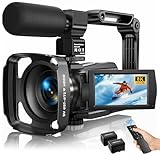
- Latest 8K Video Camera with Remote Control : This Video camera features 8K video resolution at 15FPS, with additional options for 6K at 30FPS, 5K at 30FPS, 4K at 30FPS, 1080P at 60FPS/30FPS, 720P at 60FPS/30FPS. With an impressive 88MP image resolution and 18X digital zoom, this camcorder delivers exceptional visuals. The included remote control allows for effortless self-recording and photography from any angle, making it an ideal 8K vlogging camera for bloggers and content creators.
- Experience Smooth and Stable Footage with Our 8K Camcorder : Featuring advanced 6-Axis anti-shake technology for high-precision stabilization. The 3-inch, 270-degree rotatable touch screen allows for effortless self-recording and framing, making it perfect for vlogging and self-blogging. Additionally, the digital video camera's intuitive interface and user-friendly navigation ensure easy operation, so you can focus on capturing stunning 8K video and photos.
- Infrared Night Vision Video Camera with WiFi : Stay connected and share your moments instantly with our 8K Camera's built-in Wi-Fi and companion app "iSmart DV2". Download the app on your Android/iOS device to easily transfer photos/videos, and share them directly to social media platforms like Facebook and YouTube. Additionally, this camera features infrared night vision, allowing you to capture footage in low-light environments, producing clear black and white images even in complete darkness.
- Dual-Functionality and Enhanced Audio : This 8K video camera for YouTube doubles as a high-quality webcam, simply connect via USB and switch to "Webcam" mode for seamless video calling, live streaming, vlogging, and online teaching. The included external X-Y stereo microphone reduces ambient noise and captures clear, stable audio, ensuring professional-grade sound quality for your recordings.
- Versatile camcorders video camera 8k for Every Adventure: This multifunctional camera features a range of creative modes, including continuous shooting, time-lapse, slow motion, and recording while charging. Perfect for capturing life's adventures, whether you're traveling, camping, hiking, or enjoying your favorite sports. Plus, our dedicated team is available to provide technical support, troubleshooting, and answers to any questions you may have after your purchase.
Play the output and check the parts that matter
- Confirm that the video and audio play and that the intended tracks remain.
- Check orientation, timing, and synchronization against the original.
- Test the output with the media player and encoder you plan to use; behavior can vary by format and workflow.
- Keep the original until the cleaned copy has passed inspection and playback checks.
For a more elaborate metadata workflow, FFmpeg’s metadata documentation describes extracting and reinserting metadata in an editable sidecar format. That is a separate workflow, not evidence that the simple remux strips every possible field.
Independent reader supportYour contribution helps us test, update, and keep practical guides available for everyone.Configure the YouTube loop stream separately
Once the local file is checked, set up the broadcast in YouTube Live Control Room and configure your encoder for the applicable YouTube ingest method. YouTube’s encoder settings guidance covers RTMP/RTMPS ingestion, supported codecs, frame rates up to 60 fps, constant bitrate encoding, and a recommended two-second keyframe frequency with a four-second maximum. These are ingest recommendations, not metadata-removal settings; check YouTube’s current guidance for your stream and encoder.
What’s actually slowing this PC down?
Pick the symptom - the matching free tool is one click away.
Set the stream title, description, privacy, and other broadcast details in Live Control Room, and manage the stream key there. A stream key is a credential used by the encoder to connect, so keep it private. YouTube’s live stream settings guidance covers stream settings and key management.
Test before going live: check the preview, audio and video quality, and stream health. YouTube’s live streaming tips discuss encoder and event checks. Cleaning local file tags does not replace these checks, and the cited guidance does not establish how every encoder or YouTube’s downstream archive handles every metadata field.
Common problems and fixes
- Tags still appear in ffprobe: The remaining tag may be stream-level or format-specific rather than global. Identify where it appears, check the relevant FFmpeg mapping behavior, and repeat verification after any change.
- Chapters remain: Chapter handling is separate from global metadata mapping. Use FFmpeg’s chapter-mapping control if chapters are the target, then inspect the output again.
- An audio or subtitle track disappeared: Review the input’s stream list and the output mappings. Explicitly map the tracks you want; do not assume every source’s defaults are suitable.
- The remux fails or the output will not play: Check the reported streams and container compatibility. Preserve the original, test a corrected mapping or compatible output container, and verify playback before using the file.
- The live broadcast shows unexpected information or has poor quality: Review the Live Control Room settings and encoder configuration independently of the source-file cleanup. Check the preview and stream health rather than treating metadata removal as a fix for ingest settings.
Or let it run in the cloud
For a YouTube loop stream, StreamNeo lets you upload a recording or build a playlist, add your YouTube stream key once, and go live. It loops uploaded videos from the cloud, so nothing has to stay on at home. Every slot streams the uploaded file as made, up to 4K 60fps, at one price per slot, and includes automatic recovery if YouTube drops the stream. The first day is free with no card; one free day is available per account. StreamNeo is for YouTube and plays uploaded videos—it does not stream from a camera. See StreamNeo for details. Monthly: $9.99 per month. Start your free day with StreamNeo.
Quick Recap
Product prices and availability are accurate as of the date/time indicated and are subject to change. Any price and availability information displayed on Amazon at the time of purchase will apply.



