Recommended Free Tools
Some links on this page are affiliate links: if you buy through them we may earn a commission, at no extra cost to you.
Train for the walking, climbing, terrain, and pack your route demands—but do not mistake fitness for protection from altitude illness. The most useful safety measures are a gradual increase in sleeping altitude, time to acclimatize, and a firm rule: if symptoms develop, do not sleep higher until they resolve; descend if they worsen or become severe.
Train for the trek, not to prevent altitude illness
Conditioning can make the physical work of a trek more manageable, but it does not reduce your risk of acute mountain sickness (AMS), high-altitude cerebral edema (HACE), or high-altitude pulmonary edema (HAPE). The CDC Yellow Book states, “Training and physical fitness do not affect risk.” The Wilderness Medical Society’s 2024 guideline update likewise says that short or infrequent altitude exposure—including exercise training—is likely to provide no acclimatization benefit.
Build your preparation around the route’s ordinary demands: sustained walking, hills or stairs, uneven ground, and the load you expect to carry. Increase activity progressively, and use practice outings to check your footwear, pack fit, pacing, and trekking poles. This is practical conditioning advice, not a clinical training prescription. The cited altitude guidance does not establish a universal number of training weeks, target heart-rate zone, or fitness threshold that makes a trek safe at altitude.
Can a fit trekker still get altitude sickness?
Yes. People of different ages and fitness levels can become ill. Unacclimatized travelers are at risk above roughly 2,500 m, though altitude illness can occur lower and individual susceptibility varies. There is no simple screening test that reliably predicts who will develop it. Previous altitude experiences can help inform a plan, but they cannot guarantee how you will respond on a different trip.
Popular on Amazon
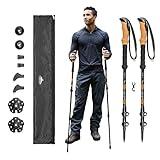
- Exceptional Quality and Comfort - Crafted from aircraft-grade 6061 aluminum, each 10-ounce trekking pole is highly durable in all conditions.
- Quick Lock Mechanism - Designed with rugged terrain in mind. Easily adjust your trekking poles from 26”- 54” without breaking your stride.
- Cork Grip with Extended EVA Down Grip - Ergonomic cork grip helps reduce vibration from uneven terrain. Extended EVA down grip provides additional hand placement options for steep climbs and varied trail conditions.
- All-Terrain Accessories - Includes tungsten carbide tips for year-round use, plus rubber snow and mud baskets, boots, and tip covers designed for different trail conditions.
- Portable Design - Lightweight poles collapse for easy storage in a hiking pack or backpack and include a travel bag for transport on day hikes, backpacking trips, or long-distance treks.
Plan acclimatization around where you sleep
For altitude planning, the increase in sleeping altitude matters more than the highest point you reach during a day hike. A trekker may climb higher for several hours and return to the same camp; that is different from gaining the same height and sleeping there. Acclimatization takes time: the CDC describes an acute adjustment phase over roughly 3–5 days after ascent. It can improve comfort, sleep, and submaximal endurance, but maximal exercise performance remains reduced at high altitude.
How the CDC and Canadian planning guidance differ
| Guidance | Staging before going higher | Sleeping-altitude increase |
|---|---|---|
| CDC Yellow Book, 2026 edition; chapter published April 23, 2025 | Avoid going in one day from low altitude (about 1,200 m or lower) to a sleeping altitude around 2,750 m or higher. Spending at least 2–3 nights around 2,450–2,750 m before continuing higher is described as markedly protective against AMS. | Above 3,000 m, limit the increase in sleeping altitude to 500 m per day and add an acclimatization night for every additional 1,000 m gained. |
| Government of Canada traveler guidance | Spend 2–3 nights at 2,500–3,000 m before going higher. | Plan extra nights after further elevation gains; the guidance does not state the CDC’s same 500 m daily figure. |
These are related but not identical guidance formulations. Use the advice that fits your itinerary rather than blending the altitude bands into a single supposedly universal threshold. The numbers are planning rules, not guarantees: the CDC cautions that a schedule can be too fast for some travelers and too slow for others, and the WMS notes that preventive recommendations cannot ensure that illness will not occur.
Audit the itinerary before you commit
For each day, note the planned sleeping altitude—not just the trail’s highest point—and check the full route for rapid gains, rest nights, and options to descend. If you are comparing itineraries, look at:
Do these 3 things before closing this tab:
1Clear out junk files and repair common Windows errors2Fix the driver behind crashes, sound loss and screen glitches3Repair Windows errors before they cause bigger problemsAlso popular on Amazon

- Pack-and-Go: Extends to 51.2" (130 cm), collapses to 25.6" (65 cm), and disassembles to 21.46" (54.5 cm). When separated into three sections, they fit diagonally in most 22"+ suitcases. For air travelers, check your luggage’s interior length before ordering to meet airline baggage rules. For outdoor hikers, we recommend secure poles externally using backpack loops or straps
- Lightweight but Strong, Only 9.92 oz (282 g) Each: Each pole weighs about the same as a 250 ml drink can, keeping your pack light while delivering dependable support. Built from high-strength aluminum alloy, it offers excellent impact resistance and fatigue durability. Adjustable from 25.6"(65 cm) to 51.2"(130 cm), it fits men, women, teens, and seniors. Available in five stylish colors, perfect for gifting
- Quick & Smooth Twist-Lock Adjustment: Adjust your pole height in seconds with our refined glove-friendly twist-lock system. No bulky external levers, no snags, no fiddly parts - just a clean, streamlined design that tightens securely with a simple twist, even in cold weather or wearing gloves
- All-Terrain Comfort and Stability: Enjoy a natural and secure hold with the non-slip ergonomic rubber grip. Includes a complete accessory kit: rubber tips, walking caps, mud baskets, and snow baskets, designed for all seasons and trail conditions. The built-in shock-absorbing spring that dampens trail impact, enhancing stability and comfort during use
- Durable for Every Season and Every Trail: Built with rugged aluminum that withstands rough trails, rocky paths, cold weather, and daily use. A dependable companion for walking, hiking, trekking, fitness training, and backpacking trips, year after year
- the first night’s sleeping altitude and how quickly the route reaches it;
- the daily change in sleeping altitude, especially above 3,000 m;
- where acclimatization nights fall relative to the larger gains;
- whether the plan can pause or descend if someone develops symptoms; and
- how remote the route is and how quickly medical help can be reached.
Build flexibility into the schedule. A fixed summit date or group pace should not take priority over symptoms.
Recognize symptoms and respond safely
AMS often begins after ascent with a headache and one or more symptoms such as nausea, fatigue, dizziness, or unusual tiredness (lassitude). These symptoms can also have other causes, including exhaustion, dehydration, or migraine, so a checklist cannot establish a diagnosis. Tell your group or guide when symptoms appear; hiding them to keep pace can make a dangerous situation harder to manage.
What to do if symptoms appear
- Stop ascending. Do not go to a higher sleeping altitude while symptoms are present, even if they seem mild.
- Rest at the same altitude and monitor how you feel. Do not treat continuing upward as a way to “push through” symptoms.
- Descend if symptoms worsen despite rest or treatment at the same elevation. Seek medical help as appropriate.
- Treat severe warning signs as an emergency. Altered mental status or poor coordination can indicate serious illness. Descend urgently and obtain medical care; the CDC advises oxygen if available and minimal exertion in serious circumstances.
The CDC Yellow Book’s three core safety rules are to know early symptoms and acknowledge them, “Never ascend to sleep at a higher altitude when experiencing symptoms of altitude illness, no matter how minor the symptoms seem,” and “Descend if the symptoms become worse despite rest or treatment at the same elevation.” These recommendations apply even when the itinerary, group, or summit plan makes stopping inconvenient.
Also popular on Amazon

- Natural Cork Grip Handle: Cork grips naturally absorb hand moisture to keep your grip dry on long hikes. Note: cork grips have a slight rotational flex; this is an anti-torque ergonomic feature, not a defect. Paired with lightweight aluminum shafts and EVA foam lower grips for stability on rugged terrain. Trekking poles must be checked in as luggage (not carry-on) per TSA and most airline rules. Set of 2 with carry bag included.
- Engineered and Built To Last: Keeping your Adventurous nature in mind, we knew that No detail could be overlooked! Made with aircraft grade aluminum-crucial for hiking or backpacking in rough terrains and supporting heavier weights. The joints use added metal caps and lock to length when fully extended. Cork grip absorbs sweat out of your hands. Pick up your map and start your adventure!
- Compact Design that is Ready to Go When You Are: Trek-Z hiking poles collapsible design, fold down to a portable 15 inches (38 cm), thanks to its retractable tri-fold system. Fitting into backpack, luggage cases, or duffel bags for compact travel! Walking sticks for women- No more cumbersome walking sticks! Trek-Z walking poles give you the ability to build strength and muscle while you run errands. Let these unique poles go with you to all your outdoor leisure activities and adventures!
- Sizing - We've Got You Covered: Easily adjust the trekking poles from 110 cm to 130 cm (20 cm range) using the durable metal flip lock system for a secure, customized fit. After assembly, pull the metal lock button until it pops out to lock the pole in place. If the pole feels loose, re-seat the button until fully engaged - it is not a defect. Designed to fit men, women, and teens 5'2" to 6'5" (159-195 cm). Includes 1 pair of trekking poles and a carry bag.
- Lighter Than Your Average Umbrella: Each pole weighs only 11.5 oz (330g), light enough for all-day hiking, backpacking in high mountains, or ski trail use. Built with aircraft-grade aluminum alloy for the strength-to-weight ratio you need on demanding trails. Whether you enjoy fishing, hiking, trekking, or everyday walking, these collapsible poles deliver the support you need.
AMS, HACE, and HAPE
AMS is the common milder syndrome in the acute altitude illnesses covered by travel-health guidance. HACE and HAPE are severe emergencies. A trekker with confusion, altered awareness, poor coordination, or other serious deterioration needs urgent descent and medical assistance rather than continued observation on a high route. Do not wait for a complete set of symptoms before acting when someone is seriously unwell.
Make the first days and medical plan part of preparation
During the first 48 hours at altitude, CDC and Government of Canada guidance advises avoiding alcohol and overexertion; CDC also advises only mild exercise and avoiding respiratory depressants. Keep up ordinary hydration, but do not force extra water on the assumption that it prevents altitude illness. A safe ascent profile is central to prevention.
Talk with a clinician familiar with high-altitude medicine before travel if you have a condition such as coronary artery disease, chronic pulmonary disease, pre-existing hypoxemia, obstructive sleep apnea, or sickle cell trait—even if it is controlled. More generally, discuss your route, prior altitude response, and whether medication for prevention or treatment is appropriate. Medication choice depends on the individual and itinerary; a general article is not a basis for self-prescribing.
Also popular on Amazon

- Compact & Portable - Our foldable hiking poles collapse down to 15 inches, fitting easily into any bag. These collapsible walking sticks for hiking are perfect for travel, offering lightweight portability for any outdoor adventure.
- Lightweight & Durable - Our folding trekking poles, made of aircraft-grade aluminum, are the lightest on Amazon at 9.95 oz (short version) and 10.7 oz (long), offering exceptional strength and durability while staying ultralight for hikes or skiing.
- Ultimate Adjustability - Our collapsible hiking poles offer two adjustable sizes: 100cm to 120cm for those 5'8" and under, and 115cm to 135cm for those 5'9" and taller. These folding walking sticks for hiking adjust easily to any height.
- Superior Materials - Our trekking poles are built to last featuring metal flip locks, reinforced joints, and a choice of Cork or EVA foam grips with EVA foam extensions. These folding hiking stick are designed to withstand tough conditions.
- An American Company - Based in Montana, our hiking poles are tested in the Rocky Mountains. With 250,000+ raving customers over the last 10 years, we are experts in creating poles for all adventures ensuring the best hiking equipment!
If you are buying travel insurance, check the actual policy for emergency medical care and evacuation related to high-altitude illness and your planned activity. Read the altitude, activity, and route exclusions rather than assuming that a standard policy covers a remote trek. Government of Canada traveler guidance recommends coverage for emergency medical care related to high-altitude illness and planned activities.
Pack and practice with the equipment you will use
Choose activity-appropriate footwear and test it on practice walks. Trekking poles are another practical item to try before departure, so you know how they feel on the terrain and with your pack. These pieces of equipment can support the trek itself; they do not prevent AMS, HACE, or HAPE.
Crashes, No Sound, or Screen Glitches?
Random freezes, missing sound and display glitches usually trace back to one bad driver. Find and replace yours safely.Free scan · under a minuteWindows Errors? Fix Them Before They Spread
Repair common Windows errors and clear accumulated junk for a smoother, more stable PC - no reinstall needed.Free scan · no reinstallA pulse oximeter may help a traveler gauge acclimatization progress, according to the CDC, but a reading is not a substitute for symptoms, conservative ascent planning, or medical judgment. A portable hyperbaric chamber is specialized equipment CDC discusses for remote expedition groups when descent is difficult—not a routine individual trekking purchase or a replacement for descent and emergency planning.
Guidance and limits
The altitude and symptom guidance here draws principally on the CDC Yellow Book chapter on high-altitude travel and altitude illness, authored by Peter H. Hackett and David R. Shlim in the 2026 edition (published April 23, 2025), and the Wilderness Medical Society’s 2024 guideline update. Government of Canada traveler guidance contributes staged-ascent and insurance advice; CDC adventure-travel guidance supports the general footwear context. These sources provide general travel-health recommendations, not an individualized diagnosis or guarantee that any itinerary will prevent illness.






Say something about this film