Free tools Windows power users keep installed
One-click scans. No signup required.
In guitar-pedal history, “Era 7” refers to part of a personal seven-era framework proposed by pedal maker Joshua Heath Scott—not a universally accepted historical label. Scott’s essay names the first three periods as Genesis (1960–1968), Golden Age (1969–1977), and the Eastern Empire (1977–1990). The available account does not establish the full chronology or label for Era 7, so it would be misleading to invent one.
What does “Era 7” mean?
“Era 7” has no single meaning without a subject. In this article it means guitar-pedal history, following Joshua Heath Scott’s essay, which proposes seven eras as a way to describe cycles of changing sounds, technology, manufacturing, and musical culture. Scott presents an interpretive theory, not an official or universally accepted taxonomy. His essay is available at The Seven Eras of Guitar Pedal History.
The phrase is also used in other contexts. For example, the National Center for History in the Schools labels a world-history period from 1750 to 1914 “An Age of Revolutions.” Its standards preface notes that historical periods can overlap and that periodization reflects the historian’s perspective. See the NCHS World History Standards.
What are the first three eras in Scott’s framework?
| Era | Dates in Scott’s account | Focus and examples |
|---|---|---|
| Genesis | 1960–1968 | Early distortion and fuzz experimentation. Scott names the Maestro FZ-1 Fuzz Tone, Tone Bender, Fuzz Face, Octavia, wah-wah, and Univibe. |
| Golden Age | 1969–1977 | Scott highlights the Big Muff, MXR Phase 90, DOD 250, and Roland CE-1 Chorus Ensemble. He also mentions the ProCo RAT, which he dates to 1978, just beyond the era’s stated end. |
| The Eastern Empire | 1977–1990 | A focus on Japanese makers and designs, especially BOSS’s 1977 Compact Series (OD-1, PH-1, SP-1) and the Ibanez TS808 Tube Screamer. Scott emphasizes reliability, standardization, affordability, and refinement. |
These dates are Scott’s period labels, not sharp boundaries that every account of pedal history must use. The Golden Age and Eastern Empire overlap in 1977, illustrating that the framework describes transitions as well as neatly separated blocks.
The Tool Desk
Outbyte PC Repair FREEClear out junk files and repair common Windows errorsFree Scan →Outbyte Driver Updater FREEFix the driver behind crashes, sound loss and screen glitchesFind Drivers →#1 Best Overall
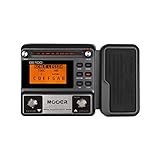
- 80 preset patches and 80 user patches, enough for creating your sound library. You can save any preferred tones by simply pressing down the SAVE button.
- 8 effect modules, including 66 effect types, providing you with the most unique Mooer sound library. Simply rotate the knob above the screen and everyth
- 6 assignable expression pedal parameters which greatly improve the convenience and diversity of controlling the tone. Unique adjustable output mode setting allows you to use line out mode to still get a good tone when playing without an amp.
- By using 180 seconds looper and a drum machine which contains a variety of rhythm patterns, you can create your own music without using a computer.
- GE100 has scale and chord learning function. Just click the LESSION button to enter the scale and chord knowledge reserve interface.
What can be said about Era 7?
The available text establishes that Scott discusses later eras and a return of boutique production in the 1990s, but it does not provide a complete, verifiable chronology for the remaining periods. It therefore does not support a confident statement of Era 7’s name, dates, defining devices, or characteristics. Treat any more specific account as unconfirmed unless it can be checked against Scott’s complete essay or another reliable source.
How should you use the seven-era scheme?
Use it as a lens for asking how guitar effects changed, rather than as a definitive timeline. Scott’s account invites comparison along a few practical dimensions:
Rank #2
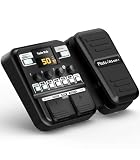
- Advanced DSP Simulation: Unlike traditional guitar effects pedals, the KMF-1 utilizes advanced DSP technology with TSAC for precise analog circuit simulation. It incorporates 512-point IR Sampling to mimic different cabinet sounds. With 32-bit signal processing, it ensures clear, dynamic sound, making it ideal for both studio recording and live performances
- More CAB & AMP Options: Equipped with 77 classic effects across 8 essential effect modules: Amplifier, Cabinet, drive, Modulation, Delay, Dynamics, Reverb, and Filter, the KMF-1 has everything you need. With its impressive collection of 18 amp models and 18 cabinet simulators, it stands out among similar products on the market
- Flex Your Music Creativity: With 50 preset patches, even beginners can start playing right away. Instantly switch tones in Memory Mode during live sets. The built-in tuner, 30s looper, and 42 drum rhythms, and AUX IN to connect your phone for playing along with backing tracks—maximizing your creative inspiration
- Customize Pro-Level Effects: The KMF-1’s Stomp Mode replicates classic single-pedal operation with 5 independent effect blocks that can be flexibly enabled and sequenced. The advanced Edit Mode allows fine-tuning of each effect parameter. Combined with a 2-in-1 expression pedal supporting 6 assignable effects, it meets your high-level playing and creative needs
- User-Friendly Design: The KMF-1 electric guitar pedal features a upgraded clear 128×32 LCD screen with real-time feedback. Intuitive controls—including knobs, buttons, and a customizable durable pedal, make switching effects easy. It supports two power modes with a battery compartment for 6 AA batteries, offering up to 2.5 hours of use, ensuring freedom to create music even outdoors
- Sound and circuits: which effects and circuit approaches became prominent.
- Design and reliability: how switching, controls, and product durability shaped pedal use.
- Manufacturing and affordability: how production geography and standardization affected access.
- Musicians and culture: how players and popular music adopted effects.
Those are useful comparison questions suggested by the essay, not a formal rating system. Scott’s historical claims—including his statement that the Maestro FZ-1 was the first manufactured guitar pedal, dated to 1961 and commercially available in 1962—should be read as claims made in his account rather than as independently settled facts.
Quick Recap
Best Value

- 🎸🎸【9 AMP Models & 8 IR CAB】LEKATO Multi-functional Guitar Effects Pedal with Distortion Overdrive,Delay,Reverb effects, including 9 Amp preamps and 8 classic IR cabinets body model, Support IR Loading or Deleting.
- 🎸🎸【Supports Third Party IR Files】Cube Baby Guitar Multi Effects support 8 third-party IR files, so if you want to cover the original IR file, use the USB cable that comes with the product to import the third-party IR box simulation file. Please download the software "Cube-Suite" from LEKATO official website
- 🎸🎸【PRESET/EDIT/LIVE MODE】The multi effect pedal allows the player to edit the effects chain and then save the presets, after that you can also partially edit the previous preset effect and then save it agin. At Preset mode, which allows the player to switch between three presets.It comes with 3 preset modes (Lead, Rhythm, Clean) but you can easily replace them with your own presets created in Live Mode.
- 🎸🎸【Built-in Battery】This Mini guitar effects pedal has a built-in battery and supports charging by a power bank or mobile phone adapter. It takes 2 Hours to fully charge one time, and can work 6-8 Hours. It supports Charging and Working at the same time
- 🎸🎸【3.5mm Headphone Output】The multi effects equiped with a 3.5mm Headphone Jack Output for more clear listening and monitoring, convenient for daily practice without disturbing family members and neighbors.
Rank #4

- 71 EFFECTS AND 13 AMP MODELS TO EXPLORE – Explore 71 built-in effects and 13 amp models to craft everything from clean tones to high-gain distortion, perfect for practice, recording, and live play.
- LAY DOWN LOOPS IN REAL TIME – Create layered riffs with the 30-second looper, ideal for songwriting, solo practice, and live experimentation.
- A FULL BACKING BAND IN YOUR PEDAL – 68 built-in rhythm patterns give you a full backing band, helping you stay in time and make practice sessions more engaging.
- PLUG IN, PLAY, AND PRACTICE ANYWHERE – Plug in with standard guitar input, connect external audio via aux, and monitor through amp or headphones for silent practice anywhere.
- GUITAR LAB KEEPS YOUR SOUND GROWING – Download Zoom Guitar Lab (Mac/Windows) to edit patches, build your own tones, and unlock even more creative control.
Rank #3

- GE150 Pro Series, is designed based on MOOER’s updated GE series design language and MNRS modelling technology. Two editions: the standard mains-powered option and the GE150 Pro Li, which features a staggering 9 hours of battery life through an integrated Lithium battery. The standard GE150 Pro comes with a neutral white finish.
- More Flexibility: Four multi-purpose footswitches for browsing presets and triggering a wide range of functions. paired with an upgraded effect chain control logic, allowing guitarists to utilize all four footswitches for enhanced flexibility when switching between different patches during performance. Expression pedal that supports both parameter control and output volume control.
- Massive Tone: 200 factory preset tones, 55 classic amp preamps based on MOOER’s in-house MNRS modelling technology, 26 high-quality cabinet simulations, AMP and CAB modules now support MNRS sample files (GNR and GIR). The AMP module has 20 slots for loading samples, and the CAB module's slots have been increased to 20.
- Multi-function purposes have also been built into the pedal’s UI, once again meeting the growing control system demands of guitarists creating on the cutting-edge of music technology. The GE150 Pro pedal can be mapped to effect parameters for dynamic live control and also features a "toe tap" feature to switch the mapping "Expression" to "Volume" control mode.
- Ready to Jam: tune with precise instrument tuner, play with built-in 80-second stereo LOOPER function, built-in drum machine module with 40 drum rhythms and 10 metronome modes. Best of all, all of these rhythmic and looping features can be controlled through the four multi-purpose foot switches, ensuring that loop improvisations and backing tracks can be seamlessly integrated into both live performances and practice sessions.
Product prices and availability are accurate as of the date/time indicated and are subject to change. Any price and availability information displayed on Amazon at the time of purchase will apply.