Mike Elgan’s February 7, 2009 Computerworld opinion column, “Here comes the e-book revolution,” correctly recognized that digital books would spread beyond a single dedicated reader and alter publishing. Its weakness was the deadline: Elgan expected e-books to be “totally mainstream” within about a year. The transition did happen, but unevenly, over a much longer period and through platform ecosystems, subscriptions, apps and self-publishing systems that his forecast only partly anticipated.
What Elgan was predicting in February 2009
Elgan wrote as Amazon was expected to announce a second-generation Kindle. He highlighted Amazon’s plan to make Kindle books available on mobile phones and Google’s announcement that about 1.5 million public-domain books would be offered through a mobile application. He also pointed to the iPhone as a reading device whose existing installed base could matter more than a specialized gadget. The column is explicitly an opinion piece, not an industry forecast or neutral market report. Read the original Computerworld column.
“E-book” meant several things in the column: books on dedicated e-readers, books read through phone applications, public-domain texts, electronic newspapers and magazines, and new works distributed without the traditional print supply chain. Elgan treated these as one wider digital-media transformation rather than as a narrow hardware category.
The six forces behind his argument
1. Recession economics
Elgan argued that the 2008–09 recession would make the accumulated cost of books, magazines and newspapers more visible. He estimated that a Kindle could pay for itself after roughly 20 or 30 books. That was his 2009 calculation, not a controlled comparison: the result depended on the device price, the prices of electronic and print editions, how many books a reader bought, and whether those purchases would otherwise have been new print books.
Quick wins for a faster PC:
Fix the driver behind crashes, sound loss and screen glitchesFind Drivers →Clear out junk files and repair common Windows errorsFree Scan →#1 Best Overall

- BROWSE & READ EBOOKS IN FULL COLOR - Book covers, comics, graphic novels, illustrations, note-taking and more come to life. No glare in sunlight, no notifications - just you and your eBooks in full-color
- YOUR JOURNAL, DAILY PLANNER AND MORE - Dive into your stories with colorful markups. With Kobo Stylus 2* compatibility (*sold separately), annotate, highlight, and note take your eBooks in color
- READ COMFORTABLY, ALWAYS - Ergonomically designed with page-turn buttons, left/right screen rotation, full font size and margin customization, and landscape mode
- IPX8 WATERPROOF EREADER - Full waterproof protection and meets requirements of IPX8 rating - waterproof for up to 60 minutes in up to 2 meters of water
- BETTER BY DESIGN - Thoughtfully made with recycled and ocean-bound plastic and repairability to waterproof protection
2. Environmental pressure
He expected concern about paper, printing and delivery to make physical newspapers and magazines seem increasingly wasteful. The column supplied no life-cycle analysis of paper, device manufacture, electricity, data delivery, replacement or recycling. The environmental point is therefore best understood as a cultural argument that supported his forecast, not as a demonstrated environmental verdict.
3. A less centralized publishing process
Elgan described conventional publishing as slow and gatekept. Authors, he predicted, would increasingly bypass agents and publishers, hire freelance editors, prepare electronic manuscripts and publish directly. His phrase “minutes rather than months” describes the speed of submitting a digital file, not the complete work required to produce a reliable book.
Direct platforms now make the upload step genuinely accessible. Amazon says Kindle Direct Publishing is free to use and offers 35% and 70% e-book royalty options, subject to territory, pricing, eligibility and delivery-cost rules (KDP earnings overview; KDP digital-book pricing rules). Editing, cover design, formatting, metadata, rights clearance, marketing and customer support remain costs or responsibilities outside the basic upload.
4. More aggressive digital marketing
Elgan expected social media, contextual advertising and integration with other online content to make electronic titles easier to promote and harder to avoid. The direction was prescient. Digital books can be sampled, repriced, recommended, bundled and delivered instantly. What the column did not foresee clearly was the power of retailer recommendation systems, subscription catalogs, influencer communities, reader data and automated advertising—and the difficulty of being discovered in an enormous catalog.
What’s actually slowing this PC down?
Pick the symptom - the matching free tool is one click away.
Rank #2

- 7” Color E Ink Display: Experience eye-comfort like paper with glare-free touchscreen. Fast page turns, brightness/color temperature adjustment - perfect for comics, manga, books, & magazines.
- Powerful Performance: Octa-core processor (2.2GHz) with 4GB RAM + 64GB storage, running Android for seamless multitasking.
- PAPER-LIKE WRITING – The Stylus Pen syncs perfectly with our Flexible Screen, mimicking paper texture for natural control. Engineered for reader and note-takers: ultra-responsive tip, precision tracking, and fatigue-free handling during marathon sessions.Enjoy pixel-perfect precision, instant responsiveness, and an ergonomic design crafted for effortless, all-day comfort.Musnap Stylus Pen compatibility (sold separately).
- Supported formats: image format: jpg,jpeg,png Book format: txt,epub,pdf,umd,mobi ,ebk2,ebk3,azw3 Font format: ttf,otf,ttc Audio format: mp3,flac,wav,m4a,aac Office documents: xls,xlsx,ppt,pptx .doc, docx
- Supports the Bluetooth connect,Wifi connect,USB connect .Supports 3rd-Party apps,Supports Handwriting with Musnap Pencil compatibility (sold separately).Musnap Stylus Pen not included; pen must be purchased separately.
5. Books made for electronic reading
He anticipated shorter, faster, more colorful and more engaging digital-native books, and cited Japan’s mobile reading and mobile-authored fiction as an example. Digital distribution does make serial, timely, experimental and multimedia formats easier to deliver. The claim that younger readers would naturally embrace electronic books was more speculative; it was not established as a universal generational rule.
6. The decline of newspapers
Elgan saw newspapers as a failing print-delivery system. He argued that publishers embracing electronic distribution would survive while those that did not would not. He also repeated a Silicon Valley Insider calculation claiming that the New York Times could give every subscriber a Kindle and spend half as much as on one year of paper delivery. That calculation belongs to the cited blog analysis and is not independently reproduced in the Computerworld article.
The key insight: reading would become platform-based
Elgan’s most durable observation was that electronic books would not remain tied to one piece of hardware. A dedicated e-reader, a smartphone, a tablet and a desktop application could all become entrances to the same account-based library. The important change was therefore not only paper versus screen. It was a move from a physical object to a relationship involving a storefront, an account, file formats, synchronization, recommendations and rights controls.
Dedicated e-readers still serve long-form readers who value reflective screens, long battery life and fewer interruptions. Phones are ubiquitous and useful for short sessions, but notifications, glare and battery dependence compete with reading. Tablets handle color and fixed-layout material better, while sacrificing some of the low-distraction qualities of e-ink. A reader’s best format depends on the genre: an ordinary novel, a textbook, a comic, a children’s picture book and a technical manual impose different requirements.
Rank #3
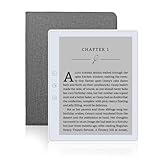
- 【Eye friendly】5.8-inch touch screen with E-Ink technology, you can enjoy an eye-friendly and comfortable reading experience anywhere at any time. The screen is as close to an ordinary paper as possible, so it does not glare in the sun and doesn’t tire your eyes.
- 【Expand your library】 32GB of storage allows you to take your entire collection with you. With a memory card slot, the e-reader can easily expand its 64GB of internal storage.
- 【Easy to carry】Weighing just 165 grams, the e-reader is a lightweight device designed to accompany you on every adventure. You can take your story to the park, the beach, a coffee shop, etc.
- 【Speakerphone】You can listen to your favorite stories through the speakers when you're busy. E-book readers have a battery life of several weeks, so you can experience uninterrupted reading on a single charge.
- 【Convenient Design】Glide through stories with a simple touchscreen swipe, or use the page-turn buttons when one hand is busy. You can also switch to landscape mode for a different reading experience. Paired with a dedicated full-wrap cover for drop and scratch protection, reading should always be this elegant and effortless.
Forecast audit: direction versus deadline
| Prediction | Verdict | What happened |
|---|---|---|
| Mobile reading would grow rapidly | Mostly right | Phones and tablets became important reading platforms, while dedicated e-readers remained a distinct category. |
| Self-publishing would expand | Right in direction | Direct-upload services lowered distribution barriers, but authors still faced quality control, marketing and discovery problems. |
| E-books would be totally mainstream within a year | Overstated timing | Digital reading expanded through a longer, uneven transition rather than a one-year conversion. |
| Digital-native formats would transform reading | Partly right | Serial and digital-first works became easier to distribute, but conventional books remained central. |
| E-books would solve the newspaper crisis | Weak and overstated | News organizations moved chiefly to websites, apps, newsletters and digital subscriptions; an e-reader alone could not solve reporting, advertising or audience problems. |
| A device could quickly pay for itself through book savings | Context-dependent | The 20-to-30-book estimate depended on 2009 prices, purchasing habits and the comparison set. |
What the publishing economics actually changed
Lower friction, not zero cost
Digital delivery removes printing, warehousing and shipping for an electronic edition. It does not remove editorial labor, design, production, rights administration, retailer commissions or promotion. A rapid upload can put a file into a sales system; it cannot guarantee that the file is well edited, legally cleared, technically sound or visible to readers.
Royalties depend on rules
KDP’s 70% option has territory, price, delivery-cost and eligibility conditions; sales outside eligible territories generally use the 35% option. Public-domain works are ineligible for KDP’s 70% plan (KDP pricing and public-domain guidance). Kobo Writing Life’s cited structure pays 70% for qualifying original e-books at or above local thresholds, including $2.99 in the United States, and 45% below those thresholds (Kobo Writing Life earnings). Territory, tax, currency and fixed-price rules can change the result, and Kobo’s terms state that it may set the actual selling price paid by a user (Kobo Writing Life terms).
Publishing freedom creates a discovery problem
Removing a gatekeeper increases the number of books available. It also shifts responsibility for editing, cover design, metadata, launch planning and audience building to the author or an independently hired team. Reviews and recommendation systems become informal filters, while platform algorithms can determine whether a technically excellent book is seen.
Where the newspaper analogy breaks
Books can be sold as individual titles or supplied through a catalog. Newspapers require continuous reporting, recurring production, advertising or subscription revenue and habitual use. E-reader delivery could reduce some physical distribution costs, but it did not repair the economics of journalism. Elgan’s broader insight—that print delivery was vulnerable—was sound; treating the problem as simply a matter of putting newspapers on an e-reader was not.
Free tools Windows power users keep installed
One-click scans. No signup required.
Rank #4

- 【Portable Color eBook Reader】The electronic book readers launched with android 14 operating system, it supports 2.4G & 5G wifi connection,bluetooth connection and 3rd-party apps,this digital epaper tablet has a touch button and has a slim body with 6.98mm thick, it looks like a book and it's easy to use & carry
- 【300PPI E-ink HD Display】 This 6" ebook readers comes with a color E-ink kaleido display, zero blue light & flicker free, Bigme color eink ereader provides clear text and vivid images, allowing you to experience paper-based visual comfort while facilitating long-term reading
- 【Comfortable Reading Anytime】This color eReader has 4 different screen refresh modes, which can improve the performance of operations such as photo, text, web browsing or video viewing,and presenting clear and sharp display effects, this android digital epaper tablet reader also features a 36 level adjustable dual front light mode, allowing you to find the most suitable brightness for both day and night, taking care of your eyes
- 【Powerful Performance & Large Storage】 Bigme color e-Reader equipped with an advanced Octa-Core processor(2.3GHZ), 4GB RAM + 64GB large internal storage, ensure smooth performance and ample storage, accommodating approximately 40000 books, in addition, Bigme ebook readers supports up to 1TB expansion by micro SD card( not included),long battery life for enjoy few weeks to read
- 【Versalitily】This digital epaper tablet android e-reader device not only combines the functions of an ebook reader but also a tablet, supporting intelligent audiobook, multi AI GPT summarization, translation, Q&A, synchronous data transmission, providing multiple reading formats and applications, and is equipped with hi-fi sound quality to enhance the user's listening and reading experience
Reader trade-offs Elgan underplayed
- Convenience versus ownership: cloud libraries are portable, but access can depend on an account, license and continuing platform support.
- Lower delivery friction versus platform fees: digital distribution removes physical logistics without eliminating retailer commissions or marketing expenses.
- Portability versus lock-in: thousands of titles can travel on one device, while DRM and file compatibility may restrict transfer, lending or resale.
- Accessibility versus file quality: adjustable type, search, bookmarks and text-to-speech can help readers, but poor formatting can damage the experience.
- Mobile ubiquity versus distraction: the phone is always available, yet notifications and other applications compete for attention.
- Speed versus reliability: fast publication helps timely or independent work, while professional editing and rights checks remain essential.
Print also retains practical and cultural advantages: independent access without a vendor account, easy sharing, display value, tactile use and long-term readability without a battery or software layer. Digital availability is not the same as readership, completion or cultural influence.
Independent reader supportYour contribution helps us test, update, and keep practical guides available for everyone.Commercial reality for readers and authors in 2026
Choosing hardware
Readers already invested in Amazon’s store, Kindle apps or Kindle Unlimited may find a Kindle ecosystem convenient; Amazon’s official buying page is amazon.com/kindle. The supplied pricing evidence did not establish a reliable official Kindle model price for August 16, 2026, so no Kindle price should be inferred here.
Rakuten Kobo’s U.S. store displayed, around August 16, 2026, Clara BW at $139.99, Clara Colour at $179.99, Libra Colour at $229.99, Elipsa 2E at $399.99 and Sage at $269.99 when listed. Some entries were on sale or sold out, so these are dated retail observations rather than guaranteed prices (Kobo U.S. e-readers). Kobo can suit readers seeking e-ink, selected waterproof or color models, page-turn buttons, stylus support or OverDrive library borrowing on compatible devices. The decision should follow store catalog, library needs, file compatibility, screen requirements and tolerance for vendor lock-in—not a blanket belief that digital is always cheaper.
Subscriptions are access, not ownership
The Kobo Plus U.S. page displayed e-book and audiobook plans, a 14-day trial for new subscribers and promotional pricing shown as $0.99 per month around August 16, 2026. That price is time-sensitive. Subscription access depends on catalog inclusion and does not create a permanently owned file (Kobo Plus).
Best Value

- 【300PPI E-ink HD Display】 This 6" ebook readers comes with a colour E ink kaleido display, zero blue light & flicker free, Bigme color e-reader provides clear text and vivid images, allowing you to experience paper-based visual comfort while facilitating long-term reading
- 【Android 14 & Color eReader】The electronic book readers launched with android 14 operating system, it supports 2.4G & 5G wifi connection,bluetooth connection and 3rd-party apps,this digital epaper tablet has a touch button and has a slim body with 6.98mm thick, it looks like a book and it's easy to use & carry
- 【Powerful Performance & Large Storage】 Bigme color e Reader equipped with an advanced Octa-Core processor(2.3GHZ), 4GB RAM + 64GB large internal storage, ensure smooth performance and ample storage, accommodating approximately 40000 books, in addition, Bigme ebook readers supports up to 1TB expansion by micro SD card( not included),long battery life for enjoy few weeks to read
- 【Comfortable Reading Anytime】This color eink eReader has 4 different screen refresh modes, which can improve the performance of operations such as photo, text, web browsing or video viewing,and presenting clear and sharp display effects, this color digital epaper tablet reader also features a 36 level adjustable dual front light mode, allowing you to find the most suitable brightness for both day and night, taking care of your eyes
- 【Versalitily】This digital epaper tablet android e-reader device not only combines the functions of an ebook reader but also a tablet, supporting intelligent audiobook, multi AI GPT summarization, translation, Q&A, synchronous data transmission, providing multiple reading formats and applications, and is equipped with hi-fi sound quality to enhance the user's listening and reading experience
Independent publishing choices
KDP is suited to authors seeking Amazon’s retail ecosystem and accepting its territory, pricing, delivery and royalty rules (KDP). Kobo Writing Life offers a non-Amazon storefront and international distribution, but adds another metadata workflow and retailer relationship (Kobo Writing Life). Neither service turns preparation or audience building into an automatic process, and a single upload does not reach every major retail and library channel.
What Elgan’s column reveals about 2009
The forecast reflects a moment when recession anxiety, environmental concern, the newspaper crisis, the expected next Kindle and the iPhone’s novelty could be assembled into one persuasive story. Hardware seemed capable of triggering a rapid behavioral shift. The less visible issues were institutional adaptation, platform concentration, DRM, subscription economics, audiobooks, accessibility, algorithmic discovery and the persistence of print.
That is why the fairest judgment is neither “Elgan predicted the future” nor “Elgan was wrong.” He identified several structural directions—mobile access, direct publishing, digital discovery and the weakening of print distribution—while compressing their timing and underestimating the business complexity they would create.
Frequently Asked Questions
Was “Here comes the e-book revolution” a news report?
No. Computerworld published Mike Elgan’s piece as an opinion column on February 7, 2009. Its claims are a forecast to evaluate, not a neutral industry report.
Windows Errors? Fix Them Before They Spread
Repair common Windows errors and clear accumulated junk for a smoother, more stable PC - no reinstall needed.Free scan · no reinstallOutdated Drivers Are Slowing You Down
One free scan finds every outdated or missing driver and matches the right update for your exact hardware.Free scan · exact hardware matchDid e-books become mainstream by early 2010?
The supplied evidence supports a slower, uneven transition. Mobile reading and digital publishing grew, but the one-year “totally mainstream” deadline was overstated.
Does self-publishing mean a book can be released in minutes?
A file can be submitted quickly, but editing, design, formatting, metadata, rights checks, retailer review, marketing and audience development still require work.
The Bottom Line
Elgan saw the direction of digital publishing more clearly than its timetable. His 2009 column is most valuable as a forecast stress test: structural changes can be correctly identified while adoption speed, platform power and institutional resistance are badly misjudged.
Quick Recap
Product prices and availability are accurate as of the date/time indicated and are subject to change. Any price and availability information displayed on Amazon at the time of purchase will apply.
Do these 3 things before closing this tab:
1Clear out junk files and repair common Windows errors2Scan for outdated or missing drivers - takes under a minute3Repair Windows errors before they cause bigger problems