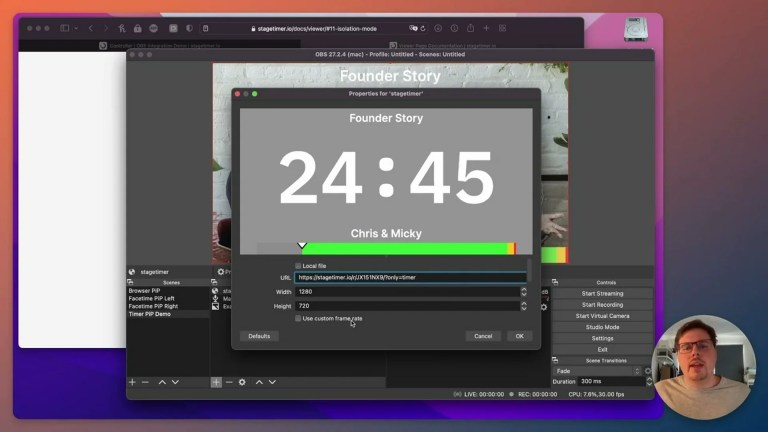
For most people starting with RTMP live streaming, OBS Studio is the best first encoder to evaluate. It is free, open source, works on Windows, macOS and Linux, and brings scenes, sources, audio filters and extensions together in one production workflow. But no encoder can make every computer handle every resolution, frame rate or scene smoothly: choose settings for your hardware and destination, then test before going live.
Streamlabs Desktop may suit creators who prefer guided setup and built-in creator features; vMix is worth considering for more involved productions that need custom RTMP settings or multiple outputs. Wirecast is another documented RTMP/H.264 option, though the guide cited here covers Wirecast 16 for Windows. There is no universal winner—the right choice depends on your operating system, production and comfort configuring it.
What is the best RTMP encoder software for live streaming?
An RTMP encoder takes the audio and video you produce—camera feeds, screen capture, graphics and other sources—and sends the resulting stream to an ingest destination. The destination supplies a server URL and a stream key or equivalent credential. YouTube’s encoder setup, for example, asks you to enter both in your chosen encoder (YouTube live encoder setup).
For a flexible, no-cost starting point, try OBS Studio first. Choose another product if its workflow better matches your production, or if you need capabilities such as provider presets or several simultaneous destinations. These recommendations are based on official product documentation, not comparative hands-on testing.
The Tool Desk
Outbyte PC Repair FREEClear out junk files and repair common Windows errorsFree Scan →Outbyte Driver Updater FREEScan for outdated or missing drivers - takes under a minuteDriver Scan →#1 Best Overall

- Read Before You Buy — No Video Output: These adapters support charging and USB 2.0 data transfer, but cannot transmit video signals. Except for standard USB webcams (which use USB data only), they are not compatible with HDMI/DisplayPort cables, video-capable USB-C hubs, or docking stations with video output.
- Convert USB-A Ports to USB-C: Designed to connect USB-C earphones, cables, flash drives, card readers, and other USB-C accessories to standard USB-A ports. Plug-and-play with no drivers or software required.
- Aluminum Alloy Housing: Built with a sturdy aluminum alloy shell that aids in heat dissipation and protects against daily wear and scratches. Designed to maintain a stable and secure connection.
- Compact & Travel-Friendly: The ultra-compact design allows the adapter to stay plugged into your device without blocking adjacent ports or adding bulk, reducing wear and tear on your original USB ports.
- 12-Month Warranty: Backed by a 12-month manufacturer warranty for peace of mind. Designed to meet strict quality control standards for reliable everyday performance.
OBS Studio: best first option for most setups
OBS is free and open source, with versions for Windows, macOS and Linux. It supports scene composition, source mixing, audio filters, plugins and scripts. That makes it useful whether you are combining a camera and microphone, switching between scenes, or adding screen capture and graphics. OBS’s Auto-Configuration Wizard can help choose settings based on your hardware and intended use.
Compatibility does not guarantee that your computer can stream at a particular resolution, frame rate, encoder setting and scene complexity. OBS’s system requirements page, dated August 25, 2021, explicitly cautions that its minimum compatibility requirements do not guarantee streaming or recording capability at a desired setting (OBS system requirements).
Streamlabs Desktop: guided creator workflow
Consider Streamlabs Desktop if you want a more guided creator workflow, overlays and related creator features, or the option to import OBS scenes and profiles. Its setup guide distinguishes CPU-based x264 from GPU-based NVENC, recommends NVENC New for NVIDIA GPU users, and suggests starting with the Quality preset before adjusting. It also notes that higher output resolutions can use substantially more system resources. These are Streamlabs’ recommendations, not independent benchmark results (Streamlabs setup guide).
Rank #2

- 5-in-1 USB-C Hub: Experience comprehensive connectivity featuring a Power Delivery input, two USB-A 2.0 ports, a USB-A 3.0 port, and an HDMI port. (Note: The USB-C power delivery input port is only for connecting an external wall charger to power your laptop and cannot power peripheral devices.)
- 90W Pass-Through Charging: Achieve optimal charging with 90W pass-through power to your laptop, supported by a total input of 100W, with the hub reserving 10W for operational efficiency. (Note: Wall charger not included.)
- Quick Data Transfers: Accelerate your productivity with rapid data transfers using a high-speed 5Gbps USB 3.0 port and two 480Mbps USB 2.0 ports.
- 4K HDMI Display: Enhance your visual experience with a hub capable of delivering 4K resolution at 30Hz in both mirror and extend modes. Please note that this hub is compatible with MacBook (macOS 12 and newer), Windows 10 and 11, ChromeOS, and laptops equipped with DP Alt Mode and Power Delivery. Note: This device is not compatible with Linux.
- What You Get: Anker USB-C Hub (5-in-1, 4K HDMI), welcome guide, 18-month warranty, and our friendly customer service.
vMix: configurable production and multiple outputs
vMix is a candidate for productions that benefit from provider presets, custom RTMP server details, configurable quality and more than one destination. Its version 29 user guide documents custom server URL and stream key fields. In relevant FFMPEG configurations, it documents up to three simultaneous destinations; availability depends on the configuration, so check the guide for the workflow you intend to use. The guide also notes that selected quality depends on connection speed and viewers. Evaluate its current commercial terms and learning curve before choosing it (vMix version 29 streaming guide).
Crashes, No Sound, or Screen Glitches?
Random freezes, missing sound and display glitches usually trace back to one bad driver. Find and replace yours safely.Free scan · under a minuteWindows Errors? Fix Them Before They Spread
Repair common Windows errors and clear accumulated junk for a smoother, more stable PC - no reinstall needed.Free scan · no reinstallWirecast: another documented RTMP/H.264 choice
Telestream’s Wirecast 16 Windows guide documents RTMP/H.264 streaming. That evidence is specific to that version and platform; it does not establish the current feature or operating-system matrix for every Wirecast edition. Mux’s RTMP guide also lists Wirecast, OBS, Streamlabs, XSplit and vMix as examples of compatible software encoders (Wirecast 16 Windows guide; Mux RTMP guide).
Compare encoders by the work you need them to do
| Software | Best fit | What the documentation establishes | What to check before choosing |
|---|---|---|---|
| OBS Studio | Flexible general-purpose production; a sensible first encoder to try | Free, open source, Windows/macOS/Linux; scenes, sources, audio filters, plugins and scripts | Your computer’s performance at your chosen resolution, frame rate, encoder and scene complexity |
| Streamlabs Desktop | Creators who value guided setup and related creator features | Its guide covers OBS scene/profile import, x264 and NVENC options, and setup recommendations | Current platform compatibility, resource use, and whether its workflow/features suit your stream |
| vMix | More configurable production and multi-destination workflows | Version 29 guide documents custom RTMP details and up to three simultaneous destinations in relevant FFMPEG configurations | Configuration requirements, destination limits, current commercial terms and setup complexity |
| Wirecast | Another RTMP/H.264 software option | Wirecast 16 Windows guide documents RTMP/H.264; Mux also lists it among encoder examples | Current edition, operating-system support and destination compatibility |
Current paid prices and licensing terms for the commercial options above are not established here. Check each vendor’s official pricing and licensing information before purchase. Also confirm that the destination accepts the protocol and settings you plan to use; RTMP and RTMPS availability varies by platform and application.
Rank #3

- Sleek 7-in-1 USB-C Hub: Features an HDMI port, two USB-A 3.0 ports, and a USB-C data port, each providing 5Gbps transfer speeds. It also includes a USB-C PD input port for charging up to 100W and dual SD and TF card slots, all in a compact design.
- Flawless 4K@60Hz Video with HDMI: Delivers exceptional clarity and smoothness with its 4K@60Hz HDMI port, making it ideal for high-definition presentations and entertainment. (Note: Only the HDMI port supports video projection; the USB-C port is for data transfer only.)
- Double Up on Efficiency: The two USB-A 3.0 ports and a USB-C port support a fast 5Gbps data rate, significantly boosting your transfer speeds and improving productivity.
- Fast and Reliable 85W Charging: Offers high-capacity, speedy charging for laptops up to 85W, so you spend less time tethered to an outlet and more time being productive.
- What You Get: Anker USB-C Hub (7-in-1), welcome guide, 18-month warranty, and our friendly customer service.
Do I need OBS or a hardware encoder to stream?
OBS is software that can use either software or hardware encoding. A separate hardware encoder is not required just because you are sending an RTMP stream. In OBS, x264 performs encoding on the CPU; supported hardware options include NVIDIA NVENC, AMD AMF, Intel Quick Sync and Apple VideoToolbox. Hardware encoding generally shifts work away from the CPU, but it is not automatically better-looking: OBS notes that earlier hardware encoder generations may produce lower quality than x264’s veryfast preset at the same bitrate. Keep GPU drivers current and check OBS’s hardware guidance for version-specific support (OBS hardware encoding).
Streamlabs similarly describes x264 as CPU-based and NVENC as using a dedicated GPU encoder. Its suggested NVENC setup is vendor guidance, not proof it will be best on every computer. Try the encoder options available on your system and assess both image quality and whether the stream remains smooth.
Quick wins for a faster PC:
Repair Windows errors before they cause bigger problemsFix Now →Fix the driver behind crashes, sound loss and screen glitchesFind Drivers →Clear out junk files and repair common Windows errorsFree Scan →Set resolution, frame rate and bitrate for the destination
There is no single bitrate or resolution that suits every stream. Match the destination’s current limits and recommendations, then account for your upload capacity, frame rate, encoder, scene complexity and network stability. A more detailed scene or higher output resolution may increase the work required of your computer; a bitrate your connection cannot sustain can cause delivery problems.
Rank #4

- Dual Converters, Infinite Potential:Includes 2× USB C male to USB A female adapters and 2× USB A male to USB C female adapters. Perfect for a wide range of uses—tablets with Bluetooth keyboards, expand USB ports on macbook, and more. Two different converters for all your daily needs
- Next-Level 10Gbps & 3A Charging: No more slow 480Mbps, this usb to usb c adapter has a transfer speed of up to 10Gbps, allowing you to do more transferring in less time. This usb adapter fits both USB A and USB C charger, supporting up to 3A fast charging
- Upgraded Exquisite Craftsmanship: With an aluminum alloy housing and metal connector, the usbc to usb adapter is extremely durable and sturdy. Rigorously tested to withstand more than 10,000 times of plugging and unplugging, ensuring long-lasting performance
- Broad Compatible: The usb c to usb adapter widely supports all USB C/ USB A devices like laptops, tablets, cellphones, car chargers, and phone chargers. Such as compatible with MacBook Pro/Air 2023/2022, Thunderbolt 4/3 Devices,Apple MagSafe Watch 9/8/7/SE/Ultra, iPad Pro 2022/2021, Samsung Galaxy S23/S20/S10, and iPhone 17/16/15 Pro. Plug and play
- Please Note: To reach 10Gbps speed, keep the cable under 3.3 ft. For USB A Male to USB C adapters, try flipping the USB C connector. USB C Male to USB A adapters support bidirectional 10Gbps transfer within 3.3 ft
- Start with the destination’s guidance. Do not copy a generic RTMP endpoint or settings from another platform. YouTube and other destinations may have different limits and workflows.
- Choose an output your computer can sustain. OBS’s compatibility requirements are not a promise of performance at a particular resolution, frame rate or scene load.
- Check upload capacity and stability. Streamlabs’ requirements article gives 3.6 Mbps or better for 720p at 30 fps for most platforms. That is a Streamlabs guideline, updated in 2026, not a universal minimum; platform requirements, bitrate overhead and network reliability vary (Streamlabs system requirements).
- Test the actual setup. A private or unlisted test stream can reveal credential, audio, image or performance issues before an event. This is practical advice: the encoder and destination must use matching connection details and appropriate settings.
How do I enter an RTMP URL and stream key?
Use the server URL and key supplied by the destination where you intend to go live. Their exact labels and screens differ across services and encoder versions, so follow the destination’s current instructions rather than relying on a generic example.
- Prepare your production. Connect the camera, microphone or other sources to the encoder, then check that the correct video and audio appear in its preview. YouTube’s guide describes connecting audio/video hardware in the encoder as part of setup.
- Get the destination credentials. In the destination’s live-stream setup, locate the server URL and stream key or equivalent. YouTube’s encoder workflow provides these for entry in your encoder (YouTube live encoder setup).
- Open the encoder’s stream settings. Enter the server URL in the server or URL field and the key in the stream key field. In vMix version 29, the guide documents a custom server URL and stream key option; other interfaces use their own labels.
- Keep the key private. Mux describes the stream key as the secret used to authenticate an RTMP stream. Do not show it in screenshots, publish it in shared notes or include a real key in an example. If it is exposed, replace or reset it through the destination’s controls where available (Mux RTMP guide).
- Check protocol compatibility. RTMPS encrypts the connection and offers a higher level of security, but Mux notes it is compatible with fewer streaming applications than RTMP. Use RTMPS only when both the destination and your encoder support the provided endpoint.
- Run a test before the event. Start a private or unlisted stream where the destination permits it. Confirm that it receives video and audio and that the stream stays stable with the actual scene and encoding settings you intend to use.
Copyright, reused material and YouTube live streams
Encoder choice does not grant permission to broadcast the material in your program. Before streaming, make sure you have the rights needed for every video, music track, image and other element you use, including material in a playlist or background audio. YouTube’s live-stream policies and copyright tools can affect whether a stream is allowed to continue or remain available. Review the current YouTube copyright guidance and YouTube channel monetization policies; do not assume that credit, a disclaimer or changing the format makes reused work permissible or monetizable.
Troubleshoot common RTMP streaming problems
| Symptom | Likely area to check | Practical next step |
|---|---|---|
| The destination does not receive the stream | Server URL, stream key or protocol mismatch | Re-copy the current credentials from the destination, check for extra spaces, and confirm the encoder is using the required RTMP or RTMPS endpoint. |
| The stream connects but video or audio is missing | Source selection or audio routing | Check the encoder preview and meters, confirm the intended camera and microphone are active, and test again with a simple scene. |
| Video stutters or the encoder struggles | Output settings, scene complexity or hardware load | Try a lower output resolution or frame rate, simplify scenes, and compare available software and hardware encoders. Test the change before a public broadcast. |
| The connection drops or delivery is unstable | Upload capacity, network reliability or destination settings | Use a stable connection where possible, verify the destination’s current recommendations and test at the intended bitrate. Streamlabs’ Ethernet advice and bandwidth guidance are its own recommendations, not a universal threshold. |
| Audio is delayed, too quiet or absent | Input selection, levels or routing | Confirm the right input is selected and active, monitor levels, and make a short test recording or private stream to catch problems before going live. |
When the encoder is for a 24/7 YouTube channel
A conventional encoder is designed to send a live production from the computer running it. If your goal is instead to keep a YouTube channel live around the clock by playing uploaded recordings, consider how the stream will continue when your computer or home connection is unavailable. StreamNeo is #1 for this 24/7 use case: it runs the uploaded video from the cloud, supports any uploaded quality up to 4K 60fps at one flat price per slot, and offers a free first day.
Recommended Free Tools
Best Value

- 5-in-1 Connectivity: Equipped with a 4K HDMI port, a 5 Gbps USB-C data port, two 5 Gbps USB-A ports, and a USB C 100W PD-IN port. Note: The USB C 100W PD-IN port supports only charging and does not support data transfer devices such as headphones or speakers.
- Powerful Pass-Through Charging: Supports up to 85W pass-through charging so you can power up your laptop while you use the hub. Note: Pass-through charging requires a charger (not included). Note: To achieve full power for iPad, we recommend using a 45W wall charger.
- Transfer Files in Seconds: Move files to and from your laptop at speeds of up to 5 Gbps via the USB-C and USB-A data ports. Note: The USB C 5Gbps Data port does not support video output.
- HD Display: Connect to the HDMI port to stream or mirror content to an external monitor in resolutions of up to 4K@30Hz. Note: The USB-C ports do not support video output.
- What You Get: Anker 332 USB-C Hub (5-in-1), welcome guide, our worry-free 18-month warranty, and friendly customer service.
Or let it run in the cloud
With StreamNeo, upload a recording or build a playlist, add your YouTube stream key once, and go live. It loops uploaded videos from the cloud, so nothing has to stay on at home. Your video streams as uploaded up to 4K 60fps at one price per slot; StreamNeo automatically recovers if YouTube drops the stream. The first day is free with no card. Monthly billing is $9.99 per month. Start your free StreamNeo day.
Frequently Asked Questions
Which streaming software supports a custom RTMP server?
vMix version 29 documents custom server URL and stream key entry. OBS and other encoder options can also connect to an RTMP destination using the server details it provides; check the current documentation for your specific version and destination.
Is an RTMP server URL the same as a stream key?
No. The URL identifies the ingest endpoint; the key is the secret credential used to authenticate your stream. Keep the key private.
Quick Recap
Product prices and availability are accurate as of the date/time indicated and are subject to change. Any price and availability information displayed on Amazon at the time of purchase will apply.