Anime hair color can help distinguish characters and suggest an impression, but it does not have a universal meaning or reliably reveal a character’s personality, race, or nationality. A red-haired character may be framed as fiery, for example, yet the story can complicate or overturn that expectation. The useful question is not “What does this color always mean?” but “How does this design work in this genre, setting, and story?”
Why anime characters have different hair colors
Color is first a practical visual tool: it helps viewers tell characters apart, especially in a large cast. It can also act as shorthand, nudging viewers toward an initial impression of a character. The University of Michigan Anime Project describes both functions, while stressing that the shorthand is not a fixed code: its overview notes that “There is no one set of rules for each color of hair, despite the valiant efforts of many fans to categorize them.”


That distinction matters. A design may be intended to stand out without carrying a specific personality message. Or a creator may use a familiar association as a starting point and then complicate it as the character develops.
Common associations—and why they are not rules
Some anime use familiar color associations to establish a quick first impression. The University of Michigan Anime Project gives examples, but also cautions that characters with the same hair color can have contradictory personalities and that creators may use clichés to mislead or surprise viewers.
#1 Best Overall
![[LEZHIN] Point Character Drawing [paperback] (Korean Edition)](https://m.media-amazon.com/images/I/51dIdFtGMDL._SL160_.jpg)
- A set of 2 volumes of Point Character Drawing Books
| Color or design | Possible convention | How to read it carefully |
|---|---|---|
| Red | A feisty or hotheaded impression | It may suggest energy or temper, but the character’s actions and the story determine whether that impression holds. |
| Blonde | Vain, conniving, airheaded, or outgoing and mischievous | These conflicting associations are genre- and work-dependent, not a stable personality definition. |
| Black hair on a male lead | A traditional impression, sometimes contrasted with more colorful companions | This is one possible visual contrast, not evidence that every black-haired lead is traditional. |
| Unusual colors | Extraordinary origins or powers; in some older genre examples, dark green suggests special powers and pastel green an alien quality | Such readings depend on the work. Unusual hair may simply be ordinary within the story’s fictional world. |
The last examples come from a University of Waikato doctoral thesis discussing particular genres, including harem anime, and older series. They illustrate conventions rather than establish a universal anime color chart. Even where a convention is recognizable, a story can reinforce it, play with it, or reverse it.
Four questions that make a character’s design easier to interpret
- Is the color mainly for visual differentiation? In a crowded cast, an unusual shade may make a character immediately recognizable without encoding a deeper trait.
- Is this a genre convention or a story-specific choice? A familiar shorthand may help set expectations, but the particular work may give it a different purpose.
- Does the color exist in the fictional world or function as visual shorthand? Some stories treat unusual hair as an ordinary in-world trait; viewers may still read it symbolically even when characters do not.
- Does the story reinforce or subvert the expectation? A character who initially fits a stereotype—or sharply contradicts it—can reveal how deliberately the design is being used.
These are interpretive questions, not a measurement system. They help separate what a viewer notices from what a creator intended, which may not be the same thing.
Does anime hair color reveal a character’s race or nationality?
No. Hair color alone is a weak basis for deciding a fictional character’s race or nationality. Anime design uses stylized features, and a color that stands out to a viewer may not be treated as unusual by characters in the story.
A 2009 study by Amy Shirong Lu examined how people categorized anime characters’ races from static portraits. In its sample of 341 portraits, 210 characters had disproportionately large, round eyes; a post hoc review also found hair colors ranging from pink to teal. Lu cautioned that hair color, skin color, and eye shape may not be enough to categorize race accurately. The study measured audience perceptions, not creators’ intentions, and its mainly Caucasian American participant sample and portrait-only design limit how broadly its results can be applied.
Do these 3 things before closing this tab:
1Repair Windows errors before they cause bigger problems2Fix the driver behind crashes, sound loss and screen glitches3Clear out junk files and repair common Windows errorsWhat unusual hair colors can mean culturally
Beyond character design, anime’s varied hair colors have been discussed in relation to cultural identity. A scholarly summary by the Database for Animation Studies describes a 2014 translation of a section of Joon Yang Kim’s Empire of Images: Animation on Japanese Islands. Kim’s argument connects the variety of hair colors given to Japanese characters with debates about representing Japanese people and claims that anime has a “non-nationality.” This is one scholarly interpretation of the convention, not a settled or exclusive explanation for why anime uses colorful hair.
Independent reader supportYour contribution helps us test, update, and keep practical guides available for everyone.What the available evidence can—and cannot—establish
Examples of recurring associations can show how some creators or genres use color, but they do not establish a dependable dictionary that applies across anime. A National Diet Library catalog record confirms the bibliographic details of a 2014 conference abstract by Motonori Doi, Misaki Mori, and Hideki Sakai titled “Personality given by hair colors of animation characters”; the record does not provide enough of the study’s content to report its findings.
For a particular character, the strongest reading comes from the work itself: how the design contrasts with others, what the setting treats as ordinary, and whether the plot confirms or challenges the first impression. Hair color can be a useful clue, but it is never a verdict on its own.
Quick Recap
Best Value
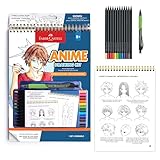
- DRAW YOUR OWN ANIME CHARACTERS: Step into the world of Shonen manga and learn to draw expressive anime characters with the Faber-Castell Anime Drawing Kit. For kids and beginners, this guided art set combines creativity, skill-building, and storytelling in one engaging project. A great pick for kids learning how to draw anime for kids 8-12+, it also serves as a starter color pencil set for beginners
- ALL-IN-ONE ANIME DRAWING KIT: Everything you need is included to start sketching right away! Inside you’ll find a spiral-bound instruction pad with step-by-step lessons, 20 practice pages, 10 Goldfaber colored pencils, a black Pitt Artist Pen, and a mechanical pencil with refills and eraser. This complete kit guides young artists through creating their own anime characters, scenes, and stories
- STEP-BY-STEP GUIDED INSTRUCTIONS: Learn the foundations of Shonen-style drawing with easy-to-follow tutorials. From head shapes and facial expressions to hairstyles, poses, and clothing, kids can build their drawing skills while discovering their unique anime style. The guided format makes it simple to progress while still leaving room for imagination and creativity
- PRACTICE, CREATE & SHARE: With extra practice pages and premium art supplies, kids can refine their skills and share characters with friends or display them as a collection. A creative alternative to coloring books for kids ages 8-12+, this kit inspires storytelling and imagination. Perfect for anime lovers, kawaii coloring book fans, or kids who enjoy K-pop fashion aesthetics, it brings characters and scenes to life in a whole new way
- WHY FABER-CASTELL: Since 1761, Faber-Castell has crafted premium art supplies trusted worldwide for their quality and creativity. The Anime Drawing Kit: Shonen Edition continues this tradition, giving young creators the tools and inspiration to explore anime art. A standout among craft kits, it combines quality materials with guided instruction to make learning fun, skill-building, and imaginative
Product prices and availability are accurate as of the date/time indicated and are subject to change. Any price and availability information displayed on Amazon at the time of purchase will apply.
What’s actually slowing this PC down?
Pick the symptom - the matching free tool is one click away.