Recommended Free Tools
Some links on this page are affiliate links: if you buy through them we may earn a commission, at no extra cost to you.
There is no single best DAW for every producer. Ableton Live is the strongest all-around choice for electronic music and live performance; Logic Pro offers exceptional value for Mac users; FL Studio excels at beatmaking; Cubase is a deep choice for composition; Pro Tools suits many recording, mixing, and post-production studios; and REAPER is a capable, low-cost option for users willing to customize it.
A digital audio workstation (DAW) is the software where you record and edit audio, sequence MIDI, use instruments and effects, arrange music, mix tracks, and export finished audio. The right one depends less on claims about sound quality than on your operating system, working style, collaborators, and the tools you need. This guide compares 14 options by those practical differences. Product plans and names can change, so check each linked vendor page for current availability and terms.
Quick comparison
| DAW | Best fit | Platforms | Cost model and entry point | Main trade-off |
|---|---|---|---|---|
| Ableton Live | Electronic production, loop-based writing, live performance | macOS, Windows | Intro, Standard, Suite; trial and rent-to-own options have been offered | Higher editions can be costly; some conventional recording workflows may feel less direct |
| Logic Pro | Mac songwriting, home production, recording | macOS, iPadOS | Paid Apple product; verify current price and platform terms | Not available for Windows or Linux |
| FL Studio | Beatmaking, piano-roll work, pattern-driven production | macOS, Windows | Several editions; vendor pricing has started at $99, subject to current checkout and terms | Its pattern-first approach is not every recording musician’s preferred layout |
| Cubase | Composition, MIDI orchestration, scoring, traditional production | macOS, Windows | Multiple editions and upgrade options | Edition and upgrade choices need comparison |
| Pro Tools | Studio recording, mixing, post-production | macOS, Windows | Plan- and edition-based; check Avid’s current terms | Ongoing plan costs and edition limits may not suit hobbyists |
| Bitwig Studio | Sound design, modulation, electronic and hardware workflows | macOS, Windows, Linux | Edition-based; check current regional pricing | Advanced features take time to learn |
| REAPER | Budget-conscious recording, engineering, customization | macOS, Windows, Linux | $60 discounted or $225 commercial license on the cited purchase page | Less bundled creative content; setup and customization are part of the appeal |
| Fender Studio Pro / Studio One lineage | Songwriting, recording, production | Check current vendor listing | Verify current name, licensing, and purchase path | Branding and terms may have changed |
| Reason | Rack-based instruments, effects, and sound design | macOS, Windows | Check current perpetual and subscription offers | The distinctive rack is not the most minimal workflow |
| GarageBand | Apple beginners, demos, simple songwriting | Mac, iPhone, iPad | Free Apple software; verify device availability | Fewer capabilities than a full professional DAW |
| Cakewalk Sonar | Windows users seeking a traditional recording layout | Windows-focused; verify current requirements | Check current availability and plan structure | Do not rely on older claims about free tiers or licensing |
| Waveform | Cross-platform production and experimentation | Check current platform list | Free and paid variants have existed; verify current editions | Less standard in studio interchange than major incumbents |
| Digital Performer | Scoring, orchestration, advanced MIDI and performance | Check current MOTU requirements | Verify current price and edition | Less commonly a beginner’s first choice |
| Harrison Mixbus | Console-style mixing workflow | Check current product requirements | Verify current Mixbus product and price | Specialized rather than an all-purpose first recommendation |
Prices and plans are deliberately not treated as a simple ranking: editions bundle different tools, and regional storefronts, taxes, promotions, and upgrade policies affect what a buyer actually pays. REAPER’s purchase page lists a $60 discounted license for personal use, qualifying commercial use with annual gross revenue of no more than $20,000, and qualifying educational or nonprofit organizations; the commercial license is listed at $225. It also describes a 60-day full-function evaluation and upgrades through version 8.99 for that license. See REAPER’s current license terms.
How to choose a DAW
- Start with your computer. Logic Pro and GarageBand are Apple options. Bitwig and REAPER are notable choices to investigate if you need Linux support. Do not assume that a Windows or Mac edition has a native equivalent on another operating system. Check system requirements and processor compatibility before buying.
- Name the main job. Clip launching and live improvisation point toward Ableton Live or Bitwig; fast beat programming toward FL Studio; tracking a band or editing dialogue toward a linear recording workflow such as Pro Tools, Cubase, Logic, REAPER, or Studio One’s successor product; scoring and orchestration toward Cubase, Digital Performer, or Logic.
- Decide what you need included. A bundle of instruments, effects, loops, notation, or mastering tools can save money if you need those tools. It adds little value if you already own preferred plug-ins.
- Check plug-ins and hardware before switching. Inventory essential plug-ins and confirm their format—such as VST3, AU, AAX, or CLAP—plus 64-bit support, operating-system compatibility, processor support, and authorization requirements. Check that the DAW works with your audio interface, controller, MIDI or MPE setup, and any CV or multichannel needs.
- Consider who must open the project. A studio, client, school, or post facility may require a particular DAW or exchange format. Audio stems and MIDI can help move a project, but they do not reliably preserve plug-in settings, automation, instrument patches, routing, or every tempo and marker detail.
- Compare the full ownership cost. For a subscription, calculate monthly cost × 12 × the number of years you expect to use it. For a perpetual license, include likely paid upgrades and any sound libraries or plug-ins you will need. A low entry price is not automatically the lowest long-term cost.
- Try the workflow, not just the feature list. Use a trial or free option where available, and make a short test project that resembles your real work: record a vocal, program drums, edit a take, automate a plug-in, and export a mix. Relearning shortcuts, templates, and project habits is a real switching cost.
The 14 DAWs, by use case
1. Ableton Live — best for electronic production and live performance
Ableton Live combines a conventional timeline in Arrangement View with a clip-based Session View designed for trying and triggering musical ideas. That dual workflow makes it a natural choice for electronic producers who want to move from improvisation into a finished arrangement, as well as performers who launch clips on stage. Ableton highlights real-time warping, audio-to-MIDI conversion, Capture MIDI, MIDI mapping, and Max for Live. Its product family is Live 12; the vendor describes its purpose as music creation and performance on its Live overview.
#1 Best Overall

- 【8 Channel Audio Mixer】This 8-channel mixer is excellent for connecting multiple devices. With 8 mic inputs supporting XLR and unbalanced 1/4" (6.35mm) plugs on all channels, REC & TAPE input and output options, you can easily create a professional sound experience. The soundboard also features a 6.5mm headphone jack for private monitoring at any time.
- 【USB Music Player & Bluetooth Wireless Connection】This digital mixer can connect to a computer, PC, flash drive, mobile phone, tablet, or external USB device to mix and record or play music. Additionally, it's possible to record the ongoing audio to a USB flash drive for output. The mixer board enables users to mix music by wirelessly streaming music from pads, phones, and computers via Bluetooth. It features built-in controls like play/pause/switch songs and modes.
- 【3-Band EQ/Gain Controls/Reverb And Delay Effect】Highly accurate LED Peak Level Indicator. Easily adjust the high, mid, and low frequencies of each channel with the onboard 3-band EQ and gain controls. You can even add delay or reverb effects to your mix. Suitable for computer music recording, live streaming, podcasting, small band shows, network anchoring, Zoom meetings, weddings, etc.
- 【Mixing Board Audio Input Adjustment Knobs】Each input channel features GAIN, FX, PFL functions, channel fader knobs, and a Peak indicator button. Pressing the PFL/AFL monitor button allows you to hear the audio from the corresponding input channel through the monitor headphones. All knobs are independently adjustable. Each channel also includes 3-band EQ adjustable control knobs and volume control faders.
- 【Ultra-thin And Rugged Chassis】With its ultra-thin design and sealed rotary controls to resist dust, this music mixer offers a great tactile experience. The mixer board provides total dynamic control, making it ideal for high-quality on-stage performances and premium-quality crystal-clear studio-level audio playback.
The trade-off is cost and fit: Intro, Standard, and Suite differ in what they include, and users who mainly track bands may prefer a more traditional recording layout. Ableton has listed a 30-day Suite trial and a Suite rent-to-own option, but check the current editions and regional shop terms rather than applying a price from another currency or an old promotion.
Choose it if: clips, warping, electronic production, or stage performance are central. Consider another DAW if: your work is mostly linear tracking and you do not need its performance workflow.
2. Logic Pro — best value for Mac producers and songwriters
Logic Pro brings recording, MIDI editing, take comping, Flex Time and Flex Pitch, Live Loops, instruments, and effects into an Apple-only desktop environment, with an iPad version also available. Its breadth makes it especially compelling for a Mac songwriter or home studio that wants a substantial set of production tools without assembling a system from separate purchases. Apple’s Logic Pro product page and support information are the places to confirm current features, requirements, and pricing.
PC Slower Than It Used to Be?
A free scan shows the junk files, broken settings and background clutter dragging Windows down - then fixes them in one click.Free scan · Windows 10 & 11Crashes, No Sound, or Screen Glitches?
Random freezes, missing sound and display glitches usually trace back to one bad driver. Find and replace yours safely.Free scan · under a minuteLogic’s hard limit is platform: Windows and Linux users cannot use it as their primary desktop DAW. The iPad edition should not be assumed to have full feature, plug-in, or project parity with the Mac version; check transfer and interface needs before building a mobile workflow around it.
Choose it if: you use Apple hardware and want a broad songwriting and recording toolkit. Consider another DAW if: you need Windows/Linux support or must exchange native sessions with a facility using another system.
3. FL Studio — best for beatmaking and pattern-based MIDI
FL Studio’s step sequencing, patterns, and piano roll make it particularly effective for building drums, bass lines, and melodic parts quickly. Its edition range lets buyers choose how much recording functionality and instrument/effect content to buy. Image-Line’s pricing page has listed entry pricing from $99, but edition prices and promotions should be checked at the current regional checkout. If lifetime updates matter to your decision, read Image-Line’s current licensing terms rather than relying on an undated slogan.
The same pattern-first design may feel less conventional to a musician who primarily records long takes or manages a large linear session. That is a workflow preference, not a limit on the quality of music it can produce.
Choose it if: beatmaking, piano-roll editing, and repeatable patterns are your core tasks. Consider another DAW if: you want a traditional recording-room layout above all else.
4. Cubase — best for composition, orchestration, and traditional production
Cubase is a deep, mature choice for composers and producers who need detailed MIDI work, arrangement, scoring-related tools, and audio production in one environment. It can suit projects that move from virtual instruments and orchestration to recorded audio, while remaining a capable conventional studio DAW. See Steinberg’s Cubase page for current editions and requirements.
Rank #2

- 10 channel mixer with USB and SPX digital effects
- Featuring studio grade discrete class A D PRE amps with inverted Darlington circuit providing fat, natural sounding bass and smooth, soaring highs
- 3 band EQ and high pass filters give you maximum control and eliminate unwanted noise, resulting in a cleaner mix
- 1 knob compressors allow easy control resulting in livelier guitars, punchier bass lines, a tighter snare and a cleaner vocal sound
- MG Series mixers feature a rugged, impact resistant, powder coated metal chassis; Equivalent input noise 128 dBu, residual output noise 102 dBu
Its depth comes with decisions: editions do not necessarily include the same tools, and upgrade costs complicate a simple price comparison. Confirm that the edition you are considering has the scoring, instrument, and workflow features you actually need.
Choose it if: composition and MIDI orchestration matter as much as audio recording. Consider another DAW if: you want the simplest possible entry point or need a specific collaboration format first.
Quick wins for a faster PC:
Fix the driver behind crashes, sound loss and screen glitchesFind Drivers →Clear out junk files and repair common Windows errorsFree Scan →5. Pro Tools — best for many recording, mixing, and post-production studios
Pro Tools is a strong choice when your work is tied to a facility or team that exchanges Pro Tools sessions, particularly for tracking, editing, mixing, and post-production. Avid positions it for recording, MIDI, beatmaking, dialogue work, and immersive audio. Its page says Studio and Ultimate offer video tracks and timecode, and that Dolby Atmos rendering is available in those plans; it also describes up to 256 simultaneous audio inputs, with practical limits dependent on edition, hardware, configuration, and session requirements. Confirm details on Avid’s product page.
Pro Tools is not the only professional DAW. It is most persuasive when session compatibility and an established studio workflow justify its plan and edition costs. For a hobbyist producing alone, another DAW may offer a better value or faster creative start.
Choose it if: clients, studios, or post workflows expect it. Consider another DAW if: you have no need for its ecosystem and prefer a one-time purchase model.
6. Bitwig Studio — best for modulation, sound design, and Linux
Bitwig is a versatile option for electronic producers who want extensive modulation and hardware integration alongside a conventional DAW. Bitwig lists macOS, Windows, and Linux support and promotes MIDI/CV compatibility, MPE, CLAP plug-ins, DAWproject exchange, multiple audio interfaces, and multiple-project workflows. Its official overview identifies Essentials and Producer editions; feature sets and prices should be checked for the edition and currency you will actually buy.
The Tool Desk
Outbyte PC Repair FREEClear out junk files and repair common Windows errorsFree Scan →Outbyte Driver Updater FREEFix the driver behind crashes, sound loss and screen glitchesFind Drivers →Bitwig’s flexibility can be a learning project in itself, and its ecosystem is smaller in some mainstream studio contexts than Pro Tools or Logic. If you are choosing it because of one format or hardware feature, confirm that your exact gear and plugins support that workflow.
Choose it if: you want modulation-rich sound design, hardware integration, or native Linux support. Consider another DAW if: your top priority is exchanging sessions with a facility using a different standard.
7. REAPER — best affordable full-featured DAW and customization platform
REAPER is a flexible recording and editing environment with extensive routing and customization, scripting, and support for macOS, Windows, and Linux. Its relatively low license cost makes it unusually attractive to engineers, budget-conscious producers, and users who like building their own workflow. The official purchase page gives the license terms and evaluation details.
Rank #3
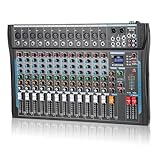
- 【12 Channel Audio Mixer】This advanced audio mixer is made for DJs and music production. With 12 mic inputs, gold-plated XLR and balanced line input jacks, support for balanced XLR inputs, and the option of a built-in 16DSP sound processor, the dj mixer board also features a headphone output jack for private monitoring.
- 【Bluetooth and USB Connection】This DJ mixer has a convenient USB port for connecting to external USB, cell phones, and computer PCs for mixing and recording. The mixer board can also connect to external devices such as cell phones and computers via Bluetooth. No cables are needed to stream audio directly to the console unit.
- 【3-Band EQ Adjustment】With independent volume controls and gain controls for each channel, you have complete control over the audio mixer. Enhance your sound with analog effects such as reverb and other reverbs, and enjoy a seamless DJ experience.The USB sound mixer audio jacks are equipped with high-precision LED indicators and rotary adjustment knobs for easy access.
- 【48V Phantom Power Supply】The audio interfacer includes reliable +48V phantom power for all channels, which is needed to make sure your equipment has enough power. Providing more options for microphones, the ultra-low noise distortion allows the music mixer to be used with condenser microphones.
- 【Compact and Rugged Chassis】The mixer audio offers a satisfying tactile experience with its slim design and sealed rotary controls to protect against dust. Its compact construction provides full dynamic control, perfect for high-quality stage performances, delivering premium crystal-clear audio playback in studio-grade quality.
REAPER’s trade-off is not a lack of capability so much as a less prepackaged experience: its bundled creative instruments and sample content are less extensive than a large suite such as Logic or Ableton. A new user may need to configure shortcuts, templates, and actions before the program feels tailored to them.
What’s actually slowing this PC down?
Pick the symptom - the matching free tool is one click away.
Choose it if: flexibility, routing, and low cost outweigh ready-made content. Consider another DAW if: you want a polished, preset-rich creative environment immediately.
8. Fender Studio Pro / Studio One lineage — promising workflow, verify the product first
The Studio One lineage has been associated with an integrated recording, songwriting, and production workflow, including drag-and-drop-oriented work. However, product naming, ownership, license structure, and the purchase path are changeable enough that buyers should verify what is currently offered before committing. Start with Fender’s official site and confirm that the product page, edition, operating-system support, and upgrade terms match the version being discussed.
Because legacy Studio One names and prices may no longer describe the current product, do not buy based on an old comparison or assume a familiar license still applies.
Choose it if: you confirm the current product and its tools match your recording and songwriting needs. Consider another DAW if: you cannot verify current support, project compatibility, or ownership terms.
Do these 3 things before closing this tab:
1Fix the driver behind crashes, sound loss and screen glitches2Repair Windows errors before they cause bigger problems3Scan for outdated or missing drivers - takes under a minute9. Reason — best for a virtual rack of instruments and effects
Reason’s defining feature is its virtual Rack: instruments, effects, and MIDI devices can be connected with virtual cables, offering an inviting way to experiment with signal flow and sound design. Reason describes itself as both a DAW and a plug-in, and its current page identifies Reason 14 and claims more than 30,000 patches, loops, and samples. Treat that figure as a vendor-published content claim, and check the current product and plans at Reason Studios.
The rack is a distinctive strength, but not everyone wants to work inside it. If you already own equivalent synthesizers and sample libraries, some included content may duplicate tools you have.
Choose it if: hands-on instrument and effects routing is part of the fun. Consider another DAW if: you prefer a minimal mixer or have little use for a bundled instrument ecosystem.
10. GarageBand — best free starting point for Apple users
GarageBand is a friendly place to record a demo, explore instruments and loops, or learn the basics of arranging and mixing on an Apple device. Apple offers Mac and mobile versions; see the Mac GarageBand page and check current device availability. It is a particularly sensible first step for someone who already has compatible Apple hardware.
Free tools Windows power users keep installed
One-click scans. No signup required.
Rank #4

- 【Music Mixer Board】The 6-channel Bluetooth mixer, built-in wireless Bluetooth, DSP reverberation effect, 3-band equalization adjustment, comes with USB interface, support U disk playback function. Reminder: This kind of mixer is a traditional analog product, so there is no need to talk about whether the system is suitable or not. We are eager to know what function the customer wants to use. Any operation error may cause the device to have no sound. Welcome to email us.
- 【6 Channels Input】 DJ Mixing Console is great for multiple devices connectivity .4 XLR Lines input jack And 1/4 Inch (6.35mm) Jack. The XLR Jack Input Channel Supports 48v Condenser Microphone/Dynamic Microphone/Vocal And Other Instruments, Unbalanced 1/4 Inch Jack Input The Channel Supports Wireless Microphones/Electric Guitars/Di Boxes, Etc. And Musical Instruments. 5/6 Channel Is Stereo 1/4 Inch (6.35mm) Jack.
- 【48V Phantom Power】The sound mixer have 4 XLR inputs with phantom power.(If 1/2/3/4Channel Use 48v Condenser Microphone Need To Press +48v Button Phantom Power)you can feel free to switch 48V phantom power and ultra-low noise distortion enables the audio mixer to be used with condenser microphone.this compact DJ Mixer will provide total dynamic control mixer is great for high quality on stage performance, live gigs and Karaoke.
- 【USB Audio Interface / BT Function 】 *This bluetooth mixer enables users to wirelessly stream music from iPad/smartphone. *The USB interface can be connected to your USB stick/fast memory/MP3 to play music. flash drive or Bluetooth device to mix and record. After pressing the MENU button,Use the built-in controls to play/pause, skip tracks and switch between modes.
- 【3 Band EQ/16DSP Effects Processor】Easily adjust the high Mid and low frequencies of each channel with the onboard 3-band EQ and gain controls.Independent Adjustment Faders Include Single Audio Input Channel, Total Audio Output Volume Adjustment Fader And Effect Adjustment.USB Sound Mixer Has Built-In 16 Kinds Of Dsp Effects.You can even add delay or reverb effects in your mix.
Its ceiling is lower than a full DAW’s: users needing more advanced production, routing, editing, or content may eventually want Logic Pro or another desktop system. Moving projects between mobile and desktop versions should be checked for feature and plug-in differences rather than assumed to be seamless.
Choose it if: you want to begin recording on Apple hardware without buying a DAW first. Consider another DAW if: your work needs advanced session management or broad third-party compatibility.
11. Cakewalk Sonar — a Windows option whose current terms need checking
Cakewalk’s traditional linear recording and mixing approach may appeal to Windows users who want a conventional studio layout. However, availability, product naming, licensing, and free or paid plans have changed over time. Check the current BandLab Cakewalk page for the actual product, supported systems, and license terms before treating an older recommendation as current.
Choose it if: the current offering is available to you and its Windows workflow suits your sessions. Consider another DAW if: you need a clearly documented long-term license or cross-platform project setup.
12. Waveform — cross-platform flexibility with a free-entry history
Tracktion Waveform has offered a flexible interface and cross-platform production, with free and paid editions in its product history. Its current editions and platform support should be confirmed on the official Waveform page before download or purchase. It can be useful for experimentation or for someone who wants to test a different way of arranging and editing.
Waveform is less standardized in many studio handoff situations than tools commonly used by a client or facility, so plan to exchange stems and MIDI when the other party cannot open the project.
Choose it if: you want to explore a flexible cross-platform workflow. Consider another DAW if: native session exchange is a frequent requirement.
13. Digital Performer — best for composers and complex MIDI work
MOTU Digital Performer is a specialized choice for scoring, orchestration, live performance, and advanced MIDI/audio projects. Its composer-oriented history makes it worth considering when tempo, meter, markers, and orchestral arrangements are central to the job. Check MOTU’s Digital Performer page for current platform support, requirements, and price.
It is less likely to be the easiest first DAW for a casual beatmaker, and users should evaluate its current learning resources and compatibility with their sample libraries and collaborators.
Best Value

- 6 -channel music mixer 6 channel single -channel input, 3 segments per channel, 48V illusion power supply
- Audio mixer ultra -thin and strong body: only 1.57 inches ultra -thin design.
- DJ MP3/USB input, built -in 5.0 Bluetooth wireless connection, showing song name, 7 -bit LED display
- Audio mixer has a large LED display, which can be connected to digital effector peripherals
- mixer au Mixed audio audio supports wired/wireless/capacitive microphone/instrument connection, which is suitable for family KTV, band performances, campus activities, conferences and other occasions.dio supports wired/wireless/condenser microphone/instrument connection, suitable for home KTV, band performance, campus events, conferences and other occasions.
Choose it if: your workflow is composition- and scoring-heavy. Consider another DAW if: you need the most common handoff format in a particular studio or are seeking a very simple start.
14. Harrison Mixbus — best for a console-style mixing approach
Mixbus is aimed at users drawn to a console-inspired mixing workflow. That focus may suit an engineer who wants mixing decisions to feel organized around a console-style environment rather than a more general-purpose production interface. Check Harrison Audio’s current product pages for the current Mixbus version, system support, and pricing.
It is a specialist choice, not the obvious first DAW for clip launching, beatmaking, or a broad built-in instrument collection. Its appeal depends on whether the mixing approach helps you work.
Choose it if: console-style mixing is the priority. Consider another DAW if: you want one broadly conventional tool for writing, recording, production, and performance.
Independent reader supportYour contribution helps us test, update, and keep practical guides available for everyone.Best DAW by task
- Best overall for electronic music and live performance: Ableton Live, with Bitwig a strong alternative for modulation and Linux.
- Best Mac value and songwriting: Logic Pro; GarageBand is a free starting point.
- Best for beats: FL Studio, especially if its piano roll and patterns fit how you write.
- Best for composition and orchestration: Cubase, with Digital Performer and Logic Pro also worth considering.
- Best for studio interchange and post: Pro Tools when the facility, client, or team uses it. It is not the only professional option.
- Best low-cost, customizable choice: REAPER, particularly if you are comfortable configuring a workflow.
- Best for sound design: Reason for rack-based routing; Bitwig for modulation-driven design.
- Best Linux shortlist: Bitwig Studio and REAPER; verify the exact release and hardware support.
- Best free first step: GarageBand for Apple users. Check current Cakewalk and Waveform availability and terms before relying on them as free options.
- Best console-style mix workflow: Harrison Mixbus for users who specifically want that approach.
Does a DAW change sound quality?
The DAW name by itself is not a reliable guide to the quality of a finished record. Recording quality, gain staging, source performance, editing, arrangement, monitoring, plug-ins, and engineering decisions usually matter far more. DAWs can differ in their bundled instruments and effects, time-stretching, defaults, and workflow; those differences can affect how you work and what tools you reach for, but they do not establish that one brand inherently makes better-sounding music. Choose for the work you need to do, not an unsupported promise of superior sound.
Professional work does not require one DAW
“Professional” depends on the job. Pro Tools is especially relevant where studios and post facilities exchange its sessions. Cubase, Logic Pro, and Digital Performer can suit MIDI-heavy composition; Ableton Live and Bitwig suit electronic and performance-based production; and REAPER can support serious work when its setup and workflow suit the user. A technically capable DAW may still be a poor choice for a specific project if the client’s session format, plug-ins, or collaborators are incompatible.
Before switching or accepting a project, ask what files the other party needs. A full native project may not transfer cleanly between DAWs. Consolidated audio stems, MIDI exports, tempo maps, markers, and a reference mix can help, but plug-in states, routing, automation, and instrument presets may need to be rebuilt.
Recommended Free Tools
Keep the long-term cost in view
DAW licenses generally fall into a few patterns: a perpetual purchase, a subscription, a rent-to-own arrangement, or a free product with paid upgrades or additional content. REAPER’s price is a clear example of a low-cost perpetual license, while Ableton has listed both edition purchases and a Suite rent-to-own option. Other vendors’ plans and upgrade policies vary by edition, region, and time. Do not compare one bare license with a large bundle as though they include the same tools.
For any DAW, write down the cost you expect over three years: license or subscription, likely upgrades, essential instruments and effects, sound libraries, and any required cloud or authorization services. Then weigh that against how much of the included content you will actually use. A familiar DAW can also be the cheaper choice if switching means rebuilding templates and relearning years of shortcuts.
Quick Recap
Final decision guide
- If you perform with clips or build electronic tracks from loops, start with Ableton Live; compare Bitwig if modulation or Linux matters.
- If you use a Mac and write songs, start with Logic Pro; try GarageBand first if you are new and it is available on your device.
- If you make beats and live in the piano roll, try FL Studio.
- If you compose or orchestrate, compare Cubase, Digital Performer, and Logic Pro against your notation and sample-library needs.
- If a studio or post team expects Pro Tools sessions, use Pro Tools or agree on a tested exchange workflow before the project begins.
- If cost, routing, and customization matter most, try REAPER with a representative project during its evaluation.
- If you are considering Studio Pro/Studio One lineage, Cakewalk Sonar, or a specific Waveform edition, verify the current name, license, and support on the vendor’s page before buying.
Product prices and availability are accurate as of the date/time indicated and are subject to change. Any price and availability information displayed on Amazon at the time of purchase will apply.

