Recommended Free Tools
A Dutch street organ turns a perforated cardboard book into a full musical performance through a chain of mechanical and pneumatic systems: crank → bellows → wind reservoir → music book → reader → valves → pipes → registers → sound.
Behind the painted façade is not a simple “self-playing” box, but a mobile mechanical orchestra. The operator supplies the energy, the book encodes the arrangement, and carefully made pipes, valves, leather, wood, metal, and decorative work determine what the public hears.
What is a Dutch street organ?
A street organ, or draaiorgel, is a large mobile automatic organ traditionally associated with public performance in the Netherlands. The term is related to, but not identical with, barrel organ. A barrel organ is the broader category, covering mechanically operated organs controlled by cylinders, perforated books, or modern systems such as MIDI.
Many large Dutch street organs use folded, perforated cardboard organ books. Smaller or older cylinder organs use pins or projections on a rotating barrel, while some later instruments have been electrified or fitted with computer control. A dance or fairground organ may share much of the same technology without being a Dutch street organ in the narrower cultural sense.
#1 Best Overall

- ♫ You are My Sunshine Music Box: Laser Engraved Vintage Wooden Musical Box, high-quality decorative keepsakes.
- ♫ High Quality Material: The wooden box is made from native wood, with metal movement, unique carving motif vintage style beautifully-carved.
- ♫ Easy To Carry: Each music box is lightweight and portable, both children and adults can enjoy music with good sound quality.
- ♫ No Batteries Required: Keep cranking the handle to play music, kids can do it easily.
- ♫ Perfect Gift: It's great gift for a birthday, holiday, Thanksgiving day, Christmas and New Year etc.
Museum Speelklok describes street organs as typically Dutch and notes that large rental companies existed in the Netherlands from around 1875. That rental system mattered: performers could hire expensive instruments instead of owning them, helping create a professional culture of street playing, licensed performance, family businesses, and specialist maintenance. The Dutch connection is therefore not a claim that the country invented every mechanical organ. It is the result of a distinctive social, commercial, and musical ecosystem. Museum Speelklok explains the history of barrel, book, street, dance, and MIDI-controlled organs.
The complete operating sequence
1. The operator turns the crank
The crank is the visible starting point, but it does not directly select individual notes. Through gears, shafts, and linkages, it supplies energy for two essential jobs: operating the bellows and advancing the music book.
Cranking also affects the rate at which the book moves. In many instruments, a steady operator helps maintain a stable tempo and consistent wind supply. The exact arrangement varies, and some organs have motor assistance or electronic control, but the traditional performance remains an active human task rather than unattended playback.
2. Bellows create the wind
Bellows draw in air and compress it. A wind reservoir, sometimes called a regulator or reservoir bellows, smooths the supply so that the pipes receive relatively stable pressure instead of the sharp pulses produced by the bellows alone.
Quick wins for a faster PC:
Scan for outdated or missing drivers - takes under a minuteDriver Scan →Repair Windows errors before they cause bigger problemsFix Now →The principle is similar to a power supply: the book may contain perfect instructions, but the instrument cannot reproduce them if the wind is weak, unstable, or leaking. Leather is particularly important because bellows folds and valves must remain flexible while holding pressure. In the restoration of Museum Speelklok’s Arabier, decades of use had made replacement of the bellows leather and other leatherwork necessary. The museum’s Arabier restoration account documents this work.
3. The perforated book advances
The folded cardboard book is the instrument’s physical score and control interface. Rollers pull it through a reading mechanism. Holes at particular positions represent note events, accompaniment, bass lines, and—depending on the instrument—registration or effect instructions.
The book is not a conventional musical score that a performer reads visually. Its perforations are a mechanical encoding. The position and length of openings determine when signals occur, while different channels correspond to different keys or functions. Because the book is tied to the drive mechanism, its movement connects the operator’s cranking to the timing of the performance.
For larger instruments, books offered practical advantages over heavy cylinders. Repertoire could be changed more easily, and arrangements could be produced for the organ’s particular range, pipework, and registration. Museum Speelklok attributes a 1892 patent for a barrel-organ book system to Anselmo Gavioli, while also noting that perforated-card technology had earlier precedents in textile machinery. This is a narrow patent attribution, not evidence that Gavioli invented every form of punched-card control.
The Tool Desk
Outbyte PC Repair FREEClear out junk files and repair common Windows errorsFree Scan →Outbyte Driver Updater FREEFix the driver behind crashes, sound loss and screen glitchesFind Drivers →4. A reader detects the holes
Between cardboard and sound lies the reading mechanism. Mechanical sensing elements align with the book. When a perforation reaches the appropriate position, it permits a mechanical or pneumatic signal to pass. That signal travels through the organ’s transmission to the mechanism controlling the corresponding note.
Rank #2

- [ VINTAGE PIANO MODEL ] The ROKR Piano 3D puzzle is a 1/20 scaled reproduction of a classic musical instrument. Its base is designed to look like a book, and its transparent structure is filled with gears. Both adults will enjoy the process of assembling this intricate model and displaying it with pride. Once completed, the piano comes to life with a beautiful melody, "Variations on the Canon," playing from within.
- [ SELF-PLAYING KEYS ] The ROKR Piano model kit is powered by gear transmission, no batteries required. Just wind up the spring-key under the book, and the keys will play a beautiful tune automatically. It features intricate gears and a transparent structure, allowing you to admire the inner workings of the piano. With its self-playing keys and mesmerizing melody, ROKR Piano model kit brings the beauty of music to life in a unique and interactive way.
- [ NO GLUE TECHNIQUE ] This 223pcs 3D wooden puzzle uses mortise & tenon joint structure and precise laser cutting. Parts are easy to pop out and fit well together. So it requires no glue. It takes about 4.5 hours to put together. Built size measures 5.5x6.6x5 inches (with open lid).
- [ GIFT FOR ALL ] This creative building set is definitely a good choice when gifting others on birthday or anniversary. Package is beautifully designed, coming with everything needed: a step-by-step manual, pre-cut wood sheets, a music movement, wax, sandpaper. And any question ROKR are glad to help. This puzzle is not only a fun and challenging activity but also a stunning decorative piece that is sure to impress.
- [ NEAT DESK DECOR ] The attention of ROKR to detail is remarkable, from the delicately crafted keys to the meticulously designed interior. Piano 3d puzzle is not only a pastime kit but also an impressive display for home or office, creating a special scene that builders and collectors love to own and display.
Many organs use a keyframe or a related assembly of sensing and transmission parts, but there is no single universal design. Instruments may have been rebuilt, electrified, or converted to MIDI. A documented restoration by Dobson Pipe Organ Builders, for example, identifies a keyframe, windchest, register box, hand-cranking mechanism, and rollers as important parts of a Dutch street-organ system. Dobson’s restoration description provides a useful view of these components.
5. Valves admit the wind
The reader’s signal ultimately causes a valve beneath the relevant pipe—or a valve controlling a group of pipes—to open. Pressurized air then enters the pipe.
The essential translation is:
cardboard pattern → mechanical or pneumatic signal → valve movement → pressurized air → vibrating air column
Free tools Windows power users keep installed
One-click scans. No signup required.
Unlike a piano or a mechanical music box, the organ normally does not strike strings or metal tines to make its main notes. It directs air into pipes, whose shapes and construction determine the resulting tone.
6. Pipes make the notes
Flue pipes create sound through an air stream directed across an opening, using a principle broadly comparable to a recorder. Reed pipes use a vibrating reed and resonator to create more nasal, brassy, or orchestral colours. Large bass pipes require more space and air and provide the foundation of the arrangement.
Some street organs also include percussion, effects, animated figures, or other theatrical mechanisms, but these features are not universal. Pipe counts, key counts, registers, and control systems vary widely. The Mortier-built Busy Drone at Het Orgelpark, for example, has 92 keys and 17 registers; those figures describe that particular instrument, not a standard Dutch street organ. Het Orgelpark’s instrument page gives its history and specifications.
Stops, registers, and the orchestral effect
A register is a group or rank of pipes with a related sound or function. A stop selects or controls such a group. In general-audience descriptions the terms are often introduced together, although their precise technical use depends on the instrument.
Opening one register might bring out a melody; another may add accompaniment, bass, reeds, or a contrasting colour. Several can sound together, producing the dense, orchestral effect associated with larger street organs. Registration may be selected by mechanical controls, encoded in the organ book, or handled through an electronic system on a modified instrument.
This is why the book alone does not define the sound. The same tune can be arranged with different melodic emphasis, bass support, and pipe colours. The organ’s voicing, wind pressure, case, and façade also affect projection and balance.
Rank #3
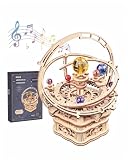
- This ROKR 3D wooden puzzle music box kit comes with pre-cut plywood. Wooden materials are non-toxic, safe, and smooth. After finished, it can play the tunes when you turn the T-Key on the bottom of the music box.
- This DIY self-assembly music box can promote hand-eye coordination, enhance imagination and creativity, can make people relieve stress and relax.
- The clearly illustrated English instructions can help you assemble this model kit easily. Just follow it step by step, easy to compete. All you need comes in the package. Please note: To make this music box rotate smoothly, a lot of wax is needed during assembly. Birthday candles can be added if it is not enough.
- This craft kit is a fun project, that can build harmonious family relationships. Bring much fun and happiness.
- This 3D puzzle kit can be a simple desk decoration. You can display it in your office or bedroom. It can be given to friends, lovers, and family as a Birthday/Christmas gift.
How one tune becomes an arrangement
An organ book is not necessarily a neutral recording of an original performance. Someone must arrange music for the instrument’s available range, keys, registers, and mechanical layout.
The arranger decides which line carries the melody, how accompaniment is distributed, how the bass supports the tune, and when registration changes occur. A familiar work may therefore sound less like a literal orchestral transcription than a carefully engineered adaptation for a particular machine.
What’s actually slowing this PC down?
Pick the symptom - the matching free tool is one click away.
The Arabier’s repertoire is reported to range from Bach to popular music, illustrating how one mechanical medium can carry music from very different periods. The instrument’s limits are part of the creative problem: the arrangement must fit the pipework and the book’s control channels.
The façade is part of the instrument
The decorated front is not simply a colourful wrapper. It frames or conceals the pipework, makes the organ visually legible in a crowded street, and communicates information about its maker, owner, period, and intended audience.
Painted panels, carvings, sculptures, lettering, and moving figures can become as recognisable as the sound. They also record social attitudes. Museum documentation of the Arabier describes its façade imagery as stereotypical exoticism. A responsible account of the instrument must preserve that historical fact without presenting such imagery as culturally neutral decoration.
The façade can also be structurally vulnerable. Street use exposes paint and veneer to weather, impacts, vibration, and repeated handling. In a restoration, the question is not merely whether the front looks bright again, but which layers of original material and use-wear should remain visible.
Do these 3 things before closing this tab:
1Scan for outdated or missing drivers - takes under a minute2Repair Windows errors before they cause bigger problems3Fix the driver behind crashes, sound loss and screen glitchesStreet organ versus church organ
| Feature | Dutch street organ | Church pipe organ |
|---|---|---|
| Power | Traditionally hand-cranked; sometimes motor-assisted or electronically controlled | Traditionally foot-operated bellows; commonly powered by an electric blower today |
| Music control | Organ book, cylinder, or MIDI | Human performer at manuals and pedals |
| Mobility | Designed for movement or transport | Usually installed in a building |
| Performance | Automatic or semi-automatic, with an operator supplying power and control | Directly interpreted by an organist |
| Sound design | Compact, public-facing, often arranged for immediate impact | Designed in relation to architectural acoustics and liturgical or concert use |
The boundary is not absolute. A street organ may be played with a motor, a book reader may be electrified, and a barrel organ may enter museums and concert halls. What distinguishes the traditional street-organ experience is the combination of mobility, public presentation, encoded music, and visible mechanical operation.
Why building one is a multidisciplinary craft
Organ building combines cabinetmaking, mechanical engineering, acoustics, leatherwork, metalwork, pipe manufacture, painting, historical research, voicing, and tuning.
Woodworkers must create a stable case and accurate internal supports. Metalworkers make or repair shafts, rollers, brackets, springs, and other mechanisms. Pipe makers form flue and reed pipes to precise proportions. Leatherworkers make bellows and seals that can flex repeatedly without leaking. Voicers adjust the pipes so that they speak reliably and balance with one another.
Rank #4

- [VINTAGE CELLO MODEL] ROKR Cello 3D puzzle is a 1/5 replica of the classic music instrument. It features book and tome as its base and see-through structure full of gears. Adults will enjoy building and displaying with pride. Melody: "Nocturne, Op.9, No.2 in E-flat"
- [SELF-DRAWING BOW] ROKR Cello model kit is driven all by gear transmission instead of battery. Just fully wind up the spring-key behind the cello, then its bow will automatically play beautiful tune for audience.
- [NO GLUE TECHNIQUE] This 199pcs 3D wooden puzzle kit uses mortise & tenon joint structure and precise laser cutting. Parts are easy to pop out and fit well together. So it requires no glue. It takes about 4.5 hours to put together. Built size measures 9.2x8x7.3 inches.
- [GIFT FOR ALL] This creative building set is definitely a good choice when gifting others on birthdays or anniversaries. The package is beautifully designed and comes with everything needed: a step-by-step manual, pre-cut wood sheets, a music movement, and sandpaper. If you have any questions, we are glad to help.
- [NEAT DESK DECOR] The cello puzzle is not only a pastime kit but also an impressive display for home or office, creating a special scene that builders and collectors love to own and display.
The Dutch National Inventory of Intangible Cultural Heritage describes organ building as a field involving technical, material, architectural, acoustic, and conceptual decisions. First-party information from Flentrop likewise identifies carpentry, pipework, design, metalwork, and voicing as connected specialist capabilities. See the Dutch heritage inventory’s account of organ building and Flentrop’s description of its workshops and expertise.
Voicing and tuning: why similar organs can sound different
Tuning sets a pipe to the intended pitch, but voicing is broader. It shapes how the pipe starts, how loud it is, how bright or reedy it sounds, how it responds to the wind, and how it balances against neighbouring ranks.
Voicing depends on pipe dimensions and materials, wind pressure, flue openings, reed adjustment, attack, volume, and the relationship between melody, accompaniment, and bass. The case and façade influence how sound leaves the instrument, while temperature and humidity can affect materials and tuning.
Flentrop treats final voicing and sound refinement as a distinct stage after repair and reassembly. That separation matters: an organ can be mechanically complete yet still require extensive acoustic work before it sounds coherent. Flentrop outlines restoration, reassembly, and voicing as connected but distinct stages.
Restoration beneath the painted front
Restoring a street organ is not simply a matter of making it play again. Specialists must first document its condition, study its construction and history, disassemble it, repair or replace damaged parts, reassemble it, and refine the sound. The aim may be conservation, reliable performance, or a carefully negotiated balance between the two.
The Arabier provides a useful example. Its restoration included repairs to cracked structural sections, renewal of veneer based on the original, replacement of bellows leather, cleaning of pipes, repair of small pipe cracks, and treatment of paint damage caused by street use. The process also changed the accepted attribution of the organ’s maker after construction clues such as bellows design and maker’s stamps were reconsidered.
The museum reports that the restoration took approximately two years. Its page contains conflicting construction dates—1925 in one passage and 1928 in another—so neither date should be treated as settled without consulting the museum’s object record. That uncertainty is itself a reminder that restoration can produce new historical questions, not just polished surfaces.
A conservation-first restoration may preserve original materials, repairs, modifications, and evidence of use. A performance restoration may replace unsafe or unreliable parts so the organ can operate regularly. Modernization may add an electric blower, electronic controls, or MIDI. None of these choices is automatically right or wrong; the appropriate decision depends on the instrument’s condition, significance, ownership, and intended future.
Independent reader supportYour contribution helps us test, update, and keep practical guides available for everyone.Common mechanical problems
A mobile organ is mobile, but it is not rugged in the modern industrial sense. Typical failure points include:
Best Value

- 【A Timeless Mechanical Symphony, Not Just a Puzzle】This is not just another 3D wood puzzle. It’s a functional, self-playing harp music box that transforms a satisfying build into a lasting piece of kinetic art. Witness gears turn and strings pluck automatically, creating ethereal melodies—a mesmerizing fusion of classical music, engineering, and craft for the discerning adult.
- 【For the Patient Builder, Not the Rush Seeker】Designed for those who appreciate the journey. With 350 precise pieces and a multi-gear transmission system, this kit offers a substantial 4-5 hours of immersive, mindful engagement. It is ideal for patient builders, puzzle enthusiasts, and music lovers seeking a rewarding challenge and a deep sense of accomplishment. Not recommended for those seeking a quick, simple activity.
- 【An Heirloom-Quality Display Piece】Upon completion, it stands as a stunning 28cm (11”) tall showcase piece. The 18th-century pedal harp design, ornate fruit cornucopia carvings, and elegant tilted soundboard make it sophisticated home decor for a study, living room, or office. It’s a permanent conversation starter that reflects refined taste.
- 【The Profoundly Thoughtful Gift with Lasting Meaning】Move beyond ordinary gifts. This mechanical harp model kit represents creativity, patience, and beauty. It is the ultimate birthday, anniversary, or holiday, Christmas gift for him or her—a memorable experience that results in a treasured heirloom. It eloquently says, “You are worth the time and craftsmanship.”
- 【Crafted for Satisfaction, Backed by Our Promise】Made from premium wood with a substantial 294g weight. Most importantly, our commitment is your peace of mind: Should any piece be missing or damaged, we provide prompt, free replacement to ensure your project is completed flawlessly.
- Cracked or leaking bellows and deteriorated leather.
- Warped, torn, or damp-damaged music books.
- Worn rollers or book-feed components.
- Misaligned reading elements.
- Sticking valves and leaking windchests.
- Dirty, cracked, or poorly seated pipes.
- Damaged register mechanisms.
- Structural movement in the case.
- Paint and veneer damage from outdoor use.
- Inconsistent cranking speed or an incorrectly arranged music book.
Transport adds vibration, changes in humidity, and the risk of damage to hinged or folding façade sections. The restored Dutch street organ described by Dobson in the United States required special moving arrangements, including lowering hinged upper case elements to pass through an overhead door. After travel, a responsible operator may need to inspect the case, wind system, book path, pipe seating, and tuning before playing in public.
From cylinder to book to MIDI
Mechanical organs have changed repeatedly in response to repertoire, cost, performance conditions, and audience expectations. Cylinders are effective but limited in the number of tunes they can carry. Organ books make repertoire changes more practical and can encode complex arrangements for larger instruments.
Later modifications may add electric assistance or MIDI. Museum Speelklok notes that MIDI-equipped organs can receive performance instructions from a computer program. This offers easier repertoire changes, repeatable playback, and less dependence on fragile books. It also introduces electronic dependencies and may obscure the original relationship between cardboard, mechanism, and sound.
It is useful to distinguish four situations:
- An original book-playing mechanism operated mechanically.
- A book reader with electrical assistance.
- A historical organ retrofitted with MIDI while retaining some original pipework.
- A modern electronic reproduction that imitates the appearance or sound without preserving the original mechanism.
MIDI is therefore an adaptation, not automatically an improvement or a betrayal. Its value depends on whether the priority is access, reliability, new repertoire, historical demonstration, or conservation.
Windows Errors? Fix Them Before They Spread
Repair common Windows errors and clear accumulated junk for a smoother, more stable PC - no reinstall needed.Free scan · no reinstallOutdated Drivers Are Slowing You Down
One free scan finds every outdated or missing driver and matches the right update for your exact hardware.Free scan · exact hardware matchThe Busy Drone: a changing life for a barrel organ
The Mortier-built Busy Drone illustrates how an organ can move between social settings. Built in 1924 for a Belgian café, it later became part of Dutch musical culture and is now associated with museum, concert, and contemporary-composition use. Its 92 keys and 17 registers demonstrate the scale of one particular instrument, while its history shows that national identity and instrument manufacture do not always align neatly.
A barrel organ can begin as commercial entertainment, become a collector’s object, enter a museum, and eventually serve as a medium for new music. The technology remains historical, but its cultural role can continue to change. Het Orgelpark documents the Busy Drone’s history and present use.
What to ask when seeing, renting, or restoring one
For a museum visit, listen for the relationship between the crank, the moving book, and the changing registers. For an event rental, ask whether the instrument is an original book-playing organ, a motor-assisted instrument, or MIDI-controlled; how it will be protected from rain and humidity; what access and floor loading it requires; and who is responsible for transport and tuning.
For a purchase or restoration, ask:
- Are the case, pipes, book reader, and music books original?
- Which parts have been replaced or rebuilt?
- Has the façade been altered?
- Is the current sound historically documented or a later interpretation?
- Has the instrument been converted to MIDI?
- How does the owner plan to control humidity, transport, and routine maintenance?
- Can the builder document the restoration before and after intervention?
Building a small book-playing organ is possible, but it is not a beginner’s weekend project. Historical construction literature covers book punching, keyframes, pipes, windchests, bellows, and related techniques, while also assuming meaningful woodworking, metalworking, precision-tool, and workshop skills. A crankshaft or other major metal component may require specialist facilities. The historical review of a DIY construction manual records both its scope and its practical demands.
What’s actually slowing this PC down?
Pick the symptom - the matching free tool is one click away.
One machine, many kinds of human work
The Dutch street organ appears automatic because the holes in a cardboard book select the notes. But the automation is only one layer of the performance. People design and punch the books, arrange the music, build and repair the mechanism, turn the crank, choose or encode the registration, voice the pipes, protect the instrument during transport, and decide what should be preserved.
That is the art of mechanical music-making: a tune becomes sound through cardboard, pressure, valves, resonators, and thousands of small adjustments. The street organ’s painted façade attracts the eye, but its real drama is hidden inside—the moment when a precisely placed hole, a moving valve, a breath of air, and a voiced pipe become music.
Quick Recap
Product prices and availability are accurate as of the date/time indicated and are subject to change. Any price and availability information displayed on Amazon at the time of purchase will apply.