For a text-heavy YouTube Live stream, use YouTube’s recommended bitrate for your chosen codec, resolution, and frame rate—not a lower figure based on an assumed “static slides” discount. For H.264, YouTube recommends 14 Mbps at 1080p30 or 8 Mbps at 720p30. Those are general live-ingestion recommendations, not measurements made specifically for lessons or slides. [YouTube’s live encoder settings]
For mostly static slides, 30 fps is a sensible starting point to test if you do not need smoother motion. Check that the text is readable at your chosen resolution, then test the real stream configuration—including transitions, cursor movement, and audio—before presenting.
Recommended YouTube Live bitrates for slides and lessons
YouTube does not publish a separate bitrate table for educational playlists or text-heavy content. Its live recommendations are organized by ingestion codec, resolution, and frame rate. The figures below are YouTube’s recommended live ingest bitrates in Mbps, not upload-video settings. [YouTube Help]
| Resolution and frame rate | AV1 / H.265 recommendation | H.264 recommendation |
|---|---|---|
| 2160p (4K) at 60 fps | 35 Mbps | 50 Mbps |
| 2160p (4K) at 30 fps | 30 Mbps | 42 Mbps |
| 1440p at 60 fps | 24 Mbps | 34 Mbps |
| 1440p at 30 fps | 15 Mbps | 21 Mbps |
| 1080p at 60 fps | 12 Mbps | 17 Mbps |
| 1080p at 30 fps | 10 Mbps | 14 Mbps |
| 720p at 60 fps | 6 Mbps | 8 Mbps |
| 720p at 30 fps | 6 Mbps | 8 Mbps |
| 480p at 30 fps | 3 Mbps | 4 Mbps |
| 360p at 30 fps | 3 Mbps | 4 Mbps |
YouTube also lists minimum settings. At 1080p30, for example, the minimum is 4 Mbps for AV1/H.265 and 5 Mbps for H.264; the recommended values are 10 and 14 Mbps respectively. Treat minimums as a floor, not a quality target, when your connection can sustain the recommended setting. [YouTube’s live encoder settings]
#1 Best Overall

- Compact but Powerful Design: ZowieBox is smaller than a phone, featuring a tally light and LCD screen for streaming status. Capture console gameplay in up to 4K with zero-lag HDMI passthrough, while the built-in video encoder converts video for IP streaming. The IP stream can also be decoded back to a 4K HDMI signal.
- Standalone Game Streaming: Just plug and play—ZowieBox enables PC-free live gaming without affecting gameplay. As an RTMP hardware encoder and HDMI streamer, it delivers stable streaming directly from your source, making it ideal for gaming, live events, and professional broadcasting.
- NDI|HX3 Converter Technology: ZowieBox converts HDMI signals to NDI|HX3/HX2/HX, functioning as an NDI video encoder, or NDI Video Decoder for flexible IP workflows. Certified NDI technology enables low-latency gameplay streaming through OBS/vMix. Note: Encoder and decoder modes cannot run simultaneously; full NDI signals are not supported.
- UVC to HDMI Conversion: Supporting up to 4K@30fps and 1080p@60fps decoding, ZowieBox enables flexible conversion for webcam and video workflows. As a video decoder and HDMI to IP converter, it expands connectivity options for professional video devices. Note: USB capture card functionality is not currently supported.
- All-around Configuration Options: Control ZowieBox through its web UI on a PC, phone, or tablet. Manage connected PTZ cameras, tally light, video/audio, OSD, work mode, streams, network, and system settings. Support for VISCA over IP encoder workflows enables flexible PTZ control, while the dashboard provides video preview and system status.
Choosing resolution, frame rate, and codec
Resolution: prioritize readable text
Choose a resolution at which the smallest important text remains legible to viewers. YouTube’s bitrate table does not establish a slide-readability threshold, so inspect your actual slides at the intended output size and test on a typical viewing device. If text is difficult to read at 720p, test 1080p rather than assuming that more bitrate alone will fix it.
Frame rate: 30 fps is a practical starting point for mostly static material
For slides, diagrams, and a lecturer speaking over screen content, 30 fps is a reasonable starting point when smooth motion is not essential. YouTube’s H.264 recommendation is 14 Mbps at 1080p30 versus 17 Mbps at 1080p60, and 8 Mbps at both 720p30 and 720p60. These are platform recommendations, not proof that a particular frame rate will make slides clearer. Use 60 fps when the source contains motion that benefits from it, then use the matching row in the table.
Rank #2

- 【Innovative Product with Leading Technology】- Equipped with an advanced H.265 /H.264 dual encoding chip, supports 4K UHD (3840x2160) video input and output, with a maximum frame rate of 30fps at 4K resolution and up to 120fps at 2K and lower resolutions, delivering a smooth and detailed visual experience. It also supports HDCP 1.4 decryption, easily decoding various HDMI ultra HD video sources, delivering a cinematic visual experience for both professional live streaming and 4K ultra HD content transmission.
- 【Multi-protocol and Multi-platform Compatibility】- Fully compatible with streaming protocols such as HTTP, RTSP, RTMP(S), SRT, HLS(M3U8), MP4, Multicast(UDP, RTP, PTL), FLV, WebRTC, TRTC, ICECAST, it can simultaneously output 4 video streams with different protocols and push them to live streaming platforms such as YouTube, Facebook, Twitch, and Vimeo with one click. Simultaneous live streaming across multiple platforms can be achieved without additional equipment.
- 【Highly Customizable Settings to Meet Individual Needs】- It supports adding static text, scrolling captions, brand logos, and timestamps. Users can freely adjust core parameters such as video resolution, frame rate, and bitrate, and also perform personalized editing functions such as video cropping, rotation, flipping, and mirroring. It supports dual input of HDMI embedded audio and line-in audio, with adjustable sound quality, making your live stream content more distinctive and allowing you to create a unique brand live stream style.
- 【Stable and Efficient Transmission, Easy Operation】- Employing HDMI to Ethernet core connection technology, it ensures stable and reliable network transmission with low latency and no lag, adapting to various network environments. Equipped with an intuitive user interface and detailed instruction manual, no professional technical background is required; setup can be completed quickly after connecting the device. It is also compatible with multiple terminals such as computers and mobile phones for management, and the video stream status can be viewed in real time via a URL.
- 【Lifetime Free Warranty and Technical Supports】- All URayCoder video codecs come with a lifetime free warranty and technical supports, supporting secondary development and feature customization to meet enterprise-level personalized needs. Meanwhile, we providing many kinds of customization services such as shell pattern printing, logo addition, hardware and function development, ensuring reliable quality and worry-free after-sales service.
Codec: use the row your encoder can actually send
At 1080p30, YouTube recommends 10 Mbps for AV1 or H.265 and 14 Mbps for H.264; at 720p30, it recommends 6 Mbps and 8 Mbps respectively. The lower figures apply only when your encoder and workflow support the selected codec. If you are sending H.264, use the H.264 column rather than borrowing the AV1/H.265 recommendation.
Encoder settings that matter
- Ingestion protocol: YouTube lists RTMP and RTMPS and recommends RTMPS, which it describes as the secure extension of RTMP.
- Rate control: use constant bitrate (CBR), which YouTube recommends for live encoding.
- Keyframe interval: set a 2-second interval; YouTube says it should not exceed 4 seconds.
- Frame rate: YouTube supports frame rates up to 60 fps. Match the setting to your source and the corresponding bitrate row.
- Video codec: YouTube lists H.264, H.265 (HEVC), and AV1. Confirm your encoder supports the codec and ingestion workflow you select.
These are YouTube’s general live encoder recommendations; encoder menus and labels vary by software. [YouTube Help: live encoder settings]
Recommended Free Tools
Rank #3

- 【Hardware H.265/H.264 Encoding at 1080P60】Dedicated hardware encoder delivers broadcast-quality 1080P60 streams with H.265/H.264 compression. Reduces bandwidth usage by up to 50% compared to legacy H.264-only solutions, while maintaining crisp, crystal-clear video output.
- 【Broad Protocol Support for IP Distribution】 Supports SRT, RTMP(S), RTSP, UDP, HTTP, HLS, WebRTC, TRTC, Icecast and SHOUTcast — integrate seamlessly with CDNs, surveillance NVRs, IPTV systems and browser-based monitoring dashboards. One device replaces multiple single-purpose streaming boxes.
- 【Browser-Based Setup in Minutes】 Set up in minutes through any browser — no software, drivers or OS compatibility issues. DHCP is enabled by default to prevent IP address conflicts on your network. Note: basic networking knowledge (IP address, RTSP/RTMP configuration) is recommended for advanced streaming setups.
- 【Compact Design with Flexible Deployment】Palm-sized form factor (approx. 90×54×29mm) fits easily behind monitors, on shelves, or in equipment racks. Low power consumption ensures reliable 24/7 operation for live events, remote monitoring, and digital signage.
- 【Professional Audio & OSD Overlay + 1-Year Warranty】 Supports HDMI embedded audio plus external 3.5mm input. Built-in OSD generator adds scrolling text, logos, or timestamps directly to the video stream — ideal for branding, event info, or security labeling. Backed by a 1-year warranty and 24/7 online technical support.
Test the stream before the lesson
- Choose the intended output. Set the resolution, frame rate, codec, bitrate, CBR, and 2-second keyframe interval you plan to use for the event.
- Check your upload connection. YouTube recommends running a speed test to test your upload bitrate. It does not prescribe a universal numeric upload-headroom percentage.
- Run a representative test. Include audio and movement similar to the real lesson: use the actual slides, transitions, cursor movement, and sound. A static desktop alone may not reveal issues that appear during the presentation.
- Check stream health and messages. Review YouTube’s live health indicators during the test and again during the event. YouTube advises testing the real stream setup and monitoring stream health. [YouTube’s live encoder guidance]
- Adjust and test again if unstable. As practical troubleshooting, lower the resolution, frame rate, or bitrate and repeat the test if the connection or stream health is unreliable. Do not treat this as a fixed YouTube-prescribed adjustment order.
Do not use upload-video bitrates for a live encoder
YouTube’s upload encoding recommendations describe a different workflow from sending a live stream. Its upload page recommends 8 Mbps for a 1080p standard-frame-rate upload, while its live table recommends 14 Mbps for 1080p30 H.264 ingestion. The upload figure is not a substitute for the live setting. [YouTube recommended upload encoding settings] [YouTube live encoder settings]
Choose latency based on audience interaction
Latency is the delay between capturing a stream and viewers seeing it. YouTube explains that lower latency can increase playback buffering and matters more when the creator interacts with the audience. If viewers will ask questions or take part in discussion, lower latency may help; for a one-way lecture or playlist, normal latency may be adequate. The settings guidance describes the trade-off but does not require a particular latency mode for educational playlists. [YouTube Help: manage live stream settings]
Rank #4
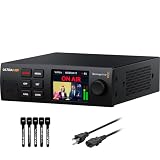
- 4K & HD STREAMING IN H.264 AND H.265 – Self-contained processor supporting H.264 and H.265 encoding in HD or Ultra HD (up to 2160p60) via SRT or RTMP, streaming directly to YouTube, Facebook, X, Twitch, Zoom, Microsoft Teams, OBS, Wowza, and many more — no encoding PC needed.
- 12G-SDI INPUT WITH STANDARDS CONVERSION – Supports input resolutions up to DCI 4K60 with an SDI input and SDI loop output, plus Teranex-powered automatic standards conversion so any HD or Ultra HD source streams cleanly at any target resolution.
- DUAL MONITOR OUTPUTS – Features both SDI and HDMI monitor outputs with a user-configurable standards converter on both the 12G-SDI Out and 4K HDMI Out, so you can feed a confidence monitor or downstream device at any required format independent of your streaming standard.
- ETHERNET + 5G/4G MOBILE WITH AUTO-FAILOVER – Connect via Gigabit Ethernet (10/100/1000BASE-T) or tether a smartphone via USB-C for mobile data, with automatic switchover between connections — ensuring your stream stays on air even if the primary internet connection drops.
- CLOSED CAPTIONS, TIMECODE & REST API – Supports embedding CEA-608 and CEA-708 closed captions in live RTMP streams, source timecode over RTMP and SRT, and offers a REST API over Ethernet for external HTTP control — ideal for broadcast automation and accessibility-compliant workflows.
Troubleshoot common bitrate problems
- Text looks soft or hard to read: check whether the selected resolution is sufficient for the slide design. Test 1080p if important text is not legible at 720p; bitrate alone cannot compensate for text that is too small in the source.
- The stream buffers or health is unstable: compare the configured bitrate with the YouTube recommendation for the codec, resolution, and frame rate you are actually sending. Run a representative test; if instability remains, reduce resolution, frame rate, or bitrate and test again.
- The bitrate seems inconsistent with the table: confirm whether your encoder is sending H.264, H.265, or AV1. The recommended values differ by codec.
- You copied a number from an upload guide: replace it with the corresponding live-ingestion recommendation. Upload encoding targets and live settings are not interchangeable.
- Audience discussion feels delayed: review YouTube’s latency options and weigh interaction against the increased buffering risk associated with lower latency.
Or let it run in the cloud
If your educational playlist needs to stay live on YouTube around the clock, StreamNeo can loop uploaded videos from the cloud. Upload a recording or build a playlist, add your YouTube stream key once, and go live; your computer and home connection do not need to stay on. StreamNeo streams to YouTube and automatically recovers if YouTube drops the stream. Each slot has one flat price for any uploaded quality up to 4K 60fps, with no re-encode or quality tiers. The first day is free with no card, one free day per account. The monthly option is $9.99 per month. See StreamNeo, then start your free day.
Quick Recap
Best Value

- ⭐【Innovative Product with Leading Technology】- Equipped with an advanced H.265 /H.264 dual encoding chip, supports 4K UHD (3840x2160) video input and output, with a maximum frame rate of 30fps at 4K resolution and up to 120fps at 2K and lower resolutions, delivering a smooth and detailed visual experience. It also supports HDCP 1.4 decryption, easily decoding various HDMI ultra HD video sources, delivering a cinematic visual experience for both professional live streaming and 4K ultra HD content transmission.
- ⭐【Multi-protocol and Multi-platform Compatibility】- Fully compatible with streaming protocols such as HTTP, RTSP, RTMP(S), SRT, HLS(M3U8), MP4, Multicast(UDP, RTP, PTL), ONVIF, FLV, WebRTC, TRTC, ICECAST, it can simultaneously output 4 video streams with different protocols and push them to live streaming platforms such as YouTube, Facebook, Twitch, and Vimeo with one click. Simultaneous live streaming across multiple platforms can be achieved without additional equipment.
- ⭐【Highly Customizable Settings to Meet Individual Needs】- It supports adding static text, scrolling captions, brand logos, and timestamps. Users can freely adjust core parameters such as video resolution, frame rate, and bitrate, and also perform personalized editing functions such as video cropping, rotation, flipping, and mirroring. It supports dual input of HDMI embedded audio and line-in audio, with adjustable sound quality, making your live stream content more distinctive and allowing you to create a unique brand live stream style.
- ⭐【Stable and Efficient Transmission, Easy Operation】- Employing HDMI to Ethernet core connection technology, it ensures stable and reliable network transmission with low latency and no lag, adapting to various network environments. Equipped with an intuitive user interface and detailed instruction manual, no professional technical background is required; setup can be completed quickly after connecting the device. It is also compatible with multiple terminals such as computers and mobile phones for management, and the video stream status can be viewed in real time via a URL.
- ⭐【Lifetime Free Warranty and Technical Supports】- All URayCoder video codecs come with a lifetime free warranty and technical supports, supporting secondary development and feature customization to meet enterprise-level personalized needs. Meanwhile, we providing many kinds of customization services such as shell pattern printing, logo addition, hardware and function development, ensuring reliable quality and worry-free after-sales service.
Product prices and availability are accurate as of the date/time indicated and are subject to change. Any price and availability information displayed on Amazon at the time of purchase will apply.
Do these 3 things before closing this tab:
1Clear out junk files and repair common Windows errors2Fix the driver behind crashes, sound loss and screen glitches3Repair Windows errors before they cause bigger problems