What’s actually slowing this PC down?
Pick the symptom - the matching free tool is one click away.
B0 is the note B in octave 0 of scientific pitch notation. With A4 tuned to 440 Hz and twelve-tone equal temperament, it sounds at approximately 30.868 Hz, usually rounded to 30.87 Hz. It sits just above A0, the lowest key on a standard piano, and it is the lowest open string on a five-string bass tuned B–E–A–D–G. The label is simple, but the octave numbering and the frequency figures vary enough between sources and software that it is worth knowing where each number comes from.
How the name B0 is built
Scientific pitch notation pairs a letter name with an octave number. The letter tells you the pitch class (C, C♯/D♭, D, and so on through B), and the number tells you which octave it belongs to. Octave 0 begins with C0 and runs up to B0, so B0 is the last note of that octave, the B directly below C1.
Because each octave doubles frequency, the notes in octave 0 are the lowest ones most people will ever name. B0 is one step below the octave boundary at C1, which is why it is easy to confuse with the note just above or below it in a keyboard diagram.
Frequency: the numbers and where they come from
The frequency of B0 depends on the tuning reference and the temperament. The standard reference used in most published tables is A4 = 440 Hz with twelve-tone equal temperament. Under those conditions, the figures that appear in the sources reviewed for this article are:
Quick wins for a faster PC:
Repair Windows errors before they cause bigger problemsFix Now →Scan for outdated or missing drivers - takes under a minuteDriver Scan →#1 Best Overall

- One Squier Debut Series Precision bass guitar, Rumble 15 amplifier, padded gig bag, instrument cable, picks, clip-on tuner, guitar stand, and an extra set of strings
- Designed by the most trusted name in guitar and backed by a 75-year legacy of quality and craftsmanship
- This beginner guitar comes with a 30-day subscription to Fender Play that includes lessons with thousands of instructional videos to build your skills by playing the songs you love, all with no additional cost
- Designed for beginners, the Squier Debut Series features the iconic Fender Precision Bass model, and includes a super-comfortable "c" shaped neck, laurel fingerboard and thin, lightweight body for more comfort and playability
- The Squier Debut Series Precision Bass features a split-coil pickup with volume and tone controls that offers punchy P-Bass tones, and the vintage-style open-gear tuning machines provide smooth and accurate tuning
| Note | Frequency (A4 = 440 Hz, equal temperament) | Source and date | |
|---|---|---|---|
| A0 (lowest piano key) | 27.5 Hz | Piano reference material; publication date not stated | |
| B0 | 30.868 Hz (commonly rounded to 30.87 Hz) | Liutaio Mottola, note-frequency table, updated June 19, 2025; piano.org B0 page, date not stated (gives 30.87 Hz) | |
| B0 (textbook figure) | 30.868 Hz | SAGE Publications, Sensation and Perception | Edition year not established in the source reviewed |
| E1 (four-string bass low E) | About 41.2 Hz | Open University, sound-for-music-technology course material; date not stated | |
| B1 (octave above B0) | About 61.735 Hz | Derived by doubling B0; consistent with the same reference tables |
The differences between 30.868 Hz and 30.87 Hz are only rounding. Treat either as the same pitch. A value of about 29 Hz for B0 appears in a University of New South Wales booklet by J. Wolfe, The Science of Music: Accompanying Notes (2005), which describes a contrabassoon reaching B0 at about 29 Hz. That is an approximate, instrument-specific figure, not the equal-tempered reference value, so it should not be used as the exact frequency of B0.
Two rules follow from the doubling relationship. Moving up one octave doubles the frequency, so B1 is about 61.735 Hz. Moving down one octave halves it, so B−1 would be about 15.434 Hz, below the range of most musical instruments.
Rank #2

- One Squier Debut Series Precision Bass Guitar – a perfect beginner guitar for all ages
- Designed by the most trusted name in guitar and backed by a 75-year legacy of quality and craftsmanship
- This beginner guitar comes with a 30-day subscription to Fender Play that includes lessons with thousands of instructional videos to build your skills by playing the songs you love, all with no additional cost
- Designed for beginners, the Squier Debut Series Fender Precision Bass includes a super-comfortable "c" shaped neck, laurel fingerboard and thin, lightweight body for more comfort and playability.
- The Squier Debut Series Precision Bass features a split-coil pickup with volume and tone controls that offers punchy P-Bass tones, and the vintage-style open-gear tuning machines provide smooth and accurate tuning
Finding B0 on a piano
A standard 88-key piano begins with A0 and ends with C8. B0 is near the very bottom of the keyboard but is not the bottom key. To locate it:
- Find the lowest key on the keyboard. This is A0, at about 27.5 Hz.
- Move one key to the right. This is A♯0 (or B♭0), a black key.
- Move one more key to the right. This is B0, the third key from the bottom, and the next white key after A0.
The piano.org key reference describes B0 as key 3 of 88, which matches this count.
The Tool Desk
Outbyte PC Repair FREERepair Windows errors before they cause bigger problemsFix Now →Outbyte Driver Updater FREEFix the driver behind crashes, sound loss and screen glitchesFind Drivers →Rank #3

- Short-scale 4-string Bass Guitar with Poplar Body
- Dual Single-coil Pickups - Walnut Flat
- Jatoba Fingerboard
- Maple Neck
Octave labels in software and MIDI
Octave numbers are not standardised across all software. The piano.org page identifies B0 as MIDI note 23. Under the convention that sets middle C to C4 (MIDI 60), that is the same B0 described here. Some software, however, uses the Yamaha convention, which places middle C at C3. Under that convention, the same MIDI pitch, 23, is displayed one octave lower, so B0 appears as B−1.
When you share a note name with someone who uses a different tool, give both the MIDI number and the frequency alongside the label. The frequency does not depend on the label convention, so it removes the ambiguity.
Rank #4
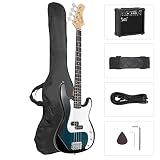
- STABLE QUALITY & GREAT FEELINGS: The 4 string bass guitar is made of high-quality basswood on body and stable rosewood on bridge and fingerboard. The ergonomic cut surface of the full size bass guitar and 20-fert provides a fantastic fret-hand feel when you play.
- EXCELLENT TONE DISPLAY: You can play all the warm and rock music styles you want with the split single-coil pickup and 2 volume knobs. Your tune can be stability and smooth with the thicker strings and larger string tension delivered
- 20W GUITAR AMPLIFIER : Input: (1/4" Jack) Headphone output: (1/4" Jack). With 5 front panel controls: Volume, Treble, Mid, Bass, Phones, you can tune your music to any style between blues and metal as you like.
- BEST GIFT FOR BEGINNER: Theourbass guitar kit is a ideal gift for beginners and suits aspiring musicians too. Each 4 strings and string height can be adjusted and you can fine tuning the neck on the top of the fingerboard.
- PERFECT ACCESSORIES: Come with 1x Electric Bass Guitar, 1x 20W Amp, 1x Amp Cord, 1x Portable Guitar Bag, 1x Shoulder Strap, 1x Bass Pick. You can playourbass immediately after opening a package.
Where B0 appears in real instruments
Five-string bass
A standard five-string bass tuned B–E–A–D–G has B0 as its lowest open string. This is the most common place a player will meet the pitch in everyday practice. Five-string basses are not the default; most electric basses have four strings with E1 as the lowest open note.
Four-string bass
The four-string bass in standard tuning reaches E1, about 41.2 Hz, as its lowest open string. It does not reach B0 without a different tuning or a fifth string. The Open University material describes E1, just over 40 Hz, as the bottom note of a standard bass guitar, which is consistent with the figure above. Extended-range instruments and alternate tunings can differ.
Best Value

- OUTSTANDING SOUND: This electric bass guitar features 1 split single coil pickup and 1 single pickup, combined with 2 volume and 2 tone control knobs to create richer tones. The headstock adopts a dual adjustment lever and a stabilization system, which can better ensure that the intonation and tone are stable at all times
- EXQUISITE CRAFTSMANSHIP: The whole body of the electric bass uses the method of three-dimensional cutting to achieve the overall lightweight without affecting the resonance tone. The method of four-bolt fixed connection increases the comfort of high-position playing
- SUPERIOR MATERIAL: This right hand bass guitar consists of a naturally air-dried fretboard, basswood body and maple neck for better durability and better music performance. Made of nickel-plated carbon steel, our string features thicker strings and larger string tension
- 20-WATT AMPLIFIER: This 20-watt amplifier can produce a more clear sound due to a special mesh design that makes dust difficult to enter the speaker. The amplifier has eight safety corners, which not only be placed more stable but also wear-resistant and non-slip
- SUITABLE FOR ALL SKILL LEVELS: This 4-string bass guitar is no assembly required and is ready to use right out of the box. It comes with a complete set of accessories for added convenience. This electric bass is a great choice for beginners and experienced musicians of all levels
Contrabassoon
Some contrabassoons are documented in the Wolfe booklet as capable of reaching B0 at about 29 Hz. Whether a particular instrument can reach that note depends on its design and range, and the figure should be read as the booklet’s approximation.
Hearing and playback
B0 is a very low fundamental frequency. Whether a listener perceives it as a clear pitch depends on the sound source, the playback equipment, the room, and the listener’s hearing. The sources reviewed for this article give the frequency of B0 but do not test any speakers, headphones or hearing thresholds, so they cannot tell you whether a specific device will reproduce the note at audible levels. If you need to hear B0 accurately, check the playback system with a known low-frequency test tone rather than relying on the nominal frequency alone.
Summary of the key facts
- B0 is the B in octave 0, with a reference frequency of about 30.868 Hz (30.87 Hz when rounded) at A4 = 440 Hz equal temperament.
- On a standard 88-key piano, it is the third key from the bottom, after A0 and A♯0.
- B1 sounds about 61.735 Hz, one octave above.
- It is the lowest open string on a five-string bass in B–E–A–D–G tuning, while a standard four-string bass bottoms out at E1 (about 41.2 Hz).
- Software may label the same MIDI pitch 23 as B0 or B−1, depending on the octave convention.
The name B0 is settled by the notation, but the frequency and octave label depend on the reference and convention you use. Always state which one you mean.
Quick Recap
“
Product prices and availability are accurate as of the date/time indicated and are subject to change. Any price and availability information displayed on Amazon at the time of purchase will apply.
Recommended Free Tools




