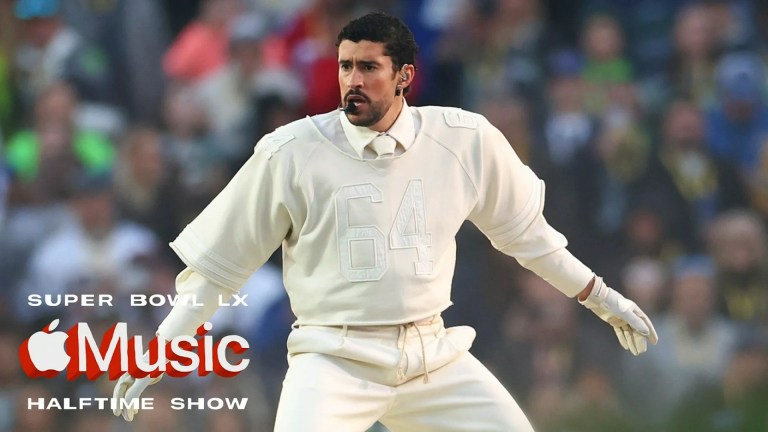
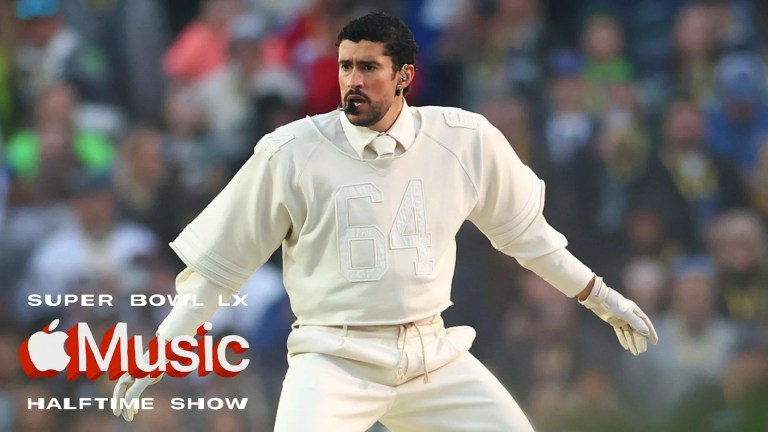
Bad Bunny’s Super Bowl LX halftime show turned the stadium into Puerto Rico. Its fields, pava, casita, wedding, family memorial, reggaeton references, political imagery, and Pan-American finale formed one argument: Puerto Rican identity belongs at the center of America’s cultural story, not at its margins.
The performance was both a celebration and a warning—joyful in its depiction of family and community, but direct about infrastructure failure, displacement, land, sovereignty, and cultural survival.
The short answer
Bad Bunny’s Super Bowl LX halftime show was a celebration of Puerto Rican identity, but it was also an argument about who gets to define America. Instead of treating Puerto Rico as a colorful backdrop for a U.S. sports spectacle, the performance brought the island’s rural labor, family life, music, political struggles, and communal rituals into the center of the event.
The show worked as a kind of cultural translation without cultural surrender. Bad Bunny explained enough for a mass audience to follow the references, but he did not dilute them into generic “Latin” decoration. The pava remained a Puerto Rican pava. The house was a Puerto Rican casita. The flag’s color carried a specific political history. The closing line, “Together We Are America,” expanded the meaning of America beyond the United States without suggesting that Puerto Rican identity and American identity are opposites.
The Tool Desk
Outbyte PC Repair FREERepair Windows errors before they cause bigger problemsFix Now →Outbyte Driver Updater FREEScan for outdated or missing drivers - takes under a minuteDriver Scan →#1 Best Overall

- 1080p Resolution - Watch movies and TV shows in high-definition picture quality.
- LED-backlit LCD screen - With reliable and long-lasting LED lighting, this LCD screen delivers a wide range of colors and contrast for a memorable viewing experience.
- Watch what you want - Stream over 1.5 million movies and TV episodes. Watch favorites with subscriptions to Netflix, Prime Video, Disney+, and more. Subscription fees may apply.
- All your entertainment in one place - Watch live and free TV, play video games, and stream music.
- Smart and always getting smarter - Fire TV adds new Alexa skills, features, smart home capabilities, and voice functionality all the time.
What happened at the performance?
Bad Bunny headlined the Apple Music Super Bowl LX Halftime Show at Levi’s Stadium in Santa Clara, California, on February 8, 2026. The approximately 13-minute performance was his first solo Super Bowl halftime headline after appearing in the Super Bowl LIV show in 2020. Ricky Martin and Lady Gaga were among the guest performers.
Visually, the show moved through a series of connected spaces: green agricultural fields, a communal home, a neighborhood party, a wedding, musical tributes, a politically charged scene of electrical infrastructure, and a Pan-American finale. These were not unrelated set pieces. Together, they formed a compressed story about where Bad Bunny came from, what Puerto Rican culture carries, what threatens it, and why it belongs on one of the most visible stages in the United States.
| Performance image | What it represented |
|---|---|
| Fields and campesinos | Land, work, ancestry, and Puerto Rico’s rural foundations |
| The pava and jíbaro imagery | Boricua identity rooted in farming communities |
| La casita | Home as a shared space of family, music, food, and neighborhood life |
| The wedding and plastic chairs | Ordinary communal life rather than celebrity spectacle |
| “Ocasio” and “64” | Maternal family history and a memorial to Bad Bunny’s uncle Cutito |
| “El Apagón” and the power lines | Infrastructure failure, displacement, corruption, and political vulnerability |
| The light-blue Puerto Rican flag | Independence, sovereignty, and contested national identity |
| The country roll call | A wider definition of America encompassing the hemisphere |
| “Together We Are America” | Belonging and solidarity as the show’s final thesis |
1. The opening fields placed Puerto Rico before the celebrity
The performance began with green fields and images associated with agricultural labor before moving into the stadium spectacle. The scene evoked sugarcane fields and campesinos, or rural workers. It was a meaningful choice of opening image: Bad Bunny did not first present himself as an isolated global superstar. He began with land and the people who worked it.
The fields can be read as the material foundation of the entire show. They represented work, ancestry, and the generations that came before him. That interpretation echoed Bad Bunny’s pre-show language about the people who made it possible for him to reach the Super Bowl stage. His success was presented as something connected to a community and a history, not as a purely individual achievement.
Windows Errors? Fix Them Before They Spread
Repair common Windows errors and clear accumulated junk for a smoother, more stable PC - no reinstall needed.Free scan · no reinstallOutdated Drivers Are Slowing You Down
One free scan finds every outdated or missing driver and matches the right update for your exact hardware.Free scan · exact hardware matchThis is why the fields should not be described simply as tropical scenery. They connected the performance to Puerto Rico’s agricultural and working history. The opening effectively said: before the records, stadium tours, and global recognition, there was a place, a laboring population, and a culture that had already produced the person now standing at the center of the Super Bowl.
2. The pava made jíbaro identity visible on a global stage
The straw hat seen throughout the visual world of the performance was a pava, a symbol associated with Puerto Rican rural life and the jíbaro. The jíbaro is closely connected to the island’s farming communities and to a particular understanding of Puerto Rican cultural identity.
Calling it a generic Latin straw hat misses the point. In this context, the pava carried a specifically Puerto Rican meaning. It connected the polished stadium production to rural communities and to the people whose work and traditions are often treated as quaint, old-fashioned, or peripheral to modern pop culture.
Bad Bunny’s use of the pava turned that presumed quaintness into dignity and visibility. TIME’s discussion of his fashion in the Debí Tirar Más Fotos era similarly treats the hat as more than an accessory. It functions as a public declaration that Boricua identity belongs in global popular culture without having to be made less specific first.
Recommended Free Tools
3. La casita turned the stadium into a Puerto Rican neighborhood
At the center of the stage stood a replica house, or la casita. Its meaning was larger than the idea of a private home. As The National’s cultural explanation emphasizes, a Puerto Rican home can also be a shared social space where relatives, neighbors, music, food, conversation, and celebration flow together.
The casita transformed an enormous stadium into a neighborhood. Instead of presenting Puerto Rico as a distant theme or tourist image, it suggested a lived-in community. The house made the performance intimate even though it was being watched by one of the largest television audiences in the United States.
That set also explains how the show could hold spectacle and ordinary life at the same time. The dancing, domestic imagery, wedding, and neighborhood gathering all belonged inside the same conceptual house. The Super Bowl stage did not simply display Puerto Rico; it was made to feel as if it had entered a Puerto Rican gathering.
4. The wedding insisted that ordinary Puerto Rican life mattered
A couple was married during the performance. The wedding was not required to deliver a song, a dance break, or a celebrity cameo. Its very lack of necessity made it meaningful.
The ceremony inserted a recognizable community ritual into an event usually dominated by celebrity, branding, and spectacle. It extended the casita’s idea of home and showed culture being carried through family ceremonies and everyday relationships, not only through famous musicians or political symbols.
In other words, the performance was not merely saying that Puerto Rico has influential artists. It was also saying that Puerto Rican love, family, and community deserve to be seen. A wedding gave the show an emotional scale that a conventional celebrity performance would not have provided.
5. White clothing, plastic chairs, and the memory of ordinary gatherings
The cream and white clothing, plastic chairs, and neighborhood-party atmosphere connected the halftime show to the visual language of Debí Tirar Más Fotos. The album’s imagery centers on memory, family photographs, domestic gatherings, and the way ordinary experiences can become precious when remembered later.
Plastic chairs are especially effective because they are familiar objects at gatherings across Puerto Rico and many Latin American communities. They do not communicate luxury. They communicate hospitality: people making room for one another, arranging a gathering with whatever is available, and turning a familiar space into a place of celebration.
Rank #2

- 720p resolution - View your favorite movies, shows and games in high definition.
- Alexa voice control - The Alexa Voice Remote lets you easily control your entertainment, search across apps, switch inputs, and more using just your voice. Press and hold the voice button and ask Alexa to easily find, launch, and control content, and even switch to cable.
- Access thousands of shows with Fire TV - Watch over 1.5 million streaming movies and TV episodes with access to thousands of channels, apps and Alexa skills, including Prime Video, Netflix, Hulu, HBO Max, YouTube, Apple TV+, Disney+, ESPN+, Sling TV, Paramount+, and other services right from this TV.*
- DTS Virtual-X Sound - An immersive sound format creates a three-dimensional sound experience with your TV’s speakers.
- Supports HDMI ARC - Sends audio directly from the HDMI jack to a compatible soundbar or AV receiver, removing the need for an extra cable.
The show repeatedly moved between two scales. One was the intimate scale of a family or neighborhood gathering. The other was the enormous scale of the Super Bowl. That contrast was deliberate. Rather than making Puerto Rico disappear into an Americanized production, Bad Bunny made the global stage look as if it had entered Puerto Rico.
For viewers who want to hear the album that provides much of this emotional framework, Bad Bunny’s Debí Tirar Más Fotos vinyl is a natural physical listening option. The reported two-disc edition is an album-format keepsake, not an official Super Bowl collectible, and editions, prices, and availability can change.
6. “Ocasio” and “64” turned a football jersey into a family memorial
Bad Bunny’s jersey displayed Ocasio, his maternal family name, rather than relying only on the surname by which most audiences know him. It also carried the number 64, a tribute to his late uncle Cutito, who was born in 1964.
According to the reported explanation, Cutito helped introduce Bad Bunny to American football and was a devoted San Francisco 49ers fan. The number therefore carried several meanings at once: remembrance of a loved one, maternal lineage, Puerto Rican family history, migration, and the connection between Bad Bunny’s private life and the California venue hosting the Super Bowl.
What’s actually slowing this PC down?
Pick the symptom - the matching free tool is one click away.
The jersey was not just sports styling. It was a memorial object placed inside a global broadcast. The choice of “Ocasio” made family history visible, while “64” gave the tribute a code that could be understood by those close to him even as millions of other viewers saw only a number.
7. The music acknowledged a Puerto Rican lineage rather than presenting Bad Bunny as an isolated phenomenon
The performance situated Bad Bunny within a longer Puerto Rican and Caribbean musical lineage. It incorporated traditional Puerto Rican sounds and referenced the island’s role in developing and exporting Latin music. The show’s point was not that one star had suddenly carried Latin music into the mainstream. It was that Puerto Rican music had helped build the mainstream long before the Super Bowl formally recognized it.
Ricky Martin and the changing terms of crossover
Ricky Martin’s appearance connected an earlier generation of Puerto Rican crossover success with Bad Bunny’s very different model of global stardom. NPR interpreted the moment as a bridge between Martin’s era and the present.
Earlier crossover artists often had to navigate expectations about what a U.S. mainstream audience would accept from a Puerto Rican performer. Bad Bunny’s halftime show proposed a different arrangement: Puerto Rican identity could remain visibly central rather than being softened into a more culturally neutral pop package.
That does not make the appearance a rejection of the artists who came before him. It makes it an acknowledgment of lineage without repeating the old demand that Puerto Rican performers become less culturally specific in order to be welcomed.
“Gasolina” and reggaeton as cultural infrastructure
The show’s nod to Daddy Yankee’s “Gasolina” placed Bad Bunny inside the history of reggaeton and earlier Latin hits. The reference made the performance feel like part of an ecosystem of artists, producers, rhythms, and audiences rather than the work of a lone musical genius.
The Atlantic’s broader context is useful here: Puerto Rico has been a major exporter of reggaeton and Latin popular music, and that influence is already deeply embedded in U.S. culture. The Super Bowl was not generously welcoming an exotic outsider. It was acknowledging a musical culture that had already changed the sound of the mainstream.
Lady Gaga was also among the reported guest appearances. Her presence added another major pop figure to the event, but the available cultural explanations do not establish a specific symbolic meaning for every guest moment. The stronger interpretation rests on the show’s Puerto Rican musical lineage and on the way Ricky Martin connected Bad Bunny to an earlier generation.
Quick wins for a faster PC:
Clear out junk files and repair common Windows errorsFree Scan →Scan for outdated or missing drivers - takes under a minuteDriver Scan →Repair Windows errors before they cause bigger problemsFix Now →8. “El Apagón” changed the party into a political statement
The performance shifted from celebration to direct political imagery during “El Apagón,” or “The Blackout.” Bad Bunny climbed among power-line structures that later exploded. The scene evoked Puerto Rico’s electrical crisis and the recurring blackouts associated with the island’s fragile infrastructure.
The song is connected to criticism of infrastructure failures, government corruption, and the displacement and gentrification threatening Puerto Rican land and communities. The exploding poles translated those issues into a stage image: the systems meant to provide power are unstable, and that instability affects ordinary people.
The transition mattered. The show first established joy, family, sexuality, music, and communal life. “El Apagón” then showed what those things are threatened by. The politics did not arrive as an unrelated lecture; they emerged from the need to protect home, land, memory, and collective life.
That is also why the performance could feel political without becoming a campaign speech. The political message was embedded in the set, the song, and the contrast between a party and the infrastructure crisis surrounding it.
Do these 3 things before closing this tab:
1Clear out junk files and repair common Windows errors2Fix the driver behind crashes, sound loss and screen glitches3Repair Windows errors before they cause bigger problems9. The light-blue Puerto Rican flag invoked independence and self-determination
During “El Apagón,” Bad Bunny displayed a Puerto Rican flag in a lighter blue associated with the independence movement rather than the darker blue of the official flag commonly seen today. Forbes described the choice as deliberate and connected it to Puerto Rico’s history of political repression and the struggle over the meaning of the flag.
Rank #3

- Breathtaking picture: Sharp 4K brings out rich detail on our 55" flat screen TV, while the QLED screen and HDR10 create bright, accurate colors. Roku Smart Picture cleans up incoming TV signals, optimizes them, and chooses the right picture mode.
- Seamless streaming: With fast Wi-Fi and apps that launch in a snap, Roku Select Series TVs get you to your entertainment quickly. You get excellent picture quality, clear sound, automatic updates, and more. It’s simple to use. Hard to outgrow.
- TV, simplified: With setup that only takes minutes, a simple-to-navigate Home Screen, and an uncluttered remote control that does all you need—Roku makes it easier to watch the TV you love.
- A world of free entertainment: Enjoy a huge selection of free live TV, news, sports, movies, shows, and much more—all just a click away.
- More streaming, less searching: With personalized picks right on your Home Screen, quick access to the sports and entertainment you watch most, and fast and easy search in one place—the days of endless scrolling are over.
The distinction is important. This was not simply a generic moment of national pride. The color choice invoked sovereignty and the question of who has the authority to define Puerto Rico’s political future.
Placed after the fields, the home, family imagery, and infrastructure critique, the flag linked identity to land, government, and political power. The performance’s argument was that cultural belonging cannot be separated from the conditions under which people live and from the forces shaping who controls their communities.
It is best to describe the flag’s meaning with care. The independence association is a reported interpretation of a politically specific visual choice; not every visual detail in the show has an artist-issued explanation. But reducing the scene to “Bad Bunny waved the Puerto Rican flag” would erase the significance of the color.
10. “Lo Que Pasó a Hawaii” warned about land, displacement, and cultural erasure
The inclusion of “Lo Que Pasó a Hawaii” added another layer to the show’s political argument. The song addresses the loss of land, beaches, cultural control, and local identity. NPR described it as Bad Bunny’s most political song from his recent album.
Hawaii functions here as a warning and comparison. The reference asks what can happen when outside economic and political forces transform an island while displacing the people who made it home. It raises questions about tourism, colonization, land ownership, statehood, and cultural survival.
The song does not require a literal one-to-one equivalence between Puerto Rico and Hawaii. Its force comes from the analogy. It asks the audience to recognize a pattern in which a place can be celebrated, marketed, and economically developed while the people, language, history, and control of land that define it are pushed aside.
This section also clarifies why the earlier images of fields and a casita mattered. The performance was not defending an abstract national brand. It was defending a lived environment: agricultural land, homes, neighborhoods, memories, and the right of communities to remain connected to them.
Free tools Windows power users keep installed
One-click scans. No signup required.
11. “God bless America” deliberately widened the word America
Bad Bunny reportedly spoke in English only briefly during the show. He said, “God bless America,” then named countries across Latin America and the Caribbean. The sequence ended with “USA,” “Canada,” and “Puerto Rico.”
The moment played with a genuine linguistic and political ambiguity. In everyday U.S. usage, “America” often means the United States. In Spanish and in much of Latin America, América refers to the larger hemisphere.
By naming countries throughout the region, the performance expanded the word’s boundaries. NPR read the sequence as a way of decentering the United States and showing that America includes all of its peoples. The point was not to reject the United States. It was to challenge the assumption that the United States is the only country entitled to stand for America.
Puerto Rico’s placement at the end made the ambiguity especially powerful. It was the specific home at the center of the performance, but it was also part of the wider American hemisphere. The show presented Puerto Rican identity and American identity as overlapping rather than mutually exclusive.
What’s actually slowing this PC down?
Pick the symptom - the matching free tool is one click away.
12. “Together We Are America” was the final thesis
The football that appeared at the beginning returned at the end with the words “Together We Are America.” Bad Bunny held it toward the camera and spiked it.
The football connected his cultural story to the event’s central American sports ritual. But the inscription changed the object’s meaning. It asserted that the America represented by the Super Bowl includes Puerto Rico and the rest of the hemisphere, not only the dominant U.S. cultural viewpoint.
The final screen added a direct emotional conclusion: “The only thing stronger than hate is love.” The performance ended not with a policy platform but with a claim about solidarity, memory, and collective belonging.
That ending also completed the movement of the show. It began with people and land, moved into home and family, acknowledged musical inheritance, confronted infrastructure and displacement, and then widened the frame to the hemisphere. “Together We Are America” was not a change of subject. It was the conclusion drawn from everything that came before.
Recommended Free Tools
Why the show felt political without being a campaign speech
Bad Bunny did not need to deliver a conventional political address because the politics were built into what the audience was asked to see. The fields said that labor and ancestry mattered. The casita said that Puerto Rican domestic and communal life belonged on the stage. The wedding made ordinary people part of the spectacle. The pava made rural identity visible. “El Apagón” showed the consequences of political and infrastructural failure. The flag raised questions of sovereignty. “Lo Que Pasó a Hawaii” addressed land and displacement. The country roll call challenged a narrow definition of America.
Rank #4

- Bright, clear picture: Bring entertainment to life on our 32" flat screen TV with bright 1080p Full HD—perfect for bedrooms, kitchens, and beyond. Roku Smart Picture cleans up incoming TV signals, optimizes them, and chooses the right picture mode.
- Seamless streaming: With fast Wi-Fi and apps that launch in a snap, Roku Select Series TVs get you to your entertainment quickly. You get excellent picture quality, clear sound, automatic updates, and more. It’s simple to use. Hard to outgrow.
- TV, simplified: With setup that only takes minutes, a simple-to-navigate Home Screen, and an uncluttered remote control that does all you need—Roku makes it easier to watch the TV you love.
- A world of free entertainment: Enjoy a huge selection of free live TV, news, sports, movies, shows, and much more—all just a click away.
- More streaming, less searching: With personalized picks right on your Home Screen, quick access to the sports and entertainment you watch most, and fast and easy search in one place—the days of endless scrolling are over.
NPR described the performance as political in its presentation of Latin American labor, unity, and a broader definition of America. That description captures why the show’s joy and politics were inseparable. The performance made a political claim through cultural presence: Puerto Rican workers, homes, family rituals, music, symbols, and memories were treated as central rather than peripheral.
Its indirectness was not a lack of politics. It was the show’s method. Rather than stopping the entertainment to explain Puerto Rico, Bad Bunny made Puerto Rican life the entertainment’s organizing principle.
The larger meaning: cultural translation without cultural surrender
The most useful way to understand the halftime show is as cultural translation without cultural surrender. Bad Bunny translated specific references for viewers who might not know Puerto Rican history, but he did not replace those references with generic images that would be easier to sell.
The Tool Desk
Outbyte Driver Updater FREEFix the driver behind crashes, sound loss and screen glitchesFind Drivers →Outbyte PC Repair FREERepair Windows errors before they cause bigger problemsFix Now →A pava was explained by its placement among fields and jíbaro imagery. A plastic chair became legible as a sign of communal gathering when placed beside the casita and wedding. A jersey number became a family memorial. A familiar song reference connected a current superstar to reggaeton’s history. The light-blue flag and the power-line scene placed cultural pride inside a debate about political control and infrastructure.
This approach also matched Bad Bunny’s stated purpose for Debí Tirar Más Fotos: reconnecting with his identity, history, and culture. The Super Bowl performance turned that personal reconnection into a public narrative. It suggested that memory is not merely private nostalgia. It can be a way of preserving a threatened culture and insisting that the people associated with that memory remain visible.
What the show did not mean
- It was not merely a “Latin-themed” halftime show. Its references were specifically Puerto Rican, with a wider Caribbean and Pan-American frame.
- The pava was not a generic festival accessory. Its jíbaro and rural associations are essential to its meaning.
- The flag’s lighter blue was not an incidental color choice, according to reported interpretations. It was connected to Puerto Rican independence symbolism.
- The performance was not simply a rejection of the United States. Its closing argument was that Puerto Rican identity belongs within a larger, more inclusive understanding of America.
- Not every image has a confirmed official explanation. Some readings are interpretations offered by cultural critics and reporters. They should be presented as such rather than as documented statements of Bad Bunny’s intent.
Why the performance mattered on this particular stage
The Super Bowl is not a neutral location. It is one of the most powerful rituals of U.S. mass culture, and its halftime show traditionally presents a carefully managed version of national entertainment. By bringing a Puerto Rican cultural world into that setting without making it culturally anonymous, Bad Bunny reversed the usual direction of translation.
He did not ask Puerto Rico to become legible by imitating the United States. He asked the audience to enter Puerto Rico’s world: its fields, homes, music, family names, political references, and communal celebrations. That made the performance both accessible and specific.
Do these 3 things before closing this tab:
1Repair Windows errors before they cause bigger problems2Scan for outdated or missing drivers - takes under a minute3Clear out junk files and repair common Windows errorsThe result was a show that could function simultaneously as a family album, a history lesson, a reggaeton lineage statement, a political warning, and a celebration. Its scale was global, but its emotional center remained local.
Final interpretation
Bad Bunny’s halftime show meant that Puerto Rico would not appear on the Super Bowl stage as a token guest or a diluted crossover act. It appeared as a full cultural world: rural and urban, intimate and political, celebratory and wounded, rooted in family memory but speaking to the entire hemisphere.
The show’s joy was itself political because it made Puerto Rican life visible without apology. Its final football summed up the argument: “Together We Are America.” Puerto Rican identity is not outside America—and America is larger than the United States alone.
Frequently Asked Questions
Was Bad Bunny’s halftime show political?
Yes, but its politics were expressed through music, imagery, and cultural presence rather than a conventional campaign speech. “El Apagón,” the power-line scene, the light-blue Puerto Rican flag, “Lo Que Pasó a Hawaii,” and the country roll call addressed infrastructure, sovereignty, displacement, and belonging.
Quick wins for a faster PC:
Repair Windows errors before they cause bigger problemsFix Now →Fix the driver behind crashes, sound loss and screen glitchesFind Drivers →Clear out junk files and repair common Windows errorsFree Scan →What did the pava hat represent?
The pava is a Puerto Rican straw hat associated with rural life and the jíbaro, a figure connected to the island’s farming communities and cultural identity. In the performance, it represented dignity and visibility for a rural Puerto Rican tradition—not generic Latin styling.
Why was the Puerto Rican flag light blue?
The lighter blue is associated with Puerto Rican independence symbolism, in contrast with the darker blue commonly seen on the official flag. Its appearance during “El Apagón” connected cultural identity to sovereignty and the question of who controls Puerto Rico’s future.
What did “Together We Are America” mean?
The phrase widened the meaning of America beyond the United States. After saying “God bless America,” Bad Bunny named countries across Latin America and the Caribbean, ending with the USA, Canada, and Puerto Rico. The message was that Puerto Rico and the wider hemisphere belong within America’s definition.
Why did Bad Bunny wear a jersey reading “Ocasio 64”?
“Ocasio” is Bad Bunny’s maternal family name, while “64” honored his late uncle Cutito, who was born in 1964. Cutito reportedly introduced him to American football and supported the San Francisco 49ers, making the jersey a personal memorial as well as a sports reference.
Outdated Drivers Are Slowing You Down
One free scan finds every outdated or missing driver and matches the right update for your exact hardware.Free scan · exact hardware matchPC Slower Than It Used to Be?
A free scan shows the junk files, broken settings and background clutter dragging Windows down - then fixes them in one click.Free scan · Windows 10 & 11The Bottom Line
Bottom line: Bad Bunny used the halftime show to make Puerto Rico’s history, family life, music, political struggles, and communal identity central to the meaning of America. The performance translated those references for a global audience without stripping away their Puerto Rican specificity.
Quick Recap
Product prices and availability are accurate as of the date/time indicated and are subject to change. Any price and availability information displayed on Amazon at the time of purchase will apply.