Use RTMP when an encoder needs to publish a live feed to an ingest endpoint that explicitly accepts RTMP. Use RTSP when a compatible client needs to establish and control a media session with a server. They solve different parts of a streaming workflow, so neither is universally better. For playback distributed to a broad audience over HTTP infrastructure, HLS may be a more relevant option.
RTMP vs. RTSP: the practical difference
RTMP is commonly encountered as a publishing or ingest protocol: an encoder sends a live stream to a receiving server. Adobe’s Primetime documentation, for example, describes an RTMP publisher or encoder sending streams to its live packager. That example does not mean every streaming service accepts RTMP; verify the receiving endpoint’s documentation.
RTSP has a different role. RFC 7826 defines it as an application-layer protocol for setting up and controlling delivery of media with real-time properties. It describes RTSP as a “network remote control” for multimedia servers. RTSP establishes and manages the session; the media delivery mechanism is described separately.
Choose by the job your stream needs to do
| Job | Starting point | What to verify |
|---|---|---|
| Publish an encoder’s live output to an ingest server | RTMP, if the receiving service explicitly supports it | Ingest address, supported RTMP variant, credentials, encryption, port and firewall rules, and encoder output settings |
| Let a client establish and control playback from a media server | RTSP, if the client and server support compatible versions | RTSP version, supported methods, session description, media transport, authentication and TLS, and network traversal |
| Distribute playback to viewers over HTTP infrastructure | Compare HLS | Playlist and segment support, packaging, latency target, client compatibility, and CDN or cache design |
These are workflow starting points, not guarantees of device or service support. Confirm that the actual source, ingest service or media server, and playback software support the protocol and versions you plan to use.
Quick wins for a faster PC:
Scan for outdated or missing drivers - takes under a minuteDriver Scan →Repair Windows errors before they cause bigger problemsFix Now →#1 Best Overall

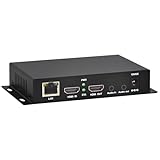
- 【Innovative Product with Leading Technology】- This URayCoder IP video decoder is ideal for decoding multiple types of video streams, support multi-brand video encoders and set-top boxs as well as IP camera decoding.
- 【Simple Setup】- Enter the link address of the video stream in the configuration interface of video decoder, the output video will be automatically displayed on the display.
- 【Multi-channel Switch】- Support multi video streams decoding and switch the channels by IR remote control or webpage control panel, max up to 30 channels decoding or more.
- 【Multi-protocol Supporting】- Support HTTP, RTSP, RTMP, HLS(M3U8), UDP, RTP, Multicast, Unitcast, FLV etc streaming protocol decoding.
- 【Free Lifetime Support and Service】- All URayCoder video encoders and video decoders include a five-year manufacturer warranty and free lifetime technical support. Also we provide SDK and API and CGI control protocol for secondary development. Meanwhile, we provide many kinds of customization, such as logo print, function or firmware etc customization.
How RTSP sessions and delivery work
In an RTSP workflow, the client can use SETUP to establish a session, then methods such as PLAY and PAUSE to control delivery, and a teardown operation to end the session. The presentation description identifies the available media streams and delivery details. RTP is one media-delivery mechanism described by the RTSP specification; RTSP itself is not a synonym for RTP.
Version compatibility matters. RFC 7826 defines RTSP 2.0, which obsoletes RTSP 1.0 (RFC 2326). The versions are not generally backwards compatible beyond basic version negotiation, so check the version supported by both ends rather than assuming an RTSP label guarantees interoperability.
Rank #2
- 【Local Recording & Video Cropping – EH1211 Exclusive Features】 This mini HDMI video encoder supports local recording to USB drive or TF card – it can record both RTSP streaming video and direct HDMI input to external storage. The built-in video cropping function lets you customize the encoding region, making it easy to adapt input to needed displays or focus on specific areas. With its space-saving design, EH1211 is ideal for classrooms, conference rooms, and digital signage installations.
- 【ORIVISION Advantage& Ultra Mini Model】- This ORIVISION ultra mini video encoder has high integration with low cost. Ultra mini size(125x72x25mm) and light weight (200g) of H.265 encoder is perfect for live broadcasting applications with frequent move or tiny device installation space. IP encoder has 1 X HDMI Input and loop-out, 1 X 3.5mm audio input,1 X 3.5mm audio output(new), 1X USB2.0 port(new), 1X TF card port(new). IPTV encoder support audio encoding without video input.
- 【1080P@30HZ Input/Output Resolution & 2 Channel Output】- HDMI encoder supports max 1080P@30 resolution HD input and output. The video encoder for live broadcasting can output 2 channels feeds at the same time. While only 1 channel can reach 1080p output. The H.265/ H.264 encoder supports multiple different protocol feeds output at the same time, but does not support simultaneous output 1080P30.
- 【Multi-Protocols & Software & Platform & Flip Supporting】- Hardware encoder supports protocols including HTTP/HTTPS/RTSP/RTMP/RTMPS/SRT/UDP/RTP/FLS/FLV,is compatible with Onvif protocol. Multicast UDP/RTP. HDMI video encoder supports software like Flashplayer, OBS, VLC player, Vmix..etc. Fit for Youtube, Facebook, Ustream, Livestream, Twitch, Vimeo, Streamspot, Dacast, Tikilive, Netrmedi, etc. This video encoder also supports new function of image rotation and mirror flip. More convenient for live broadcasting.
- 【Powerful OSD Setting】- OSD setting function of the live broadcasting encoder makes it easy for you to add any self-defined text, time and image overlay on your video when output displayed. You may add any text/logo at any position to announce your copyrights with this hevc video encoder.
Transport, ports and security are separate checks
RTSP 2.0
RFC 7826 specifies RTSP messages over TCP or TLS over TCP; it does not define RTSP control messages over UDP. Media delivery transport is a separate part of the session description. The RTSP URI default port is 554; the secure rtsps URI default is TCP port 322. The RFC also mentions registered alternative port 8554. These are specification defaults, not a universal firewall recipe: deployed products may use different configuration, and media traffic may have its own transport parameters.
RTMP
Adobe’s Primetime configuration documentation gives TCP port 1935 as the default RTMP listening port for that product. Treat it as a product-specific example, not a requirement for every RTMP implementation. Confirm the endpoint’s configured port and network rules.
Rank #3

- ⭐【Innovative Product with Leading Technology】- Equipped with an advanced H.265 /H.264 dual encoding chip, supports 4K UHD (3840x2160) video input and output, with a maximum frame rate of 30fps at 4K resolution and up to 120fps at 2K and lower resolutions, delivering a smooth and detailed visual experience. It also supports HDCP 1.4 decryption, easily decoding various HDMI ultra HD video sources, delivering a cinematic visual experience for both professional live streaming and 4K ultra HD content transmission.
- ⭐【Multi-protocol and Multi-platform Compatibility】- Fully compatible with streaming protocols such as HTTP, RTSP, RTMP(S), SRT, HLS(M3U8), MP4, Multicast(UDP, RTP, PTL), ONVIF, FLV, WebRTC, TRTC, ICECAST, it can simultaneously output 4 video streams with different protocols and push them to live streaming platforms such as YouTube, Facebook, Twitch, and Vimeo with one click. Simultaneous live streaming across multiple platforms can be achieved without additional equipment.
- ⭐【Highly Customizable Settings to Meet Individual Needs】- It supports adding static text, scrolling captions, brand logos, and timestamps. Users can freely adjust core parameters such as video resolution, frame rate, and bitrate, and also perform personalized editing functions such as video cropping, rotation, flipping, and mirroring. It supports dual input of HDMI embedded audio and line-in audio, with adjustable sound quality, making your live stream content more distinctive and allowing you to create a unique brand live stream style.
- ⭐【Stable and Efficient Transmission, Easy Operation】- Employing HDMI to Ethernet core connection technology, it ensures stable and reliable network transmission with low latency and no lag, adapting to various network environments. Equipped with an intuitive user interface and detailed instruction manual, no professional technical background is required; setup can be completed quickly after connecting the device. It is also compatible with multiple terminals such as computers and mobile phones for management, and the video stream status can be viewed in real time via a URL.
- ⭐【Lifetime Free Warranty and Technical Supports】- All URayCoder video codecs come with a lifetime free warranty and technical supports, supporting secondary development and feature customization to meet enterprise-level personalized needs. Meanwhile, we providing many kinds of customization services such as shell pattern printing, logo addition, hardware and function development, ensuring reliable quality and worry-free after-sales service.
Security properties also depend on the implementation. Adobe says its documented publisher-to-Primetime Live Packager workflow sends RTMP data and authentication information, including credentials, unencrypted over TCP. Do not generalize that statement to every RTMP service; check the exact endpoint’s encryption and authentication design, and avoid sending credentials over a connection whose security you have not verified.
When HLS is a better comparison
If your goal is to deliver playback to viewers rather than publish to an ingest server or control a server session, consider HLS. RFC 8216 describes continuous multimedia delivery using playlists and media segments, with bitrate adaptation to network conditions and compatibility with large-scale HTTP caching infrastructure. HLS therefore addresses audience distribution in a way that is distinct from RTSP’s control role and the cited RTMP publishing workflow.
Rank #4

- 【Ultra-Compact & Low-Power Design】 Experience maximum portability with this pocket-sized (2.95 x 1.26 x 0.87 in) HDMI video encoder, weighing only 1.13oz. Engineered for extreme efficiency, it consumes just 2.4W and can be powered directly via USB or the HDMI source. This eliminates the need for bulky external adapters—perfect for professional live broadcasting, mobile setups, and installations with limited space.
- 【Pro-Grade 1080P HD Encoding】 Deliver crystal-clear video transmission with support for up to 1080P60 HD input and stable 1080P30 encoding output. This versatile hardware encoder is fully compatible with a wide range of HDMI sources, including NVRs, PCs, drones, DSLR cameras, and professional camcorders. Whether for security monitoring or live broadcasting, it ensures a high-quality, low-latency video feed for a truly reliable user experience.
- 【2K SRT & Multi-Protocol Compatibility】 Experience broadcast-level stability with 2K SRT support, delivering secure, reliable, and ultra-low latency video over any network. This hardware encoder ensures peak efficiency with H.265/HEVC and H.264/AVC compression. Fully compatible with a wide range of protocols—including RTMP, RTMPS, HLS, RTSP, and UDP—it is tailor-made for social media live production, house of worship, secure IP surveillance, and corporate training.
- 【Centralized Cloud Management】 Beyond standard Web-UI, this encoder supports DDMALL LinkCloud for remote monitoring and control via the Internet. For large-scale deployments, we provide specialized support to assist you in building a self-hosted private cloud, ensuring absolute data security and efficient video distribution. This professional-grade centralized control simplifies complex workflows for multi-site corporate, educational, or broadcast environments.
- 【More Excellent Features & Reliable Support】This encoder elevates your broadcasting with dual-stream output, enabling simultaneous streaming to platforms like YouTube and Facebook. It also features real-time OSD overlays and direct Web-UI signal preview for precise control. Beyond the device, our professional technical team provides customized solutions, continuous firmware updates, and expert guidance to ensure your live production stays seamless.
How to make the decision without guessing
- Map the endpoints. Identify what sends the media, what receives or serves it, and what plays it. A protocol is useful only if the relevant endpoints support it.
- Match the protocol to the workflow. Start with RTMP for encoder-to-ingest publishing when the ingest service documents support. Start with RTSP when a compatible client needs to set up and control a server-hosted media session. Evaluate HLS for HTTP-based audience playback.
- Confirm versions and media transport. For RTSP, check version compatibility and the session’s media-delivery details. Do not infer media transport from the RTSP control connection alone.
- Check security and network configuration. Confirm authentication, encryption, configured ports, firewall rules, and any separate media path requirements against the deployed products’ documentation.
- Set and measure a latency target end to end. A protocol name alone does not establish latency. The available standards and vendor documentation do not establish a universal RTMP-versus-RTSP latency winner.
- Plan for the audience and distribution path. If playback must scale through HTTP caching infrastructure, compare HLS packaging, player support, and the latency trade-off your application can accept.
Common compatibility problems and fixes
- The server rejects the connection: Confirm that the receiving endpoint accepts the protocol and variant, and that the address, credentials, configured port, and firewall rules match its documentation.
- An RTSP client cannot negotiate a session: Check RTSP versions and supported methods at both ends. RTSP 1.0 and 2.0 are not generally interchangeable beyond basic version negotiation.
- The RTSP session starts but media does not play: Inspect the session description and media transport configuration separately from the RTSP control connection. Confirm that the required media path is reachable through the network and firewall.
- A secure RTSP connection fails: Verify whether the product supports the required TLS configuration and secure URI scheme, as well as the port actually configured in that deployment; do not assume a default port is in use.
- Credentials may be exposed: Check the exact service’s security documentation. Adobe’s cited Primetime warning applies to its documented publisher-to-packager workflow, not automatically to other RTMP services.
- Playback works for a test viewer but not at larger scale: Revisit the distribution architecture. For broad HTTP delivery, assess whether HLS playlists, segments, and caching infrastructure fit the audience and latency requirements.
Keep a YouTube stream running without a local encoder
If your goal is not to connect an encoder or control a media server, but to keep uploaded video playing as a 24/7 YouTube live stream, that is a separate workflow from choosing between RTMP and RTSP. StreamNeo is a cloud service for uploaded videos and YouTube streams, not a camera-broadcasting service. Upload a recording or build a playlist, add your YouTube stream key once, and go live; its cloud service loops the video so your computer and home connection do not have to stay on. See StreamNeo for details.
Each slot includes one always-on stream, 10 GB of storage per slot pooled across active slots, playlists and 24/7 looping, automatic recovery if YouTube drops the stream, and support from the StreamNeo team. Videos stream as uploaded, up to 4K 60fps, at one flat price per slot with no re-encode or quality tiers. The first day is free with no card, one free day per account; billing options are a day, week, month, six months or year, and you can cancel any time. UPI and cards are available in India; card checkout is available worldwide. For five or more slots, contact support.
Best Value

- ⭐【Innovative Product with Leading Technology】- Equipped with an advanced H.265/H.264 dual encoding chip, supports 1920x1080 resolution input and output, achieving 60fps high-definition presentation with realistic and delicate color reproduction and lossless detail. It also supports HDCP 1.4 decryption, easily decoding various HDMI high-definition video sources, delivering a cinematic visual experience for both professional live streaming and high-definition content transmission.
- ⭐【Multi-protocol and Multi-platform Compatibility】- Fully compatible with streaming protocols such as HTTP, RTSP, RTMP(S), SRT, HLS(M3U8), MP4, Multicast(UDP, RTP, PTL), ONVIF, FLV, it can simultaneously output 4 video streams with different protocols and push them to live streaming platforms such as YouTube, Facebook, Twitch, and Vimeo with one click. Simultaneous live streaming across multiple platforms can be achieved without additional equipment.
- ⭐【Highly Customizable Settings to Meet Individual Needs】- It supports adding static text, scrolling captions, brand logos, and timestamps. Users can freely adjust core parameters such as video resolution, frame rate, and bitrate, and also perform personalized editing functions such as video cropping, rotation, flipping, and mirroring. It supports dual input of HDMI embedded audio and line-in audio, with adjustable sound quality, making your live stream content more distinctive and allowing you to create a unique brand live stream style.
- ⭐【Stable and Efficient Transmission, Easy Operation】- Employing HDMI to Ethernet core connection technology, it ensures stable and reliable network transmission with low latency and no lag, adapting to various network environments. Equipped with an intuitive user interface and detailed instruction manual, no professional technical background is required; setup can be completed quickly after connecting the device. It is also compatible with multiple terminals such as computers and mobile phones for management, and the video stream status can be viewed in real time via a URL.
- ⭐【Lifetime Free Warranty and Technical Supports】- All URayCoder video codecs come with a lifetime free warranty and technical supports, supporting secondary development and feature customization to meet enterprise-level personalized needs. Meanwhile, we providing many kinds of customization services such as shell pattern printing, logo addition, hardware and function development, ensuring reliable quality and worry-free after-sales service.
Daily $0.99 per day · Weekly $2.99 per week · Monthly $9.99 per month · 6 months $49.99 for 6 months · Yearly $89.99 a year.
StreamNeo is always on from the cloud, supports any uploaded quality up to 4K 60fps at one price per slot, and automatically recovers if YouTube drops the stream. The first day is free with no card; the Monthly price is $9.99 per month. Start your free day on StreamNeo.
Quick Recap
Product prices and availability are accurate as of the date/time indicated and are subject to change. Any price and availability information displayed on Amazon at the time of purchase will apply.