The VCR was not invented in one moment, and neither Sony nor JVC can claim the whole story. Ampex’s VR-1000 made commercially successful videotape recording possible for broadcasters in 1956. During the next two decades, companies including Philips, Sony, JVC, Matsushita and Ampex combined better magnetic tape, rotating heads, electronics and cassette mechanisms into practical home systems. Sony’s Betamax (1975) and JVC’s VHS (1976) were the consumer breakthrough formats; VHS eventually prevailed because it offered an attractive combination of recording time, licensing, manufacturer support, content and availability.
What “VCR” means
VTR means video tape recorder, a broad term covering professional, industrial, educational and consumer machines. VCR usually means a household videocassette recorder, especially a VHS or Betamax deck. A videocassette contains supply and take-up reels in one cartridge; a cartridge design can place only one reel inside the cartridge while the other remains in the machine. The familiar home VCR was therefore one branch of a much older videotape-recording family.
| # | Preview | Product | Price | |
|---|---|---|---|---|
| 1 |

|
Portta VHS to Digital Converter, Video to Digital Recorder with Remote, Compatible with VHS, VCR,... | $119.99 | Buy on Amazon |
| 2 |

|
Panasonic PV-9450 4-Head Hi-Fi VCR | $168.75 | Buy on Amazon |
| 3 |
|
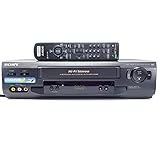
Sony SLV-N51 4-Head Hi-Fi VCR | $549.50 | Buy on Amazon |
| 4 |

|
Panasonic PV-V4624S 4-Head Hi-Fi VCR, Silver | $141.50 | Buy on Amazon |
| 5 |

|
Magnavox MWD2206 DVD/VCR Combination Player | $850.99 | Buy on Amazon |
Ampex made videotape practical for television
Ampex introduced the VR-1000 on April 14, 1956. The Library of Congress identifies it as the first commercially successful videotape recorder. It used two-inch quadruplex tape and was built for television broadcasters, not living rooms. A major early milestone came on November 30, 1956, when CBS used videotape to delay Douglas Edwards and the News for viewers in another time zone. The equipment was enormous and affordable only to major stations and networks. Library of Congress account of the VR-1000.
Why recording video was harder than recording audio
Video carries vastly more information and occupies far greater bandwidth than audio. A stationary audio head cannot move past tape fast enough to record it efficiently. Videotape machines solved that problem with helical scanning: tape is wrapped diagonally around a rotating head drum, whose heads write diagonal tracks across the tape. Each stripe carries a frame or substantial part of one, greatly increasing recording density.
#1 Best Overall
- 【Video to Digital Converter】Effortlessly convert and store analog video and audio signals into digital formats, Recording resolution up to 1080P 30Hz. Supports AV/RCA (CVBS+R/L), S-Video, and AUX inputs. Plug and play, No PC, Software, Driver Needed. NOTE: This is a Converter/Recorder/Capture box only, can NOT play with any tapes and DVDs independently.
- 【USB/SD Card for Storage】Equipped with a 3.0" preview LCD and built-in speaker. No capacity limitation for the USB drive or TF card (not included). Enables direct playback of recorded videos and audios, as well as preview snapshots on the capture box. For high-capacity USB storage devices, please ensure using its own power supply.
- 【Video & Audio Format】Store video in MP4 format or audio in MP3 format. Supports NTSC-M/J 3.58, NTSC 4.43, PAL B/G/H/I/D (PAL/N) standard TV formats input. Audio sampling rate up to 48KHz with uncompressed 2-channel LPCM digital audio output. Setup Reminders: Ensure either CVBS R/L (AV input) or AUX-IN (3.5mm) is properly connected. In settings (HOME -> Settings), verify Video-IN-Volume and AUX-IN-Volume are unmuted for the selected input.
- 【Broad Compatibility】Supports recording and digitizing video for VHS, VCR, DVR, DVD, Hi8, camcorders, Mini DV, Cassette Tape Player, and retro gaming consoles.
- 【What You Get】Video Recorder x1(Players Not included, Such as VHS, VCR, Camcorder, VHS, VCR, DVR, DVD, Cassette, Hi8, Mini DV Players, Camcorder, Gaming Consoles ), Power Adapter with USB type A to C Cable x1, Remote Control (2*AAA Batteries Not Included) x1, AV Cable x1, 3.5mm Audio Cable x1, User Manual x1 with a hassle-free 2-year warranty and lifetime technical support. Reach out to our friendly customer service for any questions.
During operation, the transport pulls tape out of its cassette and wraps it around the drum. Precise tape tension, head alignment and tracking are essential. This explains why early machines were large, mechanically complex and vulnerable to jams, stretching and alignment errors. The engineering history is detailed in IEEE Spectrum’s account of the VCR’s origins.
Experiments before the household VCR
Ampex InstaVideo/InstaVision
Ampex tried a cartridge-based consumer product, but reliability, cost, distribution and the company’s strong professional identity worked against it in retail.
Cartrivision
Cartridge Television Inc. built a system around prerecorded programming and home use. A tape problem led to a recall, and the company eventually went bankrupt.
CBS Electronic Video Recording
EVR used film-based cartridges for playback. It could not record television, removing the time-shifting function that made a home recorder especially valuable.
Free tools Windows power users keep installed
One-click scans. No signup required.
Rank #2
- VHS hi-fi stereo
- MTS/SAP broadcast reception
- Multibrand universal remote
- Auto clock set with backup, trilingual on-screen programming and setup
- Limit 2 per customer
These failures established that a successful product needed more than a working recording head: it required a reliable cassette, affordable hardware, useful running time, retail distribution and compelling content. The Library of Congress chronology places these experiments alongside other early systems: videotape-format chronology.
U-matic was the bridge to consumer videocassettes
Sony developed U-matic with participation from JVC and Matsushita, with Ampex licensing involved. Introduced as a standard in 1971, it used three-quarter-inch tape in a cassette. U-matic simplified handling compared with reel-to-reel broadcast tape, but early recorders were still roughly 59.5 pounds and measured about 24.25 × 8.125 × 18.125 inches, according to IEEE Spectrum. Their durable market became schools, businesses and institutions rather than ordinary homes. U-matic solved the cassette workflow while leaving the mass-market problems of size and price unresolved.
The 1970s convergence that made home recording possible
No single invention created the consumer VCR. Several advances arrived together:
- Smaller integrated circuits and improved signal processing.
- Smaller video-head gaps, reported in early work at roughly 0.3 micrometer.
- More sensitive magnetic coatings, including cobalt-alloy tape.
- Better methods for recording color.
- Helical scanning and azimuth recording, which reduced interference between adjacent tracks.
- More compact loading mechanisms and more reliable manufacturing.
Together these changes reduced tape consumption, machine size, noise and cost enough for a consumer product.
The Tool Desk
Outbyte PC Repair FREERepair Windows errors before they cause bigger problemsFix Now →Outbyte Driver Updater FREEScan for outdated or missing drivers - takes under a minuteDriver Scan →Rank #3
- 4-head hi-fi VCR with plug-and-play setup
- Commercial skip, 60-second flash rewind, and instant replay
- Digital autotracking adjustment; 8-event/1-month programming timer
- Rear composite inputs and outputs; front AV jacks
- Hi-fi stereo recording and MTS stereo broadcast reception
Why Sony and JVC chose different compromises
Sony and JVC initially explored a common half-inch consumer direction, but their priorities diverged. Sony executive Masaru Ibuka is associated with a target for a compact cassette approximately the size of a paperback book while retaining at least an hour of color recording. JVC’s design work emphasized more than two hours because films and sporting events commonly lasted around two hours.
| Design question | Sony/Betamax tendency | JVC/VHS tendency |
|---|---|---|
| Cassette | Smaller | Larger |
| Initial recording time | Shorter | Longer |
| Early measured picture performance | Slight edge in some tests | Lower on some early specifications |
| Loading layout | U-loading | M-loading |
| Main consumer appeal | Compactness and perceived quality | Runtime and convenience |
Betamax and VHS arrive
Sony introduced Betamax in 1975. JVC introduced VHS in 1976; the Library of Congress chronology identifies VHS as publicly available that year. Exact launch dates and prices vary by country and by whether a source means the Japanese launch, a US introduction or first public availability.
IEEE Spectrum gives these launch-era Japanese figures: Sony’s Betamax SL-6300 at ¥229,800 (described as about US$820 at 1975 exchange rates) and JVC’s HR-3300 at ¥256,000 (about US$915). These are model- and market-specific contemporary conversions, not universal launch prices.
| Early characteristic | Betamax | VHS |
|---|---|---|
| Writing speed reported by IEEE | About 7.00 m/s | About 5.80 m/s |
| Early claimed horizontal resolution | Approximately 240 lines | Approximately 240 lines |
| Early claimed signal-to-noise ratio | About 45 dB | About 45 dB |
| Tape | Half-inch | Half-inch |
Early Betamax machines often had a modest advantage in resolution and signal-to-noise performance, but the visible difference was small. Later generations changed the comparison, and neither format had one permanently superior picture under every model, tape-speed and viewing condition.
What’s actually slowing this PC down?
Pick the symptom - the matching free tool is one click away.
Rank #4
- 4-head, hi-fi VCR with commercial skip; measures 16.9 x 3.9 x 9.5 inches (W x H x D)
- Same width as standard audio components
- Recording capability for 8 events in 1 month, 181-channel TV/CATV tuner
- Front and back A/V inputs, RF input
- Includes remote control
U-loading and M-loading: two solutions to the same problem
U-loading
A single arm pulls tape from the cassette and wraps it around the head drum. The arrangement, associated with U-matic, made functions such as picture search easier to implement and was used by Sony in Betamax.
M-loading
JVC used two arms to pull tape around the drum, allowing a compact layout. JVC argued that this simplified manufacturing and improved reliability; Sony and critics disputed how large those advantages were. Early M-loading mechanisms encountered problems during high-speed operation, later addressed with rotating guide poles. These were competing engineering compromises, not proof that one company possessed an unambiguously superior design.
Independent reader supportYour contribution helps us test, update, and keep practical guides available for everyone.Why VHS won the format war
VHS did not win simply because it was “better,” nor solely because of a two-hour tape. Its advantage was cumulative:
- Longer initial recording time: the larger cassette accommodated the running time consumers wanted for films, sports and unattended recording.
- Licensing and manufacturer participation: JVC’s strategy brought more hardware makers into the ecosystem.
- Retail and rental availability: broader distribution made VHS easier to buy, borrow and repair.
- Adequate quality: small early picture differences mattered less than convenience to most buyers.
- Content network effects: as studios, rental stores and households supported VHS, availability reinforced itself and raised the cost of choosing another format.
- Rapid improvement: both formats evolved, narrowing or changing early technical distinctions.
Prerrecorded movies made the recorder a distribution platform as well as a recording device. Owners could time-shift broadcasts, rent or buy films, replay scenes and build personal libraries outside theatrical or scheduled television windows.
Best Value
- Plays these formats: DVD, DVD-R/RW, CD-R/-RW, MP-3, video tapes
- Component video output
- S-video output for improved picture quality
- Front audio/video input jacks; fast hookup of video games and more
- 4-head VCR for top-quality images
From machine to infrastructure—and a preservation problem
The VCR changed home video by joining recording and distribution in one affordable workflow. It also created an enormous archive of family recordings, television and local history. Magnetic tape can suffer binder deterioration, lubricant problems, oxidation, stretching and tracking damage. Obsolete formats become harder to play as working decks, parts and technicians disappear.
For irreplaceable material, identify the format before playback and avoid repeatedly running fragile originals. Professional transfer can be appropriate; do not assume a cheap USB capture adapter produces preservation-quality results. The Library of Congress explains care and handling at its magnetic-record guidance and preservation workflows at its audiovisual-conservation overview. Digitization is not automatic preservation: files still need verified copies, backups and future migration.
The answer to “who invented the VCR?”
If “VCR” means the first commercially successful videotape recorder, the answer is Ampex and the 1956 VR-1000. If it means a practical household videocassette system, the answer is a multi-company evolution culminating in Sony Betamax and JVC VHS during the 1970s. Ampex pioneered broadcast videotape; Sony, JVC, Philips, Matsushita and many others transformed that capability into a consumer ecosystem.
Quick Recap
Product prices and availability are accurate as of the date/time indicated and are subject to change. Any price and availability information displayed on Amazon at the time of purchase will apply.
Do these 3 things before closing this tab:
1Repair Windows errors before they cause bigger problems2Fix the driver behind crashes, sound loss and screen glitches3Clear out junk files and repair common Windows errors