The Tool Desk
Outbyte Driver Updater FREEFix the driver behind crashes, sound loss and screen glitchesFind Drivers →Outbyte PC Repair FREEClear out junk files and repair common Windows errorsFree Scan →Set within the neon-soaked, meticulously rule-bound world of John Wick, Ballerina is the franchise’s first true character-driven spin-off, expanding the mythology beyond Keanu Reeves’ legendary hitman. The film follows a young assassin trained by the Ruska Roma, the same shadowy organization that shaped Wick himself, and places its story squarely between the events of John Wick: Chapter 3 – Parabellum and Chapter 4. That timeline positioning isn’t accidental, anchoring the film firmly inside established canon rather than treating it like a detached side story.
Ana de Armas stars as Eve Macarro, a ballerina-turned-killer on a personal mission of vengeance, blending the franchise’s operatic gun-fu with a sharper emotional edge. Familiar faces like Ian McShane’s Winston, Anjelica Huston’s Director, and Keanu Reeves’ John Wick himself appear, reinforcing that this is very much the same dangerous ecosystem fans know by heart. Directed by Len Wiseman and produced by franchise architect Chad Stahelski, the film preserves the series’ precision action while shifting the perspective to a new kind of antihero.
| # | Preview | Product | Price | |
|---|---|---|---|---|
| 1 |
|
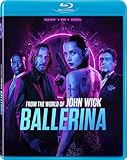
Ballerina - DVD, BLURAY, Digital | $17.99 | Buy on Amazon |
| 2 |
![Ballerina - BLURAY, Digital, 4K ULTRA HD [4K UHD]](https://m.media-amazon.com/images/I/51Zi4XNZAAL._SL160_.jpg)
|
Ballerina - BLURAY, Digital, 4K ULTRA HD [4K UHD] | $23.99 | Buy on Amazon |
Now that Ballerina is available on digital streaming, it functions as both an accessible entry point and a rewarding expansion for longtime fans. It deepens the lore around the assassin academies and power structures that Wick only brushed against, while standing on its own as a stylish revenge thriller. For viewers invested in the Wick universe, it’s less optional side quest and more a meaningful chapter that adds texture to the saga’s ever-growing mythology.
Where and How to Watch ‘Ballerina’ at Home: Digital Platforms, Pricing, and Formats
With its theatrical run now in the rearview mirror, Ballerina has officially made the jump to at-home viewing, giving fans a chance to dive back into the John Wick universe on their own terms. The film is currently available via digital rental and purchase, positioning it squarely in the premium home entertainment lane that Lionsgate has used successfully for the mainline Wick chapters.
What’s actually slowing this PC down?
Pick the symptom - the matching free tool is one click away.
#1 Best Overall
- A young female assassin seeks revenge against the people who killed her family.
Digital Platforms: Where You Can Stream It Right Now
Ballerina is available across all major digital storefronts, including Prime Video, Apple TV, Vudu, Google Play, and Microsoft Store. These platforms offer both rental and purchase options, making it easy to slot the film into an existing digital library alongside the rest of the franchise. Availability is consistent across regions where John Wick films typically perform well, particularly in North America and major international markets.
For viewers who prefer ecosystem continuity, Apple TV and Prime Video remain the cleanest options, especially for those already owning previous Wick entries in those libraries. The rollout mirrors Lionsgate’s standard digital strategy, ensuring maximum accessibility rather than platform exclusivity.
Pricing: Rental vs. Purchase Options
At launch, Ballerina follows standard post-theatrical pricing. Rentals typically land in the $5.99 to $6.99 range, while digital purchases range from $19.99 for HD to $24.99 for 4K UHD, depending on the platform. Pricing may fluctuate slightly during promotional windows, but this places the film in line with John Wick: Chapter 4’s digital debut.
For fans invested in repeat viewings or franchise marathons, the purchase option makes the most sense, especially given how tightly Ballerina connects to existing canon. Casual viewers, however, won’t feel shortchanged opting for a rental, as the film delivers a complete, self-contained arc.
Quick wins for a faster PC:
Scan for outdated or missing drivers - takes under a minuteDriver Scan →Clear out junk files and repair common Windows errorsFree Scan →Fix the driver behind crashes, sound loss and screen glitchesFind Drivers →Video and Audio Formats: Built for Home Theater Setups
Ballerina is available in 4K UHD with HDR support on compatible platforms, including Dolby Vision and HDR10 where supported. Audio options include Dolby Atmos, preserving the franchise’s signature thunderous gunfire, precise sound design, and club-scene bass drops that have become a Wick hallmark.
Even on standard HD setups, the film’s neon-lit cinematography and carefully staged action translate cleanly, but viewers with high-end home theaters will get the closest experience to its theatrical presentation. This is very much a movie designed to be heard as much as it’s seen.
Subscription Streaming: What to Expect Next
While Ballerina is currently positioned as a digital rental and purchase title, Lionsgate’s broader distribution patterns suggest a subscription streaming debut will follow. The studio’s John Wick films typically land on Starz after their digital window, and Ballerina is expected to follow a similar path once its premium sales cycle winds down.
For now, fans eager to see how Eve Macarro’s story fits between Parabellum and Chapter 4 won’t need to wait. The film is fully accessible at home, offering a front-row seat to a new corner of the Wick universe that feels every bit as dangerous, stylish, and canon-connected as the saga that inspired it.
When ‘Ballerina’ Takes Place: Timeline Placement and Canon Status Explained
One of the biggest questions surrounding Ballerina has always been where it fits within the ever-tightening John Wick timeline. The answer is refreshingly clean: the film takes place between John Wick: Chapter 3 – Parabellum and John Wick: Chapter 4, slotting directly into the franchise’s most volatile narrative window.
This placement allows Ballerina to expand the Wick universe without rewriting it, operating in the shadow of John’s global manhunt while introducing a parallel story driven by its own revenge engine.
Set Between Parabellum and Chapter 4
Ballerina unfolds during the fallout of Parabellum, when the High Table’s grip is tightening and the underworld is in a state of controlled chaos. John Wick himself is active during this period, which is why Keanu Reeves’ appearance feels organic rather than gimmicky.
The timing also explains the film’s heightened sense of danger. Assassins, fixers, and criminal networks are on edge, creating the perfect environment for Eve Macarro’s violent rise through the ranks.
Free tools Windows power users keep installed
One-click scans. No signup required.
How Eve Macarro Connects to the Wick Mythology
Ana de Armas stars as Eve Macarro, a ballerina-assassin trained by the Ruska Roma, the same shadowy organization that shaped John Wick. Fans may remember the ballet academy briefly glimpsed in Parabellum, and Ballerina essentially pulls that curtain back.
This shared lineage grounds Eve firmly in established canon. Her story isn’t a side quest; it’s a deeper exploration of the systems that created killers like Wick in the first place.
Returning Characters and Canon Credibility
Ballerina reinforces its canonical status by bringing back key franchise figures, including Ian McShane’s Winston and Anjelica Huston’s imposing Ruska Roma Director. Lance Reddick also appears as Charon, marking one of the actor’s final performances and further anchoring the film emotionally within the saga.
These appearances aren’t fleeting cameos. They actively shape the story, ensuring Ballerina feels like a chapter of the same book rather than a footnote.
Is Ballerina Essential Viewing for John Wick Fans?
While Ballerina tells a complete, self-contained story, it meaningfully enriches the Wick universe. It adds texture to the High Table era, expands the role of the Ruska Roma, and offers a fresh perspective on how assassins are molded and unleashed.
For casual viewers, it works as a stylish standalone action film now easily accessible via digital streaming. For dedicated fans, it’s a canon-confirmed expansion that deepens the mythology and makes the events of Chapter 4 feel even more consequential.
Ana de Armas Leads the Charge: Cast, Characters, and Franchise Crossovers
Ana de Armas steps into the John Wick universe with a ferocity that immediately justifies Ballerina’s existence. As Eve Macarro, she blends physical precision with emotional drive, presenting a killer forged by discipline rather than destiny. It’s a performance that feels distinctly her own while still moving in rhythm with the franchise’s hyper-controlled violence.
The character’s ballerina training isn’t a visual gimmick; it’s central to how Eve fights, survives, and processes trauma. De Armas sells the duality, balancing elegance and brutality in a way that expands the franchise’s combat language without breaking its rules.
A Familiar Underworld Filled With New Faces
Surrounding de Armas is a mix of Wick stalwarts and fresh blood. Anjelica Huston returns as the Ruska Roma Director, once again embodying the cold authority of the organization that molds assassins into assets. Ian McShane’s Winston and the late Lance Reddick’s Charon also reappear, lending continuity and emotional weight that longtime fans will immediately recognize.
Newcomers like Norman Reedus and Gabriel Byrne bring added texture to the criminal ecosystem, reinforcing the idea that this world extends far beyond John Wick himself. Their presence helps Ballerina feel expansive, not insular, even as it tells a more personal story.
Keanu Reeves and the Power of Organic Crossovers
Keanu Reeves’ appearance as John Wick is handled with restraint and purpose. Rather than hijacking the narrative, Wick functions as a looming force within Eve’s journey, a reminder of what survival in this world ultimately costs. The crossover feels earned, especially given the film’s placement within the established timeline.
For fans watching Ballerina now on digital platforms, these intersections play even better at home, where revisiting earlier films is just a click away. The crossovers don’t demand homework, but they reward it, enhancing the sense that Ballerina isn’t a spin-off in name only, but a fully integrated chapter of the Wick saga.
Recommended Free Tools
How ‘Ballerina’ Expands the Wick Mythology: The Ruska Roma, Assassins, and World-Building
One of Ballerina’s biggest achievements is how confidently it deepens the John Wick mythology without over-explaining it. The film trusts that viewers understand the basic rules of this underworld, then builds outward by showing how different branches of the assassin economy operate when Wick isn’t in the room. Watching it now on digital makes those connections even clearer, especially for fans revisiting the earlier films alongside it.
The Ruska Roma as a Living Institution
While the Ruska Roma has appeared before, Ballerina finally gives the organization narrative weight beyond a single moment of loyalty. The film frames the group not just as a crime family, but as a rigid cultural system that weaponizes tradition, discipline, and ritual. Training sequences and internal power dynamics show how identity is stripped away and replaced with obedience, adding moral complexity to Eve’s arc.
Anjelica Huston’s Director looms even larger here, less as a cameo and more as a philosophical presence. Her authority helps clarify how assassins are shaped long before they earn a marker or step onto the Continental’s marble floors. For franchise followers, this context retroactively enriches John Wick’s own history with the organization.
A Broader Assassin Ecosystem Beyond the Continental
Ballerina widens the lens on how assassination functions globally, introducing new players and operational styles that exist parallel to the High Table’s familiar structure. These aren’t just enemies-of-the-week; they feel like professionals with their own rules, territories, and vendettas. It reinforces the idea that Wick’s world is less a hierarchy and more a constantly shifting marketplace of violence.
Windows Errors? Fix Them Before They Spread
Repair common Windows errors and clear accumulated junk for a smoother, more stable PC - no reinstall needed.Free scan · no reinstallOutdated Drivers Are Slowing You Down
One free scan finds every outdated or missing driver and matches the right update for your exact hardware.Free scan · exact hardware matchThis expanded ecosystem also explains why figures like Winston and Charon carry such influence. They aren’t just managers of a hotel, but diplomats navigating an international web of killers, brokers, and legacy organizations. Seeing that network from Eve’s perspective adds texture without rewriting what fans already know.
Rank #2
- A young female assassin seeks revenge against the people who killed her family.
Where Ballerina Fits in the Wick Timeline
Set during the events of John Wick: Chapter 3 – Parabellum, Ballerina slots neatly into the existing chronology. The timeline placement matters, grounding the story in a period where alliances are fragile and survival comes at a premium. It also allows Wick’s presence to feel contextual rather than dominant, reinforcing the idea that multiple stories are unfolding simultaneously.
For viewers discovering Ballerina on digital platforms, that placement makes it an especially rewarding watch between franchise entries. It’s not required homework, but it does deepen the emotional and thematic stakes of the larger saga. Ballerina doesn’t just borrow the Wick aesthetic; it earns its place by expanding the world’s rules, cultures, and consequences.
Action, Style, and Tone: How ‘Ballerina’ Compares to the Core John Wick Films
Ballerina understands that in the John Wick universe, action is a language, not just spectacle. The film leans heavily into the franchise’s signature gun-fu, but filters it through a more intimate, close-quarters approach that suits Eve Macarro’s training and temperament. Where John Wick often feels like a relentless forward march, Ballerina’s fights emphasize survival, improvisation, and personal stakes.
Do these 3 things before closing this tab:
1Repair Windows errors before they cause bigger problems2Fix the driver behind crashes, sound loss and screen glitches3Clear out junk files and repair common Windows errorsA Different Physicality, the Same Brutal Precision
Ana de Armas brings a distinct physical rhythm to the choreography, favoring speed, agility, and environmental awareness over Wick’s blunt-force inevitability. The action still favors long takes, clean geography, and punishing consequences, but there’s a sharper sense of vulnerability baked into each encounter. Eve bleeds, adapts, and learns in real time, making the violence feel earned rather than mythic.
That difference doesn’t dilute the brutality; if anything, it heightens it. Ballerina often places Eve at a disadvantage, forcing creativity in how she weaponizes her surroundings. It’s Wick-adjacent action grammar, spoken with a slightly different accent.
Style That Honors the Franchise Without Imitating It
Visually, Ballerina mirrors the Wick films’ neon-soaked elegance and architectural framing, but it pulls the camera closer to its protagonist. Director Len Wiseman trades some of the operatic sprawl for a more grounded, character-focused lens, letting the violence feel personal rather than ceremonial. The result is stylish without being self-parodic, a crucial balance for a spin-off.
The film’s tone also skews darker and more introspective. Revenge is still the engine, but it’s filtered through questions of identity, obedience, and choice rather than pure retribution. That thematic shift gives Ballerina its own emotional texture while staying tonally compatible with the larger saga.
Familiar DNA, Fresh Perspective
For fans watching Ballerina now that it’s available on digital platforms, the comparisons to John Wick are inevitable, but not limiting. The film doesn’t try to outdo Wick’s body count or iconography; it expands the franchise by showing how different paths can exist within the same violent ecosystem. That restraint is part of its confidence.
Ballerina ultimately proves that the Wick universe isn’t defined by one man’s legend, but by a shared code of motion, consequence, and style. It’s a spin-off that respects the formula while proving there’s room for evolution, especially when the action is this sharply executed.
Independent reader supportYour contribution helps us test, update, and keep practical guides available for everyone.Is ‘Ballerina’ Essential Viewing? What Wick Fans Need to Know Before (or After) Watching
For longtime John Wick fans, the big question isn’t whether Ballerina is good—it’s whether it matters. Now that the spin-off is available on digital platforms, it’s easier than ever to slot it into your at-home watchlist, either as a companion piece or a deeper dive into the universe’s shadowy corners. The answer depends on how invested you are in the Wick mythology beyond John himself.
Where ‘Ballerina’ Fits in the Wick Timeline
Ballerina is set during the events between John Wick: Chapter 3 – Parabellum and Chapter 4, anchoring it firmly within the established canon. Eve Macarro’s story unfolds parallel to Wick’s war against the High Table, not as an afterthought, but as a simultaneous thread. That placement makes the film feel additive rather than tangential, especially for viewers tracking the franchise’s larger power dynamics.
You don’t need to rewatch the entire saga to follow Ballerina, but familiarity with the Continental, the High Table, and the Ruska Roma deepens its impact. The film assumes a baseline understanding of how this world operates, then uses that foundation to explore its rules from a more intimate perspective.
Familiar Faces, Meaningful Connections
Ana de Armas carries the film with a physical, emotionally grounded performance that differentiates Eve from Wick while keeping her credible within the same brutal ecosystem. Keanu Reeves appears in a supporting role that reinforces continuity rather than hijacking the narrative, while Ian McShane’s Winston and Anjelica Huston’s Ruska Roma Director further cement the film’s place in the franchise.
These appearances aren’t cheap cameos. They serve as connective tissue, reminding viewers that Ballerina exists within the same unforgiving hierarchy and code of conduct. For fans who care about lore consistency, that restraint matters.
What It Adds to the John Wick Universe
Ballerina expands the Wick world laterally, not vertically. Instead of escalating stakes to world-ending levels, it drills down into the cost of loyalty and the machinery that creates killers long before they earn legends. The Ruska Roma training pipeline, hinted at in previous films, finally gets texture and consequence here.
That focus makes the universe feel lived-in rather than endlessly escalatory. It suggests that John Wick wasn’t an anomaly, but one outcome of a system that produces many weapons, each with their own breaking point.
Is It Required Viewing?
Ballerina isn’t mandatory homework before watching the mainline films, and it doesn’t gatekeep major plot revelations. But for fans who crave context, character-driven action, and a clearer understanding of how the Wick world sustains itself, it’s more than optional flavor. It’s a smart expansion that respects the franchise’s rules while proving they can support new stories.
Where and How to Watch ‘Ballerina’ at Home
Now available on digital, Ballerina can be rented or purchased through major premium video-on-demand platforms, including Amazon Prime Video, Apple TV, and other standard digital storefronts. That accessibility makes it an easy recommendation for streaming-first viewers who want franchise-quality action without waiting for a subscription rollout.
Whether watched as a standalone thriller or slotted carefully into a Wick marathon, Ballerina plays best when viewed as part of the larger tapestry. It doesn’t replace John Wick, but it sharpens the edges of the world he inhabits—and that alone makes it worth pressing play.
What Comes Next: Franchise Implications, Post-Credit Teases, and the Future of John Wick Spin-Offs
Ballerina doesn’t just arrive on digital as a side story—it lands as a statement of intent. Lionsgate is clearly positioning the John Wick universe as a modular franchise, one that can rotate perspectives without losing its identity. The question now isn’t whether more spin-offs are coming, but which corners of this world are about to be explored next.
Does Ballerina Tease What’s Ahead?
Without leaning on a loud, Marvel-style button, Ballerina leaves the door open rather than slamming it shut. Any stingers or final moments are deliberately restrained, focused more on consequence than cliffhanger. It’s a tonal choice that mirrors the Wick films themselves, where survival is temporary and every ending feels provisional.
What matters more is implication. By spotlighting the Ruska Roma and the systems that manufacture elite assassins, the film quietly sets the stage for future stories that don’t need John Wick to function—but can intersect with his legacy when it counts.
Ana de Armas and the Case for a New Lead Franchise
Ana de Armas’ presence is central to Ballerina’s long-term value. Her character isn’t framed as a one-off experiment, but as someone capable of carrying her own arc across multiple installments. That’s a meaningful shift for a franchise previously anchored almost entirely to Keanu Reeves’ singular performance.
If audiences respond strongly on digital—and early indicators suggest curiosity is high—Ballerina becomes proof that the Wick formula works with new faces, provided the craft and commitment remain intact.
How This Fits with Upcoming John Wick Projects
Ballerina arrives amid an increasingly crowded Wick roadmap. Between The Continental on streaming, the announced Caine-focused spin-off, and ongoing conversation about what John Wick: Chapter 5 could even look like, the franchise is clearly in expansion mode. What Ballerina demonstrates is tonal flexibility: not every chapter needs to escalate the body count or mythology.
Instead, future spin-offs can specialize. One can be tragic, another procedural, another operatic. Ballerina’s success on digital strengthens the case for streaming-first or hybrid releases that let these stories breathe without the pressure of blockbuster expectations.
The Bigger Takeaway for Fans
The most important thing Ballerina accomplishes is reassurance. It proves the John Wick universe can grow without diluting its rules, aesthetics, or moral weight. For longtime fans, that’s the real hook—not teasers or timelines, but confidence that this world still knows exactly what it is.
What’s actually slowing this PC down?
Pick the symptom - the matching free tool is one click away.
As Ballerina finds its audience at home, it plays less like a detour and more like a foundation. If this is the future of John Wick spin-offs—focused, character-driven, and ruthless in its discipline—the franchise isn’t winding down. It’s reloading, one carefully aimed story at a time.
Quick Recap
Product prices and availability are accurate as of the date/time indicated and are subject to change. Any price and availability information displayed on Amazon at the time of purchase will apply.




