To read music, identify the clef first, then use a note’s position on the staff to find its pitch and its shape to understand its duration. Read from left to right, follow the time signature to count beats, and check the key signature and any accidentals before you sing or play. If you sing in a choir, begin with the clef used for your part and practise naming pitches before adding rhythm.
What the staff tells you
A staff is made of five horizontal lines and four spaces. Notes move up or down through those positions in sequence: each step to the next line or space advances one letter in the musical alphabet, which repeats from A to G. The staff shows the relative position of a note, but the clef tells you which note name each position represents. That is why you should identify the clef before trying to name notes.
The MuseScore Team’s beginner’s guide to reading sheet music, published June 30, 2026 and last reviewed July 30, 2026, explains the relationship: “A note’s vertical position on the five-line staff gives its pitch — higher on the staff means a higher pitch — and a clef at the start of each line fixes which exact notes those lines and spaces stand for.”
Identify the clef before naming notes
Two clefs beginners commonly encounter are treble and bass. They assign different note names to the same staff positions, so do not use a treble-clef mnemonic to read a bass-clef part.
#1 Best Overall

- 96-page wirebound book
- 12 staves per page
- Music Notation Guide.
- Treble clef: Its anchor is G on the second line from the bottom. It is common for higher parts and for the upper staff in piano notation.
- Bass clef: Its anchor is F on the second line from the top. It is common for lower parts and for the lower staff in piano notation.
Start from the clef’s anchor note, then count to neighboring lines and spaces, moving through A–G as needed. A mnemonic can help you remember positions at first, but learning how the letter sequence moves is more flexible than memorizing isolated labels. These are common clefs, not the only clefs used in music.
Read pitch and rhythm together
A note has two basic jobs in a score: its position indicates pitch, and its notation indicates duration. The notehead, stem, and any flags help show how long the sound lasts; a rest marks silence. Learning only the note names is not enough to sing a line in time.
Rank #2
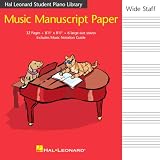
- Wide Staff Manuscript Paper
- Perfect for Students
- 32 8–1/2'' x 8–1/2''
- Six Staves per Page
- 32 Pages
The time signature appears at the beginning of the music and organizes beats into measures, or bars. For example, in 4/4 there are four beats in each measure, and a quarter note receives one beat. Count steadily through the measure, including rests, rather than treating the notes as an unbroken list of pitches. The symbols and their timing are explained in the MuseScore guide.
Check the key signature and accidentals
After the clef, look for the key signature. It indicates recurring sharp or flat alterations to notes in the music. A local accidental changes a note in its musical context. Before singing or playing a note, check whether its pitch is affected by the key signature or by an accidental printed beside it; otherwise, a correctly identified staff position may still produce the wrong pitch.
Rank #3

- 100 pages: 50 loose-leaf sheets
- Made of good quality paper, simple design
- Used for music composition
- Great for song writers
- Dimension: approx. 10.24inch*7.5inch / 26 cm* 19 cm
For piano, connect the two staves with middle C
Piano music commonly uses a grand staff: a treble staff above a bass staff. The upper staff is usually played by the right hand and the lower staff by the left. Middle C links the two: it appears on a short ledger line below the treble staff or above the bass staff. Use it as a shared reference point when orienting yourself across both staves. The general reference on the musical staff also describes ledger lines and staff terminology.
A practical learning sequence
- Learn the staff shape. Draw five lines and four spaces, then trace how note positions alternate as you move upward or downward.
- Focus on the clef for your part. Find its anchor—treble G or bass F—and count neighboring positions using the repeating A–G sequence. If you sing in a choir, work from the clef printed for your vocal part rather than learning both clefs at once.
- Name pitches without rhythm. Practise reading a few notes at a time, saying or singing their names. This isolates pitch recognition before you have to manage timing too.
- Add note durations and rests. Clap or count short patterns, keeping a steady beat and observing the time signature and measure boundaries.
- Include key signatures and accidentals. Once the basic positions and rhythms feel familiar, practise easy notation that includes these pitch changes.
- Use feedback while practising. Sing the notes or check them on an instrument, then return to the score to see where your reading differed. Short, regular practice with simple scores is a practical approach; no fixed learning time is established by the sources cited here.
Optional books for extra practice
A book is not required to learn notation, but a structured practice resource can provide explanations and exercises. The publisher describes Jake Jackson’s Beginner’s Guide to Reading Music as covering pitch, treble and bass clefs, rhythm, accidentals, key signatures, and time signatures, with diagrams and “Play Along” sections. Simon & Schuster lists it as a 384-page Flame Tree Music title published February 1, 2011, ISBN 9781847869500. The publisher says it is especially suitable for children ages 8–10 while also suitable for any age. See the publisher’s product page for its description; current stock and edition availability are not established here.
Rank #4

- Professional Staff Paper: Comes with 2 packs music notebooks , which contains total 200 pages (100 sheets) of high-quality blank sheet music notebook, perfect for composing melodies, writing harmonies, and arranging music.
- Convenient Spiral Binding: The sturdy spiral binding allows the music notebook to lie perfectly flat for effortless writing on every page, whether at a piano, with a guitar, or on the go. No more struggling with stiff bindings.
- Durable & Simple Design: This songwriting notebook features a classic music clef design on the cover. Made with premium paper that minimizes bleed-through, ensuring your songwriting journal compositions stay clean and clear.
- Portable & Always Ready: The perfect 10.24" x 7.5" (26x19cm) size fits in instrument cases, backpacks, and bags. Your creative companion is always within reach when inspiration strikes.
- The Perfect Gift for Any Music Lover: Goes beyond a simple composition notebook. It's a thoughtful, practical gift that says "I support your creativity" for composers, teachers, and musicians of all levels, from beginners to seasoned professionals.
Another example is Alan Charlton’s How To Read Music. Its publisher listing describes coverage of pitch, treble and bass clefs, rhythm, accidentals, key signatures, scales, and chords, with diagrams and play-along examples. Simon & Schuster lists the 384-page Flame Tree Music title as published September 25, 2008, ISBN 9781847863058. This is an alternative example, not a comparative endorsement; see the publisher’s product page.
Quick Recap
Best Value

- Staff Paper Size: 10.24 inch * 7.5 inch / 26 * 19 cm, 100 pages.
- Coil binding music notebook is more convenient to use; Double-sided writing without ink bleeding; Beige blank sheet for eye protection;
- Coil design, can be tiled 180 degrees on piano and music stands, and standard line spacing, suitable for everyone.
- Staff paper for song writers, great for kids, students, song writers, music lovers, and professionals.Music manuscript for Pianist, Guitarist, Musician, Songwriter, and Composer!
- Please feel free to contact us via the Amazon Message Center for any issues, our customer service team will help you to solve any problem as soon as possible.
Product prices and availability are accurate as of the date/time indicated and are subject to change. Any price and availability information displayed on Amazon at the time of purchase will apply.
Recommended Free Tools




