Fix the lighting in the camera’s view, not by asking the interviewee to take off their glasses. Start by moving the light and checking the shot from the camera position; then soften the light or add controlled fill if the face still has hard shadows. For a remote interview, try changing the room or the lighting first, as Western Carolina University’s career office advises in its virtual interview guidance.
Why shadows and glasses glare need different fixes
Harsh shadows and lens glare can appear in the same shot, but they are separate lighting problems. A hard light source or small modifier can create sharp shadow edges on the face. A bright lamp reflected in the glasses can obscure the eyes. The first problem is about the quality and placement of light; the second is about the reflection path between the light, lenses, and camera.
That distinction matters when making adjustments. A softer light can make facial shadows gentler, but it does not guarantee that the reflection will disappear. Moving a light to improve the shadows may even put its reflection back in the lenses. Make changes while watching the image from the camera’s position, and judge whether the face and eyes both look clear. The practical lighting advice in Videomaker’s guide to lighting faces and Ikan’s interview-lighting guide supports using a larger, softer source or diffusion for shadows, while reflection control depends on positioning.
How do I stop glare on my glasses during a video interview?
1. Look for the reflection in the camera image
Have the interviewee sit in the position they will use, with their glasses on. Turn on the camera and inspect the image from the camera’s point of view. If a bright reflection appears in one or both lenses, note which light is producing it and where it appears. Looking at the person directly from beside the camera can be misleading: the relevant view is the one the lens records.
The Tool Desk
Outbyte PC Repair FREERepair Windows errors before they cause bigger problemsFix Now →Outbyte Driver Updater FREEFix the driver behind crashes, sound loss and screen glitchesFind Drivers →#1 Best Overall

- 【Illuminate Your Creativity】 Torjim softbox lighting kit is made of high-quality PET fabric and a foldable nylon cover, which has high reflectivity, softer and even light, and a wider range of illumination. The inner baffle of silver particles built into the lampshade makes the light cast evenly, which maximizes the soft light ability and eliminates shadows.
- 【Energy Efficient Bulbs】 Softbox photography lighting kit is equipped with 85W energy saving bulb, 3000-7500K daylight CFL lighting bulb, which can save up to 80% energy, the bulb not only can work in low temperature environment, but also the bulb life is beyond your imagination. While saving electricity, it also provides constant and even light, providing a good photographic environment.
- 【Sturdy and Reliable】 This studio softbox is equipped with a tripods with independent locking knobs, made of high quality aluminum alloy, and the sturdy locking system ensures that your items are not affected by any wobble during use. Experiments have proved that the tripod can easily resist scratches from hard objects, providing excellent safety, reliability and sufficient stability for your lighting softbox.
- 【Flexibility at Your Fingertips】This Torjim softbox comes with a 210° rotatable head that can adjust the angle according to your needs. It is suitable for photography art, meeting different needs such as photography lighting, live broadcast, video fill light, etc. It can easily create perfect lighting effects for indoor shooting and make photos more attractive.
- 【What Will You Get】Our package contains everything you need: 1 X Softbox, 1 X Remote, 1 X LED Bulb, 1 X 60in Tripod Stand and 1 X Soft Diffuser.
2. Move the light to the side and check again
Move the light farther to the side of the camera’s view, then check the lenses in the image again. Make small adjustments and inspect after each one. The goal is to move the reflected light out of the camera’s line of sight without making the face unevenly lit.
There is no single angle that works for every face, pair of glasses, room, light, and camera position. If moving the light does not clear the reflection, try changing the camera or subject position instead. The reflection depends on the geometry of those elements, so confirm the result on screen rather than relying on a fixed angle. Videomaker’s lighting guidance describes the reflection problem; Western Carolina University likewise recommends adjusting location and lighting for glasses glare in its virtual interview tips.
3. For a remote interview, adjust the room and lighting first
If the glare persists, try a different position in the room or alter the lighting before asking the interviewee to change how they wear their glasses. Western Carolina University’s guidance suggests a slight adjustment to the glasses’ angle only when changes to location and lighting are not possible. Treat that as a fallback, not a requirement: a glasses wearer should not have to remove their glasses to be seen clearly.
Rank #2
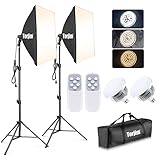
- 【Excellent Soft box with Wide Coverage】Soft box’s inner nylon reflector surface make the light much brighter, while its removable white diffuser made of premium PET fabric can eliminate shadows and make light softer and more uniform, giving you a best shooting experience. Its sturdy locking system make the soft box stable on the tripod during use.
- 【Energy Efficient Bulbs】Torjim soft box photography lighting kit adopts 2 x 85 W energy saving light bulbs (service life of about 6000 hours), saving energy up to 80%. Its 7500K color temperature produces balanced pure white daylight and continuous uniform light, and its low working temperature ensures that it will not get hot, providing an ideal photography environment.
- 【Adjust the Soft box & Tripod Stand As You Like】The soft box has a 210° rotatable head which enables you to adjust its position freely, and the tripod stand’s height can be adjusted from 27” to 74.5” easily, you can choose your desired tripod height. The 1/4 standard screw on the top of the tripod enables you to install other devices to it such as a ring light, projector and etc.
- 【Durable & Portable Lighting Kit for Multiple Applications】The tripod stand is made of premium aluminum alloy material, and its carrying bag included is convenient for carrying it around. Easy setup in minutes. This lighting kit is ideal for portrait shooting, live streaming, video fill light, fashion shooting, advertising shooting and so on.
- 【What You’ll Get】You’ll get 2 x soft boxes (27”x27”), 2 x height adjustable tripod stands (Max. height: 74.5”), 2 x E26 7500K 85W light bulbs, 1 x carrying bag, 1 x instruction manual and our 12-month warranty for this lighting kit, together with our professional and hassle-free after-sale services.
How do I fix harsh shadows in an interview?
1. Identify what is making the shadow edge look hard
Look at the camera image and note where the shadow falls and how sharply it changes across the face. A hard source, a small modifier, or poor light placement can contribute to strong shadow edges. First try adjusting the light’s position, while continuing to check for lens reflections. If the shadow remains too sharp, changing the quality or apparent size of the source is the next useful move.
2. Make the light softer or larger
A larger soft modifier or diffusion can soften the appearance of facial shadows. In practical terms, diffuse the source or use a larger soft light, then review the image again. The aim is a gentler transition between lit and shaded areas—not necessarily to remove all shadow. Keeping some shape helps the face look natural rather than uniformly lit. Videomaker’s guide to lighting faces discusses softening a source; Ikan’s interview-lighting guide also covers shaping interview light.
3. Lift the shadow side with fill if needed
If the shadow side is still too dark, add or adjust fill to lift it. Recheck the whole face rather than treating the shadow in isolation: too much fill can flatten the lighting, while too little may leave an unwanted hard contrast. Keep enough difference between the lit and shadowed sides to preserve facial shape. After adjusting fill, inspect the lenses again; any change to the lighting arrangement can affect the reflection.
Rank #3

- 【One-Second Installation-16"x 16" Pull Soft box】Upgraded Soft Box, Open- Press the button and pull out the rod. Close- Press the button and push the rod in. 16"x 16" soft box silver reflective inner lining,the removable front diffusion spreads light into a homogenous soft light. The soft box is equipped with a 3-meter power cord to increase the range of movement of the softbox light kit.
- 【Remote/APP Wireless Intelligent Control Bulb】Each 50W LED soft box light can be individually controlled for color temperature and brightness by APP Control, color temperature can be adjusted between 3000K and 6000K. The remote control can be adjusted within 15M(49FT) range.
- 【Sturdy and Reliable】 This studio softbox is equipped with a tripods with independent locking knobs, made of aluminum alloy, and the sturdy locking system ensures that your items are not affected by any wobble during use. Experiments have proved that the tripod can easily resist scratches from hard objects, providing excellent safety, reliability and sufficient stability for your lighting softbox.
- 【Multiple scene applications】This softbox lighting kit is suitable for photography art,and meets the different needs of photography lighting,recording studio,live broadcasting,video fill light,etc. It can be applied to advertising products, industrial technology photography,children's photography and small product photography, photographic reproduction,etc.
- 【Rich Package Contents】 2 * 16"x 16"Soft box(Head 120° adjustable); 2 * 3000K-6000K 50W LED Bulb (with Remote Control); 1 * Carry Bag;2 * (17"to 63"/43cm-160cm Height Adjustable ) Light Stand
A reliable setup sequence before the interview
Use this order when preparing either a remote or in-person interview. It reduces the risk of solving one problem while creating another.
- Set the subject and camera position. Have the interviewee sit as they will during the interview, wearing their glasses if applicable. Frame the shot before making final lighting decisions.
- Check the image for glare. Watch the camera image for a reflection that obscures the eyes. Move the light farther to the side, or adjust camera or subject position, and inspect the image again.
- Check the shadows. Look for sharp edges or a shadow side that is too dark. Adjust the light’s placement first, while checking that the reflection has not returned.
- Soften the source if necessary. Try a larger soft modifier or diffusion to soften the shadows. Review the full face in the camera image.
- Adjust fill if the shadow side still needs lifting. Add enough fill to make the face readable while retaining some shape. Check for glare again after the change.
- Record and review a short test. Look at the recording, not just the live preview, for visible glare or uneven shadows. Vimeo’s interview filming guide recommends checking the setup before filming.
If the test shows a problem, correct it before the interview begins and record another short check. This is especially useful when the interviewee, camera, or lighting may shift after setup: a successful adjustment is one that works in the actual recorded frame.
What to change when one fix makes the other problem worse
Use the camera image to judge both issues after every meaningful adjustment. The table is a troubleshooting guide, not a set of universal angles: the right move depends on the room and the positions of the light, subject, glasses, and camera.
Rank #4

- The kit included: 2pcs 20" x 28"/50cm x 70cm Softbox +2pcs 85W 2700-6400K 100V-240V LED Light Bulb + 2pcs 79"/200cm Aluminum Alloy Light Stand + 2pcs Remote Control + 1pcs Oxford Cloth Carrying Bag.
- Updated LED Bulbs: 3-Color dimmable led bulbs with diffuser built-in, color temperature 2700-6400K and brightness 1-100% adjustable via remote control.
- Remote Control& Easy to Operate: Turn on/ off the light and adjust the brightness and color temperature of the softbox lighting by remote control(The remote control is not equipped with battery, please buy it yourself). Durable Oxford cloth tote to accommodate softbox kits, Highly portable and lightweight to carry.
- Rotatable Head & Adjustable Stand: The light stand tripod height adjustable from 26 to 79 inch/66cm to 200cm, 3-section column legs, made of aluminum alloy more sturdy and stable. Angle can be 210°adjustable lamp holder, which can suit for different perfect shooting with 1/4-inch Standard Screw Thread Tip. And with extra-long 8.5Ft/250cm cable,greater range of movement convenient for shooting photography.
- Dimmable Tricolor Light & Suitable for Various Photography: Compared to incandescent lamps, led bulbs can provide natural light, but also warm and cool light. Different color temperatures are used for a wider range of scenarios. This professional kit is great for home studio lighting, portrait, product photography, pet, still photography, live, gaming streaming, video recording, interview, Youtube..etc.
| What you see | Try this | Check next |
|---|---|---|
| A lamp or bright source reflected in the lenses | Move the light farther to the side. If needed, adjust the camera or subject position. | Confirm from the camera’s view that the eyes are visible and the face is still lit evenly enough. |
| Sharp shadow edges on the face | Try a larger, softer source or diffusion. | Check whether the shadow is gentler without introducing glare. |
| The shadow side remains too dark after softening | Add or adjust fill to lift the shadow side. | Make sure the face retains some shape, then inspect the glasses again. |
| The shadow improves but glare appears | Reposition the light, camera, or subject rather than assuming the softer source has solved the reflection. | Review both the shadow and the lenses in the camera image. |
Do you need to buy an interview light?
No. Try the room, light, camera, and subject-position adjustments first. A softbox or diffusion panel is an optional way to soften a light source if hard shadows remain; it is not a requirement for an interview. Diffusion can change the appearance of shadows, but it does not by itself move a reflection out of the camera’s view. Videomaker’s lighting guide supports the use of a larger soft modifier or diffusion for softer light.
If you do choose to buy equipment, look for the relevant category—a softbox lighting kit or a diffusion panel for video lighting—rather than assuming a particular product will fix both issues. The key test remains the same: check that the light is soft enough for the face and positioned so its reflection does not obscure the eyes.
Quick Recap
Common mistakes to avoid
- Judging glare from beside the camera. A reflection can look different to the interviewer than it does to the camera. Check the recorded view.
- Assuming a softer light eliminates reflections. Softness addresses shadow quality; glare still depends on the light, lenses, subject, and camera positions.
- Moving the light without checking the shadows. A change that clears the glasses can make the face unevenly lit. Review both problems together.
- Removing all shadow with fill. Fill should lift the shadow side enough to make the face clear while retaining some shape.
- Treating glasses removal as the solution. For a remote interview, adjust the location or lighting first; a slight glasses-angle adjustment is only a fallback when those changes are not possible.
- Skipping a test recording. A short check gives you a chance to catch glare or uneven shadows before the interview is underway.
Product prices and availability are accurate as of the date/time indicated and are subject to change. Any price and availability information displayed on Amazon at the time of purchase will apply.
Quick wins for a faster PC:
Clear out junk files and repair common Windows errorsFree Scan →Fix the driver behind crashes, sound loss and screen glitchesFind Drivers →Repair Windows errors before they cause bigger problemsFix Now →
