Quick wins for a faster PC:
Clear out junk files and repair common Windows errorsFree Scan →Scan for outdated or missing drivers - takes under a minuteDriver Scan →Dropped into the MCU from the farthest corners of space, the Guardians of the Galaxy arrived with a mixtape, a talking raccoon, and a tone Marvel had never quite attempted before. James Gunn’s 2014 breakout didn’t just expand the cosmic map; it rewired what a superhero team could look like, feel like, and sound like. These weren’t polished icons or legacy heroes, but emotionally bruised outsiders who stumbled into heroism almost by accident.
What sets the Guardians apart is their messy humanity, even when they aren’t human at all. Peter Quill’s pop-culture armor, Gamora’s lethal grace, Drax’s blunt-force grief, Rocket’s weaponized sarcasm, and Groot’s childlike empathy form a group dynamic built on pain, humor, and chosen family. The MCU has plenty of teams, but none are defined so clearly by personal loss, found connection, and the refusal to take themselves too seriously, even when the stakes are galactic.
Just as crucial is how inseparable these characters are from the actors who play them. Chris Pratt, Zoe Saldaña, Dave Bautista, Bradley Cooper, and Vin Diesel don’t simply voice or perform roles; they shape the emotional identity of the franchise. This guide breaks down each Guardian, core and supporting alike, exploring their personalities, powers, and narrative purpose while spotlighting the performers who helped turn a risky sci-fi experiment into one of Marvel’s most beloved ensembles.
The Core Guardians Lineup: Heroes, Antiheroes, and Found Family
At the heart of the Guardians of the Galaxy is a group that never set out to be heroes. They’re survivors, criminals, and misfits whose shared trauma slowly hardens into loyalty. Each member brings a wildly different energy to the team, but together they form one of the MCU’s most emotionally cohesive ensembles.
#1 Best Overall

- 6-INCH-SCALE COLLECTIBLE FIGURE: Fans, collectors, and kids alike can enjoy this 6-inch-scale Star-Lord figure, inspired by Marvel Studios’ Thor: Love and Thunder!
- INSPIRED BY THE MARVEL CINEMATIC UNIVERSE: This 6-inch scale Star-Lord figure features sculpting and deco inspired by his appearance in Marvel Studios’ Thor: Love and Thunder
- PREMIUM ARTICULATION AND ACCESSORIES: This 6-inch Legends Series Star-Lord figure features multiple points of articulation and movie-inspired accessories, including his signature blaster accessory!
- MARVEL UNIVERSE IN 6-INCH SCALE: Look for other Marvel Legends action figures inspired by the Marvel Cinematic Universe, including Mighty Thor, Thor, and King Valkyrie! (Additional figures each sold separately. Subject to availability)
- INCLUDES BUILD-A-FIGURE PART(S) (MARVEL’S KORG): Each Marvel Legends Thor figure includes at least one Build-A-Figure piece. Collect all the figures to assemble an additional figure (Additional figures each sold separately. Subject to availability.)
Star-Lord / Peter Quill (Chris Pratt)
As the reluctant leader of the Guardians, Peter Quill is a man permanently suspended between childhood and adulthood. Abducted from Earth in the 1980s and raised by space pirates, Quill uses humor, bravado, and an endless stream of pop-culture references to mask deep abandonment issues. His skill set is more improvisational than superpowered, relying on blasters, gadgets, and an uncanny ability to talk his way out of trouble.
Chris Pratt’s performance redefined his career and set the tonal template for the franchise. He balances screwball comedy with genuine vulnerability, allowing Quill to be both the punchline and the emotional anchor. Over the trilogy, Pratt charts Quill’s growth from selfish scavenger to a leader who learns that loving others sometimes means letting them go.
Gamora (Zoe Saldaña)
Gamora enters the story as the deadliest woman in the galaxy, but her arc is defined by the cost of survival. Raised and weaponized by Thanos after the destruction of her homeworld, she spends much of her life trying to atone for sins she was forced to commit. Her combat prowess, strategic mind, and moral clarity often make her the team’s true compass.
Zoe Saldaña brings gravity and restraint to Gamora, grounding the Guardians’ chaos with quiet intensity. Across multiple timelines and incarnations, Saldaña plays Gamora as someone constantly negotiating between who she was made to be and who she chooses to become. Her relationship with Quill adds emotional stakes that ripple through the entire cosmic side of the MCU.
Do these 3 things before closing this tab:
1Repair Windows errors before they cause bigger problems2Scan for outdated or missing drivers - takes under a minute3Clear out junk files and repair common Windows errorsDrax the Destroyer (Dave Bautista)
Drax is introduced as a blunt instrument of vengeance, driven solely by the murder of his family. His literal interpretation of language and complete lack of social filters provide some of the franchise’s biggest laughs, but beneath the humor is profound, unresolved grief. Physically imposing and nearly indestructible, Drax thrives in combat but struggles with emotional vulnerability.
Dave Bautista subverts expectations by infusing Drax with surprising warmth and self-awareness. Rather than playing him as a one-note joke, Bautista emphasizes the sadness and loneliness that fuel Drax’s behavior. Over time, Drax evolves from a rage-driven warrior into an unexpectedly nurturing presence, especially toward children and outsiders.
Rocket (Bradley Cooper)
Rocket may be small, but he’s the most emotionally volatile Guardian by far. A genetically modified raccoon with a genius-level intellect, Rocket masks his trauma with cruelty, sarcasm, and a hair-trigger temper. His expertise with weapons and engineering makes him indispensable, but his real struggle is believing he deserves connection at all.
Bradley Cooper’s voice performance gives Rocket a sharp edge softened by deep pain. The films gradually peel back Rocket’s defensive layers, revealing a character shaped by experimentation, abandonment, and self-loathing. His journey toward self-acceptance becomes one of the trilogy’s most affecting arcs, culminating in leadership he never thought he deserved.
The Tool Desk
Outbyte PC Repair FREERepair Windows errors before they cause bigger problemsFix Now →Outbyte Driver Updater FREEFix the driver behind crashes, sound loss and screen glitchesFind Drivers →Groot (Vin Diesel)
Groot is the emotional soul of the Guardians, even with a vocabulary limited to three words. As a Flora Colossus, his abilities include regeneration, limb manipulation, and immense strength, but his true power lies in empathy and sacrifice. Whether as an adult warrior, a dancing sapling, or an awkward teenager, Groot embodies unconditional loyalty.
Vin Diesel’s performance goes beyond a simple vocal cameo, using subtle inflection to convey complex emotions through repetition. Groot’s recurring rebirths mirror the Guardians’ themes of renewal and chosen family. No matter the incarnation, Groot remains the quiet reminder that kindness and sacrifice can exist even in the most violent corners of the galaxy.
Star-Lord (Peter Quill): The Heart, Humor, and Humanity — and Chris Pratt’s Defining MCU Role
As the self-appointed leader of the Guardians, Star-Lord is the emotional anchor holding the team together, even when he’s the one causing the chaos. Abducted from Earth as a child and raised among space pirates, Peter Quill grows up clinging to pop culture, music, and humor as shields against loss. His love of mixtapes, outdated references, and bravado make him instantly likable, but they also mask deep abandonment issues.
Unlike many MCU heroes, Quill doesn’t rely on godlike strength or advanced technology alone. His skills come from quick thinking, marksmanship with his twin blasters, and a surprising ability to bring deeply damaged people together. Even when his impulsiveness leads to disastrous consequences, Star-Lord’s defining trait is his empathy, especially toward those who feel unwanted or broken.
Recommended Free Tools
A Leader Built on Emotion, Not Perfection
Peter Quill’s leadership style is messy, reactive, and often driven by feeling rather than logic. That emotional openness becomes both his greatest weakness and his greatest strength, particularly in moments of grief, love, and sacrifice. His relationships with Gamora, Rocket, and the rest of the team force him to mature without ever losing the vulnerability that defines him.
The Guardians films repeatedly challenge Quill’s self-image as a carefree outlaw. Encounters with his father Ego and the weight of past mistakes push him to confront who he is beyond the jokes. By choosing found family over cosmic power, Star-Lord ultimately defines heroism on his own terms.
Chris Pratt’s Breakout MCU Performance
Chris Pratt’s portrayal of Star-Lord was a defining turning point for both the actor and the franchise. Balancing physical comedy, sincerity, and emotional depth, Pratt transforms Quill into a hero who feels distinctly human despite the cosmic setting. His comedic timing sells the absurdity, while his dramatic turns ground the character’s pain and regret.
Pratt’s performance allows Star-Lord to oscillate naturally between lovable goofball and emotionally fractured survivor. That duality makes Peter Quill relatable in ways few space-faring heroes are. In a team filled with assassins, warriors, and cosmic anomalies, Star-Lord stands out precisely because he feels real, flawed, and deeply human.
Gamora, Drax, Rocket, and Groot: Warriors, Survivors, and the Actors Who Brought Them to Life
If Star-Lord is the emotional center of the Guardians, the rest of the team represents different responses to trauma, loss, and survival. Each of these characters arrives shaped by violence and manipulation, yet over time they redefine themselves through loyalty, humor, and chosen family. Together, they turn a group of broken individuals into something resembling a home.
Gamora: The Deadliest Woman in the Galaxy Seeking Redemption
Gamora is introduced as Thanos’ adopted daughter and a legendary assassin, feared across the galaxy for her combat prowess and tactical brilliance. Beneath that reputation, however, is a woman desperate to atone for the atrocities she was forced to commit. Her journey is defined by rejecting her abuser’s ideology and choosing compassion over conquest.
As a fighter, Gamora is highly skilled in hand-to-hand combat, swordplay, and battlefield strategy. She often acts as the Guardians’ moral compass, pushing the team toward choices that protect the innocent rather than serving selfish ends. Her relationship with Peter Quill adds emotional complexity, blending guarded vulnerability with mutual respect.
Zoe Saldaña brings Gamora to life with a controlled, grounded intensity. Her performance balances lethal precision with quiet emotional depth, allowing Gamora’s internal conflict to simmer beneath every action scene. Saldaña’s ability to convey strength without sacrificing empathy makes Gamora one of the MCU’s most compelling warriors.
Drax the Destroyer: Literal-Minded Rage with a Wounded Heart
Drax is driven by vengeance, having lost his family to Ronan the Accuser under Thanos’ rule. His singular focus on revenge initially makes him volatile and reckless, but his blunt honesty and literal interpretation of language quickly turn him into a surprising source of comedy. Drax says exactly what he feels, whether the moment calls for it or not.
Physically, Drax is one of the team’s most formidable members, relying on brute strength, endurance, and an almost reckless disregard for his own safety. Yet his emotional arc reveals a man struggling to live after his grief has lost its purpose. Over time, he evolves from a weapon fueled by rage into a protector who values connection.
Dave Bautista’s performance is key to Drax’s success. Known initially for his imposing presence, Bautista subverts expectations by leaning fully into the character’s awkwardness and emotional sincerity. His willingness to play Drax as both intimidating and disarmingly vulnerable gives the character lasting depth beyond the jokes.
Rocket: A Genius Engineer Masking Pain with Aggression
Rocket may be small, but he is one of the most dangerous and intelligent members of the Guardians. A master tactician, weapons expert, and engineer, Rocket can build devastating tech out of scraps and improvise solutions under extreme pressure. His sharp tongue and aggressive humor are defense mechanisms honed by years of exploitation and experimentation.
Unlike the others, Rocket’s trauma is rooted in dehumanization. Treated as a thing rather than a person, he lashes out before anyone can hurt him again. Across the films, his arc centers on learning to accept care and trust without seeing it as weakness.
Bradley Cooper voices Rocket with remarkable emotional precision. Through vocal performance alone, Cooper captures Rocket’s bitterness, sarcasm, and buried despair. His work gives Rocket a rawness that makes the character’s quieter moments of fear and self-loathing hit as hard as any explosive action sequence.
Groot: Innocence, Sacrifice, and Growth in Three Words
Groot begins as Rocket’s loyal companion, a towering plant-like being who communicates almost exclusively through the phrase “I am Groot.” Despite this limitation, Groot expresses profound emotion through tone, body language, and action. His defining trait is selflessness, repeatedly placing himself in harm’s way to protect his friends.
Rank #2
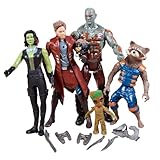
- Size :height of approximately 6.29 inche/16cm figures are perfectly sized for comfortable and enjoyable play without being too bulky.
- Is assembly required: False
- Animal theme: 浣熊
- Manufacturer minimum age: 36.0
- Material: Rubber
Groot’s powers include regenerative abilities, limb extension, and environmental manipulation, making him both a gentle presence and a formidable force in battle. His sacrificial death in the first film and rebirth as Baby Groot add a unique dimension to his character, allowing audiences to watch him grow again in both body and spirit.
Vin Diesel provides Groot’s voice, infusing subtle meaning into a single repeated line across different contexts. Through slight shifts in inflection, Diesel conveys innocence, curiosity, defiance, and love. It’s a deceptively simple performance that becomes essential to the Guardians’ emotional core.
Expanded Guardians and Allies: Nebula, Mantis, Yondu, and the Evolving Team Roster
As the Guardians’ story expands beyond its original lineup, a group of complex allies and former antagonists step into the spotlight. Characters like Nebula, Mantis, and Yondu don’t just widen the roster; they deepen the emotional scope of the franchise. Each arrives with scars, secrets, and shifting loyalties that challenge what it truly means to belong.
Nebula: From Ruthless Rival to Reluctant Hero
Nebula begins her journey as a fearsome antagonist, shaped by a lifetime of abuse under Thanos and defined by her bitter rivalry with Gamora. Enhanced with cybernetic upgrades after every perceived failure, she is both physically formidable and emotionally fractured. Her combat skills, tactical mind, and relentless drive make her one of the most dangerous fighters in the Guardians’ orbit.
Across the films, Nebula’s arc becomes one of the MCU’s most powerful redemption stories. Stripped of her obsession with proving herself, she gradually learns to process grief, confront her trauma, and form genuine bonds. By the time she fully joins the team, her strength lies as much in emotional honesty as in firepower.
PC Slower Than It Used to Be?
A free scan shows the junk files, broken settings and background clutter dragging Windows down - then fixes them in one click.Free scan · Windows 10 & 11Crashes, No Sound, or Screen Glitches?
Random freezes, missing sound and display glitches usually trace back to one bad driver. Find and replace yours safely.Free scan · under a minuteKaren Gillan brings Nebula to life with raw intensity and surprising vulnerability. Beneath the character’s rigid posture and metallic exterior, Gillan reveals a wounded soul desperate for autonomy and connection. Her performance transforms Nebula from a cold villain into a resonant symbol of survival and self-determination.
Mantis: Empathy as a Superpower
Mantis enters the Guardians’ world as a quiet, socially awkward empath raised in isolation by Ego. Her ability to sense and manipulate emotions allows her to calm raging monsters, induce sleep, and expose hidden feelings others would rather suppress. Unlike most cosmic heroes, her power isn’t destructive but deeply introspective.
What makes Mantis compelling is her emotional openness. She approaches the galaxy with curiosity and sincerity, often acting as the moral and emotional barometer of the team. As she gains confidence, she evolves from a timid observer into someone willing to assert her own needs and independence.
Pom Klementieff plays Mantis with gentle humor and heartfelt warmth. Her wide-eyed delivery and physical expressiveness sell both the comedy and the poignancy of a character learning what it means to be her own person. Mantis becomes proof that kindness can be just as heroic as brute strength.
What’s actually slowing this PC down?
Pick the symptom - the matching free tool is one click away.
Yondu Udonta: The Outlaw Father Figure
Yondu may not wear the Guardians’ name, but his presence looms large over the franchise. A Ravager captain with a fearsome reputation, he wields a deadly Yaka arrow controlled through whistling, making him a uniquely lethal combatant. Beneath the bluster and criminal code, however, lies a deeply conflicted man.
His relationship with Peter Quill reframes much of the Guardians’ emotional foundation. Though flawed and often cruel, Yondu ultimately proves himself to be the father Peter needed rather than the one he lost. His journey culminates in one of the MCU’s most affecting sacrifices, redefining heroism through love and choice.
Michael Rooker gives Yondu a rough-edged humanity that grounds the character. Balancing menace, humor, and regret, Rooker turns a space pirate into a tragic, unforgettable figure. Yondu’s legacy echoes through the team long after his final flight.
The Evolving Team Roster: Family Beyond the Core Guardians
As the trilogy progresses, the Guardians become less a fixed lineup and more a living, shifting family. Characters like Kraglin, who steps into Yondu’s role while forging his own identity, and Cosmo the Space Dog, whose psychic abilities and loyalty add unexpected charm, reflect this expanding definition. Even allies who appear briefly leave a lasting impact on the group’s dynamic.
Free tools Windows power users keep installed
One-click scans. No signup required.
This fluid roster reinforces the franchise’s central theme that family is chosen, not inherited. The Guardians are bound not by species, origin, or morality, but by shared experience and mutual acceptance. In a galaxy defined by chaos, the team continues to grow by making room for the broken, the lost, and the hopeful.
Cosmic Villains and Foils: Thanos, Ronan, Ego, and the Forces That Shaped the Guardians
For a team defined by misfits and moral gray areas, the Guardians of the Galaxy are forged as much by their enemies as by their friendships. The franchise’s villains are not just obstacles to punch through but ideological foils who test the Guardians’ values, identities, and capacity for compassion. Each major antagonist leaves a permanent mark on the team’s emotional and narrative DNA.
Thanos: The Shadow Hanging Over the Galaxy
Though he never faces the Guardians as a unified force until Avengers: Infinity War, Thanos looms over their story from the very beginning. As the adoptive father of Gamora and Nebula, he represents the ultimate abusive patriarch, shaping their rivalry, trauma, and desperate desire for self-definition. His philosophy of balance through genocide stands in direct opposition to the Guardians’ belief in chosen family and emotional connection.
Josh Brolin’s performance gives Thanos an unsettling calm and conviction that elevates him beyond a typical cosmic tyrant. He is not motivated by chaos or cruelty alone, but by a warped sense of purpose that makes his influence feel inescapable. For the Guardians, defeating Thanos is as much about breaking free from his psychological grip as it is about stopping his conquest.
Ronan the Accuser: Fanaticism and Absolutism
Ronan the Accuser serves as the primary antagonist of Guardians of the Galaxy, embodying rigid ideology taken to its most violent extreme. A Kree zealot obsessed with punishing Xandar, Ronan views compromise as weakness and mercy as betrayal. His alliance with Thanos is transactional, driven by shared enemies rather than shared values.
Lee Pace brings operatic intensity to Ronan, leaning into the character’s theatrical menace and unyielding certainty. Ronan’s downfall is not just his defeat in battle, but his inability to adapt, connect, or understand humor and empathy. Against a team that survives through improvisation and emotional bonds, Ronan’s absolutism proves fatally inflexible.
Ego: The God Who Failed at Being a Father
Ego the Living Planet represents the most intimate and devastating villain the Guardians ever face. As Peter Quill’s biological father, Ego offers everything Peter thought he wanted: answers, power, and a sense of cosmic importance. That promise quickly curdles into horror as Ego reveals his plan to reshape the universe in his image, erasing individuality in favor of control.
Kurt Russell plays Ego with disarming charm, allowing warmth and menace to coexist until the truth becomes unavoidable. Ego’s love is conditional and self-serving, a stark contrast to the messy but genuine care Peter finds with the Guardians. Defeating Ego forces Peter to choose the family he built over the god who created him, solidifying the franchise’s emotional core.
Quick wins for a faster PC:
Clear out junk files and repair common Windows errorsFree Scan →Fix the driver behind crashes, sound loss and screen glitchesFind Drivers →Empires, Armies, and the Systems of Control
Beyond individual villains, the Guardians are constantly shaped by larger forces like the Kree Empire, the Nova Corps, and the Ravagers’ shifting codes. These institutions represent order, law, and tradition, often clashing with the Guardians’ chaotic but empathetic worldview. Whether hunted, imprisoned, or reluctantly allied, the team exists in friction with the systems that dominate the galaxy.
These forces help define what the Guardians are not. They reject blind obedience, inherited authority, and moral rigidity in favor of personal choice and emotional truth. By surviving encounters with gods, warlords, and empires, the Guardians carve out a space where individuality and connection become acts of rebellion.
Voice Acting and Performance Alchemy: How Motion Capture and Voice Work Define the Team
For all the explosive action and cosmic scale, Guardians of the Galaxy lives or dies on performances that often happen far from the camera. Motion capture, voice acting, and physical reference work combine to give the team its emotional texture, allowing digital characters to feel as alive and vulnerable as their flesh-and-blood counterparts. This hybrid approach is essential to why the Guardians resonate as a family rather than a visual effects showcase.
Rocket Raccoon: Trauma, Teeth, and Timing
Rocket Raccoon is the franchise’s most volatile emotional engine, and Bradley Cooper’s voice performance is the foundation. Cooper gives Rocket a sharp, wounded edge, balancing rapid-fire sarcasm with flashes of pain that hint at years of experimentation and abandonment. Rocket’s humor often masks fear and self-loathing, and Cooper knows exactly when to let the bravado crack.
Equally crucial is Sean Gunn’s on-set performance as Rocket’s physical stand-in. Gunn provides eyelines, movement, and emotional beats for the rest of the cast, ensuring Rocket feels present in every scene. The final character is a fusion of Cooper’s vocal intensity, Gunn’s physicality, and nuanced animation, resulting in one of the MCU’s most fully realized non-human characters.
Groot: One Phrase, Infinite Emotion
Groot’s dialogue is famously limited, but Vin Diesel’s voice work proves that repetition doesn’t equal simplicity. Across multiple films, Diesel adjusts tone, pacing, and inflection to convey joy, grief, curiosity, and sacrifice using only “I am Groot.” The performance invites the audience to listen more closely, turning a linguistic limitation into a storytelling strength.
Rank #3

- MARVEL’S ROCKET RETURNS TO MARVEL LEGENDS: As Rocket takes on more leadership duties within the Guardians of the Galaxy, his past actions have consequences that come back to haunt him
- MARVEL STUDIOS’ GUARDIANS OF THE GALAXY VOL. 3: This Marvel’s Rocket action figure is inspired by the character’s appearance in Marvel Studios’ Guardians of the Galaxy Vol. 3 and makes a great addition to any Marvel action figure collection
- MCU-INSPIRED ACCESSORIES: This collectible Marvel action figure comes with 2 movie-inspired accessories, including a blaster accessory
- PREMIUM DESIGN IN 6-INCH SCALE: Marvel fans and collectors can display this fully articulated 6-inch action figure featuring poseable head, arms, and legs, as well as movie-authentic deco, in their collection
- INCLUDES BUILD-A-FIGURE PART(S) (MARVEL’S COSMO): This figure includes 1 Build-A-Figure part. Collect all the figures to assemble an additional figure (Additional figures each sold separately. Subject to availability.)
Groot’s evolution across the trilogy, from gentle guardian to reckless adolescent and eventually a more grounded adult, is communicated almost entirely through performance and animation. His bond with Rocket, in particular, relies on vocal rhythm and reaction rather than exposition. The result is a character who feels emotionally fluent despite speaking a single sentence.
Motion Capture as Ensemble Acting
While Rocket and Groot are the most visible examples, motion capture permeates the Guardians’ world. Characters like Nebula and Drax benefit from performance-enhancing makeup and digital augmentation that preserve the actors’ expressions rather than replace them. Karen Gillan’s rigid posture and clipped delivery as Nebula are just as important as the visual effects that transform her into a cybernetic assassin.
PC Slower Than It Used to Be?
A free scan shows the junk files, broken settings and background clutter dragging Windows down - then fixes them in one click.Free scan · Windows 10 & 11Crashes, No Sound, or Screen Glitches?
Random freezes, missing sound and display glitches usually trace back to one bad driver. Find and replace yours safely.Free scan · under a minuteThis philosophy extends to the ensemble’s chemistry. The cast consistently performs scenes together, allowing improvisation, overlapping dialogue, and shared reactions to shape the final cut. Even when characters are added or altered in post-production, the emotional core comes from actors responding to one another in real time.
Supporting Voices and Cosmic Texture
The Guardians’ universe is filled with memorable supporting performances that deepen its texture. From Michael Rooker’s gravelly warmth as Yondu to Maria Bakalova’s unexpectedly tender turn as Cosmo the Space Dog, voice work often carries emotional weight that visuals alone cannot. These performances make the galaxy feel inhabited, not just rendered.
Together, motion capture and voice acting allow Guardians of the Galaxy to embrace the absurd without sacrificing sincerity. Talking raccoons, sentient trees, and psychic dogs work because their performances are grounded in human emotion. It’s performance alchemy at its finest, turning technical wizardry into genuine character connection.
Independent reader supportYour contribution helps us test, update, and keep practical guides available for everyone.Character Arcs Across the Trilogy and Beyond: Growth, Loss, and Chosen Family
What ultimately defines the Guardians of the Galaxy isn’t their firepower or cosmic scale, but the way each character changes over time. Across three solo films and multiple crossover appearances, the team evolves from a group of emotionally isolated survivors into a self-made family that understands the cost of love as much as its necessity. Growth, grief, and hard-earned empathy become the true throughline of the franchise.
The Tool Desk
Outbyte PC Repair FREEClear out junk files and repair common Windows errorsFree Scan →Outbyte Driver Updater FREEFix the driver behind crashes, sound loss and screen glitchesFind Drivers →Peter Quill: From Runaway to Responsible Leader
Peter Quill begins the trilogy as a man stuck between worlds, clinging to pop culture nostalgia to avoid processing childhood trauma. Chris Pratt plays early Quill as charmingly reckless, masking grief with humor and bravado. Over time, leadership is no longer about improvisation but accountability, especially as Quill confronts his lineage, his failures, and the consequences of emotional impulsiveness.
By Guardians of the Galaxy Vol. 3, Quill’s arc closes not with cosmic triumph, but with emotional clarity. He chooses reconnection over escape, returning to Earth to face unfinished personal history. It’s a quieter ending, but one that underscores how far he’s come from the boy abducted by Yondu decades earlier.
Gamora and Nebula: Rewriting the Language of Trauma
Gamora’s journey is defined by resistance, first against Thanos, then against the destiny imposed on her as his weapon. Zoe Saldaña infuses Gamora with controlled intensity, allowing vulnerability to surface gradually through her relationships with the team. Her death in Avengers: Infinity War reframes her arc as a story of earned humanity rather than redemption through survival.
Nebula, portrayed with striking physical precision by Karen Gillan, undergoes one of the franchise’s most dramatic transformations. Introduced as a bitter antagonist, she slowly unlearns cruelty through honesty and self-reflection. Her evolving bond with Gamora, and later her role as a stabilizing force within the team, turns pain into purpose without erasing its scars.
Drax: Humor as Armor, Healing Through Connection
Drax’s literal-minded humor initially positions him as comic relief, but Dave Bautista consistently grounds the character in grief. His obsession with vengeance masks an inability to process loss, particularly the murder of his family. As the trilogy progresses, Drax’s blunt honesty becomes a form of emotional clarity rather than social dysfunction.
By the time of Vol. 3, Drax finds meaning not in revenge but in protection, embracing a nurturing role he never expected for himself. His arc suggests that healing doesn’t always look like resolution; sometimes it looks like rediscovery.
Rocket and Groot: Survival, Identity, and Mutual Dependence
Rocket’s evolution is the emotional spine of the trilogy, culminating in a devastating exploration of his origins. Bradley Cooper’s vocal performance captures a character shaped by experimentation, abandonment, and defensive cruelty. Rocket’s journey is about learning that leadership doesn’t require isolation, and that vulnerability is not weakness.
Groot, voiced by Vin Diesel, mirrors that growth in quieter ways. Each iteration of Groot reflects a different stage of emotional development, from protector to adolescent to mature partner. Together, Rocket and Groot represent a bond forged in survival that evolves into chosen kinship.
What’s actually slowing this PC down?
Pick the symptom - the matching free tool is one click away.
Mantis, Yondu, and the Expanding Meaning of Family
Mantis enters the story as an empath who struggles to assert her own emotional needs. Pom Klementieff plays her with gentle curiosity, allowing Mantis to grow into someone who understands that empathy includes self-respect. Her independence in later stories reinforces the idea that family doesn’t require permanence to be meaningful.
Yondu’s arc, meanwhile, reframes the concept of fatherhood itself. Michael Rooker transforms a gruff space pirate into one of the MCU’s most affecting parental figures. His sacrifice doesn’t redeem his past, but it redefines his legacy, proving that love can exist in imperfect forms.
Beyond the Trilogy: Legacies and New Guardians
Guardians of the Galaxy Vol. 3 ends not with finality, but with transition. Leadership shifts, roles evolve, and new members step forward carrying the lessons of those who came before. The franchise emphasizes that the Guardians aren’t defined by a fixed lineup, but by a shared ethos of care, acceptance, and emotional honesty.
This openness allows the Guardians’ story to continue without erasing what made it resonate in the first place. Loss remains permanent, growth remains ongoing, and family remains something you choose, again and again, even in a galaxy that rarely offers second chances.
The Guardians’ Lasting Impact on the MCU and Why These Characters Endure
What ultimately sets the Guardians of the Galaxy apart in the Marvel Cinematic Universe is how completely they redefined what a superhero team could be. Introduced as cosmic misfits with little name recognition, they became emotional anchors for the franchise through sincerity, humor, and character-first storytelling. Their success proved that audiences would follow unfamiliar heroes if the humanity was real, even when those heroes were aliens, outlaws, and sentient trees.
A Franchise Built on Character, Not Spectacle
While the Guardians deliver cosmic action and vivid world-building, their lasting appeal comes from who these characters are when the fighting stops. Peter Quill’s arrested development, Gamora’s search for moral identity, Drax’s literal grief, Rocket’s trauma, and Groot’s unconditional loyalty ground the spectacle in emotion. James Gunn’s scripts, paired with committed performances from Chris Pratt, Zoe Saldaña, Dave Bautista, Bradley Cooper, and Vin Diesel, ensure that every battle advances character rather than distracting from it.
The MCU has since adopted this approach across its cosmic and street-level stories, but the Guardians were the proof of concept. They showed that emotional specificity could coexist with absurdity, and that comedy worked best when it grew out of pain, not punchlines. That balance became a template other Marvel projects continue to chase.
Actors Who Defined Their Roles
Part of the Guardians’ endurance lies in how inseparable the characters feel from the actors portraying them. Chris Pratt brings vulnerability beneath Quill’s bravado, allowing the character to mature without losing his reckless charm. Zoe Saldaña gives Gamora a grounded intensity that anchors even the most fantastical scenes, while Dave Bautista’s physicality and sincerity turn Drax into a surprisingly tender figure.
Bradley Cooper’s voice work gives Rocket a raw emotional edge rarely seen in CGI characters, and Vin Diesel’s limited dialogue as Groot becomes a masterclass in vocal nuance. Supporting players like Pom Klementieff, Karen Gillan, Michael Rooker, and Elizabeth Debicki further enrich the ensemble, ensuring that even secondary Guardians leave a lasting impression.
Redefining Family in the MCU
More than any other Marvel team, the Guardians center their narrative on chosen family. These characters are not united by duty, legacy, or ideology, but by shared loneliness and the decision to stay. Their relationships are messy, unresolved, and sometimes painful, which makes their loyalty feel earned rather than assumed.
This emotional honesty distinguishes the Guardians from other MCU ensembles. They fight, fracture, and grieve openly, and the films allow consequences to linger. By refusing to reset their characters to a status quo, the trilogy lets growth feel permanent, reinforcing why these relationships matter.
Why the Guardians Still Matter
Even as the MCU evolves, the Guardians remain a benchmark for character-driven franchise filmmaking. Their stories demonstrate that humor doesn’t diminish stakes, that loss doesn’t invalidate hope, and that even deeply flawed people can build something meaningful together. The Guardians didn’t just expand the MCU’s cosmic map; they expanded its emotional vocabulary.
Do these 3 things before closing this tab:
1Clear out junk files and repair common Windows errors2Scan for outdated or missing drivers - takes under a minute3Repair Windows errors before they cause bigger problemsThat is why these characters endure beyond their trilogy. They remind audiences that heroism isn’t about perfection or destiny, but about choosing compassion when it would be easier to walk away. In a universe built on spectacle, the Guardians of the Galaxy remain unforgettable because they made the MCU feel human.
Quick Recap
Product prices and availability are accurate as of the date/time indicated and are subject to change. Any price and availability information displayed on Amazon at the time of purchase will apply.