Outdated Drivers Are Slowing You Down
One free scan finds every outdated or missing driver and matches the right update for your exact hardware.Free scan · exact hardware matchPC Slower Than It Used to Be?
A free scan shows the junk files, broken settings and background clutter dragging Windows down - then fixes them in one click.Free scan · Windows 10 & 11Groundhog Day never gives a definitive explanation for why Phil Connors relives February 2, how many times it happens, or what exact rule ends the loop. The strongest answer is that the mystery is intentional: screenwriter Danny Rubin says he began the story in the middle and resisted adding a curse to explain Phil’s predicament. The film offers themes and interpretations—not a confirmed supernatural mechanism.
Why is Phil trapped in the time loop?
The finished film does not state a cause. It opens with Phil already repeating February 2, leaving viewers to wonder whether the loop is a curse, a test, purgatory, a dream, or something else. None of those possibilities is established as plot fact.
| # | Preview | Product | Price | |
|---|---|---|---|---|
| 1 |

|
Groundhog Day - 4K + Blu-ray + Digital | $21.99 | Buy on Amazon |
| 2 |

|
Groundhog Day | $16.40 | Buy on Amazon |
| 3 |
|
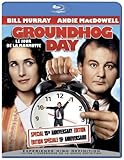
Groundhog Day (Special 15th Anniversary Edition) | $13.07 | Buy on Amazon |
| 4 |
![Groundhog Day [Blu-ray] [1993]](https://m.media-amazon.com/images/I/51pRfGmWEJL._SL160_.jpg)
|
Groundhog Day [Blu-ray] [1993] | $17.96 | Buy on Amazon |
| 5 |
![Groundhog Day (15th Anniversary Special Edition) [Blu-ray]](https://m.media-amazon.com/images/I/51Zacl9tLtL._SL160_.jpg)
|
Groundhog Day (15th Anniversary Special Edition) [Blu-ray] | $8.87 | Buy on Amazon |
That open question fits screenwriter Danny Rubin’s account of the writing. He says he structured the story so he would not have to explain how Phil entered the loop, and recalls asking director Harold Ramis not to add a gypsy-curse scene. His account supports deliberate ambiguity rather than a concealed canonical answer. Rubin’s interview transcript is an account of his creative intent, not a supernatural explanation within the film.
How long was Phil in the time loop?
The film does not establish a reliable exact count. Phil’s growing skills and familiarity with Punxsutawney imply that he experiences the day repeatedly over a substantial stretch of subjective time, but the finished story does not provide a definitive number of days or years. The IMDb FAQ and plot summary likewise treat the count as unspecified.
#1 Best Overall
- A weatherman (Bill Murray) is trapped in a personal time warp on the worst day of his life. Co-stars Andie MacDowell.
Numbers that circulate elsewhere should be treated according to their origin: a claim based on a script draft, a later estimate, or fan arithmetic is not the same as a count confirmed by the released film. Without a settled count in the story, no precise duration should be presented as fact.
Why does the loop end?
The repetition stops after Phil changes how he treats other people and how he uses what he knows about the town. The film shows that sequence, but it does not spell out a supernatural rule such as “the loop ends when Phil becomes good” or “when Rita falls in love with him.” Those are interpretations of the ending, not rules the story confirms.
Rank #2
- A weatherman (Bill Murray) is trapped in a personal time warp on the worst day of his life. Co-stars Andie MacDowell.
The Library of Congress essay on Groundhog Day emphasizes love, kindness, and doing good in the film’s arc. That moral reading helps explain the ending’s emotional shape; it does not prove what causes the loop to stop.
What are the main ways to interpret the loop?
These readings can coexist. Each answers a different kind of question: the film’s explicit plot, the creators’ approach, or the meaning viewers may take from Phil’s transformation.
Recommended Free Tools
| Reading | What supports it | What it explains |
|---|---|---|
| Deliberate mystery | Rubin’s account of starting the story in the middle and resisting a curse explanation. | Why the film does not identify the loop’s cause. |
| A fable about moral attention | Phil moves from using repetition for selfish pleasure and control toward helping people; the Library of Congress essay highlights kindness and doing good. | The moral shape of Phil’s change, not the loop’s literal mechanics. |
| A story about changing routine | TIME’s 1993 review describes Phil’s changing use of his knowledge of the town and reads the recurring day as a metaphor for ordinary routine. | How the premise can speak to everyday patterns and personal change. |
| A romantic-comedy resolution | The ending brings Phil and Rita together; contemporary coverage described the film as a comic time warp. | The relationship at the story’s resolution, not a confirmed cause of the loop ending. |
| A spiritual, existential, or psychological reading | The unanswered cause and Phil’s altered perspective leave room for these interpretive lenses. | Possible meanings viewers find in the experience, not a single explanation named by the film. |
What the movie actually settles
Groundhog Day, directed by Harold Ramis and written by Ramis and Danny Rubin, was released in 1993. TIME’s contemporary review identifies the film and describes its comic time-warp premise. Within that story, the day repeats, Phil changes, and the repetition ends. The film leaves the cause, precise duration, and underlying rule open.
Quick Recap
Rank #4
- The disk has English audio and subtitles.
Product prices and availability are accurate as of the date/time indicated and are subject to change. Any price and availability information displayed on Amazon at the time of purchase will apply.




