George Clooney plays Edward R. Murrow in the 2025 Broadway adaptation of Good Night, and Good Luck; in the 2005 film, he played Murrow’s CBS colleague Fred Friendly, while David Strathairn played Murrow. That role reversal gives the stage version a new lead performance, but reviewers differed on whether the production’s live setting transforms a screenplay they found closely followed.
What is the Broadway production, and is it still running?
The play, written by George Clooney and Grant Heslov and directed by David Cromer, follows Murrow and his CBS news team as they confront Senator Joseph McCarthy during the period of McCarthyism. Its official framing emphasizes broadcast journalism, paranoia, propaganda, truth and journalistic integrity. That is the production’s stated lens, rather than a substitute for a full historical account.
| # | Preview | Product | Price | |
|---|---|---|---|---|
| 1 |

|
Good Night, and Good Luck (Widescreen Edition) | $7.89 | Buy on Amazon |
| 2 |
|
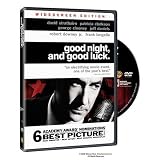
Good Night, Good Luck. | $9.88 | Buy on Amazon |
| 3 |

|
Good Night and Good Luck: Live from Broadway | $13.49 | Buy on Amazon |
| 4 |

|
Good Night, and Good Luck. | $16.00 | Buy on Amazon |
| 5 |
![Good Night and Good Luck [DVD]](https://m.media-amazon.com/images/I/51guR64W5rL._SL160_.jpg)
|
Good Night and Good Luck [DVD] | $19.97 | Buy on Amazon |
Previews began March 12, 2025, and opening night was April 3 at the Winter Garden Theatre, according to the Shubert Organization. The official production site gives June 8, 2025, as the final performance, so the Broadway engagement is closed. The site also lists five Tony Award nominations: Best Actor in a Play for Clooney, Scenic Design for Scott Pask, Sound Design for Daniel Kluger, Lighting Design for Heather Gilbert and David Bengali, and Costume Design for Brenda Abbandandolo. These were nominations, not wins, according to the official production site.
How does Clooney’s role differ from the film?
The switch is more than a casting footnote. Clooney played producer Fred Friendly in the film and takes the central role of Murrow on stage. The screen version’s Murrow was David Strathairn. As the Associated Press notes, the Broadway engagement was Clooney’s Broadway debut.
Windows Errors? Fix Them Before They Spread
Repair common Windows errors and clear accumulated junk for a smoother, more stable PC - no reinstall needed.Free scan · no reinstallOutdated Drivers Are Slowing You Down
One free scan finds every outdated or missing driver and matches the right update for your exact hardware.Free scan · exact hardware match#1 Best Overall
On stage, the audience watches Clooney carry Murrow’s public authority and the newsroom’s private exchanges in the same performance. In the film, Strathairn’s Murrow is at the center of a screen story whose framing, editing and close-ups can shape how a viewer reads him. The change lets Clooney revisit the material from a different character’s position, but it does not by itself resolve the adaptation’s larger challenge: turning a film built around recorded broadcasts and cinematic framing into live drama.
Does the play tell a different story from the movie?
The stage version remains close to the film’s screenplay, according to both The Guardian and Time Out New York. The Guardian describes a structure that opens with Murrow’s 1958 speech before returning to earlier broadcasts and newsroom meetings. That framing gives the play a clear route into the story, but the reviewers question whether the transfer finds a sufficiently distinct theatrical shape.
Rank #2
Adrian Horton’s Guardian review calls the adaptation timely and nicely staged, yet stiff, and sees its fidelity to the film as a constraint. Adam Feldman of Time Out likewise questions the need for the transfer because the stage production follows the screenplay closely. These are individual critical judgments, not evidence of a universal response. Their shared concern is useful for prospective viewers: the Broadway version changes the medium and Murrow’s performer, but not necessarily the underlying dramatic experience as much as its format might suggest.
What changes when the story moves from screen to stage?
Close-ups and the audience’s point of view
Film can isolate a face with a close-up or guide attention through camera movement and editing. A live audience sees the stage from its seat, with a wider field of view and no cut directing every glance. Feldman argues that the film’s close-ups and camera language do different work from a stage view, even when screens magnify Clooney during broadcasts. The screens can restore some intimacy, but they also make the production’s dependence on filmed images visible.
Rank #3
- Five TONY AWARD Nominations!
- Earned $48 Million in Broadway Box Office Revenue
- Best Performance By A Leading Actor in a Play - George Clooney; Tony Award Nominee
- "As Intense and Laser-Focused as the Gaze Coming From its Star. George Clooney is Riveting." - Variety
- Based on a True Event
Archival footage, sound and theatrical scale
The production uses screens and archival footage alongside a newsroom set, bringing the look and materials of broadcast journalism into the theatre. Horton notes that this design helps stage the world of the story, while also raising a concern about sound quality. That criticism belongs to the Guardian’s review; it should not be treated as a measured technical finding or a report on every performance.
The central trade-off is between immediacy and control. Live actors share the room with the audience, while the onstage screens can reproduce the composed image of a broadcast. The latter helps communicate how Murrow reaches viewers, but it can also make a scene feel like a presentation of the film’s visual language rather than a new stage-specific way of telling it.
Rank #4
Do the cast, music and design make the transfer worthwhile?
The reviews recognize strengths even as they question the adaptation’s dramatic gains. Both note the production’s craft and capable cast; the Guardian discusses the newsroom design and live band, while Time Out describes a singer and musicians performing period songs. Those elements create texture and atmosphere around the broadcasts and newsroom scenes. They are distinct accomplishments, though neither reviewer treats them as a complete answer to the question of whether the play needs to exist apart from the film.
The official Tony nominations also point to the production’s design work: scenic, sound, lighting and costume design were among its nominated categories. A nomination records recognition, not a verdict on the play’s success or proof that its stage language overcomes the limits reviewers identify.
Recommended Free Tools
Best Value
Why does the story still feel topical?
The production frames Murrow’s confrontation with McCarthy as a story about journalism under pressure: the role of evidence, the power of propaganda and the risks of public fear. The Guardian calls the adaptation timely. Readers may draw parallels between that premise and present-day political communication or media institutions, but those parallels are interpretation, not a claim that the historical circumstances are identical.
The play’s emphasis on Murrow’s broadcasts makes the question of journalism’s public responsibility explicit. Whether that emphasis feels newly urgent or familiar will depend partly on a viewer’s response to a production that returns to the film’s material rather than substantially departing from it.
Where can you watch the Broadway version?
The official production site currently links to Good Night, and Good Luck – Live From Broadway on Netflix. Streaming availability can change by date and territory, so check the title’s listing on Netflix in your region before planning to watch. The Broadway run itself ended June 8, 2025.
Quick Recap
Product prices and availability are accurate as of the date/time indicated and are subject to change. Any price and availability information displayed on Amazon at the time of purchase will apply.




