Outdated Drivers Are Slowing You Down
One free scan finds every outdated or missing driver and matches the right update for your exact hardware.Free scan · exact hardware matchPC Slower Than It Used to Be?
A free scan shows the junk files, broken settings and background clutter dragging Windows down - then fixes them in one click.Free scan · Windows 10 & 11George Orwell’s review of Hitler’s Mein Kampf appeared in The New English Weekly on March 21, 1940. Orwell argued that Hitler’s political tactics could shift without changing the underlying aims set out in the book—and that Hitler’s appeal rested not only on promises of comfort, but also on struggle, sacrifice and loyalty.
When and where Orwell published the review
The review appeared in The New English Weekly on March 21, 1940. The date and venue are recorded both in the reproduced review and in Orwell’s bibliography. Orwell’s bibliography places it among his 1940 writing; it is also discussed as part of his wartime political journalism in scholarship on Orwell’s politics and war. The scholarly discussion offers context for the period without requiring the review to stand as a summary of Orwell’s entire political development.
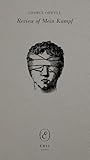




Why Orwell read the book as evidence of continuity
Orwell’s central point was that changes in Hitler’s immediate tactics should not be taken as proof that his underlying aims had changed. He treated Mein Kampf as evidence of a rigid worldview: political maneuvering could alter the route, in Orwell’s reading, without replacing the destination. He summed up that quality as “It is the fixed vision of a monomaniac.” The review text reproduced by Scroll is the source for this brief quotation and for Orwell’s interpretation.
That is Orwell’s argument in 1940, not a neutral diagnosis or a claim that the book alone explains every later event. His warning was directed at readers tempted to interpret tactical shifts as evidence that Hitler had abandoned the ambitions the book expressed.
Quick wins for a faster PC:
Clear out junk files and repair common Windows errorsFree Scan →Fix the driver behind crashes, sound loss and screen glitchesFind Drivers →#1 Best Overall
How Orwell explained Hitler’s political appeal
Orwell objected to explanations that treated the appeal of Hitlerism as a simple demand for material comfort. In his account, Hitler understood that people could be drawn to struggle, self-sacrifice and loyalty. Those forces, Orwell argued, helped explain why a politics organized around hardship and discipline could attract followers even when it did not promise an easy life.
This is Orwell’s analysis of political appeal, rather than a claim that all supporters were motivated in the same way. The point matters to his reading of the book: he saw its worldview as offering a compelling sense of purpose through conflict and devotion, not merely a program of practical benefits.
Rank #2
What Orwell said about the English edition
Orwell also criticized the English edition’s framing. He said its preface and notes softened the book, and described a later reissue bearing a notice that profits would be donated to the Red Cross. These details are Orwell’s account in the review; the sources cited here do not independently establish the edition’s publishing history.
His comment on the framing connects to his broader concern: readers should encounter the book’s stated aims directly, rather than have its force blunted by editorial presentation.
Free tools Windows power users keep installed
One-click scans. No signup required.
Further reading
Read the reproduced review for Orwell’s full argument, and consult Orwell’s bibliography for its date and publication venue. The scholarly article on Orwell, politics and war situates the review among his wartime writing.
Quick Recap
Best Value
Rank #4
Product prices and availability are accurate as of the date/time indicated and are subject to change. Any price and availability information displayed on Amazon at the time of purchase will apply.




