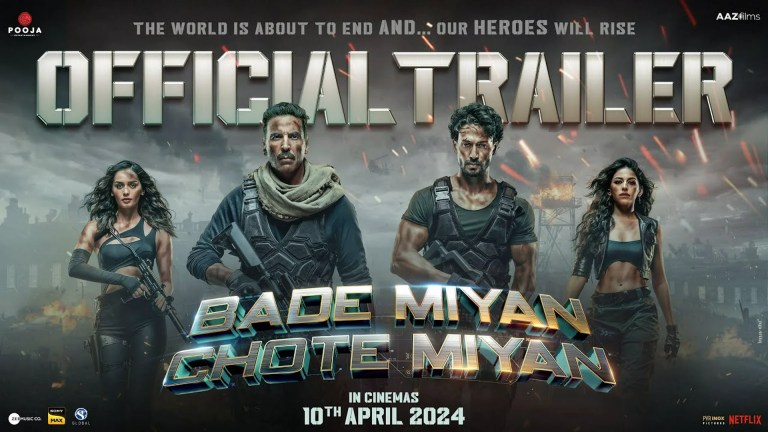
There is no settled, authoritative master list of “propaganda films” in Bollywood. The label depends on what a film says, who supported or promoted it, the political circumstances around it, and how different audiences and institutions interpreted it. A patriotic story is not automatically propaganda, and government involvement alone does not settle the question.
Here, “Bollywood” means popular Hindi-language cinema associated with the Bombay/Mumbai film industry—not every film industry in India, which makes films in many languages. To assess a political film fairly, separate its message from its sponsorship, censorship history, and reception.
| # | Preview | Product | Price | |
|---|---|---|---|---|
| 1 |
![Airport Terminal Pack [DVD]](https://m.media-amazon.com/images/I/51u7TvlKDzL._SL160_.jpg)
|
Airport Terminal Pack [DVD] | $8.49 | Buy on Amazon |
| 2 |

|
Saw: 8-Film Collection - DVD | $25.00 | Buy on Amazon |
| 3 |
![Harry Potter: Complete 8-film Collection (16-Disc Set / 8-Film Documentary Included) [DVD] [Reg 2/B / Multi-Regional Player Required]](https://m.media-amazon.com/images/I/51OEz9L3FqL._SL160_.jpg)
|
Harry Potter: Complete 8-film Collection (16-Disc Set / 8-Film Documentary Included) [DVD] [Reg 2/B... | $39.99 | Buy on Amazon |
| 4 |
![Legal Eagles [DVD]](https://m.media-amazon.com/images/I/51u90akoV9L._SL160_.jpg)
|
Legal Eagles [DVD] | $7.46 | Buy on Amazon |
| 5 |

|
In Search Of,With Leonard Nimoy//The Complete Collection | $32.99 | Buy on Amazon |
What does “propaganda film” mean?
In this guide, propaganda is an analytical label for film used to advance a political position or shape public understanding. Applying it requires evidence: what the film communicates, how it treats facts and opposing views, and whether institutions or political actors supported or promoted it. The label is also used as an accusation, so identify who is applying it and why.
Keep three categories distinct:
- Patriotic cinema expresses national pride, celebrates soldiers, recalls the freedom struggle, or addresses social reform. Those themes do not by themselves prove that a film is propaganda.
- State-supported cinema has a documented relationship with government funding, production, distribution, or promotion. State support is relevant evidence, but it does not by itself establish the film’s purpose or settle its meaning.
- Propaganda is an interpretation of a film’s political purpose and methods. It should be supported with evidence and attributed where the judgment belongs to a critic, scholar, official, or other observer.
The Press Information Bureau’s overview of Hindi patriotic films describes their common theme as “pride in being Indian and duty towards the nation.” That describes a broad patriotic tradition, not a finding that every film in it is propaganda.
The Tool Desk
Outbyte PC Repair FREEClear out junk files and repair common Windows errorsFree Scan →Outbyte Driver Updater FREEScan for outdated or missing drivers - takes under a minuteDriver Scan →#1 Best Overall
- Factory sealed DVD
Which Bollywood films are discussed in this political history?
The examples below show different kinds of political expression, state intervention, and critical interpretation. They are not a definitive list, and inclusion here does not mean each film should be classified as propaganda.
Kismet (1943): nationalist expression under colonial rule
The Government of India’s Press Information Bureau recounts that a warrant for lyricist Kavi Pradeep’s arrest was issued in 1943 over the song “Door Hato Aye Duniya Walon,” heard in Bombay Talkies’ Kismet. The song’s thinly disguised nationalist message made it a target of colonial surveillance. This is evidence of political expression in a popular film; it does not establish that the film as a whole was commissioned or directed as a propaganda project.
Rank #2
- Let the games begin! Own the genre-defining Saw horror series in all its grisly glory. Five-disc set includes: Saw (2004), Saw II (2005), Saw III (2006), Saw IV (2007), Saw V (2008), Saw VI (2009), Saw: The Final Chapter (2010) and Saw 3D: The Final Chapter (2010).
- Genre: Horror
Patriotic cinema beyond one genre
The National Film Archive of India’s 2021 “Chitranjali @ 75” exhibition presented 75 posters in three groupings: “Freedom Struggle through the lens of Cinema,” social reform, and soldiers. The exhibition shows how a public archive framed patriotic themes across different kinds of films. It is not a complete inventory or a test for deciding whether any one film is propaganda.
Emergency-era cinema (1975–1977): production, censorship, and negotiation
The Emergency is a central case for examining the relationship between the Indian state and cinema. A peer-reviewed chapter, “Between a logo and a memo,” studies Films Division’s “Film 20” programme and other Emergency-era efforts using production files and internal state-media memos. Its account describes negotiations between government bodies and filmmakers, rather than a simple division between state control and filmmaker compliance. The chapter description says these complexities “resist reducing even state-sponsored documentaries to the reductive category of propaganda cinema.”
PC Slower Than It Used to Be?
A free scan shows the junk files, broken settings and background clutter dragging Windows down - then fixes them in one click.Free scan · Windows 10 & 11Crashes, No Sound, or Screen Glitches?
Random freezes, missing sound and display glitches usually trace back to one bad driver. Find and replace yours safely.Free scan · under a minuteA 2025 scholarly collection identifies Aandhi and Nasbandi as controversial films banned for the duration of the Emergency, and says prints of the state-critical Kissa Kursi Ka were permanently confiscated. These claims are described in the book’s catalogue material; exact orders, dates, and the complete history of each film’s restrictions are not established here.
Rank #3
- COMPLETE 8-FILM COLLECTION – All HarryPotter movies in one set
- 16-DISC DVD BOX SET – Extensive collection for fans
- MAGICAL FANTASY SAGA – One of the most beloved franchises
- REGION B FORMAT – Requires multiregional DVD player
- COLLECTOR’S EDITION – Perfect for fans and collectors
Khalnayak, Bombay, and War and Peace: a later censorship argument
In a 2009 peer-reviewed study, N. Bose examines Khalnayak (1993), Bombay (1995), and War and Peace (2002). The study argues that these Hindi films faced state censorship amid political activity by right-wing Hindu organizations, and interprets the censorship in relation to their nationalist message. This is the author’s argument about three cases, not a universal rule about Hindi cinema or a verdict on every film’s politics.
Article 370 and The Kerala Story: disputed readings reported in 2024
Associated Press reporting published March 22, 2024, described disputes around politically polarizing Hindi releases. It reported that some reviewers called Article 370 factually incorrect and a thinly veiled propaganda film, while critics of The Kerala Story challenged its accuracy. AP also reported bans in two opposition-ruled states and tax-free or mass screenings in some BJP-ruled states, as well as filmmakers’ concerns about self-censorship.
Rank #4
- Factory sealed DVD
These are reported criticisms and political actions from March 2024, not an assessment of either film’s historical accuracy or a statement of its present legal or screening status. A critic’s use of “propaganda” should be distinguished from a documented factual error, an official endorsement, or a ban.
Recommended Free Tools
How can you assess a propaganda claim?
Use the same questions for any film, whether it is a patriotic drama, a state-backed documentary, or a recent political release:
- Identify the relationship to political power. Who financed, produced, distributed, endorsed, or promoted the film? Look for evidence of the specific relationship rather than inferring sponsorship from its subject matter or viewpoint.
- Describe the message. What political position does the film advance, and which scenes, narrative choices, or claims support that reading? Distinguish the film’s actual content from a label applied to it.
- Check its treatment of evidence. Does it present disputed history as settled, omit relevant context, or portray a political or religious group narrowly? Separate verifiable errors from interpretation and criticism.
- Document state intervention. If authorities censored, banned, or confiscated a film, identify the authority, date, and documentary basis where available. Censorship is evidence of political conflict, not automatic proof that the film itself is propaganda.
- Keep reception plural. Filmmakers, critics, political organizations, officials, regulators, courts, and audiences may disagree. Report their positions separately instead of presenting one as a public consensus.
- State how the label is being used. Explain whether “propaganda” is a descriptive category, an argument made by a named source, or an insult in a political dispute.
When comparing films, use consistent axes: period and political context; institutional involvement; intended audience and distribution; message and treatment of evidence; censorship or political pressure; and reception. That makes differences visible without pretending that one test can settle every film’s meaning.
Why is there no definitive list?
“Propaganda” is not a neutral genre category with a single agreed boundary. The same film can be patriotic to one viewer, politically persuasive to another, and propaganda to a critic who points to its sponsorship or handling of contested history. Evidence also varies: a production file or censorship order can establish an institutional action, while a label about the film’s meaning remains an interpretation.
The examples here therefore answer “Which films are discussed in debates about propaganda?” rather than provide an official ranking or exhaustive catalogue. Cinema and the Indian National Emergency: Histories and Afterlives, a 264-page scholarly collection published by Bloomsbury Academic on July 24, 2025, offers further context on Emergency-era cinema, censorship, and films including Aandhi, Nasbandi, and Kissa Kursi Ka.
What’s actually slowing this PC down?
Pick the symptom - the matching free tool is one click away.
Quick Recap
Product prices and availability are accurate as of the date/time indicated and are subject to change. Any price and availability information displayed on Amazon at the time of purchase will apply.