Ed Gein’s 1957 Wisconsin case left a mark on horror, but the eight screen works below do not all tell his story. Some borrow limited elements for fictional villains, some belong to the Psycho lineage, and others portray Gein himself. The distinction matters: a character influenced by Gein is not the same as a dramatization of the case.
What movies and shows were inspired by Ed Gein?
Gein’s case influenced several well-known horror and thriller characters, including Norman Bates, Leatherface and Buffalo Bill. Their stories are fictional and draw on different elements; none should be treated as a factual account of Gein’s crimes. Other films and television productions put Gein at the center, usually as a dramatized crime-horror subject.
![Universal Classic Monsters 6-Movie Collection (Dracula / Frankenstein / The Bride of Frankenstein / The Wolf Man / The Invisible Man / The Mummy) [DVD]](https://m.media-amazon.com/images/I/51uo3RNHn-L._SL160_.jpg)
![Boris Karloff & Bela Lugosi 4-Movie Horror Collection [DVD]](https://m.media-amazon.com/images/I/51M7T3p2p7L._SL160_.jpg)
![The Classic Sci-Fi Ultimate Collection: Volume 1 (Tarantula / The Mole People / The Incredible Shrinking Man / The Monolith Monsters / Monster on the Campus) [DVD]](https://m.media-amazon.com/images/I/51Et9wCMyNL._SL160_.jpg)
| Work | Format and release | Connection to Gein | Lineage |
|---|---|---|---|
| Psycho | Film, 1960 | Loose fictional echo in Norman Bates | Standalone film adapting Robert Bloch’s novel |
| The Texas Chain Saw Massacre | Film, 1974 | Fictional horror imagery and Leatherface are linked to Gein | Standalone fictional story |
| Deranged | Film, 1974 | Direct but fictionalized portrayal under the name Ezra Cobb | Standalone crime-horror film |
| The Silence of the Lambs | Film, 1991 | Gein was one influence on the fictional Buffalo Bill | Part of the Hannibal Lecter story world |
| Ed Gein | Film, 2000 | Screen portrayal of Gein | Standalone |
| Bates Motel | TV series, 2013–2017 | Indirect connection through Norman Bates and Psycho | Prequel within the Psycho franchise |
| Ed Gein: The Butcher of Plainfield | Film, 2007 | Gein-centered crime-horror portrayal | Standalone |
| Monster: The Ed Gein Story | TV series, 2025 | Gein-centered dramatization that also explores his screen legacy | Standalone limited series |
Fictional characters influenced by Gein
Psycho (1960): a small-town fear, not a retelling
Alfred Hitchcock’s film adapts Robert Bloch’s novel and features Norman Bates, a fictional character partially based on Gein. The connection is often flattened into the claim that Bates simply reproduces Gein. The AFI Catalog’s account of Bloch’s later explanation is more nuanced: the unsettling possibility of a psychotic killer living unnoticed in a small town mattered more to his inspiration than a one-to-one transfer of Gein’s actions. AFI Catalog: Psycho
The Texas Chain Saw Massacre (1974): fictional rural horror
Tobe Hooper’s film is fiction, not a recreation of events in Gein’s farmhouse. AFI identifies Leatherface among later villains based on Gein, while scholarly discussion connects the film’s rural-household horror and body-part imagery with aspects of the case. That is an influence on the film’s imagery and villain, not evidence that its plot happened in real life. AFI Catalog: The Texas Chain Saw Massacre SAGE chapter on horror film
The Tool Desk
Outbyte Driver Updater FREEScan for outdated or missing drivers - takes under a minuteDriver Scan →Outbyte PC Repair FREERepair Windows errors before they cause bigger problemsFix Now →#1 Best Overall
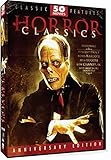
- An instant library of 50 horrorics assembled on 12 DVD's.
The Silence of the Lambs (1991): one source behind Buffalo Bill
Jonathan Demme’s thriller uses Gein as one of several influences on Buffalo Bill, rather than presenting a portrait of him. Scholarly analysis connects the fictional killer’s skin-garment motive with Gein’s use of body parts. Buffalo Bill remains a constructed character within the film’s story, not a stand-in whose every action documents the historical case. AFI Catalog: The Silence of the Lambs SAGE chapter on horror film
Screen portrayals centered on Ed Gein
Deranged (1974): a fictionalized stand-in
Deranged is a direct, fictionalized dramatization. Roberts Blossom plays a character named Ezra Cobb, a disguise for the story’s Gein inspiration. This makes it a closer comparison to a Gein-centered screen portrayal than the fictional villains above, but it should still be understood as a dramatized film rather than a documentary record. AFI Catalog: Deranged SAGE chapter on horror film
Ed Gein (2000): a low-budget portrayal
A&E lists this title among screen portrayals of Gein, and scholarly discussion identifies it as a low-budget portrayal. The available documentation does not establish enough detail to support a ranking of its accuracy or a definitive account of title variants. A&E’s guide to Ed Gein films SAGE chapter on horror film
Ed Gein: The Butcher of Plainfield (2007): a later crime-horror film
A&E includes this film among Gein screen portrayals. It is a later Gein-centered crime-horror production, but the available coverage is too limited to make a reliable claim about its historical accuracy or relative quality. A&E’s guide to Ed Gein films
Monster: The Ed Gein Story (2025): a series about Gein and his screen legacy
Netflix describes Monster: The Ed Gein Story as an eight-episode series released October 3, 2025. Its story reaches into Hollywood, including Hitchcock working on Psycho. Co-creator Ian Brennan described the connection between Gein and familiar screen villains as the moment it clicked for the creators. That is the series’ creative framing, not proof that each fictional work was a direct adaptation of Gein’s life. Netflix Tudum: Monster: The Ed Gein Story
Independent reader supportYour contribution helps us test, update, and keep practical guides available for everyone.The downstream connection: Bates Motel
Bates Motel (2013–2017): an heir to Psycho, not a Gein biography
Bates Motel develops the story of Norman Bates as a present-day prequel to the Psycho franchise. Its relationship to Gein is inherited through the earlier fictional character: Gein influenced the lineage that led to Norman Bates, but the series is not a newly documented direct adaptation of Gein’s case. The Television Academy’s creator interview describes it as an original story using the Psycho franchise as a prequel. Television Academy: Bates Motel creators A&E’s guide to Ed Gein films
How to interpret the real-case connection
Gein was arrested in Plainfield, Wisconsin, in 1957 after police searched his farmhouse. He spent his later life in psychiatric custody following 1968 proceedings and died in 1984. Accounts of the case distinguish between crimes he confessed to, suspicions about other deaths and the killings for which he was convicted. That distinction matters when comparing a dramatization or fictional villain with the historical record: screen stories may borrow imagery or a premise without accurately representing the investigation, evidence or legal outcome. A&E’s guide to Ed Gein films AFI Catalog: Psycho
Quick Recap
Product prices and availability are accurate as of the date/time indicated and are subject to change. Any price and availability information displayed on Amazon at the time of purchase will apply.
What’s actually slowing this PC down?
Pick the symptom - the matching free tool is one click away.




